Swallows, Swallows Everywhere
Chen Hsin-yi / photos Cheng Wangshi / tr. by Chris Nelson
September 2012


Traditionally, the swallow is considered an auspicious bird; it’s also believed to be particularly intelligent. No wonder they’re beloved by humans.
Barn swallows are among the bird species most familiar to the Taiwanese, but few people are aware they’re mostly “summer residents” that migrate vast distances to make their way here. Let us explore the unique ecological phenomena that arise from the close contact between man and swallow, and take a peek into their secret lives.
On a clear, breezy late afternoon in August, some 40 people, young and old, walk excitedly along a reed-encompassed path in the Erchong Floodway at Wugu, looking up at the sky as they ask each other in hushed tones, “Are they back yet?”
Just as the surrounding landscape is gloriously illuminated by the glow of twilight, throngs of returning swallows emerge from all directions. Like miniature F-16 fighters, they swoop low then climb swiftly, deftly turning on a dime. Looking up at the sky far beyond the reeds, you see dense patches of black dots swelling and making a racket. Only when the sky darkens do the birds finally land amongst the reeds and gradually quiet down.
“These are barn swallows, which we often see living under the eaves of houses. Every year they flock here in large groups after the end of their breeding season, which lasts from spring to late summer. This food-rich, undisturbed area makes it an ideal place to fly around, one where they can teach their young to fly. Because not long afterwards, they fly south, continuing their epic journey!” So says Su Xiurong, a Society of Wilderness ranger stationed at the Wugu Wetland Ecological Park.
The park, located where the river and sea converge, contains northern Taiwan’s largest reed marshland. With an area of around 19 hectares, it’s the biggest gathering spot in northern Taiwan for barn swallows before their journey southward, with an estimated 20–30,000 individual birds passing through here. The Society of Wilderness has kept an eye on this phenomenon since 2006, and four years ago they started leading public swallow-watching events during the peak flocking period of mid- to late August, with a growing number of people signing up each year.

Residents along Zhongyang South Road in Beitou believe that swallows building nests represent good luck. The residents are accustomed to living together with these birds.
The barn swallow (Hirundo rustica) is a passerine bird of the swallow family, and is one of the most common migratory birds in Asia, Europe, Africa and the Americas. It has a body length of about 17 centimeters, a russet throat and forehead, and lustrous blue and black feathers on its back. Its tail feathers are long and forked, and it sports a horizontal black stripe above its white breast, like a gentleman in a suit and tie.
The legs of the barn swallow are short and feeble; they can only stand for a short time. But they are outstanding flyers: their wings are slightly longer than their bodies, and are slightly pointed for low air resistance, so they can attain high flying speeds. And the long tail, which can spread quite widely, is helpful for steering, enabling them to fly up nimbly and swoop down or turn quickly. Hence swallows are among the few bird species that can easily catch insects (termites, dragonflies, damselflies, mosquitoes, flies, moths, bees, etc.) while airborne, swallowing them in one gulp without having to stop.
Tsai Yi-jung, a technician for the Conservation Research Section of the Kenting National Park headquarters, points out that in Asia, barn swallows breed in northern areas such as Siberia, mainland China, Korea and Japan in the spring and summer, while their wintering areas are in Thailand, Singapore, the Philippines, Indonesia and Borneo.
Since Taiwan happens to be in a central region of the barn swallow’s range and on one of its migration routes, this bird can be seen in all four seasons: as summer residents that arrive from the south, build nests and breed here; as winter residents that fly in from the north; as migrants in transit, passing though on their spring and fall migrations; and, in small numbers, even as year-round residents.

Each August, Wugu Wetland Ecological Park serves as a site for barn swallows to practice flying before they depart on their southward migration. At night they perch amongst the reeds, attracting bird lovers in droves.
On either side of a kilometer-long stretch of Beitou’s Guangming and Zhongyang South Roads, over 200 barn swallows’ nests can be found. In spring and summer, countless swallows flit about, presenting a grand sight. Some years ago the Beitou Zhongyang Development Association formed a volunteer team to investigate the swallows’ nest building process and brooding patterns, attaining much delight and awe from the exercise.
The volunteers observed that swallows like to build their nests in the arcades of decades-old buildings beside riverbanks and parklands, because the arcades of these buildings have concrete surfaces, which are easier to stick mud onto than the smooth tiles of newer buildings.
The nest-building skills of swallows are a sight to behold: they mix their saliva with mud, straws, twigs and stems gathered from riverbanks, parks and worksites, and mold them into pellets which they pile up one by one into bowl-shaped nests. The nest-building process takes a long time, perhaps seven to 10 days, because they need to wait for the bottom layer to dry before they pile on more, to prevent the nests from falling.
“Barn swallows are lucky because they can reuse old nests left behind the previous year. All they need to do is patch them up a bit, and much of the work is done,” says Tsai. Overseas bird-ringing studies show that some barn swallows return the following year with the same mates to their old nests, others bring back new partners to the old nests, and still others come to occupy nests built in previous years by other swallows.
After taking care of their “housing” issues, what happens next is a touching testimony to life. During the breeding period, barn swallow pairs produce between one and three broods, each containing an average of four or five chicks; moreover, the feeding duties are shared by both parents.
About 14 days after the chicks hatch, their downy coats turn into feathers, and their flight feathers and tail feathers grow in the subsequent week or two. At this time, while still feeding the chicks, the parents beat their wings around the arcades to show the young swallows how to fly, and then take the offspring, who have just learned to fly, in search of food. This behavior stops only when the last fledgling has become independent.
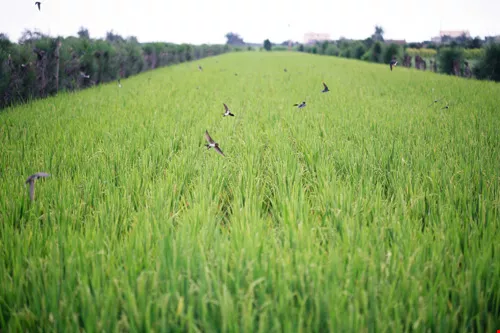
Barn swallows are agile aerial acrobats, and can catch insects in their open mouths while in flight.
Besides the barn swallow, there are six other swallow-family species in Taiwan: the Pacific swallow (Hirundo tahitica), a close relative of the barn swallow; the greater striated swallow (H. striolata) and striated swallow (H. daurica); the brown-throated martin (Riparia paludicola) and the sand martin (R. riparia); as well as the common house martin (Delichon urbicum). Of these, the Pacific swallow is both resident and migratory, the sand martin and striated swallow are purely migratory, and the rest purely resident.
“The barn swallow is more numerous and more broadly distributed than the other members of the swallow family, showing that they’re highly adaptable to manmade environments,” says Wild Bird Society of Taipei research and conservation officer Chiang Kung-kuo; the reason barn swallows choose to build their nests under the arcades, besides sheltering from wind and rain, is because they can avoid natural enemies like snakes and eagles, and more easily hunt mosquitoes and other insects.
Despite these advantages, most other members of the swallow family choose to build their nests in natural environments, such as forests, estuaries and open fields. The brown-throated martin only breeds in winter, digging holes in riverside sand dunes to build their nests. But since waters rise and waterways change each year, they need to be rebuilt come the next wintertime.
Perhaps because the instinct of barn swallows to diligently feed their offspring is so moving, humans reciprocate by defending these long-term guests. Moreover, the Chinese have come to see the swallow as a symbol of good fortune and well-being.
Lee Wu-i, a science teacher at Zhonghua Elementary School in Taichung’s Taiping District, has for many years been observing the interaction between greater striated swallows and humans in Taiping, finding that locals each have their own way of showing their affection for swallows. Some people install metal struts right under the nests to prop them up and prevent them from falling under their own weight. Others stuff metal rods or newspaper into the openings of the nests during the off-breeding season to stop sparrows from occupying them, which would cause the swallows to abandon their nests the next year. And some homeowners, having discovered that swallows have built nests inside their houses, not only don’t drive them away; they get up early each morning when they hear the swallows and open their front doors to let the birds go in and out more easily.
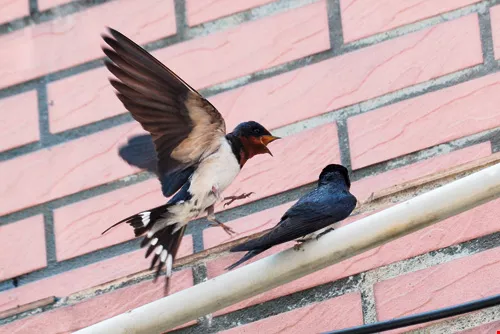
During mating, the male climbs onto the female’s back, placing his cloaca next to hers. The sperm transfer is completed in a few seconds.
Tsai, who has kept a long-term watch of migratory birds in the Hengchun region such as shrikes, herons, raptors and waterfowl, serendipitously found over a decade ago that barn swallows, which fly in from mid to high latitudes, roost at night in great numbers in the Hengchun Peninsula from May through August each year.
Unlike most other migratory birds, which have to search for highly concealed places rich in water and vegetation and with few natural enemies for a stopover of several days, barn swallows choose populated urban areas like Checheng, Chaozhou and Hengchun in Pingtung County, and just stop for the night. “The barn swallow’s advantage is that it can eat mosquitoes and other insects while it flies, so it needn’t stop to eat,” says Tsai.
Barn swallows passing through downtown Hengchun number at least 3,000–4,000 a night. But the record high was over 30,000, “the effect of a pre-typhoon ‘traffic jam’ before they set out across the sea,” he says.
Tsai eagerly points out that the Hengchun Peninsula also has multitudes of migrating Pacific swallows stopping for the night, but they’re more savvy: “They know how to find shelter in the underground parking garage of the five-star Howard Beach Resort in Kending, perching en masse on the pipes in the ceiling for a good night’s rest. The bad part is that cars parked there end up ‘baptized’ with bird droppings.” Hotel employees, unable to shoo them away, are always ready at migration time, hanging nets beneath the pipes to catch the droppings.
Tsai found that despite power lines being put underground and locals trying to drive away the birds to address the droppings problem, the population of barn swallows overnighting here is still steadily rising. “The barn swallow is an anomaly among wild birds. Their numbers aren’t dropping due to human influence; instead they’re thriving. Maybe you can compare them to sparrows and pigeons in this way,” he says.
Perhaps because they’re so common and numerous, there’s no detailed account of the total number, taxonomy, distribution, or migration paths of Taiwan’s swallows, and there’s little priority for research into these questions. Still, the barn swallow can open a window through which people can explore nature, and can continue giving ordinary folk warmth and blessings.
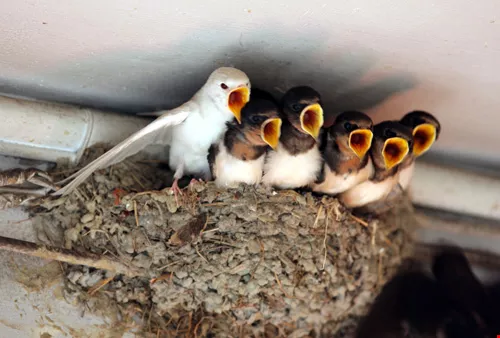
“Feed me! Feed me!” The baby swallow on the far left exhibits albinism, which also affects some humans.
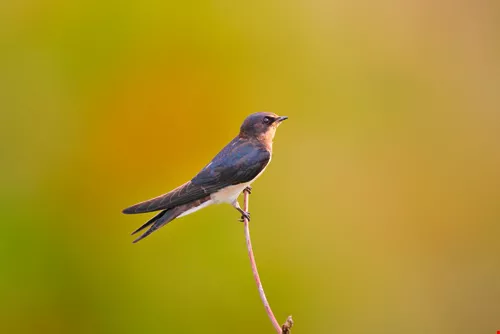
This juvenile, which has just learned to fly, hasn’t yet grown its long, pointed tail feathers.


@List.jpg?w=522&h=410&mode=crop&format=webp&quality=80)


