The Beautiful New World of BBS
Teng Sue-feng / photos Lin Meng-san / tr. by Brent Heinrich
June 1995


What's the latest craze among Taiwan's college students? One if the hottest items is certainly electronic bulletin boards. Why has this feature of computer networks, which combines seminars, information gathering, video games and friendship exchanges, become the new darling of the campus? When you enter Taiwan's cyberspace, you'll find a virtually separate universe.
Lu Yi-chang, a junior in the music department at Kaohsiung's National Sun Yat-Sen University, holds special feelings for the system of interlinked computers commonly known as "the Net." It's not only because he is the monitor of the music forum on his university's "Formosa" bulletin board. A year ago when his previous girlfriend had just broken up with him, he became melancholy, almost to the point of quitting school, and he fell into the habit of confessing his problems over the electronic bulletin boards, finding spiritual consolation in this way. After half a year of such soul-baring over the omnipresent Net, he was able to meet his current sweetheart.
Scholars in ancient China used to say, "The path to a fair maiden lies within books." For young scholars in the information age, perhaps the sentence should be changed to "The path to a fair maiden lies within bulletin boards."
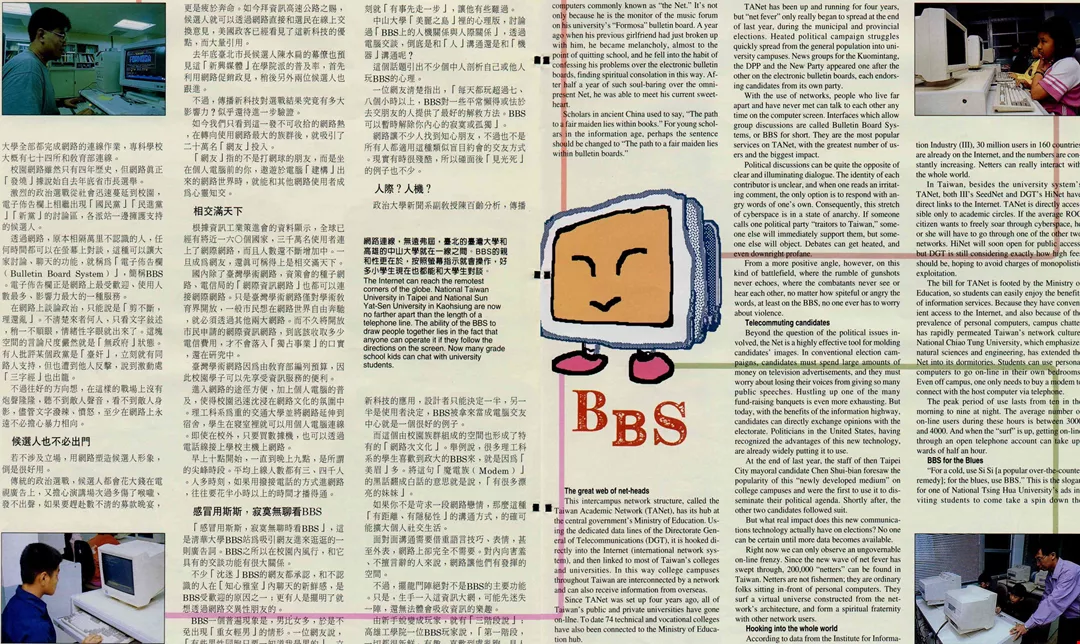
The Internet can reach the remotest corners of the globe. National Taiwan University in Taipei and National Sun Yat-Sen University in Kaohsiung are now no farther apart than the length of a telephone line. The ability of the BBS to draw people together lies in the fact that anyone can operate it if they follow the directions on the screen. Now many grade school kids can chat with university students.
The great web of net-heads
This intercampus network structure, called the Taiwan Academic Network (TANet), has its hub at the central government's Ministry of Education. Using the dedicated data lines of the Directorate General of Telecommunications (DGT), it is hooked directly into the Internet (international network system), and then linked to most of Taiwan's colleges and universities. In this way college campuses throughout Taiwan are interconnected by a network and can also receive information from overseas. Since TANet was set up four years ago, all of Taiwan's public and private universities have gone on-line. To date 74 technical and vocational colleges have also been connected to the Ministry of Education hub.
TANet has been up and running for four years, but "net fever" only really began to spread at the end of last year, during the municipal and provincial elections. Heated political campaign struggles quickly spread from the general population into university campuses. News groups for the Kuomintang, the DPP and the New Party appeared one after the other on the electronic bulletin boards, each endorsing candidates from its own party.
With the use of networks, people who live far apart and have never met can talk to each other any time on the computer screen. Interfaces which allow group discussions are called Bulletin Board Systems, or BBS for short. They are the most popular services on TANet, with the greatest number of users and the biggest impact.
Political discussions can be quite the opposite of clear and illuminating dialogue. The identity of each contributor is unclear, and when one reads an irritating comment, the only option is to respond with angry words of one's own. Consequently, this stretch of cyberspace is in a state of anarchy. If someone calls one political party "traitors to Taiwan," someone else will immediately support them, but someone else will object. Debates can get heated, and even downright profane.
From a more positive angle, however, on this kind of battlefield, where the rumble of gunshots never echoes, where the combatants never see or hear each other, no matter how spiteful or angry the words, at least on the BBS, no one ever has to worry about violence.
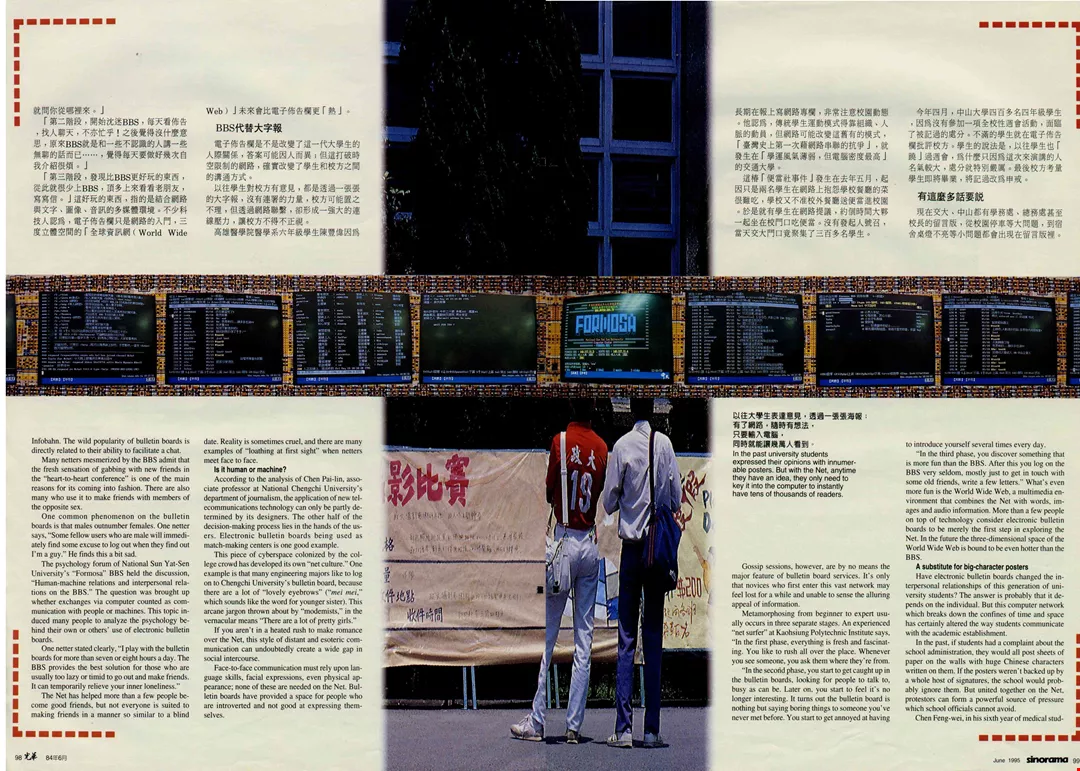
In the past university students expressed their opinions with innumerable posters. But with the Net, anytime they have an idea, they only need to key it into the computer to instantly have tens of thousands of readers.
Telecommuting candidates
Beyond the question of the political issues involved, the Net is a highly effective tool for molding candidates' images. In conventional election campaigns, candidates must spent large amounts of money on television advertisements, and they must worry about losing their voices from giving so many public speeches. Hustling up one of the many fund-raising banquets is even more exhausting. But today, with the benefits of the information highway, candidates can directly exchange opinions with the electorate. Politicians in the United States, having recognized the advantages of this new technology, are already widely putting it to use.
At the end of last year, the staff of then Taipei City mayoral candidate Chen Shui-bian foresaw the popularity of this "newly developed medium" on college campuses and were the first to use it to disseminate their political agenda. Shortly after, the other two candidates followed suit.
But what real impact does this new communications technology actually have on elections? No one can be certain until more data becomes available.
Right now we can only observe an ungovernable on-line frenzy. Since the new wave of net fever has swept through, 200,000 "netters" can be found in Taiwan. Netters are not fishermen; they are ordinary folks sitting in front of personal computers. They surf a virtual universe constructed from the network's architecture, and form a spiritual fraternity with other network users.

From high-volume mainframes to light little notebooks, computerization has developed at lightning speed. Where will it end? Will those who can't use computers be wiped away by the times?
Hooking into the whole world
According to data from the Institute for Information Industry (III), 30 million users in 160 countries are already on the Internet, and the numbers are constantly increasing. Netters can really interact with the whole world.
In Taiwan, besides the university system's TANet, both III's SeedNet and DGT's HiNet have direct links to the Internet. TANet is directly accessible only to academic circles. If the average ROC citizen wants to freely soar through cyberspace, he or she will have to go through one of the other two networks. HiNet will soon open for public access, but DGT is still considering exactly how high fees should be, hoping to avoid charges of monopolistic exploitation.
The bill for TANet is footed by the Ministry of Education, so students can easily enjoy the benefits of information services. Because they have convenient access to the Internet, and also because of the prevalence of personal computers, campus chatter has rapidly permeated Taiwan's network culture. National Chiao Tung University, which emphasizes natural sciences and engineering, has extended the Net into its dormitories. Students can use personal computers to go on-line in their own bedrooms. Even off campus, one only needs to buy a modem to connect with the host computer via telephone.
The peak period of use lasts from ten in the morning to nine at night. The average number of on-line users during these hours is between 3000 and 4000. And when the "surf" is up, getting on-line through an open telephone account can take upwards of half an hour.
BBS for the Blues
"For a cold, use Si Si [a popular over-the counter remedy]; for the blues, use BBS." This is the slogan for one of National Tsing Hua University's ads inviting students to come take a spin down the Infobahn. The wild popularity of bulletin boards is directly related to their ability to facilitate a chat.
Many netters mesmerized by the BBS admit that the fresh sensation of gabbing with new friends in the "heart-to-heart conference" is one of the main reasons for its coming into fashion. There are also many who use it to make friends with members of the opposite sex.
One common phenomenon on the bulletin boards is that males outnumber females. One netter says, "Some fellow users who are male will immediately find some excuse to log out when they find out I'm a guy." He finds this a bit sad.
The psychology forum of National Sun Yat-Sen University's "Formosa" BBS held the discussion, "Human-machine relations and interpersonal relations on the BBS." The question was brought up whether exchanges via computer counted as communication with people or machines. This topic induced many people to analyze the psychology behind their own or others' use of electronic bulletin boards.
One netter stated clearly, "I play with the bulletin boards for more than seven or eight hours a day. The BBS provides the best solution for those who are usually too lazy or timid to go out and make friends. It can temporarily relieve your inner loneliness."
The Net has helped more than a few people become good friends, but not everyone is suited to making friends in a manner so similar to a blind date. Reality is sometimes cruel, and there are many examples of "loathing at first sight" when netters meet face to face.
Is it human or machine?
According to the analysis of Chen Pai-lin, associate professor at National Chengchi University's department of journalism, the application of new telecommunications technology can only be partly determined by its designers. The other half of the decision-making process lies in the hands of the users. Electronic bulletin boards being used as match-making centers is one good example.
This piece of cyberspace colonized by the college crowd has developed its own "net culture." One example is that many engineering majors like to log on to Chengchi University's bulletin board, because there are a lot of "lovely eyebrows" ("mei mei," which sounds like the word for younger sister). This arcane jargon thrown about by "modemists," in the vernacular means "There are a lot of pretty girls."
If you aren't in a heated rush to make romance over the Net, this style of distant and esoteric communication can undoubtedly create a wide gap in social intercourse.
Face-to-face communication must rely upon language skills, facial expressions, even physical appearance; none of these are needed on the Net. Bulletin boards have provided a space for people who are introverted and not good at expressing themselves.
Gossip sessions, however, are by no means the major feature of bulletin board services. It's only that novices who first enter this vast network may feel lost for a while and unable to sense the alluring appeal of information.
Metamorphosing from beginner to expert usually occurs in three separate stages. An experienced "net surfer" at Kaohsiung Polytechnic Institute says, "In the first phase, everything is fresh and fascinating. You like to rush all over the place. Whenever you see someone, you ask them where they're from.
"In the second phase, you start to get caught up in the bulletin boards, looking for people to talk to, busy as can be. Later on, you start to feel it's no longer interesting. It turns out the bulletin board is nothing but saying boring things to someone you've never met before. You start to get annoyed at having to introduce yourself several times every day.
"In the third phase, you discover something that is more fun than the BBS. After this you log on the BBS very seldom, mostly just to get in touch with some old friends, write a few letters." What's even more fun is the World Wide Web, a multimedia environment that combines the Net with words, images and audio information. More than a few people on top of technology consider electronic bulletin boards to be merely the first step in exploring the Net. In the future the three-dimensional space of the World Wide Web is bound to be even hotter than the BBS.
A substitute for big-character posters
Have electronic bulletin boards changed the interpersonal relationships of this generation of university students? The answer is probably that it depends on the individual. But this computer network which breaks down the confines of time and space has certainly altered the way students communicate with the academic establishment.
In the past, if students had a complaint about the school administration, they would all post sheets of paper on the walls with huge Chinese characters written on them. If the posters weren't backed up by a whole host of signatures, the school would probably ignore them. But united together on the Net, protestors can form a powerful source of pressure which school officials cannot avoid.
Chen Feng-wei, in his sixth year of medical studies at Kaohsiung Medical College, has been writing a newspaper column on the Internet for some time, so he has paid close attention to the latest developments on campus. He believes that the conventional model of student demonstrations relied upon organized, systematic activists, but the advent of bulletin boards has possibly changed this old formula. "The first protest in Taiwan's history that made use of network communications" happened at Chiao Tung University, where "student activism is weak, but the density of computers is highest."
The "Box Lunch Society Incident" took place in May of 1994. It began with only two students who complained on an electronic bulletin board that the food in the school cafeteria tasted terrible, and that the school didn't permit off-campus restaurants to deliver lunch boxes onto campus. Eventually students began to bring up suggestions over the BBS, and a time was arranged for students to meet in a group and sit at the front gate of the campus eating from the banned lunch boxes. No other forum was used to rouse the student body, yet on the appointed day more than 300 students assembled at the front gate.
In April of this year more than 400 seniors at National Sun Yat-Sen University faced the prospect of receiving demerits for skipping a weekly all-school assembly. The distressed students used the electronic bulletin boards to criticize their school administration. Their reasoning was that in the past other students had "played hooky" from assembly; why should they receive a particularly severe punishment, simply because that week's speaker was more famous than usual? Finally, the administration, considering that the students were about to graduate, changed their demerits to reprimands.
Currently both Chiao Tung and Sun Yat-Sen Universities have electronic message boards for the student services center, the administration headquarters, even the university president. Major problems, such as on-campus parking facilities, and minor ones, such as dormitory desk lamps not being bright enough, will all appear on these message boards.
There's so much to say
When analyzing the popularity of the BBS, many people believe that, as with the popularity of radio talk shows, "people who in the past had no means to express themselves, now have the power to do so."
"A lot of people in society have something to say," affirms Liu Ta-chwan, network director for Chiao Tung University's computer center. What gives the Net a superior edge over the conventional broadcast media is that radio talk shows have inherent time limitations, and they can cut callers off if they don't like what is being said. The BBS is different. "It is basically very fair, because the capacity is unlimited." He asks, if the size of newspapers were also unlimited, who could control them?
Sun Yat-Sen University Institute of Information Management associate professor Chen Nian-shing concurs. Chen single-handedly developed his university into the largest Net server in Taiwan. He recalls that three years ago when he introduced bulletin board services to Taiwan, he already recognized that the Net had the potential of becoming "the fourth mass media."
The equality and popularity that technical experts notice are explained in different ways by scholars of the humanities. Chen Pai-lin believes this egalitarianism is actually "an equality that passes through many customs barriers." Although one can use Chinese to input messages into electronic bulletin boards, it is still necessary to issue commands in English and computer languages.
Chen opines that the current fashion of using the Internet "is not diffused among the general population." University professors, graduate students and undergraduates, as well as writers and journalists who pay attention to news about the Net, all belong to a certain stratum of society. This is only "equality for a handful of individuals, freedom and democracy for a minority," he says.
Management is not the problem
The popularity of the Net in Taiwan may, for the time being, be limited to academia and professional computer circles. We therefore have not encountered the same negative side effects that have developed in Western countries. According to foreign wire service reports, British anarchists have used the Internet to communicate with terrorist organizations, transmitting subversive articles over the Net on how to rob stores, infiltrate government bureaucracies, manufacture bombs, and so forth.
Serious criminal activity or profiteering does not commonly appear on Taiwan's academic network. What one frequently encounters are abusive language, gossip, the dissemination of pornographic images, and plagiarism.
National Chiao Tung University's erotic literature bulletin board, for example, appears on the surface to have been closed down by the school administration; in fact, it has merely "gone underground." On the bulletin board system netters can still be seen inquiring how to get onto that particular board, and another netter will reply, "This kind of talk can't be openly exchanged over the Net; wait a minute and I'll contact you by E-mail." Information of this variety has still found a route through which to flow.
Erotica or pornography--how is the dividing line to be defined? Where is the standard? National Central University and Chung Yuan Christian University jointly opened the "Mrs. Kinsey" bulletin board, a forum for media excerpts and discussions about sex education and sexual viewpoints. Occasionally students are known to post "adult-rated" messages or off-color comments.
Intellectual property rights is yet another new problem. Recently one magazine published a compact disk of bulletin board discussions. This incited protests from students that their copyright had been violated, and the matter has gone to court.
The question that these controversies have brought up is, should there be any managerial controls over the Net? More than a few users support imposing management regulations, even requesting that IDs be verified, punishments be instituted and users' access be restricted.
Sun Yat-Sen University's Chen Nian-shing points out, "There are definitely ways to control the Net, but it will increase the inconvenience of those who abide by the law." He asks, if there are 40,000 users and ten are breaking the law, should everyone accommodate ten people? Chen Nian-shing believes that the most effective method is voluntary restrictions over the Net; the vast majority should exert the power of public reprimand.
Faster than the news
Is the influence of the Internet truly expanding? Will it become the fourth mass media? What impact will it have on conventional media?
For example, the Cable News Network (CNN) is already well established in the United States. It has special correspondents around the globe, sending back the latest news 24 hours a day from all over the world. It is a medium that is generally recognized as transmitting the news most quickly. But after the Federal Building bombing incident in Oklahoma City, the situation has changed.
The devastating explosion has received extensive attention from the whole citizenry in America. According to reports in the Wall Street Journal, locals in Oklahoma City almost replaced the traditional role of the reporter. They transmitted their first-hand observations over the Internet; the speed was faster than the television reports.
The Net's impact on the major media of Taiwan has yet to be seen, but with university newspapers, it is a different story. The student newspaper put out by Chengchi University's journalism department, University News, is focused on campus news. After they began to post the news over the Net, they met with unprecedented challenges.
Every Friday before 12 o'clock, the news will be sent over the Net. Within three hours, responses from the readers will be received. In traditional printed media, there is no way to discover where the readers are. If there is something wrong with the news, corrections can only be allotted a small space. Now things are different. Once the news is on the Net, when readers find mistakes they often immediately post their corrections.
Not long ago a reporter for the University News interviewed the president of the student body at National Taiwan University. The news stated that he belonged to a certain political party, but after the information was posted on the Net, the interviewee himself immediately responded with a denial. He continuously posted corrections on the bulletin board, and his tone was very indignant.
The sense of crisis among reporters may well be on the rise, but they don't have to worry too much. Although the printed media cannot compete with the Net's mutual interactivity, it still far exceeds the Net in terms of credibility.
After a period of groping, it is not too hard to get accustomed to the convenience of electronic bulletin boards. But the truly worrisome part is still to come. Simply looking at the vast stream of information could make a person dizzy. But we all may be wondering, if I don't get on the Net soon, am I going to fall behind the times?
[Picture Caption]
p.94
Is using the BBS to make new friends part of academic studies? Will the Net change interpersonal relations among college students?
p.96
The Internet can reach the remotest corners of the globe. National Taiwan University in Taipei and National Sun Yat-Sen University in Kaohsiung are now no farther apart than the length of a telephone line. The ability of the BBS to draw people together lies in the fact that anyone can operate it if they follow the directions on the screen. Now many grade school kids can chat with university students.
p.99
In the past university students expressed their opinions with innumerable posters. But with the Net, anytime they have an idea, they only need to key it into the computer to instantly have tens of thousands of readers.
p.100
From high-volume mainframes to light little notebooks, computerization has developed at lightning speed. Where will it end? Will those who can't use computers be wiped away by the times?


@List.jpg?w=522&h=410&mode=crop&format=webp&quality=80)


