

They've been the stuff of science fiction novels, movies, and comic books for ages, but the dream of robots could become a reality this century.
Mankind's fantasy with mechanical men can be traced back at least 3,000 years. In Greek mythology, genius metalworker Daedalus crafted a bronze giant named Talos who faithfully watched over the Island of Crete, driving off any would-be invaders by flinging stones at them--an ancient Greek version of Robocop.
Centuries later, the ancient Chinese text Liezi tells us about master craftsman Yan who creates a wooden man of sorts, complete with all the innards, as a gift for King Mu of the Zhou Dynasty. Adept at singing and dancing, the randy robot makes a pass at the king's favorite concubine. The enraged King Mu commands that "he" be beheaded. The craftsman pleads with the king on his knees and tells him that "it" is an artificial man. King Mu doesn't believe him and orders his soldiers to tear the philanderer apart. When they do, they discover that its internal organs are actually complicated mechanisms.
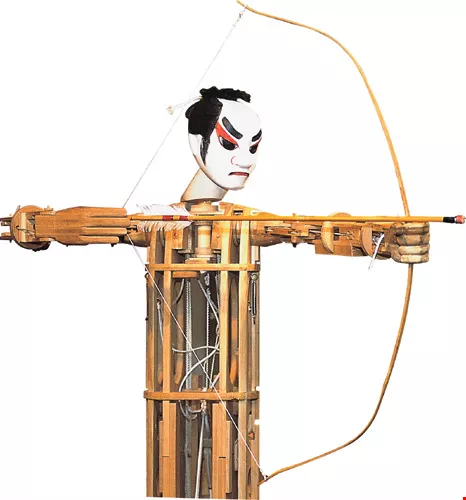
17th-century Japanese craftsmen created mechanical automata known as karakuri, such as Yumihiki-doji, "Archer Boy" (top left), which can shoot an arrow, or the one shown at right, which can leap forward, catch and unfurl a scroll, then land on the floor. These early "robots" amazed visitors when they were displayed at the National Museum of History in Taipei two years ago.
Sci-fi leads the way
Fast forwarding through time, we find Frankenstein, penned in 1818 by British author Mary Shelley. Generally regarded as the world's first science-fiction novel, it describes a young Dr. Frankenstein who stitches together body parts from various corpses and then applies a jolt of electricity to give the new creature life. Repulsed by its hideous appearance, ranting mobs seek to wreak retribution on its creator, but their wrath spills over and harms the innocent in the process. Frankenstein's monster isn't a robot in the strict sense of the word. Lacking the stereotypical nuts, bolts, and wiring, it's more a clone than a robot.
The term "robot" first appeared in 1920 in Rossum's Universal Robots, a play by Czech playwright Karel Capek. In it, man has mass-produced mechanical servants. A "lightbulb" appears over the head of one particularly smart robot who thinks to himself, "We robots are pretty darned outstanding. What are we doing serving these lazy dimwits?" He mobilizes an android army to exterminate the human race.... The plot depicts the potential fear and dissatisfaction of humans toward robots. And that is how robota (the Czech term for "contract laborer") became the appellation for... well, for robots.
In his book I, Robot, published 20 years later, US sci-fi guru Isaac Asimov boldly portrays androids of the future not simply as performing menial and dangerous work, but as caring for children and establishing mutually beneficial relationships with humans.
A prolific writer, Asimov wrote his first science-fiction novel at the age of 19. After obtaining a PhD in chemistry from Columbia University in 1948, he took a teaching position at Boston University, but later resigned to concentrate on his passion--writing.
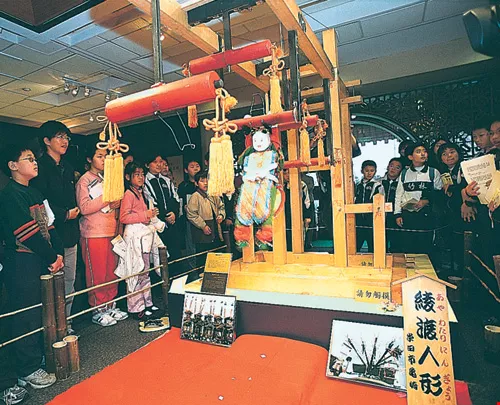
17th-century Japanese craftsmen created mechanical automata known as karakuri, such as Yumihiki-doji, "Archer Boy" (top left), which can shoot an arrow, or the one shown at right, which can leap forward, catch and unfurl a scroll, then land on the floor. These early "robots" amazed visitors when they were displayed at the National Museum of History in Taipei two years ago.
Reality overtakes sci-fi
Robots don't simply "pop out of a test tube in some laboratory." Many robotics specialists can trace their decision to plunge into the virgin territory back to science-fiction literature.
A prime example is Joseph F. Engelberger, known as "the father of robotics." Engelberger, who later also studied at Columbia, developed a keen interest in researching robotics after devouring all of Asimov's SF works.
In 1956, he and a friend founded Unimation, the world's first robotics company. It was responsible for installing the first industrial robot for automobiles in a General Motors plant in 1961. Engelberger's influence even reached across the Pacific Ocean to Japan, where he helped the automobile manufacturing industry automate, using robots to take the place of humans in performing "dull, dirty, and dangerous" tasks. The Japanese automobile industry has since become renowned for its quality and efficiency.
Asimov's robot novels have served as a beacon, leading the way for American engineers engaged in robotics research. The Japanese, who are just as infatuated with robotics as Americans, have their own Asimov of sorts.
Japanese manga master Osamu Tezuka began drawing the comic strip Astro Boy in 1951. The adorable young robot hero is equipped with rocket engines in his feet and powerful searchlights in his eyes. He can distinguish between good and evil and has a power output of 100,000 horsepower. In 1963, Astro Boy leapt from the pages of comic books onto the TV screen and into the hearts of the Japanese public.

17th-century Japanese craftsmen created mechanical automata known as karakuri, such as Yumihiki-doji, "Archer Boy" (top left), which can shoot an arrow, or the one shown at right, which can leap forward, catch and unfurl a scroll, then land on the floor. These early "robots" amazed visitors when they were displayed at the National Museum of History in Taipei two years ago.
A number of robotics researchers in Japan would love to build a robot with a heart of gold like Astro Boy. Robot specialists at Honda Motors, including Toru Takenaka and Masato Hirose, are big Astro Boy fans. In 1986, Honda launched a secret ten-year project at the end of which, in 1996, the official unveiling of its first humanoid robot, christened P3, caused a sensation the world over.
Standing 160 centimeters tall and weighing in at 130 kilograms, it looked spiffy in its white astronaut's suit. Like humans, it swayed slightly from side to side to maintain its balance. It looked very natural as it walked to a door, turned the doorknob, and pushed it open. It even climbed stairs, but it was incapable of reacting to changes in the environment. If somebody stepped in its way, it just kept plugging forward.
In November of 2000, following countless modifications, Asimo, a 120-cm, 43-kg humanoid with a light frame of magnesium alloy covered in plastic resin, walked leisurely onto a stage during a press conference and waved at the cameras. Many in the audience watched with eyes brimming with tears.
Generally speaking, robots fall into two major categories--"humanoids" and "non-humanoids." Non-humanoids appeared earlier and have a wide range of applications like the robotic arms that are now standard equipment on US space shuttles and space stations.
The road has been bumpier for their humanoid counterparts, for a number of reasons. The simplest explanation being that "flesh robots," i.e., humans, are difficult to imitate--we're just too darned complicated.
Some believe that the Japanese view of robots is more idealistic, that robots are an extension of "human beings" and that they will be friendly and sincere companions to us. Americans, on the other hand, consider robots the "antithesis of humans" and as such as potential competitors, even enemies. The theory goes on to state that these disparate views are based on the completely different cultural thinking of the two nations and that the US is lagging behind Japan in regard of the development of humanoid robots, possibly because of its Christian roots. The "creation of man" lies within the province of God. By creating in his own image, man is assuming God's role and as such could incur His wrath.
Tinier and tinier
In addition to learning from human beings, robotics specialists can study "the fish of the sea, and the birds of the sky, and the animals of the field, and all creeping things that creep on the earth."
"Bionics" is the simulation of forms and functions of organisms and its application to engineering various designs. The US' Defense Advanced Research Projects Agency (DARPA), for example, is sponsoring a Berkeley University research project entitled "Smartdust" which distributes micro-robots the size of dust particles into the air. When the miniscule sensors of myriad tiny robots form a network their collective power is enormous. Affixing them to your fingertips could enable you to operate a computer without a keyboard. Sprinkled inside a refrigerator, they might monitor and control the freshness of the food within.
Fantastic Voyage, rewritten and adapted for the screen by Asimov in 1966, predicted nano-medicine--the use of miniature robots in medicine.
The idea of shrinking humans and machines to the size of atoms violates the laws of physics, but injecting miniaturized machines into the bloodstream of humans to enhance the body's immune system as the machines search for viruses, tumors, and carcinogens is an idea currently being studied in earnest in countries around the world.
Cyborgs come of ageThe idea of attaching robotic parts to humans is no longer somewhere off in the distant future. The 20th century was the "age of the cyborg." You only need to look around to see things like artificial joints, hearing aids, and pacemakers. Other replacement parts are also being developed, like artificial hearts, cochleas, and retinas, and intelligent prosthetic limbs that can receive signals from the nerves.
Today, humans who have lost a body part due to injury or illness are willing to receive repairs, transplants, or modifications, so their counterparts in the future might have no problem with the idea of popping down to the local robot store to get an upgrade, like Andrew the robot in Asimov's The Positronic Man.
Hugh Herr is a researcher at the Massachusetts Institute of Technology's Mechanical Leg Laboratory and a double-leg amputee. "From the thighs down, he's a robot. Not an elaborate one, mind you. He's more of a prototype--metal rods where bones would be, computer circuitry where muscles would be, batteries held on by duct tape, and wires hanging off everywhere." This is how Herr is described in the book Flesh and Machines, written by MIT Artificial Intelligence Laboratory director Rodney A. Brooks. Herr's goal is to develop prosthetic limbs driven by artificial muscles.
As we see once-futuristic robots gradually materializing in today's world, the need and longing for as well as the fear and rejection of robots will be studied more and more by psychologists and debated more and more by ethicists. Sources indicate that Japan and Korea are drawing up laws of robotics a la Asimov. A lot of people would love to get a peek at what they've written.
Robots already play a number of roles in society, from explorer, laborer, and surgeon to actor and pet. The list will keep growing and we will continue to be amazed by robots, because the imagination of man knows no limits.
@List.jpg?w=522&h=410&mode=crop&format=webp&quality=80)


