Navigating the Pitfalls of the Mainland Market--An Interview with Agriculture Minister Lee Ching-lung
interview by Teng Sue-feng / photos Jimmy Lin / tr. by Josh Aguiar
June 2005


On April 16 Premier Frank Hsieh traveled south to the Yunlin-Chiayi area for an inspection tour and to talk with farmers there. They reported to him that crops such as rice, soybeans and peanuts needed fertilizer but that the Taiwan Fertilizer Company (TFC) was not providing an adequate supply. The farmers explained their situation in the hope that Hsieh would coordinate fertilizer supply and prices. Hsieh was frustrated and unhappy to hear this-why in the world had the farmers' most basic need, fertilizer, become so difficult a problem?
Premier Hsieh immediately decided to give priority to the first-season rice crop for allocating fertilizer from TFC and also to set up a fertilizer safety stock system. He said that although TFC had been privatized and was under the jurisdiction of the Ministry of Economic Affairs, as well as seeking profits it should have some conception of inventory control. With regard to fertilizer, it should also consider its policy support function. For this reason the premier suggested putting the management of TFC under the Council of Agriculture (COA). Neither agriculture nor farmers should ever be sacrificed for Taiwan's economic development, but after Taiwan joined the WTO in 2002 agriculture had inevitably suffered a degree of impact. Moved by concern for farmers, COA minister Lee Ching-lung's primary task is to assuage their doubts and fears.
Lee acknowledges that the problem with agriculture in Taiwan is "good skills and technology, but poor marketing." He points out that the best oolong tea in the world is produced here in Taiwan, and one in every two butterfly orchids comes from Taiwan. With the proper presentation, there's no doubt that Taiwanese farm products can be internationally competitive if we take the high-end route. In this interview, Lee Ching-lung takes the opportunity to illuminate the intergovernmental negotiations behind the thriving cross-strait agricultural exchange.
Q: Taiwan has been a WTO member for three years now. What impact has membership had on agriculture?
A: All countries experience an unprecedented jolt when joining the WTO. The government set out from the very beginning to anticipate this and make adjustments in the production and sale of the farm products that would most likely be affected by the mass inflow of foreign goods. For example, we reduced the total rice field acreage from 500,000 hectares at its peak down to 270,000, and made improvements in quality.
Another thing is to tap into foreign markets. A lot of folks say that because costs in Taiwanese agriculture are high, it is difficult to sell overseas, but I don't buy it. Personally, I think that what we should develop is the high-end produce market. You don't have to emphasize quantity, but instead concentrate on quality. We are already seeing good results thanks to a combination of good policy and farmers' diligence.
Over the last three years there has been a slight increase in Taiwan's farm output value. The number of people working in agriculture has gone down, but productivity has actually shown marked improvement. In 2003 average output value per person was NT$514,000, which was 8.7% more than in 2001, the year before we joined the WTO. You could say the impact on domestic farmers hasn't been as significant as expected.
Q: China's Taiwan Affairs Office has recently announced that it would like to increase Chinese purchases of Taiwan produce. Do you think that this announcement is a goodwill gesture?
A: We have to continue to observe matters circumspectly. Both Taiwan and the mainland are WTO members, and should discuss relevant issues within that framework. Shipping farm produce involves complex issues of inspection and quarantine for pest and disease control that are difficult for the private sector to manage.
Then there is the question of tariffs. China imposes tariffs of up to 29% on agricultural produce from Taiwan, in addition to an average 15% value added tax. Finally there's the issue of having goods clear customs efficiently. The Japanese have these dilatory tactics down to a fine art-we call it "the soft wall." The Japanese government will delay the entry of foreign goods with a litany of excuses like having to inspect the fruit for pests or nitpicking about whether the size of a shipment matches the amount declared on customs forms.
Although recently the mainland announced it would allow imports of 18 different kinds of fruit from Taiwan, it was not clear about which varieties would be able to enter tariff-free. We hope the other side's good intentions can translate into concrete actions and that we can adopt an approach where both the governments exercise their authority to put down on paper an agreement for the flow of agricultural products between both sides of the strait.
The government needs to take a broad view of the situation, and attempt to make sure that exporting to the mainland has both near-term and long-term advantages. The mainland only wants Taiwan's fruits, but fruits and vegetables are two different stories. Growing vegetables from planting to harvest takes a total of three months; it takes a minimum of three or four years after planting until fruit trees bear fruit. Let's say that in their eagerness to cater to the Chinese market Taiwan farmers focus all their energy on cultivating fruits. Then later the target market shifts dramatically-what do our farmers do then? The government needs to consider what's in our farmers' best interest.
Q: The percentage of Taiwan's agricultural produce exported to China has been rising year by year. Should we be worried about becoming overly dependent on China? What about the danger of revealing valuable farming techniques and technologies by exporting to the mainland?
A: Taiwan's produce is mostly tropical and subtropical, whereas the regions north of the Yangtze River are mostly temperate. As a result, they have less tropical produce. Taiwan's farming techniques are second only to Japan in Asia. So, our superior skills plus our different climate really do allow us to meet mainland market needs.
I'm optimistic about future developments. The way I think about the future is, as long as we manage to sell our farm products, I don't care who the buyer is-the US, Japan, Hong Kong, mainland China, Singapore, what have you. The important thing is for the government to assist farmers in marketing overseas, to help them increase their profits and to ensure that production and sales are balanced.
At present we allow 1,473 types of farm imports from the mainland, 800 of which are recent additions following WTO accession. Most of them are things that are not produced in large quantity domestically or that pose no biohazard, such as frozen cod, frozen daikon turnips, and traditional Chinese medicinal ingredients. Chinese imports don't have too large of an impact, really.
As for leaking techniques and secrets, cross-strait interaction has become very common, and since this knowledge is in farmers' brains, there's no way the government could suppress its disclosure. The government, of course, needs to keep a tight lid on sensitive technologies and on research conducted in government R&D units. What if Taiwanese farming techniques did somehow get leaked over to the mainland, would that be the end for us? Not entirely. It's best to keep developing new technologies to stay ahead of the pack.
Q: There are a lot of Taiwanese farmers in Guangdong and on Hainan Island growing top-grafted pears, as well as pineapples and other tropical fruits. Do you have any advice for these farmers seeking their fortunes outside of Taiwan?
A: Take Taiwan tilapia for instance. Three years ago Taiwan was the single biggest exporter, producing 100,000 metric tons annually and exporting 50,000 tons. In the last two years, though, China has eclipsed that figure, exporting over 70,000 tons. It isn't that mainlanders have become better breeders than the Taiwanese-this is what happens when Taiwanese breeders bring their eggs and their breeding skills over to Guangdong and Hainan.
We can't criticize Taiwanese farmers who make their living elsewhere, since they may have had little other choice. Nonetheless, we hope they will consider the welfare of Taiwan first and foremost, and not have their labor be counterproductive to their brethren back home. After all, if produce grown by Taiwanese farmers overseas is sold back to Taiwan and undercuts local produce, it is our own farmers who will suffer.
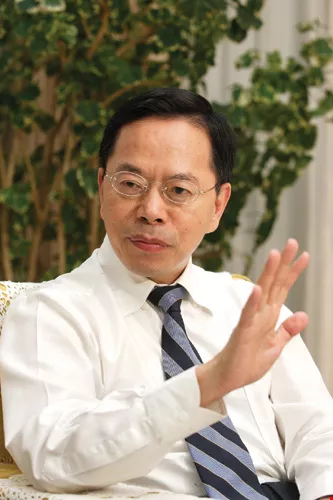
Lee Ching-lung says the government will carefully assess Chinese plans to import large amounts of Taiwanese fruit, to seek long-term as well as short-term benefits.


@List.jpg?w=522&h=410&mode=crop&format=webp&quality=80)


