Ethnic Chinese Venture Capitalists Build Silicon Valley Dream Works
Teng Sue-feng / photos Chuang Kung-ju / tr. by Scott Williams
September 2006


A joke currently making the rounds in Silicon Valley runs: A guy is visiting Silicon Valley for the first time, and is a little confused by the signage. He finally turns to a local and asks, "Is 'Available' the biggest company in Silicon Valley? Their shingle is everywhere."
Though Silicon Valley last year finally began recovering from the bursting of the dot-com bubble, demand for commercial real estate is still weak and many office buildings remain empty. Properties that were leasing for more than US$10 per square foot at the market's peak now go for only US$3 per square foot.
Though the area has yet to fully recover, the spirit of garage entrepreneurship that has dominated it for the last half century has made it the Weeble of the global high-tech industry--it may wobble, but it never falls. The area's resiliency is widely known. Less well known is that many, many of the new companies operating from within its glass and steel office towers were formed by ethnic Chinese. Ethnically Chinese businesspeople have established countless new businesses here, seeking untapped market niches in the hope that someday their companies will soar.
A group of people emerges from a three-hour board meeting in a conference room in a building that the company hasn't gotten around to putting its name on yet. The group includes Chiu Chun-pan and David Weng, founders of the Taiwanese American Industrial Technology Association (TAITA); Frank Marshall, a former vice president at Cisco; Duh Jia-bin, a former president of Cisco's China operations; and Wu Fang, CEO of Azalea Networks.
Founded early last year, Azalea is a trans-Pacific endeavor. Its technology team has been drawn from the "Tsinghua Mafia"--graduates of China's Tsinghua University who studied in the US. It is funded by Taiwanese-Americans, and it has hired former managers of major US corporations as directors and consultants to help establish it in the market. Over the last decade, this kind of three-way cooperation between China, Taiwan and the US has become an established model for the founding of new Silicon Valley enterprises.
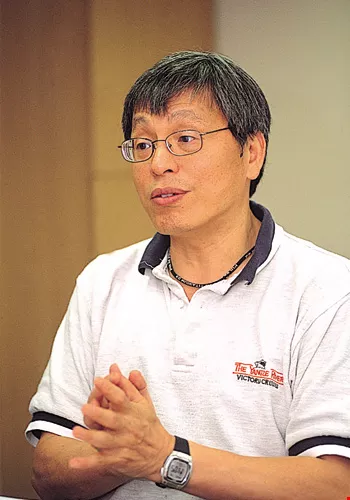
Chen Wu-fu is a professional entrepreneur who returned to Taipei from Silicon Valley to run iD Innovation, a VC fund that cultivates young Taiwanese entrepreneurs.
Angel investors
Chiu Chun-pan introduces the much younger Wu Fang to us, patting him on the shoulder and telling us, "He's a treasure."
With the company getting set to release its key product, a high-end router, Wu is under enormous pressure. He asks an employee to heat a glass of milk for him to ease his troubled stomach. "My stomach is killing me," he says, his pain evident on his face. Wu has been working in Silicon Valley for 14 years, and Azalea is the second company he has founded.
Wu, a graduate of the electrical engineering department at Tsinghua in Beijing, came to California in 1989 intending to complete a Master's degree and go straight to work on a PhD. But he had a job offer in hand when he finished his Master's, and, thinking that it was time he got himself "established" in the US, he abandoned the PhD. After stints at two companies, he started his own in 1997. When he sold that company to Cisco just two years later for US$128 million, he met David Weng, who was then working for Cisco. When Weng retired six years later, he and Chiu became "angel investors" in Wu's second venture.
In the US, the term "angel investor" is an extension of the idea of the "guardian angel." The principal difference is that in the business world, an "angel's" help consists largely of capital--angel investors provide relatively small sums--US$100,000 or US$200,000--in early-stage investment to help get new ventures off the ground.

In Silicon Valley, new ventures generate a seemingly endless stream of new technologies and everyone hopes that their company will become the next Google.
A high-tech Weeble
In the years since China began liberalizing, it has sent wave after wave of students pouring into the US to pursue advanced degrees. So many, in fact, that mainland Chinese students comprise the second largest contingent of foreign graduate students in the US after those from India. As a result, some 70% of the business plans now being submitted to Silicon Valley venture capitalists (VCs) originate with mainland Chinese who received advanced degrees in the US. Meanwhile, many Silicon Valley Taiwanese-Americans are retiring from positions as engineers or entrepreneurs and becoming VCs. Chiu is a case in point. After 30 years spent working in the valley, he's now reaping rewards as a VC.
Chiu Chun-pan came to the US after graduating from Japan's Waseda University in 1969. He earned a Master's degree from Oregon State University, and went on to work for Hewlett-Packard developing semiconductors for use in personal computers. Having seen at first hand the emergence of Silicon Valley's semiconductor, personal computer, and network equipment industries, the 65-year-old Chiu is well acquainted with technological change and the ebbs and flows of the economy.
In 1980, he co-founded IDT with two former classmates. "We were the first company to believe that high-speed, low-power CMOS [complementary metal-oxide semiconductor] chips would become an important technology," he explains. "In those days, neither Intel nor AMD were optimistic about them. But we were proved right within a few years." Chiu recalls that there were few Chinese starting businesses then, and capital was hard to find--it took him and his partners six months to raise the US$1 million in operating capital they needed for their first year.
Chiu founded Quality Semiconductor in 1989 and later sold the technology it developed to the watchmaker Seiko and to Yamaha, which was manufacturing sound chips, for several million US dollars. The company prospered, and, when it listed on the stock market in 1994, Chiu became CEO. But the pressure was enormous. After struggling to grow the company's revenues from US$70 million to US$100 million, Chiu hit upon a solution--in 1998, he merged Quality Semiconductor with IDT, which was then ten times its size. Having found a good home for his 200 employees, he gradually removed himself from management and became an amateur angel investor. These days, he sits on the boards of seven companies and consults for four.
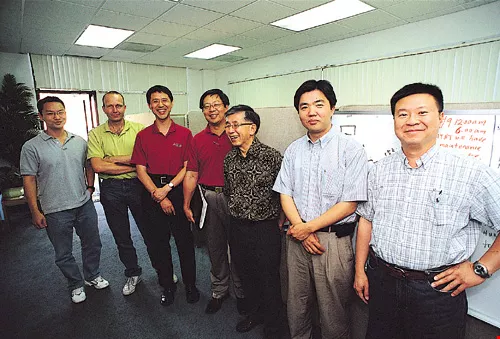
Silicon Valley's Azalea Networks was formed by a very strong team that included: Chinese-born entrepreneur Wu Fang (second from right), Taiwanese-born venture capitalists Chiu Chun-pan (third from right) and David Weng (fourth from right), and Cisco VP Frank Marshall (second from left).
Playing in the big leagues
On 11 February 2004, World Journal, the US's largest Chinese-language newspaper, ran a Silicon Valley story that caught the eyes of its Chinese readership: a Chinese-American company called NetScreen Technologies, which had been founded in 1997 by two Tsinghua alums, Deng Feng and Ke Yan, was being acquired by the world's number-two network equipment maker, Juniper Networks, for US$4 billion. Not many people knew that Chiu and Weng were early investors in the company.
Those within the ethnic Chinese technology community who knew of the two men's role at NetScreen had to admire their perspicacity in guiding this small company to a big-league payday. How had they spotted this diamond in the rough before it had even entered the minor leagues?
Weng retired as an engineering director with Cisco's IOS technology division in 2003. Then 49, he reflected on how hard it was to find lasting value and larger truths in the volatile tech industry. Realizing he was no longer interested in being a senior executive, he left to devote himself to spreading the Christian gospel and assisting start-up enterprises with technological advice and his management experience, as well as aiding them in finding capital.
"Many ethnic Chinese entrepreneurs don't package their business plans well," says Weng, "which makes it hard for them to catch the attention of major US venture capital firms." Weng explains that he wants to help grow Chinese businesses. Taking that as a starting point, he and his partners then select businesses to invest in by thoroughly investigating companies' technologies and their vision of their market.
"The media rarely reports on VCs' failures," says Weng, "but in fact fewer than 10% of new ventures are ultimately listed on the stock market or bought out." In Weng's view, during the Internet frenzy, too many people were over-optimistic about the outlook for networking. They poured investment into networking companies, even those whose business plans lacked a profit model, enabling several companies to raise upwards of US$1 billion in funding. When the NASDAQ market went into freefall in March of 2000, losing 75% of its value as it plunged from 5,000 to 1,200 points, many start-ups were hard hit or even folded, badly burning the VCs who had invested in them. The three years following the dot-com collapse were a bleak time for VCs, and it was only last year that the industry gradually began to regain some of its earlier vibrancy.
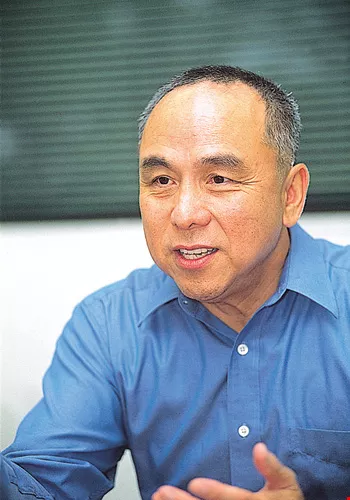
Bob Lin, a partner in the Silicon Valley VC firm Acorn Campus, has investments that span the Pacific and touch on both sides of the Taiwan Strait.
When "ventures" go wrong
The term "venture capital" suggests risk and adventure. VCs must carefully weigh information and minimize their risks because a mistake can be devastating, turning their "adventure" into a disaster. What criteria do they use to decide whether a company or an industry is worth investing in?
"I often ask people in my field," says Bob Lin, "if someone had come to you with Google's business plan six years ago, would you have invested? I know I wouldn't have been that smart." So says a man who is a co-founder of the Silicon Valley VC firm Acorn Campus and a board member at the Mount Jade Science and Technology Association. He says the niche American VCs saw at the time wasn't next-generation search technology, but the coming displacement of real-world advertising by online advertising.
"Before 1990, I was following other people's lead," admits Lin. "When I started businesses or invested in them, I did what other people did, and had a pretty good batting average. It was only in 1990, after having paid a lot of dues, that I realized I was just as dumb as everybody else. But because I never suffered devastating losses, I was able eventually to learn."
"A few years ago, an increase in the capacity of hard drives from ten megabytes to 20 megabytes was something you called a press conference about," continues Lin. "These days, it doesn't matter how fast a CPU runs, it's just not going to have a big impact on the industry." He says his own high-school-age son has no idea Apple also makes computers. The company relies on sales of its iPod music players, which have higher added value, to make money.
In addition to spotting changes in the market, teamwork is crucial. Lin says that even if a new company has a unique technology, it takes a group of people to bring it onstream. He invested in one company that had four PhDs on staff--two were Peking University alums, and two were Tsinghua alums. But though they were among China's best and brightest, they were at each other's throats from the word go. "Why does he get to be president, when I'm a vice president?" "Why is his desk bigger than mine?" "Why is he going to that international conference instead of me?" People with solid-gold credentials don't necessarily make the best team players. It's more important to have people with complementary skills and personalities.
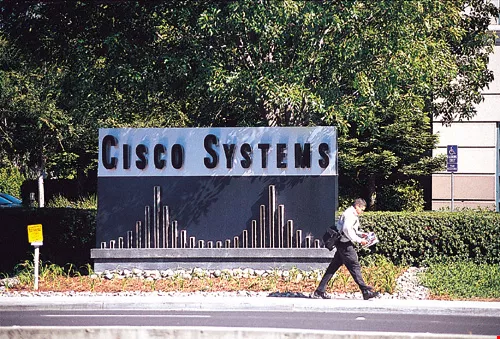
US networking giant Cisco excels at using acquisitions to expand its business. Many of Cisco's technologies were developed by ethnically Chinese entrepreneurs.
Homeward bound
With the rise of the Asian economies, investments by ethnic Chinese venture capitalists now span the Pacific and touch on both sides of the Taiwan Strait.
Lin's investments include four companies in China and two in Taiwan. Four years ago MondayTech, a company Lin calls "Taiwan's most profitable online retailer," came to him seeking investment. Last year, the company generated NT$3 billion in sales, and it forecasts that revenues will reach NT$5 billion this year.
In 2003, Ho and Kung established MondayTech as a means to dive into the still-developing online retailing market. When they opened their virtual department store on Yahoo's portal in early 2004, business took off. In fact, their company grew so fast they had trouble keeping up--within 18 months, sales grew from 3,000 to 40,000 items per month.
Online business opportunities are booming in Taiwan. This is expanding the network security market, which is, in turn, drawing overseas tech workers back to Taiwan to start their own businesses. TAITA's Weng hopes to provide some of them with a return route. In 2003, he founded Essence Technology Solution with US$30 million he had raised in Silicon Valley, and made himself its chairman.
Weng hired about a dozen engineers and developed a series of highly complex, highly featured network security chips. By acting as a router and firewall, and providing VPN, VoIP, and bandwidth management functionality, Essence's chips allow the CPU to focus on other tasks and provide the necessarily technological underpinnings for e-commerce.
In the thick of it
In recent years, the tech industries in Taiwan and the Bay Area have become so closely connected that many of Silicon Valley's ethnic Chinese venture capitalists have relocated their families and businesses to Taiwan.
In late 2003, Chen Wu-fu, an entrepreneur of exceptional drive, returned to Taiwan at the invitation of Acer founder Stan Shih to act as chairman of iD Innovation, a VC fund. Chen got the Executive Yuan Development Fund involved, and raised US$60 million for his fund, which invests in four or five companies every year.
Chen, who has especially keen insight into the fiber-optic communications market, has founded 13 companies since 1985. When Cisco purchased one of them, Ardent, for US$156 million only nine months after the company was established in 1996, financial markets lauded Ardent's management for generating such large returns in such a short time.
Chen says that even though the majority of the companies he has founded have eventually been acquired or turned over to another management team, he has never, with the exception of Ardent, which was a joint venture with Cisco, gone into a venture planning to sell it. In fact, he believes that doing so is a recipe for failure.
"I'm not interested in managing companies," explains Chen. "My field is entrepreneurship because it offers the greatest number of unknowns and the most room to maneuver. Entrepreneurs delight in inchoate situations because there are always demands that are not being met." Chen's adventurous personality is unsuited to the drudgery of managing an established company--focusing on the financials, on changes in the market in the coming quarter, on employee morale.... It's exhausting.
Looking at the tech industry as a whole, Chen feels that the US's advantages are in advanced technologies and mature markets, and notes that Silicon Valley is still the source of the industry's freshest ideas. He sees Taiwan's strength as production management and believes it should be able to leverage its experience in semiconductor manufacturing and chip design to the next generation of technological service industries (e.g. personal health management), the energy industry, and the medical devices segment of the biotech industry.
By the time capital markets recovered from the effects of the dot-com crash, a new wave of ethnic Chinese venture capitalists had already begun investing in a big way, and the young entrepreneurs whom they were backing were starting to create a stir. Some of these investors have kept their involvement out of the public eye, while others have quietly lent their support. As the business cycle turns, the spirit of innovation is once again invigorating the economy with its life-giving waters, and new ideas are beginning to sprout.
An old saying runs, "money can't do everything, but without it, you can't do anything." Hence, venture capitalists (who have money) and entrepreneurs (who have heads full of ideas) exist in a symbiotic relationship to one another.
The US was the birthplace of the world's venture capital (VC) industry, and Silicon Valley, which is home to half of the US's 600-some VC firms, might be said to be the heart of the US industry. Surprisingly, Taiwan isn't that far behind: it and Israel are second only to the US in terms of the development of their VC industries.
When Taiwan was creating the Hsinchu Science Park in the 1980s, Li Kwoh-ting, then the minister of finance, Hsu Li-te, then minister of economic affairs, and Acer Group founder Stan Shih, traveled to Silicon Valley to study its tech industry. Li discovered that the behind-the-scenes activities of VCs were driving the development of the US's high-tech industry, and therefore began cultivating Taiwanese VCs to support the development of Taiwan's fledgling tech industry.
In 1983, the Ministry of Finance established the Regulations Governing Venture Capital Firms, thereby paving the way for the industry in Taiwan. The Executive Yuan's Development Fund and Chiao Tung Bank then raised NT$800 million to establish the island's first VC seed fund.
In 1984, Acer Computers and Continental Engineering together formed Taiwan's first VC firm, Multiventure Investment. Soon after, Silicon Valley venture capitalist Hsu Ta-lin returned to Taiwan at Li's request and established another VC firm, H&Q Asia Pacific. Hsu had great difficulty raising the firm's first US$50 million. He ended up sourcing nearly half the money from Far Eastern Textiles, President Enterprises, and Mitac Computers, and receiving another 49% from the government.
In the 1990s, Taiwan's venture capitalists invested heavily in the emerging semiconductors industry, including firms such as Taiwan Semiconductor Manufacturing Corporation, Macronix, Winbond, and Mosel Vitelic, with considerable success.
According to the Taiwan Venture Capital Association, Taiwan's VC industry grew from 48 firms in 1996 to 259 in 2004. It invested NT$172.2 billion in 9,782 ventures in Taiwan and abroad over the same period. Over the years, these firms have succeeded in listing more than 400 of their investments on the stock market, but they have had anything but a smooth ride.
When the networking and fiber-optics industries collapsed in 2000, VC firms around the world entered a four-year period of consolidation. Taiwan's economy was battered again in 2003 following the outbreak of SARS, and investment dried up for a time.
As a result, Taiwan's VCs were able to list only 39 companies in 2004, down from 68 in 2002.
Taiwan's VCs also changed their geographic focus in 2004, choosing to direct a larger percentage of their investment to local companies with which they were more familiar. In fact, the percentage of VC capital going into local firms rose from 66.4% in 2002 to 80.2% in 2004, while the portion going to Silicon Valley ventures declined by nearly half, from 18.9% of the total to only 9.96%. But with the world moving towards regionalized economies, Taiwan's VCs know they must again look beyond Taiwan's borders.


@List.jpg?w=522&h=410&mode=crop&format=webp&quality=80)


