Mobile Life--Who's Picking Up the Tab?
Vito Lee / photos Chuang Kung-ju / tr. by Chris Taylor
August 2005


By 2007 Taiwan will have around a million Internet subscribers, creating a considerable business opportunity. This kind of commercial volume will lead to further technological advances in the wireless broadband industry.
To explore the face of the mobile future, a huge experiment is unfolding in Taiwan's 25 counties and cities. These wireless broadband demonstration projects will provide many free broadband services to citizens. However, while there is no lack of originality in these services--which span everything from medical treatment to tourism, education and employment--they are troubled by a shortage of users. Just where is the problem?
If the equipment and the services are there, will the users simply come?
Entering the Niaosung wetland area of Chengching Lake, scattered people and geese walk between the ornamental gardens. Because of Niaosung's many functions, including education and tourism, the Kaohsiung County Government has selected it as a wireless broadband demonstration area. However, although the program has been operation for several months, only 20 or 30 people are using it every month. Bad management has turned the ecological research area of Niaosung into a private farm, while the investment in wireless broadband has produced a toothless tiger.
"Just offering guide services doesn't attract many tourists," says Hsieh Pei-fen, who is responsible for strategy development at the park for Myerstone Internet and Multimedia Corporation. "Not having a permanent operating organization is a problem. If tourists want to borrow a PDA or a dual-mode mobile phone, they have to apply in advance. And if something goes wrong with the equipment they don't know who to turn to. It's pretty inconvenient." Another problem is insufficient publicity. The services have slipped into a mode of partial operation.
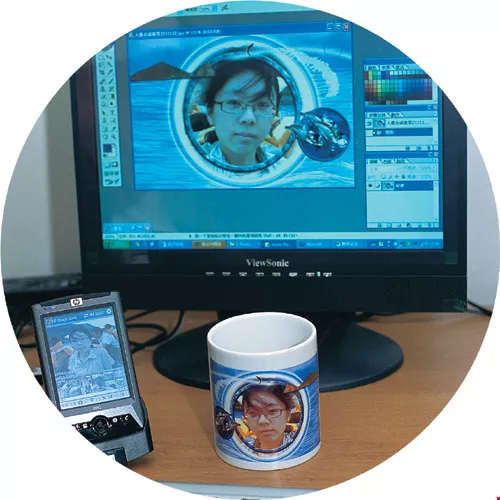
The boat for viewing whales at scenic Kueishan Island features Taiwan's first ocean hot spot. On leaving the boat whale watchers can take their completely customized souvenirs, making whale-watching even more fun.
Demand on demand?
With its convenient portability, wireless has been factored into the plans of many public places, including museums and scenic areas, as a tool for guiding people.
Traveling from Kaohsiung to the old town of Taiping in Yunlin County's Touliu, tourists can not only enjoy wireless broadband services, they can also choose to use the service to buy agricultural and fishery products.
With its optimistic view of the future commercial opportunities of wireless applications, Chunghwa Telecom--which originally was only responsible for Yunlin's wireless hardware--decided to take up overseeing this project, which includes guide and sales services for scenic areas. However, "since operations began at the end of last year the average amount of time people are online a month is only 300 minutes. That falls way short of the original estimate of 10,000 minutes a month," says Fu Yun-long, who is responsible for Chunghwa's wireless strategy in Yunlin.
From the installation of hardware to finding businesses to cooperate with and then promoting the service, it took Chunghwa's Taichung branch a year to put everything in place. The work unit was exhausted. When the users did not materialize, it made Fu's "hair turn white fast"--"We're wondering whether the services we provide are what the customers want," he says bitterly.
From a technological point of view, the area covered by one wireless access point (AP) is a hot spot. If you bring many APs together in one area, apart from increasing the area of coverage for the convenience of users, is it possible to use this special feature to provide services more effectively? In order to find an answer, from east to west, from the coast to the mountains, more than 20 wireless broadband projects will be rolled out over the next two years. But for now the answer remains murky.
"Everybody's swarming into wireless broadband, but there's still no killer application to excite people," says Chen Jung-tang, director of Ilan County Government's Information Service Department, while riding on a whale watching boat that has just departed from Ilan's Wushi Harbor. "This kind of program lacks application value."
The AP installed on the boat allows whale-watchers to get online during the course of their trip and read a tour guide or enjoy surfing the web while on the sea. When the whale-watchers get to Kueishan Island they can send back the digital pictures they take to people on the Taiwanese mainland, and when they return to land they can immediately get souvenir mugs and T-shirts printed with pictures of themselves on their heroic mission, ingeniously integrating local businesses.
However, since the start of the service at the end of 2004, it has drawn a mixed response from tourists. The captain of the whale-watching ship, Li Lung-chi, says: "When whale-watching tourists hear about this service they think its an original idea, but when it comes to producing their wallets at sea to get online and buy souvenirs, it doesn't seem to be enough to attract them."
Why is it not attracting users? Local governments and wireless entrepreneurs are all asking that question.
"The answer may be that our services are not touching consumers' hearts," says Chen Jung-tang. "At the moment, the usage volume cannot support long-term operations, not to mention opening up new services."
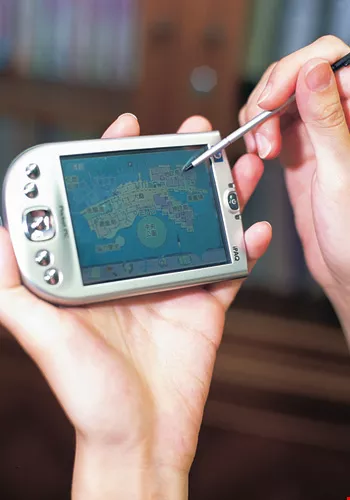
Ilan may only have one coffee shop that offers wireless internet, but the county is not lagging behind when it comes to mobile services. In the green architectural complex for the county government and councilors, not only can officials read online documents at any time, but ordinary people can use the mobile guide services.
Learning to profit
The logic of needing good services in order to attract customers is very clear. But creatively combining the advantages of wireless with the special characteristics of local industry in practice often fails in a ruthless market.
Coming up with something amazing that is also easy to use, while finding convenient ways to charge, is not necessarily easy to pull off no matter how much you put your mind to it. But faced with the enormous future opportunities and influence of wireless, many people refuse to passively sit and wait, going on the attack rather than waiting for services and charging mechanisms to mature.
"That's the thinking of the Taipei and Kaohsiung city governments at the moment," says Myerstone general manager Phyllis Chou. "They're attracting city residents with free wireless Internet. They think that as soon as there are enough wireless broadband subscribers, its vast influence will attract more enterprises, and that in turn will create profitable services."
It is not difficult to understand the mentality of operators entering the race and bleeding profits in order to grasp a window of opportunity. "But comparing it to the experience of the Internet bubble that started in 2000, it's possible that this method of attracting users with free services will go off the tracks and produce the same rapid creation of a bubble in wireless applications," says the director of one Internet firm. The result of the large volume of free Internet services of that time was that users became spoiled. No matter how outstanding the content was, no sooner did a website begin charging than its popularity plummeted. What is more, advertising charge mechanisms were not mature, making the Internet a financial hole. Businesses could not take the long-term financial pressures and a large number of them collapsed. The bitter memories still fill the hearts of Internet operators and investors with fear.
In actual fact, even though it is free to users, without any strong incentives to attract them the uptake of Taipei City's wireless broadband has not met predictions.
According to statistics of Qware Systems, which is responsible for Taipei City's wireless Internet project and for providing online services, the last four months of 2005 netted only about 20,000 online users. That is a long way from the firm's estimate that it would get 10,000 users in the first month, January, and then see user numbers doubling and redoubling in subsequent months. To make matters worse, it now appears that Taipower will not meet its schedule for powering up the APs, meaning the goal of 90% wireless coverage for Taipei will have to be put off, making rapid improvement in usage even less likely.
With the need to simultaneously establish a wireless environment and find application methods, the problems that have to be overcome in bringing about a wireless life are considerable.
The problems do not stop there. "There is simply no business model that connects wireless life with applications that win over consumers," says Weng Pu-shan, a long-time researcher of hi-tech product business models, and head of the Communications Industry Association. "At the start, you have to plan for future revenue problems. In the end, making the switch from free provision to charging is always going to alienate users."
In view of this, the new M-Taiwan initiative has made some special adjustments. Government administrator Lin Feng-ching points out: "The most important aspect of M-Taiwan is to use government capabilities to create an environment that will attract the private sector to join in. In contrast to optical fiber connections laid out by fixed network operators, M-Taiwan lowers operators' costs, and the prospect of payback from leasing rentals over the years will increase operators' willingness to invest."
"Also, no matter whether it is BOT or OT, before any firms embark on a project they have to submit a business plan covering at least three years. That will ensure that they take into consideration operating problems from the beginning."
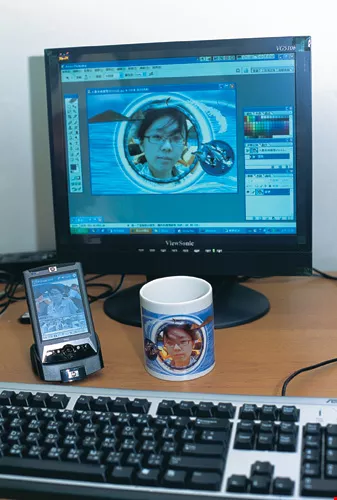
The boat for viewing whales at scenic Kueishan Island features Taiwan's first ocean hot spot. On leaving the boat whale watchers can take their completely customized souvenirs, making whale-watching even more fun.
A looming bubble?
In the 1980s the Internet began to envelop the world. Knowledge underwent digitization to become expressed in ones and zeros. With its successful propagation, the Internet today has become the most important tool of communication. Even in the aftermath of the dot-com bubble, humanity's dependency on the Internet is increasing rather than decreasing. Wireless is actually simply an extension of the traditional wired Internet.
Moreover, because of this, micro-charging for services by Internet operators will also be a feature of wireless. When dual-mode matures, the SIM cards of mobile phones, apart from recording call charges, may also be able to record small charges for Internet services. When that time comes, telecom operators will be able to gather charges from Internet service providers, using their existing platform to earn revenues. The situation of Internet service providers that formerly could not collect charges will also improve. Thus these two old rivals, telecoms and the Intenet, will also have opportunities for win-win cooperation.
However there is a crucial difference between the two.
"First, because of the convenience of roll-out, in future the operators of the Internet infrastructure will not look like the huge fixed network operators that monopolize it today," says Professor Mao Chih-kuo of National Chiao Tung University's Institute of Business and Management. "As soon as there are many competitors, service models and charging methods may become more diversified."
"When the Internet first began to develop, the long-term dream was that it could be accessed any time, anywhere and by anybody. That's also the goal of wireless broadband Internet," says Mao. "The special feature of wireless is that it is even more able to overcome the restraints of time and place. Looking long term, the original hopes for the Internet will become reality, but whether it will take the path we have predicted is by no means a certainty."
So it is for the Internet, and so it will be for wireless applications.

Ilan may only have one coffee shop that offers wireless internet, but the county is not lagging behind when it comes to mobile services. In the green architectural complex for the county government and councilors, not only can officials read online documents at any time, but ordinary people can use the mobile guide services.


@List.jpg?w=522&h=410&mode=crop&format=webp&quality=80)


