Rewriting the Book--Publishing in Cultural Greater China
Eric Lin / photos Jimmy Lin / tr. by Phil Newell
October 2003


In this age of economics uber alles, the entry of Taiwan and China into the WTO has not only created a "Greater China economic grouping," but also a greater Chinese cultural zone. In this zone, there has been liberalization of the publishing market and increased interaction and investment across the Taiwan Strait, giving rise to a "Chinese publishing realm."
These developments have sparked a reshuffling of the deck among publishers in China, Taiwan, and Hong Kong. Following the reorganization of television in mainland China into business groups at the provincial level, the publishing industry there is also about to embark on restructuring. As subject matter and distribution have become more open and lively, sales of printed materials have sharply increased.
In Taiwan, meanwhile, over the past few years, as a result of overblown expectations, the publishing industry has seen explosive growth followed by implosive decline. As they increasingly feel the pressure of overloaded warehouses, publishers facing market saturation at home are looking for new markets abroad.
Hong Kong's publishing industry, meanwhile, caught between the comparative advantages held by Taiwan on one side and China on the other, is struggling to maintain autonomy. But the influx of cheap books from the rest of the PRC, printed with simplified Chinese characters, is brewing a crisis in which the very "character" of Hong Kong publishing could be undermined.
Leaving aside the business aspect for the moment, the cross-border circulation of works by authors from these three Chinese societies, now commonplace, is also drawing attention, and is prompting visions of greater cultural interaction and even cultural convergence among the Chinese.
For investors, the fascinating thing about the publishing industry is the ambiguous relationship between commercial ambitions and cultural expectations. In the new situation emerging in the field of Chinese-language publishing, there are new target markets on the radar screen, and there is an ongoing redeployment of publishers' forces and consequent shifts in local economies and even cultures. How do Taiwanese publishers plan to get their foot in the half-closed door of the mainland? What are the obstacles? What fundamental cultural reflections do these developments inspire?
Put on your reading lamp, settle in, and all things will be revealed to you.
In preparation for the 2008 Olympics, Beijing is setting fires under people to get construction and roadwork completed. Wind-blown sand fills the air, and that, combined with the intense sun, still hot at its peak even now in late summer, forces you to squint. But at the Beijing Publishing Building on West Chang An Boulevard, people are coming and going in swarms. Many parents walk through the aisles with their children, everybody looking enthusiastic, as they take advantage of the last weekend of summer vacation to buy books for the new school year.
This building, opened in 1998, gets up to 50,000 visits a day. It contains well over 100,000 titles, and there is a post office in the basement so that visitors from afar can conveniently mail their purchases home.
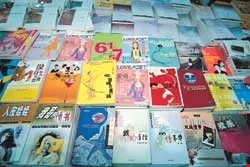
Authors of light literature from Taiwan, such as Tsai Chih-heng, Jimmy, and Wang Wenhua, have swept the Chinese reading public. The simplified-character editions of their books published in the PRC not only have covers like those in Taiwan, but even the approaches to packaging and marketing have been "imported whole" from Taiwan.
Cresting wave
Head up to the literature section on the second floor, and you can see an entire corner filled with works by Jimmy, a writer of illustrated books from Taiwan. A poster proclaiming a "Jimmy Craze" obscures a whole pillar. Meanwhile, Red Ink, whose Love Post series of online novels swept the Chinese world two years ago, now has enough simplified-character publications in print to fill their own display rack. The style of the covers is exactly the same as in Taiwan, and if you don't look closely enough to notice that the characters are simplified, you might think you were in a corner of Taipei's Kingstone Bookstore.
Exciting things have also been happening in Shanghai's book market. The Century Scholar bookstore chain has just opened China's first 24-hour bookstore, seizing the lead with an outlet in the Pudong District of Shanghai, an event that provides fat for publishing folk in Taiwan, Hong Kong, and China to chew over. On the day of the opening, Wu Hsing-wen, the Beijing representative of Taiwan's Yuan Liou Publishing, sitting in the Sanlidun Coffee Shop in Beijing at dusk, excitedly talked about the event, saying that it is well worth the trip to go to Shanghai for a look if you have the time. A few hours later, the lights of the Century Scholar bookstore quietly glowed in the after-work hours of the Pudong office district. Here, too, works by Taiwan authors are set out in the most prominent places.
In recent years, the mainland's publishing boom has been described by local media as "a cresting wave." Not only are the type and scope of books becoming livelier by the day, sales have increased greatly. Beginning this May, foreign investors were allowed to begin getting into the downstream end of the market, in hopes that outsiders will introduce more flexibility and creativity into the distribution, wholesaling, marketing, and retailing of books.
"2002 was the most critical year for offshore publishers to start in earnest to get a piece of the China book market, and also the most active and exciting year," says Chen Hsin-yuan, an associate professor in the Graduate Institute of Literature at Fo Guang University in Ilan who specializes in Chinese language publishing. All publishers know that under the pressure of the WTO it is only a matter of time before the mainland liberalizes its publishing market. Whoever is most familiar with the territory will stand the best chance of coming out ahead.

In 2002, Wang Dong of Beijing's Alpha Books went against the conventional wisdom and decided to publish illustrated books by Jimmy. They have since sold more than a million copies in the PRC, somewhat closing the "reading lag" between the two sides of the Taiwan Strait.
Hunkering down or redeploying
This current boom has prompted Germany's Bertelsmann, Britain's Longmen, and other international publishing groups to make the leap into the PRC in a big way. Taiwan firms, whose strong point is content, have long been sending reps to the mainland. Many familiar names from Taiwan's publishing industry have either been living in Beijing or Shanghai for quite some time, or make frequent trips to the PRC. These are the point men and women. And at this year's Beijing Book Fair in September, virtually all Chinese-language publishers from Taiwan, Hong Kong, and the mainland crowded in. The general manager of China Times Publishing even arrived in Beijing a month in advance.
It is easy to see that the PRC's vast publishing market is bringing the idea of a "Chinese language publishing realm" into sharper focus. According to official PRC stats, in 2002 more than 178,000 titles were published in China, a 12% increase over the previous year, of which more than 100,000 titles were new. A total of 6.75 billion volumes were cranked out, with total value reaching RMB72.6 billion. The mainland accounted for three-fourths of all Chinese-language titles produced in that year, with the other one-quarter being shared among Taiwan, Hong Kong, Southeast Asia, and North America.
Because of the vast potential of the Chinese language market, in the past few years large cities on both sides of the Taiwan Strait have been competing to hold book fairs, each hoping to become the "Chinese-language publishing rights trading center." But the mainland market has been growing too fast, upsetting all previous calculations. Virtually all publishers in the four main cities for Chinese-language publishing-Taipei, Hong Kong, Beijing, and Shanghai-now say the same thing: There is no question that Beijing is already the publication rights trading center.
"A few years ago, the Taipei International Book Exhibition was billing itself as the center for trading in Chinese-language publishing rights. But, adjusting to reality, next year the book fair, run by Cite Publishing, will be billed as a center for the art and craft of publishing," says Cite vice-chairman Su Shih-ping. Demand in the mainland is currently skyrocketing, and Hong Kong's publishing industry has been plagued by crippling problems, whereas publishing in Taiwan has long been mature. Taiwan can best exert genuine influence on the overall course of Chinese-language publishing through its know-how in areas like editing, packaging, sales, and interaction with readers.

(left) The publishing boom has made reading fashionable in itself. Bookshops in the mainland are now paying increasing attention to style and interior design. The SDX Joint Bookstore in Beijing is known, in a comparison with Taiwan's most fashionable bookstore, as the "Eslite of Beijing."
Go west!
This conclusion may leave many people in Taiwan disappointed, because the "publishing rights trading center" label evokes the appealing myth of "gathering place for the most deals, the most publishers, and the most intellectuals and cultural figures," which is the goal of all Chinese metropolises. But if you look from a different angle, the idea of an offshore publisher penetrating the mainland market and taking a prime position in the country that accounts for three-fourths of Chinese-language titles worldwide is no less exhilarating. The challenge for Taiwan publishers at this stage is to figure out how to get their foot in the door, or at least get a clear look at the whole interior from the window.
"If Taiwan publishers want to get into the mainland market," advises Wu Hsing-wen, who knows the book market on both sides like the back of his hand, "there are only three ways: subcontracting out publication rights, joint publishing, or opening a subsidiary." Selling publication rights is easy, but the latter two options are much more complicated.
A few well-known publishers from Taiwan have already tried their luck. Yuan Liou opened a tech company in Beijing in 2000 to develop e-books. This year they will open another subsidiary to handle general operations. Red Ink established a subsidiary in China to handle publishing, trading of publication rights, packaging, marketing, and so on. But last year, as a result of problems with collecting debts and personnel management, they declared their trial effort a failure. They now have an agent in Beijing who handles their PRC affairs for them. Locus Publishing, on the other hand, is trying to establish name recognition by publishing the Jimmy books with Liaoning Educational Publishers under a formula in which both publishers' names will appear on the books.
Looking outside of Beijing, Commonwealth Publishing is producing Dongfang Qiye Zazhi (a business magazine) in Shanghai, and is using that office as its base to negotiate publications rights. Chen Hsing (Morning Star) has created a joint venture with Harbin Publishing. And Linking Books has teamed up with the Shandong Publishing Company and Shanghai's Jifeng Bookstore chain.

(right) Shen Chang-wen, former general manager of SDX Joint Publishing in Beijing, makes the most of his many contacts in Taiwan, Hong Kong, and China to promote more publishing interaction between the three places. Though already retired, he still "punches in" every day at the bookstore coffee shop.
Keeping a low profile
Taiwan's publishers are generally fast on their feet, and each has its own strengths. But there are political risks to expanding PRC operations.
The official attitude in the PRC is clear: Currently only a limited part of the downstream market is open to outside competition. It is illegal for any offshore publishers to get involved in any aspect of upstream publishing affairs. Taiwanese publishers have all kinds of ways around the restrictions to operate in the mainland market, but even a joint venture with a local company faces great risks of getting into political trouble. Taiwanese publishers have no alternative but to keep a low profile and move cautiously in developing business in the mainland.
Shen Chang-wen, former general manager of the SDX Joint Publishing Company in Beijing, who has been an important player encouraging cross-strait publishing interaction, often tells his friends in Taiwan, "Just keep one foot in over here, that's enough; don't try to make a big splash."
Shen states that a lot of cases of failures of foreign companies in the PRC are due to excessive ambitions. He points to the Ming Pao Group in Hong Kong as a case in point. When Ming Pao wanted to get listed on the stock exchange in Switzerland, they printed a prospectus boasting of the group's influence on mainland public opinion and culture. This sparked a negative reaction from the PRC's intelligence agencies, and years of effort put into building a publishing empire were destroyed overnight.
By way of contrast, he mentions Bertelsmann of Germany. Bertelsmann is trying to get into the mainland market through distribution, marketing, and sales. Although they already have agreement from "the highest levels," they are still moving cautiously. They don't sell any books of a "sensitive nature" (such as histories that show the present in an unflattering or derisive light, risque material, or books that test the margins of permissible speech). Membership in Bertelsmann's PRC online book club has hit 1.5 million, and its influence is steadily growing.

(this page) The popularity of bands like F4 has made photo books of pop stars one of the touchstone categories for concurrent publication of books in Taiwan, Hong Kong, and China. Commerce and pop culture are advancing hand-in-hand across the Taiwan Strait.
Partners and intermediaries
So long as ambitions remain limited-focusing on content-the future still looks good in the mainland for Taiwan publishers. But simply buying and selling publishing rights itself introduces other variables, since the success of any book will depend on such things as collecting debts, accounting, oversight of the editorial process, and marketing.
Here is a summary of the model most commonly used at present for publishing Taiwan's books in the PRC: The publisher and the author simultaneously sign a publishing contract and agency contract. Revenues from publication rights in the mainland are generally divided evenly between the publisher and the author. The Taiwanese publisher goes through an intermediary in the PRC-a local agent, private bookseller, the publishers's own mainland representative, a "culture company"-to purchase a shuhao (book registration number) from a mainland publisher. The intermediary takes responsibility for promotion and marketing, while the mainland publisher handles printing and distribution.
"The mainland publishing industry is complicated," says academic Chen Hsin-yuan. "Publishers are all state-owned, and books have to have a shuhao. Each publisher gets a quota of only one or two hundred shuhao, so they are obviously very valuable. Therefore, before taking on any book, the publishing company will always carefully consider what commercial and political effects the book will have on the firm." Despite the fact that in recent years the mainland government has opened up a "second channel" by allowing the establishment of private book companies, these must still purchase shuhao from the "first channel" (state-run publishers).
This is why different books from a single Taiwanese author, or books originally published as a series by a single Taiwanese publisher, often come out of different mainland publishing houses. For example, Red Ink's Love Post Series is published by three different firms in the PRC, though all use the term Love Post (which has been registered as a trademark in the mainland) and the books are produced according to uniform size and design specifications.
"Things like direct mail, advertising copy, cover design, promotion, packaging, and marketing, have already been done once in Taiwan, and what was used in Taiwan can, with small adjustments, be adopted in the mainland," says Joyce Chou, deputy editor-in-chief of Red Ink.
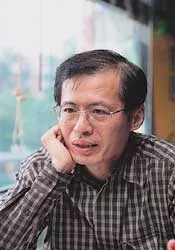
(opposite page) In the past couple of years many publishing firms from Taiwan have assigned permanent representatives to Beijing or Shanghai to handle publication rights for the mainland. Wu Hsing-wen of Yuan Liou Publishing has been working in the PRC market for many years, and writes a column about media and publishing on the two sides of the Taiwan Strait.
Lit lite
Serious literary and cultural works from Taiwan need time to be absorbed into the mainland market, meaning that short-term sales are slow. Putting out such a book is often like throwing a stone into the sea-it's already quite an achievement to spark some discussion, much less enjoy broad sales. The result is that little cross-strait effort is devoted to works of this nature.
Given this reality, the types of books from Taiwan that have made the biggest splashes in the PRC the last two years have been in the genres of "inspiration" and "urban lit." Of these two, it has been urban lit-books focusing on the problems of romance in contemporary urban life, written by such figures as Tsai Chih-heng, Wang Wenhua, and Jimmy-which has gotten the most attention, with sales so high that even a figure like 200,000 would be at the low end of the range.
Tsai Chih-heng's The First Intimate Contact swept the PRC in 2002 as an online novel, becoming the breakthrough book in the PRC for Red Ink (a subsidiary of Cite Publishing). Over the past few years, a fixed model has taken shape for the spread in the PRC of online literature and light fiction, a model that includes joint promotion, autograph sessions, press releases, and adaptations of works to the stage.
Jimmy and Wang Wenhua are seen as symbols of the fact that urban consumers in mainland China are nearly keeping up step for step with their peers in Taiwan.
In 2000, Jimmy's illustrated books were released in the PRC as part of series called World Masters of Illustrated Books. But not even the paltry 5000 volumes in the initial printing sold out, causing mainland publishers to suspect that the mainland market had not matured to the point where people will pay to purchase illustrated books for adults. But Wang Dong of Alpha Books in Beijing ignored the accepted wisdom. She was convinced that sales would be no problem if only the printing and texture could be brought up to the level in Taiwan. As she predicted, Jimmy then went large.
"There is a very modern feel to Jimmy, but the stories also take into account Chinese-style refinement," says Wang. "This fits right in with the consumer behavior and sentimental orientations of the newly rising class of petty bourgeoisie in the PRC, so these books have been very popular." There is a saying current among young people in the mainland: "If you want to be in love, you'd better read Jimmy first." In crossing the Taiwan Strait, Jimmy has taken on a role he has never played and never intended to play in Taiwan-an Oracle of Romance.
Wang agrees that there is definitely an element of chance or serendipity in catching on with the latest fads, but that doesn't mean books can be chosen at random. A book must still conform to three principles: It must be a good read, satisfy market tastes, and meet the personal standards of the editor and publisher. In sum, quality and taste are still decisive. By way of example, she says that when they published three books by Taiwan author Eric Wu, despite the timing being right during the SARS epidemic and the lack of any advertising or promotion, sales were still off the charts. Wu will go to Beijing in October for a book signing, and his star is on the rise in the mainland.
On the other side of the equation, authors must choose the right publishers in order to get their books marketed effectively.
Sun Xiaoning, a reporter in Beijing who covers the publishing industry for the Beijing Evening News, states that given Beijing's status as the center of the industry in the PRC, book reviews in the Beijing media have an opinion-maker effect across the country, so it is only logical that one should choose to have one's book come out in Beijing first.
Wang Wenhua's Protein Girl, on the other hand, was first published by Shanghai's Cenury Publishing, which has lots of experience marketing youth literature. Shanghainese have a special knack for playing to popular tastes and setting the standards for what becomes fashionable. The book has only been out for a month, but has already sold 150,000 copies. It seems that both the author and the publisher got an added boost in this case.

(left) The mainland publishing market is vast, so vast that even a trade paper like China Book Business Report has a print run of more than 60,000.
Don't judge a book by its cover
The popularity of Taiwan's urban lit is based on the follow-the-leader transmission of fashion from one city to the next. But is there anything deeper Taiwan's publishers can offer in the mainland?
In fact, Taiwan publishers are very up-to-date and highly innovative in terms of topics, editing, and marketing, so they can have a positive locomotive effect on mainland publishing houses. Whereas in other areas of culture like visual entertainment and broadcasting, the authorities have always been very conservative and restrictive toward Taiwanese media, the press release for this year's Beijing International Book Exhibition explicitly praises the high level of development of the publishing industry in Taiwan and Hong Kong.
The press release quotes a comment by Chan Man-hung, vice-chairman and president of Hong Kong's Sino United Publishing (a company in which PRC official interests have invested), to the effect that the film Crouching Tiger, Hidden Dragon could serve as a model for cross-strait publishing. The movie, you will recall, gathered together cultural elites from Taiwan, Hong Kong, and mainland China, and enjoyed both great critical reviews and strong box office returns.
But print is, after all, different from visual entertainment. There is a deeper cultural significance behind publications, and some have high hopes for the impact of Taiwanese culture on the PRC. However, the status of Taiwan books in the mainland publishing industry is not nearly as glorious as it may appear at first glance. Beneath the fad for urban lit, the cultural interchange being led by the book market is very much a one-way street.
Sun Qingguo, vice general manager of the Beijing Open Book Market Consulting Center, notes that offshore works account for only about 20% of books in the PRC, and Taiwan accounts for a mere 4% of offshore books. In terms of number of volumes published, the amount of talk about the subject is vastly disproportionate to the actual impact.
"Popular reading cannot reflect cultural influence-all pop culture is fleeting. Now that publishers on both sides of the Taiwan Strait have experience with commercial genres like urban literature, they should develop even broader and deeper interaction," says Cheng Sanguo, editor-in-chief at the China Book Business Report. After all, people have higher expectations of publishing than just selling books.
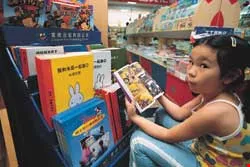
(opposite page) The mainland's demand for books in all fields-literature, lifestyle, technology, foreign languages, children's books-is growing fast, and publishers are expecting limitless commercial opportunities.
Backlash effect
The mainland market has offshore publishers champing at the bit, and there's nothing blameworthy about trying to maximize profits. But the Taiwan and Hong Kong publishing industries are still suffering from problems that have been building up for years. In trying to jump in to the mainland market even before resolving their internal problems, they are raising concerns about what will happen to their home-market cultures. The clearest example of this problem is the influx of cheap books from China printed using simplified characters.
Whereas all books in China use simplified characters, Hong Kong, like Taiwan, has always used traditional (complex) Chinese characters. In the past, because of the popularity of the martial arts novels of such older generation authors as Louis Cha, traditional-character works were still able to hold pride of place in the Chinese-language book market. But since then large numbers of materials printed in simplified characters have poured into Hong Kong, and readers there are now accustomed to them. Meanwhile, books printed in traditional characters in Hong Kong are usually too expensive to be competitive in the PRC, or face import restrictions, so cannot sell well in the mainland. Sino United Publishing's Chan Man-hung consequently says that right now the most important task for the Hong Kong publishing industry is to find a niche for itself that offers something no one else can.
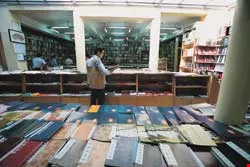
Booklovers will go a long way for a good book. Knowledge knows no borders, and flourishing commercial interactions may also build bridges of reading between different places.
The problem of simplified character books is also cropping up in Taiwan.
Over the last two years, Taiwan, with its internal market of 23 million people, has produced more than 40,000 titles per year. New titles get only short shelf lives, and unsold books have been putting more and more pressure on both warehouse floors and marketing departments. Given that mainland books cost only half of what Taiwan books do, publishers are even more jumpy. Books like Harry Potter have given rise to discussions of whether to draw a clear line between the traditional-character and simplified-character markets, and publishers are demanding that the Government Information Office come up with new regulations governing imports of books from the PRC, enforce them rigorously, and block dumping of these books in Taiwan.
"In fact, Taiwan's publishers should see this as a good opportunity to reassess, says Wu Tsung-sheng, editor-in-chief of academic texts at Laureate Book Company. "If readers are abandoning traditional characters for simplified ones, does it mean that prices of Taiwan-published books are set too high? If readers prefer mainland translations, does it imply that Taiwan has no clear-cut advantage in terms of the speed and quality of translators? Or does it suggest that Taiwan publishers are taking the cheap way out, simply accepting the mainland's simplified character files-already edited and proofed-and running them through a computer program to change all the characters into traditional format, then publishing the books in Taiwan as is?"
Wu remarks that the publishing industry is not like other industries-publishers cannot simply move to another country to find cheaper labor when local costs get too high. While other industries flock to the PRC, more thought should be given to resolving the problems of the local publishing industry here and creating a nourishing cultural atmosphere for writers and publishers.
Taiwan's publishing industry has relied on its years of experience to penetrate the Chinese-language market, and its high standards of creativity, diversity, and open-mindedness to bring greater life into the newborn Chinese-language publishing world. But even as light literature from Taiwan sweeps the PRC, editions of the Encyclopedia Britannica translated in the PRC are being printed here. The two sides are criss-crossing in terms of "popular culture" and "knowledge discourses."
The PRC maintains strict political controls over culture, using the profits from light literature to produce "serious" works (like encyclopedias and textbooks), thereby using the power of the state to prop up the publishing of works at a deep cultural level. Publishers in Taiwan and Hong Kong, on the other hand, with their faith in the open economy, only complain that the mainland market is being opened too slowly, but in cultural terms they should do more to take into account the publishing industry's cultural mission. After all, when readers browse through the shelves of books in their local bookstores, their eyes are searching for much more than just the lowest price.
The market is still in its embryonic stage. We anticipate more waves of realignment in Chinese-language publishing, but let us hope that amidst all the calculations we do not lose sight of the human value of the written word.

Hong Kong's publishing industry once played an important intermediary role between Taiwan and the PRC. Today, caught between the powerful currents running in both directions, it is seeking to find a unique niche for itself. Ngan Shun Kau, the deputy chief editor at Hong Kong's Cosmos Books, says that the strength to move forward derives from the ideals of the publisher.
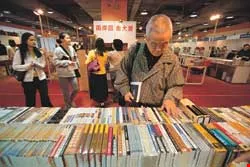
In recent years, cross-strait books have gradually transcended political barriers, and publishers from mainland China, Hong Kong, and Taiwan now regularly gather at book fairs and exhibitions, paving the way for further steps in cooperation and exchange.
@List.jpg?w=522&h=410&mode=crop&format=webp&quality=80)


