Helping Green Farming Churn out Greenbacks--Taiwan's Barefoot Plant Doctor Tsay Tung-tsuan
Kuo Li-chuan / photos Jimmy Lin / tr. by Josh Aguiar
March 2010


To farmers, he's a patron saint. To pesticide dealers, he's an arch-fiend. What kind of man is this professor who travels around the island all year long selling his miraculous bacterial elixir to farmers for cheap, and who maintains an emergency plant clinic in his office even during the Chinese New Year holiday?
No stranger himself to the farmer's toil, Tsay Tung-tsuan, director of the Department of Plant Pathology at National Chung Hsing University, has dedicated his life to transforming Taiwan's agriculture into a cash cow. His efforts as a goodly plant doctor help protect the welfare of Taiwan's farmers, ecosystem, and consumers.
As last year drew to a close, a cold front descended on Taiwan, bringing temperatures to below 10°C. On the campus of National Chung Hsing University, a group of farmers undeterred by the cold pitched a tent from which they began to sell farm products. All the items sold that day had been developed by Dr. Tsay by using biological control methods, and all had passed inspection for pesticide residue. With this kind of scientific muscle in their corner, the farmers easily won the confidence of consumers, with many of the concession stands happily sold out after just two hours.
On a corner of the campus is the Plant Pathology Department, where today a special monthly class is being held for farmers in the International Conference Center located on the 10th floor. It's a popular event that attracts farmers from around the country, bringing sick crops for the experts to examine in the hopes of obtaining a cure.
The long table in front of the lectern is covered with ill plants. Tsay diagnoses the problems of each one in turn and offers a prescription for their recovery. To protect tomatoes from bacterial blight, for instance, he recommends thoroughly sanitizing the seeds by soaking them for 15 minutes in a diluted solution of household disinfectant, then rinsing them until the sanitizer scent disappears, and finally drying them in the shade before planting. Not only is this method effective, it is cost efficient, as well. For problems relating to pests, Department of Entomology associate professor Tang Li-cheng takes over.
The farmers throw out volley after volley of questions, scribbling furiously in their notebooks when the answers come back. Tsay's knowledge seems to have no limits. He peppers his comments with good-natured humor and when on occasion he locks horns with one of the more intransigent farmers, he is quick to point out to them the disastrous consequences incurred by not following his instructions in the past, causing the hall to erupt with laughter at their embarrassment.
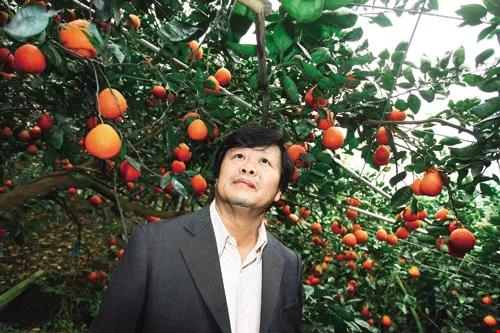
Revered by farmers as a patron saint, Tsay Tung-tsuan travels Taiwan's length and breadth all year round sharing his knowledge and expertise in his mission to galvanize agricultural production.
For many years, Tsay and a group of colleagues have made good on the College of Agriculture's avowed commitment to those who make their living tilling the land. Rolling up their sleeves and pant legs, they forsake the shimmering ivory tower for the fields. They give farmers comprehensive, easy-to-implement strategies for dealing with pests and diseases, knowing when to fertilize and how to optimize crop production. They also instruct them in how to apply Tsay's patented 18-bacteria formula instead of traditional pesticides and fertilizer.
In reality, the "18-bacteria" formula is made from only one strain of bacteria, Streptomyces saraceticus, to which water, soybeans, and granulated sugar are added. After fermenting for 10 days, it breaks down into a number of different amino acids, three kinds of chitinolytic enzyme, and a few types of protease and lipase. The formula shores up the development of a plant's root system, and has been shown to be up to six times more effective in this capacity than products available on the market. It helps keep pests like spider mites and whitefly at bay and hold the nematode population in check. It can enhance flavor and cause fruits to ripen faster, allowing them to be harvested (and therefore sold) sooner. To top it all off, it is priced more economically than similar products on the market.
Tsay explains that, using traditional farm methods, it costs at least NT$4000 to fertilize 1000 square meters of land. However, Tsay's elixir after fermentation can be diluted anywhere between 50 to 100 times, reducing the cost per liter to under NT$10. If you use six liters per 1000 m2, the cost tops out at NT$60; even after adding some base fertilizer for NT$100-120 on top of that, you've still spent only NT$200.
Biological calcium fertilizer fortifies the exterior of the plant, increases the sugar concentration, improves texture, and makes the stem hardier and therefore easier to store. Calcium powder typically runs for NT$1200-1400 per liter in the marketplace, but Tsay teaches farmers to manufacture their own by mixing vinegar and lime to the tune of NT$5 per liter!
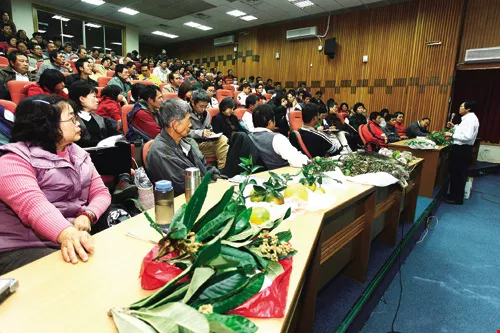
NCHU's monthly seminars for farmers always attract a full house, a testament to their willingness to learn. One of the features of the seminars is an on-site plant clinic where farmers can obtain a diagnosis for sick crops.
Reducing the amount of pesticides and fertilizer dramatically lowers overhead. At the same time, farmers are less susceptible to the health risks associated with applying pesticides, and the farms themselves trend progressively towards being completely organic. In fact, organic status-the best hope for a sustainable ecosystem-is usually attainable after about five years.
According to statistics, over 70% of farmers believe that crop diseases and pests are the biggest obstacles to the organic farming movement.
Countries in temperate zones have chilly winters that kill off a fraction of the farm pests annually, but things are different in warm, rainy Taiwan. Even should a farmer desire to go organic, he must first contend with pests and then with particles of pesticides and chemical fertilizers being blown over from nearby fields. Unless there is a sufficient buffer between farms, it's pointless to even think of organic farming. Space is, of course, hard to come by in a country as small and as dense as Taiwan, so Tsay is of the opinion that farmers should decrease the use of pesticides and chemical fertilizers incrementally, one year at a time, to create a model of safe farming that protects both the environment and farmers' livelihoods.
Xu Junming has been planting grapes and loquats in Taichung's Xinshe Township for more than 40 years. In years past he sprayed his crops with pesticides annually anywhere from 15 times at the low end to more than 20 times, and long-term exposure has had negative consequences for his health. Six years ago he was diagnosed with liver cancer. After undergoing successful surgery he vowed never again to use pesticides. The local farmers' association gave him assistance in organic farming techniques, but he soon found himself at the mercy of crop disease and pests. 0.8 hectares of his loquat crop was afflicted with root rot, and their leaves were sickly and bent over themselves, leaving him with a scant 30% harvest rate. In despair, he turned again to the farmers' association, but they had no remedy for his plight.
It wasn't until 2007, when he came across a newspaper article about Tsay's formula 18 delivering orange orchards in Dongshi Township from ruin, that he felt his hope renewed. He went straightaway to seek Tsay's assistance.
"Loquats are shallow-rooting shrubs that are easier to cultivate than apples even," says Tsay. "But the downside is that, once they get sick, the root system goes under really fast." When Xu gave up using pesticides, nematodes and root rot disease began an inexorable assault that drastically reduced crop output. A few months after he began applying Tsay's elixir and bio-calcium fertilizer along with liquid fertilizers, however, tender leaves began to sprout from his trees, a sure sign that they were on the path to recovery.
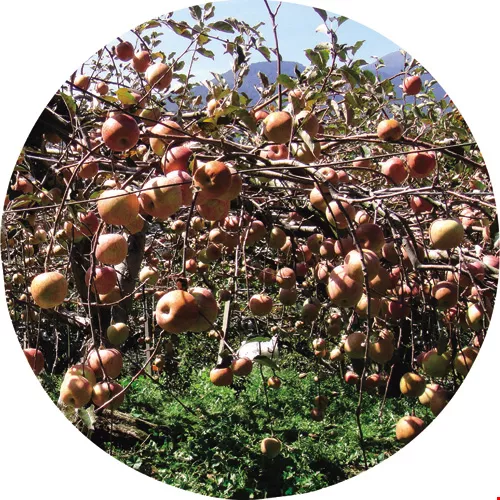
NCHU's agriculture team travels around the island devising farming strategies specific to the geography and produce of each region they visit. Fruits like Motianling persimmons (right) and Lishan honey apples (left) have delighted the Taiwanese palate in recent years and have posted impressive sales.
In 2006, the farmers of the Gonglaoping area in Fengyuan made an emergency call to Tsay. His investigation of the citrus orchards revealed a progressive worsening of root rot over the past few years. The source of the problem was toxic alkaloids that plants secrete as they engage in territorial struggles with one another, which contributes to an increase in fungi, bacteria, and nematodes. If left alone, Tsay reckoned crop quality would diminish by 90% over the next few years.
"When fruit trees are hit by disease and pests, it causes deficiencies in trace elements, which inhibits their growth and causes root rot or otherwise just poor root growth. Farmers turn to desperate measures like excessive pesticide or fertilizer use, which is not only a waste of money at that point, but could even make them miss the critical juncture for applying a permanent solution."
Tsay recalls that the blooming period for fruit trees had already passed when he picked up the SOS. He instructed the farmers of Gonglaoping to scrape off the bark and apply medicine in the afflicted areas, and also gave them complimentary doses of his elixir. Within four months, the situation there stabilized. One Mr. Tu of the local Agricultural Production and Marketing Group experienced great triumphs after using Tsay's tonic. One of his trees yielded 600 kilograms of fruit that year, and with each catty (600 grams) selling lucratively at NT$30, Tsay's reputation as a miracle worker exploded; so did the number of entreaties he receives.
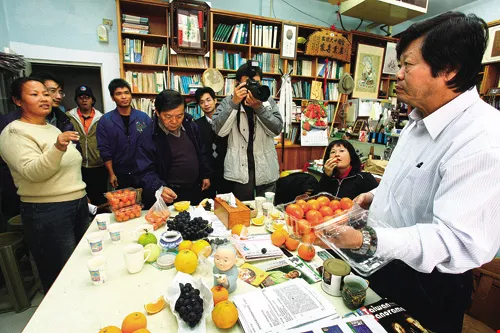
Farmers from around Taiwan routinely visit Tsay at his office, often bearing fruits and vegetables from their farms as presents.
The origins of Tsay's miracle in a bottle have become the stuff of legend.
Tsay was born in 1952 in Baihe Township in Tainan County. His father was a middle school teacher, but the family grew sesame and lotus on the side. Cultivation was taxing work, but not profitable for the Tsay family, and from an early age Tsay identified with the farmer's toil. He originally intended to pursue a career in medicine, but after seeing what kind of financial strain his older brother's attendance at Kaohsiung Medical University, a private institution, placed on his family, he changed his plans. A year later, he tested into the Department of Plant Pathology at National Chung Hsing University, where he majored in microbiology. Before he took his graduate school exams, he and two of his friends made a pilgrimage to Taichung's Xingxiu Temple where they swore to the Saintly Emperor Guan to put the welfare of the people ahead of their own wealth and fame.
Many are no doubt curious to know what prompted him make such an oath.
Tsay vividly recalls witnessing common people suffer abuses at the hands of local gentry. Once as a nine-year-old boy he saw his friend bullied for no apparent reason until some gangsters intervened. Tsay was so taken by the unlikely rescue that, on a school paper shortly thereafter, he wrote that his aspiration was to be a gangster!
"My dad was alarmed when he saw the paper, but my grandfather just said, 'If you're going to be a gangster, be the kingpin, not just a punk.'" His grandfather hired a martial arts tutor for him, and later in college his tai-chi teacher advised him to take up a form of Kunlun Qigong and Guanyin Meditation.
His spiritual training nurtured a compassionate heart. He longed to use his knowledge to benefit his fellow man. After obtaining his PhD in plant pathology at National Taiwan University, he returned to his alma mater to teach. Practicing martial arts from an early age made him sturdy in frame and constitution, but doing field experiments with pesticides over the years nevertheless landed him in the hospital on four occasions.
While recuperating in the hospital, he would often reflect, "If a stout fellow like me is no match for these chemicals, what does that mean for the average farmer?" In 1981 he made up his mind to study biological control methods, a decision that resonated with his mentor, Dr. Ko Wen-hsiung.
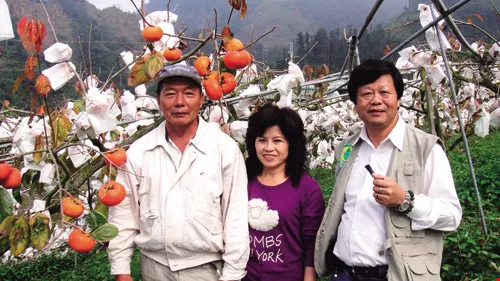
NCHU's agriculture team travels around the island devising farming strategies specific to the geography and produce of each region they visit. Fruits like Motianling persimmons (right) and Lishan honey apples (left) have delighted the Taiwanese palate in recent years and have posted impressive sales.
In his research, Tsay discovered the importance of using "friendly" bacteria to bolster a plant's immune system. In 1983 he repeatedly beseeched Emperor Guan to help his research. "One time the divination slip told me that Lord Guan would instruct me later that night!" That night as he was deep in meditation, Lord Guan did in fact appear to him, telling him to travel to the east the next morning. Tsay complied, setting out early the next morning on his motorcycle. He stopped for lunch in Zhudong at the orchard of a farmer named Fan, and while he was eating, his eye chanced upon a tree leaf that was covered in a whitish powder of bacteria and spores. His heart racing, he exclaimed, "Eureka! Those are the bacteria I need!"
Tsay's missing link was a kind of filamentous bacteria of the order Actinomycetales that resembles mold. Although there are approximately 9000 different actinomycetes on the planet, due to insufficient research, agricultural applications have only been found for three or four of them, Tsay's formula naturally being one of them.
The journey from discovery through development and finally to successful application and promotion lasted 18 years. But the reason for the 18 in the name comes from the observation early on in the research and development process that it produced watermelons and citrus fruits as vigorous as an 18-year-old youth.
Amazingly enough, although saddled with home and car loans at the time, never once did he think to go commercial with his formula, preferring to pay out of his pocket. For more than 10 years, he has crisscrossed the island with his precious bacteria housed in a PET bottle. For the farmers of the more than 1000 agricultural production and marketing groups that he has visited, Tsay has become something of a mythic figure, a veritable living Buddha.
For many years now he has gone to school at 5:30 a.m. and returned after midnight. He works seven days a week so as to make himself available to farmers for consultation. If he receives a distress call, he'll make the trip to investigate in person no matter how far it is. Sometimes in a single day he'll head to Southern Taiwan to check out some orchards and be back at school to teach classes by midday. Tsay never complains about the amount of work, because he knows all too well from experience that a failed crop doesn't just affect one person's livelihood, but that person's children. In fact, he's seen farmers tell their children: "The reason you kids are able to go to school is because of Professor Tsay."
Since Tsay's efforts directly interfere with pesticide merchants' profits, he has received numerous threats over the years. Tsay's certainly no man to be trifled with-he runs two martial arts schools and is himself a master-but, as one saying goes, "an arrow in the dark is hard to avoid." Though he does feel guilty for making his family worry, and even though he's received offers of up to NT$60 million for the patent of his formula, his will remains as immovable as a mountain.
Faced with these threats, Tsay recalls his oath years ago to put the welfare of the people ahead of his own fortunes. Sometimes the farmers he helps are able to earn in one year what Tsay makes in 10! When asked what his compensation is, he replies succinctly, "Satisfaction."
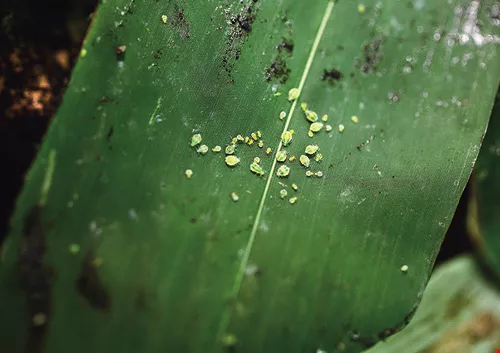
NCHU's monthly seminars for farmers always attract a full house, a testament to their willingness to learn. One of the features of the seminars is an on-site plant clinic where farmers can obtain a diagnosis for sick crops.
In his travels to and from farming villages throughout Taiwan, Tsay has become aware of the lack of information available to farmers. Nowhere is this more acute than in Aboriginal areas.
"Poor access to good information is what makes farmers overly reliant on fertilizer and pesticides," says Tsay. One Aboriginal vegetable farmer once told him that he spent NT$7000 in five days to fertilize an area of only half a hectare. Tsay was aghast, and he wondered how anyone could expect to break even that way.
"We farmers can't earn a cent, we're all in debt!" Hearing the tone of despair in the Aboriginal farmer's voice moved Tsay to action. His proposal of assembling a team of experts to educate farmers met with resounding approval from National Chung Hsing University's College of Agriculture and Natural Resources.
Since its inception in 2005, the NCHU agriculture team has promoted environmentally safe farming around the island at the lectures they put on every month. Each lecture features experts on specific fruit or vegetable crops, and also doubles as a clinic where farmers can obtain a diagnosis for their sick crops.
"A farmer's lot really is a difficult one. They have to invest so much capital and labor, but even then their success is largely dependent on the whims of nature. If they're lucky enough to get a decent harvest, their earnings aren't guaranteed, because the prices are determined by the market," says Tsay.
The team generously sacrifices its time as it travels the length and breadth of the nation, devising farm solutions tailored to the geography of each region. For instance, the salty soil of Yunlin County's Kouhu Township is ideal for producing rose tomatoes so sweet and succulent that they sell out just as soon as they come into season.
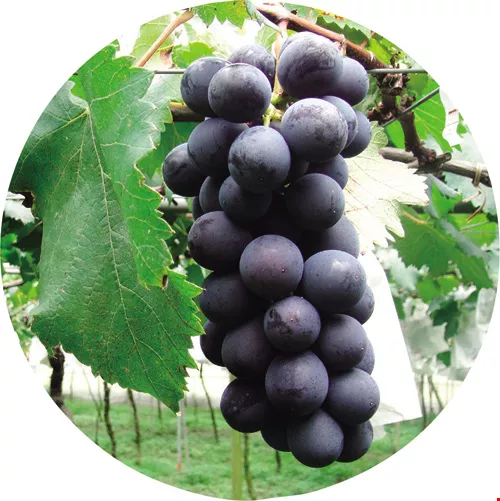
Grapes that are fortified with bio-calcium produce more natural sugars and possess a crisper texture. In addition, their stems are hardier, making them easier to store after the harvest.
The NCHU agriculture team has strongly advocated postharvest management techniques.
Postharvest management refers to procedures taken to prep the fields for the following year, including training, pruning, and using appropriate amounts of fertilizer and pesticides. The principal aims of the practice are to prevent pests from surviving the winter and to reduce infestation density at its source, so as to prevent its spread, allowing for healthier trees when spring arrives. According to Tsay, when properly implemented, this strategy can help reduce fertilizer use by 50% and pesticide use by as much as 70%. Farmers save a bundle this way, of course, and it also benefits the environment by preventing acidification of the soil.
A Dongshi Township citrus farmer named Zhang Zhaohuo was one of the first to receive consultation from the NCHU squad. "In the past, I would spray my crops with pesticides about once a month. If I didn't, I'd worry nonstop!" In the first month after his harvest in 2007, he conducted two comprehensive postharvest cleanings. On Tsay's recommendation, he used an instant soluble fertilizer-which cost him about NT$100 per 1000 m2-along with Tsay's redoubtable formula. In total he spent NT$120,000 to fertilize his two hectares of orchards, a significant improvement compared to the NT$230,000 he had to spend on base and chemical fertilizers in seasons past. Moreover, his annual output began to trend upwards.
After word had gotten around a bit, farmers from all over the country swarmed the NCHU campus-one fellow even set off from far-off Hualien in the middle of the night to attend the seminar-to learn the secrets of postharvest management. On one day alone, Tsay's office received more than 400 consultation calls.
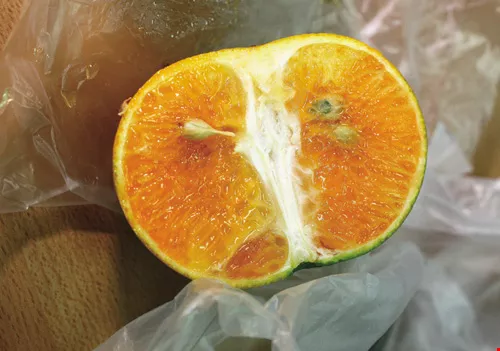
NCHU's monthly seminars for farmers always attract a full house, a testament to their willingness to learn. One of the features of the seminars is an on-site plant clinic where farmers can obtain a diagnosis for sick crops.
"Pesticide abuse has long been rampant amongst Taiwan's tea farmers. Tea trees are especially vulnerable to mites, so farmer's have come to rely excessively on bug sprays," says Tsay. For example, in Ren'ai Township in Nantou County, a big producer of high altitude oolong tea, there are 25 pesticide stores. Tsay has advised the farmers there that they can achieve good results with some tidying up after the winter harvest by using pesticides with low levels of toxicity that break down easily, and following up with his tonic instead of the usual mite spray.
Tea planted at high elevations in low latitudes can be harvested five to six times a year on average, but Yu Jinxin, a tea farmer in Minjian Township in Nantou County, has been able to harvest 11 times annually since he adopted NCHU's methodology. As if that weren't enough, the quality of the tea is superb, the output is stable, and it passes all of the tests for pesticide residue. He's been exporting to Japan, Germany, and Britain, and even the Czech Republic and Russia have been clamoring to send in orders. In Ren'ai Township, Aboriginal farmer Gao Junde took over his father's tea farm some years ago, and implemented the same measures in 2008. Last year his tea won first prize at a spring tea competition. "Six years of posting losses, and I earn it all back in an instant!" he exclaimed.
His voice bursting with pride, Tsay says, "Of the 70,000 farmers in Taiwan, over 40,000 have received help from our team!" This remarkable statistic bears out Taiwan's farmers' desire to learn and improve.
NCHU entomology professor Tang Li-cheng, formally recognized last year as one of the country's top 10 distinguished agricultural experts, laments that although Taiwan's agricultural technology is sophisticated, there is a paucity of qualified plant pathologists, which means that diagnosis and prescriptions are undertaken by those significantly less qualified, namely pesticide merchants. This blatant conflict of interest harms farmers by raising their overhead and damaging their health. Excessive pesticide use also poisons the environment and can make consumers ill. His advice to the government is to reduce the number of permits issued to pesticide dealers year by year, as well as to establish a comprehensive certification system for plant pathologists.
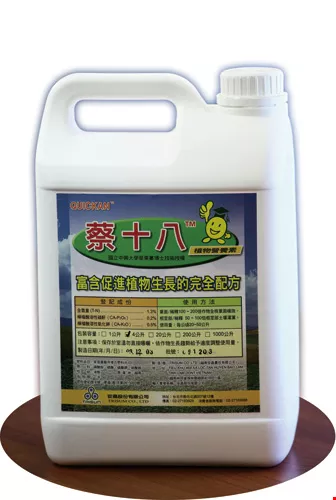
To make his "18" bacterial formula readily available for farmers to purchase, Tsay turned over fermentation and production to the Trisum Corporation. The formula comes in four- or 20-liter sizes. The 20-liter size sells for NT$2000, and when diluted with water, can be applied to a hectare worth of crops-an amazing cost of only NT$200 per 1000 square meters.
In order to encourage farmers to produce quality fruits and vegetables in an environmentally safe way, NCHU has been issuing certified seals of approval for products that test clean for pesticide residue. Consumers can now purchase these products with confidence at three different freeway rest stops across the island, in Tai'an Township in Miaoli, Qingshui Township in Taichung, and Gukeng Township in Yunlin.
During our interview with Professor Tsay, there was a constant flow of visiting farmers, many of whom brought fruits and vegetables that they had raised themselves. Tsay's expert eye can see immediately from appearance alone which items are healthy or ill, and which items will have the best flavor. When he eats a particularly tasty fruit, he gives unstinting praise. The farmer then blushes and smiles a diffident smile, like an elementary student being singled out for praise amongst his peers. At that moment, one cannot help but feel love and respect for Taiwan's farmers and their earnest souls.
With his ever-present pipe in his mouth and a smile on his face, Tsay Tung-tsuan is always ready to roll up his pants and head barefoot into the fields to talk with farmers. Today as always, he is ready to walk to the ends of the island to expedite the transformation of Taiwan's struggling agriculture into an economic juggernaut.


@List.jpg?w=522&h=410&mode=crop&format=webp&quality=80)


