Drawing on Foreign Know-How To Make Taiwan Into an "Innovation Island"
Laura Li / photos Jimmy Lin / tr. by Phil Newell
April 2003


The 21st century is the age of the knowledge-based economy. Innovation and R&D have replaced labor, capital, and physical plant as the driving forces of economic development. During this transitional period, Taiwan can definitely use help from major multinational corporations. So what is happening at the "R&D innovation centers" set up in Taiwan by major international firms over the past couple of years? What substantive assistance do they provide to domestic industry? Now that "friends have arrived from far away," how can we create a win-win situation for both guests and host?
Numbers released by the Directorate-General of Budget, Accounting, and Statistics show that last year Taiwan's investment as a percentage of GNP fell to 16.77%, the lowest in 40 years and far below the 24% or above in Japan, Korea, and Singapore. Overseas Chinese and foreign investment flowing into Taiwan fell by 35% (as of the end of November, 2002), suggesting that in foreign eyes Taiwan is no longer one of the top choices of places to put their money.
Can it be that Taiwan's investment climate is really deteriorating and that foreign and local firms are all scaling down and moving to mainland China? In an atmosphere of fear and doubt, there is good news: The Ministry of Economic Affairs' (MOEA) recently initiated program to attract foreign conglomerates to set up "R&D innovation centers" in Taiwan has met with a resounding response. A number of transnational corporations (TNCs) have taken substantive action to show that they still feel positive about Taiwan, providing a soothing balm to local nerves.
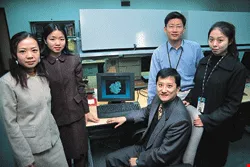
IBM's Life Sciences Center of Excellence, led by Spencer Wang (seated at center), though not boasting a very large staff, has great ambitions for the long run.
From the setting of regulations for attracting foreign firms at the beginning of last year through the end of March of this year, five R&D centers belonging to four different TNCs have already received approval and gone into operation (see table). Another four have been approved, and are only waiting for the final contracts between the founders and the government to be signed. And discussions have been opened with other TNCs, including Japan's Fujitsu and 3com of the US. At this rate, the policy should be able to achieve its declared target of 30 foreign-backed R&D centers within five years.
Why would a foreign firm that wants to set up an R&D center in Taiwan need a contract with the government? It's a result of the fact that competition for direct foreign investment is intense in the Asia-Pacific region, and governments are going all out to attract TNCs, so the MOEA is likewise offering a mind-boggling array of inducements, from tax incentives to manpower support to operational subsidies.
Current incentives allow companies whose projects are approved to take an investment write-off or tax exemption. In addition, Taiwan's government will subsidize rents, salaries for R&D personnel, and travel expenses for foreign experts to come to Taiwan. Each center can also receive from the Ministry of Defense an allocation of up to 20 persons who can take R&D employment as an alternative to compulsory military service, while the government will also help companies recruit technical personnel from abroad or from mainland China to come work in Taiwan. And if foreign R&D centers are willing to undertake cooperative development projects with Taiwanese companies, the government will subsidize these as well. And the fact that the MOEA's Department of Industrial Technology serves as a "one-stop services window," handling all negotiations and problems, guarantees that foreign firms can take care of business in the shortest possible time.
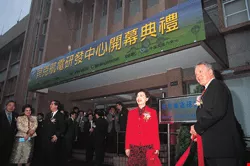
The recently opened R&D center of Becker Avionics (right and below) can be expected to create a product testing and certification system for Taiwan's nascent avionics industry, helping to fill a gap in the domestic industrial structure. (photo by Hsueh Chi-kuang)
Given that the government is in financial dire straits at the moment, why is it willing to spend so freely to help TNCs will set up R&D centers in Taiwan?
MOEA Vice Minister Shih Yen-shiang, the man in charge of attracting foreign firms to Taiwan, says that from "made in Taiwan" to "made by Taiwan," Taiwan has always made its mark by manufacturing. But, based on Acer Corporation chairman Stan Shih's "smile curve" theory, manufacturing is at the lowest part of the curve, which is to say it has the lowest value added. It has been especially difficult to avoid the fate of "micro-profits" in the last few years given the cutthroat competition between Taiwan's manufacturers.
"To upgrade, manufacturers must extend themselves toward the two ends of the smile curve-upstream R&D and downstream marketing," points out the MOEA's Shih. Domestic firms are generally in agreement on the need for this ongoing structural transformation, which has been called the most important in Taiwan in the last 50 years. (See the interview accompanying this article.)
In fact, even though most people in the world still think of Taiwan as "the OEM kingdom," a place where local factories simply assemble things for foreign manufacturers, Taiwan has long been at the cutting edge of innovation in terms of creating new commercially viable products. You can see the creativity of Taiwanese in many places, from low-volume but high-quality carbon-fiber products, to the "air cushion" idea that revolutionized athletic shoes, to the latest ideas in tablet PCs.
One indicator is patents registered in the US over the past ten years. In terms of total number, Taiwan ranks fourth in the world, behind only the US, Japan, and Germany. In terms of number per capita, Taiwan surpasses Germany and is tied with Japan for second place. If you consider that R&D spending in Taiwan is less than NT$10 billion annually-not even near to one-tenth the figure in Japan (whose population is only about five times bigger)-then you will realize just what an amazing accomplishment this is.
But while Taiwan's industries are creative, few local firms have their own name brands, so the fruits of innovation are bought up by large international procurement agents. The reason that the government wants to attract TNCs to set up R&D centers here is that it hopes that Taiwan's R&D capabilities can be systematized, so that in future people will see the real source of the innovation that lies behind big-name reputations. As Hwang Jung-chiou, the director-general of the Department of Industrial Technology at the MOEA, expresses his wish for five years from now: "When companies around the globe think of Taiwan, they will think of a stronghold of product design and development."
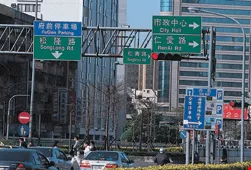
The key factor in innovation is people. Taiwan needs an environment that is more internationalized to attract top people from around the globe.
That's a nice image, but its realization will require some practical work. It is expected that foreign-invested innovation centers in Taiwan will, as a first step, stimulate the growth of related peripheral supply chains and increase the competitiveness of Taiwanese firms.
The US firm Hewlett-Packard (HP), which set the pace among TNCs by setting up a product development center in Taiwan, provides a case in point. Kai Hsiao, director of HP's Asia International Procurement Operations and the key promoter of the project, relates that the formal announcement of the founding of the center was made last September, and by December HP and its Taiwan supplier Inventec had already jointly produced a new type of notebook computer.
Hsiao declares with a smile: "Under normal conditions, a new product like this would need at least five or six months, but we cut that down to only 84 days." Cooperation between the two companies has been so smooth, in fact, that besides the current lines of notebook computers, servers, PDAs, and the like, HP headquarters is considering bringing other operating groups to Taiwan.
"We are like the rock being cast into the darkness to check if there is open road ahead," waxes Hsiao, adding, with a shift in metaphors, "fortunately, the shot has hit the mark." HP's R&D center, located in a bustling neighborhood in Taipei, with twice the staff and departments that Hsiao originally suggested to his boss, boasts a genuinely international team of researchers from the US, France, Singapore, Mexico, Sri Lanka, and Taiwan.
If you want to talk about reach, before their merger last year the two giants HP and Compaq bought NT$14.5 billion worth of exports from Taiwan, and HP maintains close ties to Taiwanese firms. These factors were central in the decision to establish the R&D center in Taiwan.
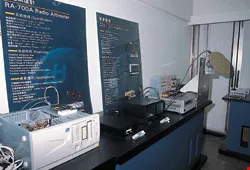
The recently opened R&D center of Becker Avionics (right and below) can be expected to create a product testing and certification system for Taiwan's nascent avionics industry, helping to fill a gap in the domestic industrial structure. (photo by Hsueh Chi-kuang)
Kai Hsiao says that they originally had the R&D center in Singapore. In terms of incentives, degree of concentration of talented people from around the world, internationalization, liberalization, policy stability, transparency, and so on, nobody can beat Singapore. The only problem is that the R&D center was too far from HP's suppliers, who are mainly Taiwanese firms.
"Every time we developed a new product, we would make 20 samples. Ten would go to headquarters in the US, and ten would be sent to Taiwan for trial production. If there were differences of opinion, people from all three locations, that is, including Singapore, would have to come to the production venue in Taiwan to do tests to resolve the problems," says Hsiao. The result of all the coming and going was higher production costs and a drawn-out product development timetable, so that it became difficult to keep up with the competition.
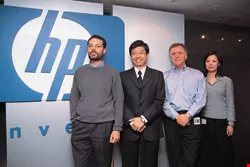
Hewlett-Packard has gone all out to make its R&D center in Taiwan a success. Besides project leader Kai Hsiao (second from left), the others in the picture reflect the center's multinational nature: (left to right) Julien Massol, Taiwan Server PDC manager, from France; Tom Mitchell, vice president of the Personal Systems Group in the Notebook Global Business Unit, from the US; and Josephine Tan, director of the Personal Systems Group in Mobile Computing and Business, from Singapore.
After the HP Product Development Center came to Taiwan, HP found, says Hsiao with a smile, that "Taiwanese firms are quick to learn, react flexibly and dexterously, make a full commitment, and are very accommodating." During the day, HP's Taiwan corporate partners talk things over with the R&D teams, and then at night bury themselves in their own work, running virtually 24 hours a day. This ability and ambition to take on responsibility is deeply impressive to foreign firms.
HP has a clear global division of labor. The US headquarters is responsible for operations planning and global strategy, critical parts are made in Japan and Korea, Taiwan is making the upgrade from OEM and ODM to product development and design, and manufacturing is based in mainland China with its comparative advantage in cheap labor. Together these create an "iron quadrangle" for the Asia-Pacific region.
Under this structure, HP sees the growth of Taiwanese firms as being in its own interests. As Kai Hsiao puts it, "The more capable Taiwanese firms are, the faster HP can pass the baton, and focus their own energies on even more advanced research." Hsiao says that Taiwanese companies, after many years of experience and training, now have mature technology and vision. They should no longer restrict themselves to the design and production of a single product, but should develop "the ability to control the entire product development process." The newly established R&D center can have the function of a mother hen guiding its chicks.

After work, foreigners working in Taiwan can find some solace for homesickness by letting off steam at a Western-style bar.
HP aims to bring together R&D with production to achieve maximum efficiency. The R&D center set up by Sony, on the other hand, reflects different decision principles.
Sony has received approval to set up two R&D centers in Taiwan. One, the System in Module Center, will focus on development of image modules for mobile communications and on "system on a chip" products (SOCs), with applications ranging from mobile phones to notebook computers to PDAs. The other, called the Design and Engineering Center, is dedicated to R&D in information technology and consumer electronics.
One might wonder, since Sony already has extremely strong product development and is continually coming out with new products that pique consumers' curiosity, why they would want to set up an R&D center in Taiwan.
"We are not doing this for show; we don't make meaningless investments," says Sophie Tsai, senior manager for corporate communications and external relations at Sony Taiwan. "We plan to undertake R&D that takes advantage of areas in which Taiwan is especially strong and of the human talent here." Taiwan excels at rapidly turning modules into products, and this is what Sony is looking for.
Unlike Hewlett-Packard, where R&D and procurement are closely linked, all products developed at Sony's Taiwan R&D centers will be turned over to the global operations department at headquarters in Japan to farm out the production work, so that product manufacturing orders will not necessarily end up in Taiwanese hands.
"It is not Taiwan's OEM ability that we are looking to, but Taiwan's design ability," emphasizes Sophie Tsai. Sony has always been reticent about discussing whom it is cooperating with to make what products. Of course, the R&D center can't become just an ivory tower. Once set up in Taiwan there will be many opportunities for cooperation with local R&D institutions and companies. And given that Taiwanese companies are close at hand, "the pavilion nearest the water gets the moonlight first," so the possibility that they will get orders will correspondingly increase.

Sony has decided to establish two R&D centers in Taiwan at the same time. Taiwanese firms will now have a chance for some up-close observation of the operating methods and R&D philosophy of this global home electronics giant.
Another major transnational corporation, IBM, plans to set up two R&D centers in Taiwan. Approval has already been received for the "Mobile e-Business R&D Center." Over three years, IBM headquarters will transfer technology to assist Taiwanese companies in employing IBM advanced technology to develop and find applications for various critical embedded software.
The Mobile e-Business Center, in line with the strategies adopted by other large transnational corporations, focuses on Taiwan's strengths in the information-technology and communications industries. But the other facility for which IBM has submitted a proposal, the Life Sciences Center of Excellence, has the ambition of making something out of nothing, of filling the vacuum that currently exists in this sector in Taiwan.
"Over the past decade, biotechnology has been the new pampered baby of global industry, but few people think of it in combination with information technology," says Life Sciences Center manager Spencer Wang. Nonetheless, with work on breaking the genetic code moving ahead rapidly, the amount of computer data accumulated about gene sequences worldwide is calculated in the trillions of bytes and is doubling every nine months. Unless there is proper backup in terms of computing, storage, and Internet links, it will be impossible to search, compare, and handle this enormous body of information. This is why "bioinformatics" has taken shape worldwide over the past few years as a glittering new field of knowledge.
"Taiwan still has only the vaguest notions about bioinformatics. But IBM decided to set up its first Asia-Pacific bioinformatics center here because Taiwan has plenty of highly talented people in both the infotech and biotech fields, and offers the possibility of bringing in the Chinese gene pool and traditional Chinese medicine," explains Wang.
Grid computingBreaking from the mold of other big information multinational, IBM has not opted to import its own supercomputers into Taiwan for the information system at its bioinformatics center. It has instead adopted the "grid computing" approach, aiming to build an information sharing "community" and create a firm foundation for the bioinformatics industry in Taiwan in the future.
Grid computing originated in America's NASA program. To search for signs of life in the limitless universe, NASA linked up 300,000 home computer users, who agreed to "contribute" their computer down time, so that NASA data could be processed and compared, thereby greatly accelerating research speed.
By the same logic, when a researcher discovers a gene fragment that might be implicated in causing disease, he or she can dump this sequence into the network structure and undertake searches and comparisons in a vast bubbling pool of data, to answer questions like: What is the difference from the normal sequence? Is there any connection to other sequences implicated in disease? This should save a great deal of time in the research process.
But many in academia or industry might wonder: Won't throwing private discoveries onto other people's computers expose the secrets you have researched? Might it not expose your data to alteration by malicious hackers? Also, those who lack confidence in their own work may fear that others will find it ridiculous. Precisely for these reasons, Spenser Wang is visiting each researcher one by one to make his case. Fortunately, people are beginning to accept the idea, and it is likely that some research teams at places like the Academia Sinica, National Taiwan University, and Yangming University, as well as private firms such as Agnitio, will join the project.
Bringing together academics and research institutes and assisting in the construction and organization of databases is all well and good, but it doesn't appear that there will be much that is profitable in IBM's bioinformatics center. Not so, says Spencer Wang, declaring straight out that after all "business is business." The main reason IBM is investing so much effort to create a free information superhighway for Taiwan's biotechnology industry is to establish its long-term influence.
"According to the government's Challenge 2008 program, five years from now Taiwan will have 500 biotechnology companies," says Wang. "These biotech companies will all need enormous databases and systems. If IBM can take the lead in establishing a stable community upfront, we aren't afraid there will be no money to be made in the future." IBM's strategy of casting a long line to catch a big fish is attracting a great deal of attention in the marketplace.
Breaking into avionicsSimilar to IBM's Life Sciences Center in its ambition to create something from nothing and assist Taiwan in establishing a new industry is the "Avionics Certification Skill and Key Technology Development Center," backed by the German company Becker Avionics.
Established only in March of 2003, and located in the Chungshan Institute of Science and Technology (CIST), it has been called Taiwan's first avionics research center. As early as 1999, Becker began working with CIST to develop a variety of electronic products required for aircraft, such as radar altimeters, transponders, and software radios. Because cooperation between the two sides proved to be so smooth, and because Becker headquarters is currently endeavoring to expand their technology sources and product lines, the result is the establishment of this R&D center.
In terms of name recognition and size, there is a considerable gap between Becker and companies like Hewlett-Packard, IBM, or Sony. But in the field of avionics, Becker, which leads the industry in Europe, is a highly reputable company of genuine importance and capability.
Chou Kuang-chung, who moved to the Becker R&D unit after leaving CIST, says that the center will not only initiate mass production of the products jointly developed with CIST, but will also independently do research in advanced technology of Becker's own in the cutting-edge areas of aircraft displays and communications modules. Even more importantly, it is hoped that the R&D center will be able to draw on the resources and contacts of the German parent company to establish a set of certification standards and systems on behalf of Taiwan companies for manufacture of avionics products.
"Internationally," says Chou, "the avionics industry uses a membership system, and is an oligopolistic market." Given Taiwan's sound foundation in the electronics and information industries, the level of difficulty involved in producing such products is not out of reach. The problem is that Taiwan firms do not understand the rules of the international market, product specifications, or the verification procedures for inspection of the production environment and production process. This is particularly a problem given that Taiwan has no standing to participate as a member in international meetings, which means it naturally loses opportunities to compete. If, with the help provided by personnel sent from German headquarters, the R&D center can smoothly establish a verification system, this will be equivalent to opening up a new road for Taiwanese companies to get into the avionics industry.
Learning to flyThe electronic instruments used in flight are very differently designed from consumer electronics. "For ordinary products you can try to find ways to reduce labor and materials, but the level of precision and stability of avionics is a matter of life and death, so you absolutely cannot cut corners, and the design is extraordinarily important."
Moreover, even when aircraft can use "ordinary products," there are hard and fast differences in the way they are applied in the air from on the ground. Take for example displays. During the daytime the sunlight in a cockpit can be blinding, so it must be possible for the monitor to be adjusted to extreme brightness, otherwise the screen will just be a sheet of white. Indeed, whether it is the black of night or the middle of a lightning storm, all kinds of weather conditions and topography are variables in the use of instruments in flight, and must be carefully considered.
The avionics industry in Taiwan is still just cutting its teeth, and must be built up from scratch, so this is no cakewalk we are talking about here. However, Chou Kuang-chung points out that avionics products are sold at low volumes with high profit, and that they have long life expectancies: A company can earn money off of one model for ten years; they needn't continually rack their brains to come up with hip innovations and new looks, as do companies in the information or consumer appliance industries.
A new approach to R&DThe foreign R&D centers that have already taken shape are naturally a varied group. Not only are US, Japanese, and European firms represented, but they differ significantly in terms of scale, industry category, and operational model.
"An R&D center is not just about the development and dissemination of technology; there are many other benefits," says Hwang Jung-chiou of the Ministry of Economic Affairs. Taiwan can use this opportunity to observe up-close the global strategic thinking of large transnational corporations, and even their market instincts and cultural creativity. This can be very helpful to broadening perspective.
Lin Ferng-ching, president/CEO of the Institute for Information Industry (III), which maintains very close relations with the major enterprises in that field, opines that these TNCs have only become as big as they are by using many tricks of the trade that outsiders cannot fathom. Once the III sent a female engineer to Germany for training. In the course of her work she traveled throughout Europe and cooperated with a team composed of persons from 31 different countries. The degree of internationalization of both the management and the division of labor made an impression on her she has never forgotten.
As the director of an R&D institution, Lin Ferng-ching emphasizes that Taiwan has never devoted enough attention to investment in R&D, and the core of the problem is that people do not have a correct understanding of what R&D really means.
"Research and development is not like manufacturing, where you can sell something for a profit immediately after producing it. R&D is high-risk," says Lin earnestly. In R&D, there is a higher rate of money burned than money earned, and often projects come up against dead ends halfway through, in which case all you can do is start again. Therefore, you have to leave yourself some room for maneuver. The establishment of R&D centers by foreign enterprises perhaps will be helpful to changing the typical mindset in Taiwan of seeking rapid profits from R&D.
Coming up with innovationsLooking at the long-term picture, as a growing number of R&D centers from various industries gather in Taiwan, because Taiwan is small and transportation and communications are rapid, there is great potential here for the development of an Asia-Pacific technology exchange hub, because Taiwan is small and transportation and communications are rapid. Once this critical mass takes shape, even more R&D centers will de drawn in. Nothing could be more helpful to upgrading Taiwan's global status and industrial competitiveness than such a virtuous cycle.
In fact, technological stews and creative turbulence are key trends for the future.
"When you make a call you will want to see your counterpart, when you're on a plane you will want to use the Internet, at home you'll want to enjoy a selection of classic films from around the globe, and you'll even want to be able to carry your personal health history around wherever you go," says Hwang Jung-chiou. It can be predicted that in the future we will see confluences among a variety of industries-consumer electronics, mobile communications, information, optics, avionics, and even bioinformatics. Whoever can find the most appropriate technology in the shortest time to create a new product that meets market needs will be the winner. Given the diversification of industries and R&D fields here, there is a good chance Taiwan will come out ahead.
We'll figure it out laterDespite such promise, it is only natural that some grumbling has been heard in the Taiwanese business community over how the R&D center program has been going so far. Generally speaking, the parent companies of the centers are not small, but in virtually every case the amount of money invested has been, well, not large. Moreover, most of the centers are only doing R&D into product applications. Is this an expression of disdain for Taiwan?
"First we get them here, then we figure it out later." This is how Hwang Jung-chiou always responds to this kind of skepticism. After all, many nations are competing to attract foreign investment, while foreign companies don't have unlimited resources, and cannot disperse their R&D bases too widely. If they don't come to Taiwan, they will end up in Korea or mainland China. But if they just come, and can work well with local businesses and R&D institutions, it will be perfectly logical for them to expand and upgrade their future work here.
Barry Lin, chairman of Quanta Computer, the leader in notebook computers in Taiwan, has made a much celebrated remark: "It doesn't matter if it's high-tech or low-tech, if you can make money it's good tech." In contrast to cutting-edge technology, with high risk and enormous capital investment, mid-range technology fits right in with the practical reality of Taiwan's industrial environment, so that Taiwanese companies can absorb this technology in a very short time span. This also allows foreign firms to effectively utilize Taiwan's edge in manufacturing, so this is a win-win situation.
Another complaint being heard among domestic enterprises is that TNCs have a great deal money, but still the ROC government is subsidizing them. Yet it should already be in the interests of the TNCs, who treat Taiwan as their in-house low-cost factory and warehouse, to help Taiwanese businesses, so isn't it only right and fair that they do so without extra incentives?
In the face of such protests, III director Lin Ferng-ching says Taiwan companies should not necessarily assume that they will always be the preferred suppliers to TNCs; after all, rapid change is the norm in international industrial competition. In fact, the production partner is often decided early in the product development process. It is only with the establishment of R&D centers, allowing both sides to develop closer relations and communicate more rapidly, that Taiwanese firms can be guaranteed high status among TNCs.
The most important thing, emphasizes Lin, is: "You don't want to create an adversarial atmosphere between foreign and Taiwanese enterprises." In the era of globalization, TNCs and Taiwanese companies have long been making alliances, and their interests are intimately connected. It is necessary to cooperate for mutual benefit in order to keep such relations going for the long haul.
Off to a good startThe establishment of foreign R&D Innovation Centers one after another has set off a wave of follow-the-leader, both at home and abroad. Domestic companies are especially proactive. Major electronics firms such as Foxcomm, Asustek, and TSMC have all announced they will establish their own R&D academies. It's just that in comparison with the enormously powerful TNCs, domestic companies are still the runts of the litter, and only venture into relatively mature directions in their R&D. Because it is impossible to alter this "hand-me-down-ism" in the short run, it is in Taiwan's interest that foreign R&D pace-setters are here, because future international industrial trends will be clearer, and local R&D centers can avoid unnecessary detours.
Of course, in the end foreign companies are only guests who are just passing through. In the long run, if Taiwan wants to become a global leader in design and development, the critical factor will be that Taiwan companies have their own research and development capabilities.
"The fact that foreign companies are here is only the first step on the road to success," points out Lin Ferng-ching. Next comes figuring out how to keep the foreign R&D centers here for the long term while at the same time allowing domestic companies to take advantage of the opportunity to learn from them and grow as quickly as possible. That will be an even bigger challenge.
| Foreign R&D Centers in Taiwan Projects already being implemented Hewlett Packard (US): Product Development Center Becker Avionics (Germany): Avionics Certification Skill & Key Technology Development Center Aixtron (Germany): Manufacturing Oriented Research Lab SONY (Japan): Design & Engineering Center Taiwan SONY (Japan): System in Module Center Taiwan Projects which have been approved but not yet formalized IBM (US): Mobile e-Business R&D Center Dell (US): Dell Taiwan Design Center Pericom (US): Advanced Mixed-Mode Signal IC Development Center Microsoft (US): Microsoft Technical Center Projects currently in the review stage IBM (US): Excellence in Life Sciences Center Nokia (Finland): Applications and Services Development Center More than ten companies are in the stage of preliminary discussions. Source: Department of Industrial Technology, Ministry of Economic Affairs |


@List.jpg?w=522&h=410&mode=crop&format=webp&quality=80)


