

In the first half of 1994, the ROC's exports grew by only 3.5%. This figure pales in comparison to the double-digit growth experienced by other Asia-Pacific countries. Both domestic and overseas investment was stagnant, bringing up the rear among Asian countries, earning Taiwan the appellation "foreign investment orphan." How ever, just as the media was reporting all manner of pessimistic views, the domestic economy took a turn for the better, so that 1994 reaped an unexpectedly large harvest. Looking ahead to 1995, beyond the inevitable ups and downs, what will the final outcome be?
In early December, the Chung-Hua Institution for Economic Research held its traditional conference on the outlook for the economy for the coming year. Although outside were the first signs of the approach of winter, the atmosphere at the conference was warm and upbeat. "I came to the conference a lot more optimistic this year than I did last year," said Wei Duan, the deputy director-general of the Directorate-General of Budget, Accounting, and Statistics.
"Optimism" seems to be the recurrent theme in forecasts for 1995.
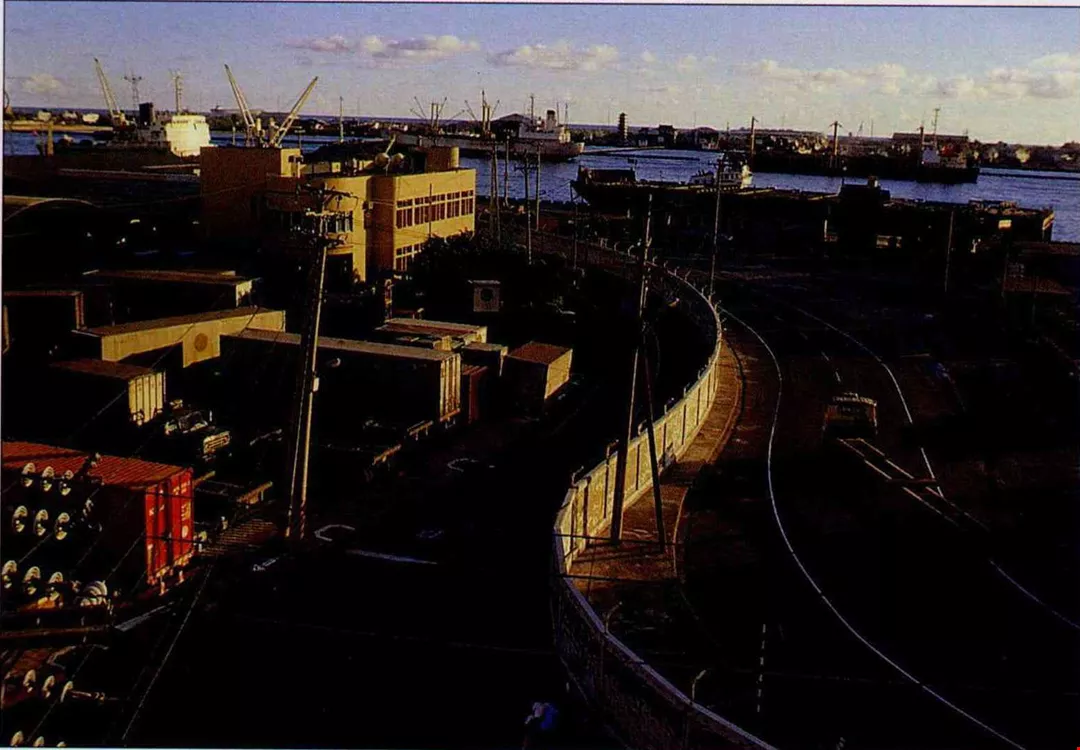
The success or failure of export industries can reflect Taiwan's relative competitiveness in the world economy. The photo is of the Kaohsiung Export Processing Zone. (photo by Wang Wei-chang)
A positive outlook
For Taiwan, optimism means a shift from the "quite good" of 1994 to "should be even better" in 1995, which does not amount to all that dramatic a psychological leap. But for many countries in the world, optimism for 1995 is as moving and exciting as looking at a rainstorm coming in after an extended drought.
From the international perspective, the global economy has been dragging along at a low ebb for some years now. There have been many reports of layoffs, salary cuts, and plant closings, even for established multinational giants. It was only in the middle of 1994 that light showed at the end of the tunnel, and the turnaround that is making everyone so pleased only really began then.
Yeh Wan-an, a consultant to the Council for Economic Planning and Development, points out that the economy of the United States--the biggest in the world--began to recover just over a year ago. The unemployment rate in the States fell to 6.2% in 1994. Also, according to a report released in September by Switzerland's IMD International, the United States finally won back the top spot for productivity from Japan.
Compared to the US, where the recovery has been under way for a year and where the economy is peaking out, it is still unclear whether Japan is emerging from the hard times which followed the bursting of its bubble economy. Fortunately the people of Japan don't give up easily. "There has been non-stop debate about whether Japan's economy will continue to deteriorate or will slightly improve. Regardless, there was steady improvement over the second half of 1994. Although the pace of improvement has been slow enough to inspire continued concern, at least no one can doubt that Japan has finally begun to climb up from the nadir," proclaims Okura Atsushi, the Taiwan representative of Nikko Securities, a Japanese firm.
And the good news doesn't stop there. According to estimates by the WEFA Group, a renowned international research institute, using 1990 as the base year, global economic growth, which was low at-0.4%, 0.2%, and 1.1%, for 1991 to 1993, rose to 2.1% in 1994, and it is estimated that it will jump to 3.4% in 1994.
"The global economy is clearly doing well, which is something that we haven't seen for many years now," says K.C. Lee, director of the Economic Research Department of the Council for Economic Planning and Development. Because economic activity was more vigorous at the beginning of 1994 than had been expected, many international economic institutions revised their mid-year estimates of total growth for 1994 upward, yet "actual growth was higher than even the revised estimates." Eastern Europe, an economic basket case, has hopes of leaving behind years of decline and seeing positive growth. Even Russia, whose transformation has not been smooth and which has experienced several years in a row of severe negative growth, can at least expect to end its "free fall" in 1995.
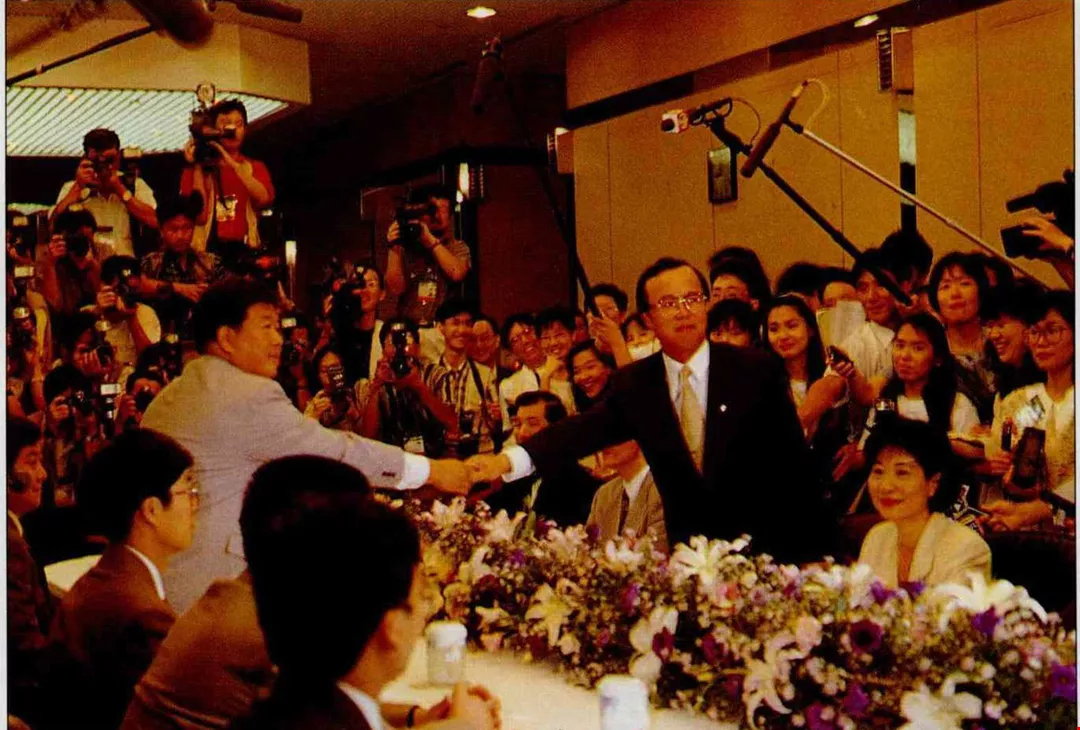
Peaceful relations across the Taiwan Strait are a major prerequisite to economic development in Taiwan. The photo was taken at the high-level cross-strait meeting held in Taipei in July 1994. (photo by Vincent Chang)
Unknowns in the equation
Why has the international economy recovered? Many scholars say it is the "natural outcome of the business cycle." However, another reason is the completion of the Uruguay Round of the General Agreement on Tariffs and Trade (GATT) at the end of 1993. Wang Chien-nan, a researcher at the Chung-Hua Institution for Economic Research, explains that "the agreement goes one step further in eliminating tariff and nontariff barriers to trade, and this is causing trade to increase sharply." Conservative estimates by the International Monetary Fund suggest that the Uruguay Round agreement will increase world trade by ten percent. This means an additional US$250 billion dollars flowing around the globe, which will be a tremendous impetus to economic activity.
Looking further, with economic recovery in the world's major markets--North America, Japan, and Western Europe--it is not overly optimistic to expect that Taiwan's traditionally export-oriented economy will once again have "more orders than it can fill." However you look at it, concludes a confident K.C. Lee, "in the global recovery, growth is fastest in the Asia-Pacific region, and Taiwan is at the heart of the Asia-Pacific economic circle. All boats float upward as the water rises. So what is there not to be optimistic about?"
To be sure, looking at things from the global perspective, there are plenty of reasons for Taiwan to be optimistic. However, as Antony C.Hu, president of the Sinkong Spinning Company, reminds us, "although the global economic pie is growing, there are many competitors." Right in the neighborhood there are Malaysia, Thailand, and the other Southeast Asian economies, while more distant countries like Mexico and other Latin American nations also are determined to get their share. What's more, amidst the vacillations in the global economy, there are always some countries that never get onto the growth train, and others--the Philippines being the most clear example--that have proved unable to come up with new comparative advantages and have been defeated by their competitors. Whether or not Taiwan can get as large a share of the pie as it has in the past depends not only on hard work by the people of the island, but on a number of internal and external variables.
One of the most critical variables is the economic relationship between the two sides of the Taiwan Strait.
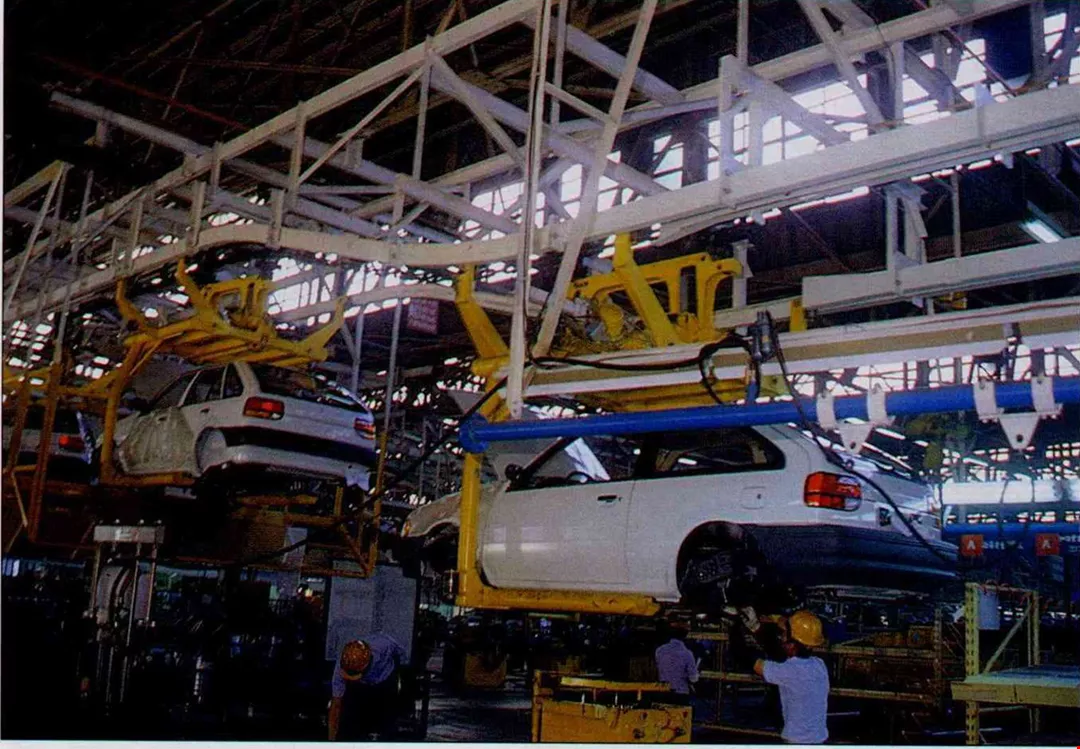
When will Taiwan enter GATT? What conditions will be negotiated with its trading partners? This is one of the most important topics for business people in 1995. The auto industry will be one of those most seriously hit by GATT entry. (Sinorama file photo)
The biggest base, the biggest market
Regardless of how desirable the current situation may or may not be, it is undeniable that mainland China is already the most important offshore production location for Taiwan firms. Even citizens who don't have any connection to doing business in the PRC are hearing that "Taiwan's dependence on the mainland economy is constantly increasing."
Micky M.C. Chen, director of the Economic Division of the government's Mainland Affairs Council, has long been concerned about this trend and is hopeful that the raging fever for economic interactions with the mainland can be appropriately cooled off. He points out that today mainland China and Hong Kong together absorb one-fourth of Taiwan's exports. It is estimated that by 1997, when the PRC reclaims control of Hong Kong, the PRC will surpass the US as the single largest export market for goods from Taiwan. Moreover, Taiwan investment and technology have been steadily flowing into the mainland. Of outward investment from Taiwan in the first eight months of 1994, 42% went to either mainland China or Hong Kong.
These figures are startling enough. But those who understand the mindset of Taiwanese businessmen that "we can do things but had best not report them" know that the above statistics underestimate the situation. Many scholars and business people do not hesitate to say that cross-strait trade and the condition of the mainland economy are "the lifeline" of Taiwan's enterprises. As one person expresses it, "the only important thing is that the PRC's economy continue to do well. Then Taiwan definitely will not do badly."
In 1994 the mainland went through a period of "macroeconomic retrenchment." In addition, a number of problems--such as inflation, losses by state-run corporations, a widening gap in wealth between the coast and the hinterland, and a growing number of wandering unemployed--showed no signs of radical improvement. Nevertheless, it does not appear that these are preventing the PRC's economic reform from charging forward at high speed.
Looking to the mainland's economy for 1995, "barring unforeseen disasters, then economic growth should be about 10%, roughly the same as 1994, and cross-strait economic activities will continue to be vibrant," says K.C. Lee.
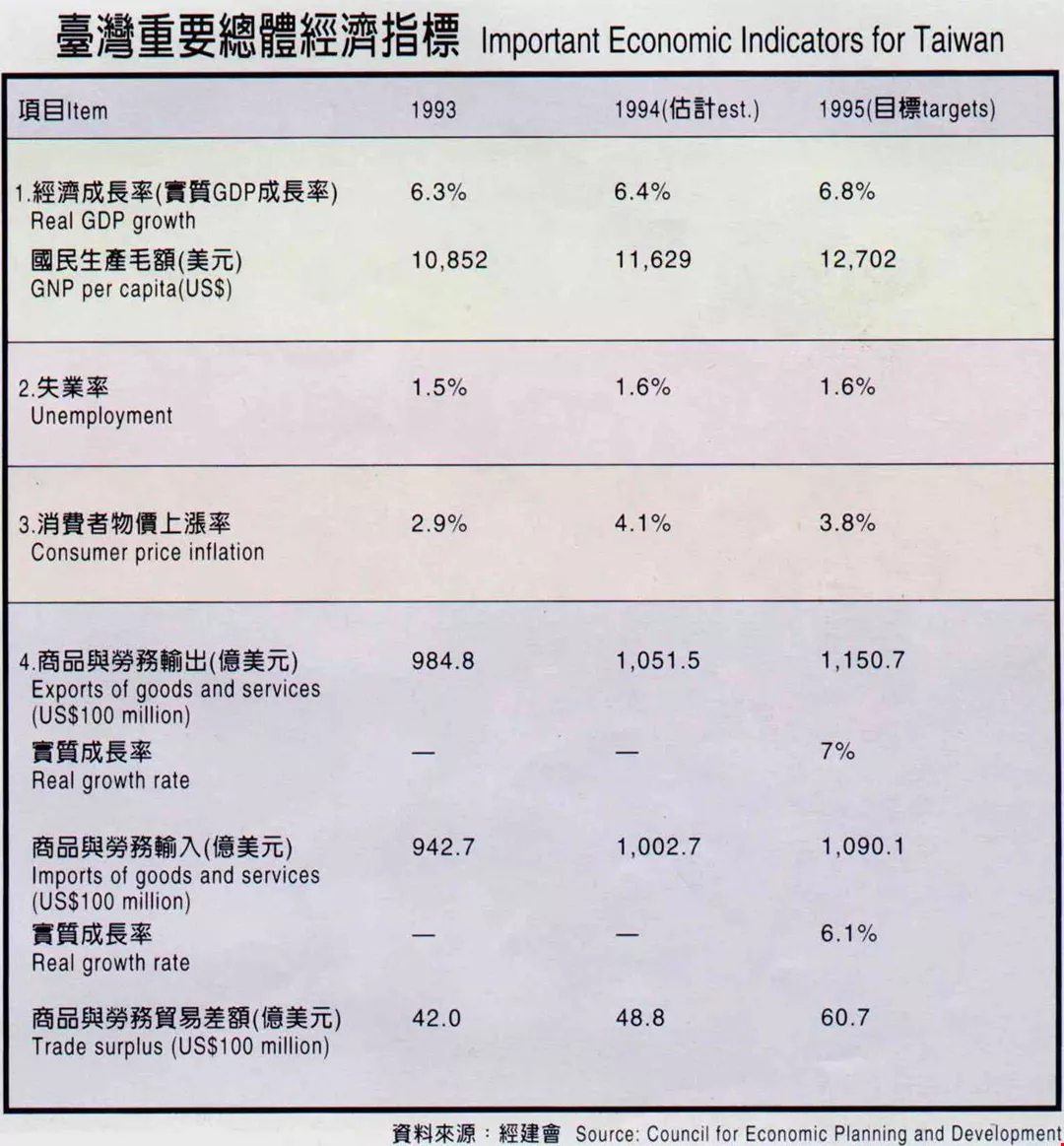
Important Economic Indicators for Taiwan Source: Council for Economic Planning and Development.
The war for the mainland market
There are things to be careful of, however. Recently the mainland government, trying to put the economy on a more sound foundation, passed a series of new laws covering taxes, corporations, accounting, labor, and foreign trade. In particular, the labor law, which went into effect on January 1, 1995, "is much stricter than the comparable legislation in Taiwan," says Chu Chih-yang, chairman of the Fair Friend Group. If these laws are rigorously enforced, Taiwan companies will face much higher costs and operational difficulties.
Another consideration is that the PRC, like Taiwan, may very well accede to GATT in 1995. This has both positive and negative implications for the many Taiwan businessmen in the mainland.
First, if the PRC wants to gain entry to GATT it will have to greatly open up its markets and allow outside firms to invest and trade on an equal footing with domestic firms. Secondly, on the other hand, mainland products will have better opportunities to enter the international market and compete on fair terms.
Taiwan firms are now defined as "special domestic investors" by the PRC, and they enjoy somewhat greater privileges and incentives than foreign firms. However, as the mainland makes the transition to a less protected market, it may be hard for Taiwan firms to hold on to the advantages that come with being one of the "local boys." In the future they will have to compete with non-Chinese companies from the same starting point.
For Taiwanese companies which have invested in the PRC to produce products for export to third countries, PRC accession to GATT should be helpful in opening up foreign markets. However, for those businesses which mainly sell to the mainland domestic market, GATT entry will be a severe blow.
"In the past, even though foreign firms were not allowed a quota of products that they could sell in the domestic market, Taiwan firms had their own channels and relationships to get such quotas. But after GATT, foreign firms will be able to openly sell in the domestic market, so there will inevitably be fierce fighting over this territory," says Chu Chih-yang.
In fact, in the past two years enterprises from many countries have invested startling amounts in the mainland hoping to get a leg up on the competition. Moreover, the companies taking the plunge are not unknown small firms, but powerful multinational corporations with deep pockets and advanced technology. In the future, as the door to the PRC opens ever wider, "the main competitors for firms from Taiwan will not be local mainland companies, but well-established multinationals," says Li Chi-chu, a professor in the Department of Economics at National Chengchih University.
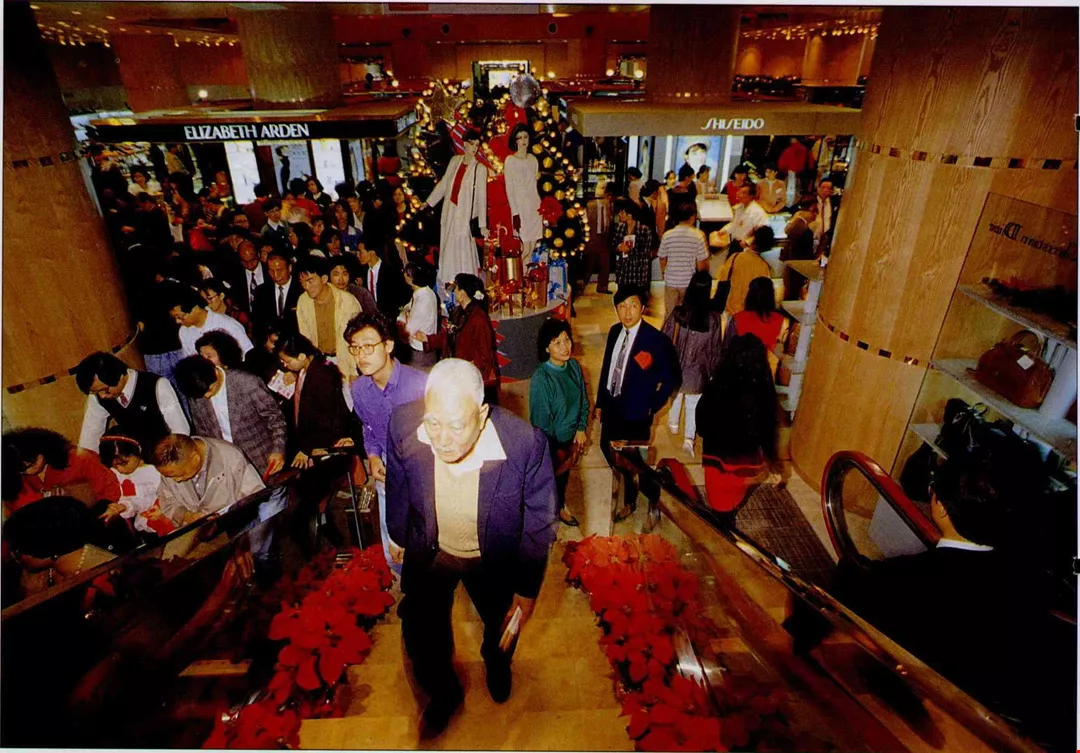
The burst in consumption at year end seems to reflect public confidence in the economy and in the future. (photo by Diago Chiu)
Year-end report card
While it may be true that the situation in the PRC will change dramatically, economists are mostly confident in the innate ability of Taiwan firms to adapt. It is disconcerting, however, that more and more large Taiwan corporations are applying to invest in the mainland. Not only are the amounts invested ever larger, the types of investments are shifting from traditional industries toward mid- and high-tech production, or to mid-stream processing of raw materials. These are precisely the types of industries that the government is working so hard to keep in Taiwan.
But does the slogan of "keeping your roots in Taiwan" have any appeal for Taiwan businessmen? Is Taiwan an asset or an albatross for these entrepreneurs as they strive to remain competitive internationally?
A study released by IMD International graded 42 countries on their competitiveness. Taiwan finished 18th, far below key rivals like Singapore (2nd) and Hong Kong (4th). Clearly Taiwan is no longer the dexterous "flying dragon" of yesteryear, but has become a sluggish dinosaur; indeed, the survey even listed it behind Malaysia (17th), a newly industrializing country. Many people are concerned that Taiwan may be left out of the global recovery and Asia-Pacific economic takeoff expected for the end of this century.
There are reasons for concern. In particular, domestic economic growth was very slow in the first three quarters of 1994. There were also many typhoons as well as shortages of water and electricity, causing industry to cry "uncle" repeatedly. But, perhaps feeling the effects of the global recovery and of the appreciation of the Japanese yen, in the fourth quarter the economy experienced explosive growth. In November, usually the slow period for overseas sales, exports totaled US$9.4 billion, an increase of 26% over the same period in 1993. Imports also were dazzling, increasing 35% over the same period. The two categories combined to record the highest growth rate in trade in seven years. A report released by the OECD in December indicated that Taiwan's overall economic growth for 1994 was 6.4%, seventh highest in the world. Taiwan still seems to be "at the head of the class."
"If all is going well with trade, then this will stimulate investment and production in the manufacturing sector, and will also stimulate consumption. So there isn't any worry about deindustrialization or recession," argues K.C. Lee. And when you look further at the data, at the end of 1994 not only did imports and exports rapidly increase, investment, consumption, and production all flourished. "Hot, hot, hot!" is how Lee sums up the economy. In fact, he even suggests that the government should prepare early to avoid "overheating"-- excessively fast growth which can bring inflation.
Long-term problems still need work
Wei Duan notes that at the end of 1993, different schools of thought were debating about whether the forecast for economic growth in 1994 should be above or below 6%. However, the sudden surge in trade at the end of 1994 has made everyone optimistic that 1995 "will be even better." The only difference among scholars is over just how much "better" 1995 will be, and over whether Taiwan can do better than the other Newly industrialized Economies.
Though the upbeat outlook for 1995 has temporarily overridden longer-term worries, it is undeniable that there are still a number of problems with the domestic investment and production environment. As K.C. Lee states, "the private sector has a very high willingness to invest, but for various reasons this is not being realized in practice." Faltering investment will reduce future returns, and the upgrading of Taiwan's industry--so critical to long--term economic development--will not move forward. It could become a fatal blow to Taiwan's economic development.
It is not hard to diagnose why Taiwan's investment environment is less than ideal, but it is hard to get to the root of the problem. Looking at input factors, there are a number of inadequacies which greatly add to the costs of production: a shortage of labor, difficulties in acquiring industrial land, uncertainties in the supply of water and electricity, and inadequate development of infrastructure (especially transportation and communications). Also, technology is proving hard to come by for industrial upgrading, while small and medium enterprises are short of capital and are unable to keep investing....
The curing of the investment environment will require long-term treatment. In fact, after much research by scholars and practitioners, the prescriptions have already been written up. But decisions must be made and then implemented. As for the new challenges of 1995, one will be that Taiwan needs to accede to GATT this year. Another is that it will be necessary to thoroughly implement the blueprint to make Taiwan into a "Regional Operations Center" for the Asia-Pacific area. Both of these would be major steps forward in Taiwan's efforts, which have been underway for several years, to "internationalize, liberalize, and systematize" the economy.
Pressure brings out potential!
In order to prepare for GATT accession, Taiwan must reach bilateral trade agreements with 23 nations. However, as of the end of November 1994, final agreements had been reached with only Malaysia, South Africa, and Turkey. Moreover, the PRC is insisting that it enter GATT before Taiwan does, creating many variables which affect when Taiwan will actually be able to join GATT. Further, many key trading partners like the US and Japan have failed to accept Taiwan's conditions for joining GATT. How many concessions will Taiwan have to make to secure its entry into GATT? Right now it's hard to be certain.
"This sense of uncertainty leaves businessmen not knowing where to begin," said one public relations person in the local auto industry, which will be one of the first to feel competition from major international rivals after GATT accession. Because there is no clear indication of what the relative position of the local and foreign producers will be, all the former can do at present is to minimize costs and increase competitiveness, and to organize themselves to appeal to and communicate with the government.
It will be necessary to implement waves of tariff reductions on imported products after GATT entry, giving foreign firms a chance to compete on equal terms in the domestic market. The question is: Which product areas will take the brunt of the first wave of reductions? Which products will get a somewhat longer period to adjust? How far and how fast should tariffs fall? How can disputes over losses incurred be handled? GATT accession creates dilemmas everywhere. As the moment of accession approaches, the wrestling between government and industry will become ever more obvious.
In each industry perhaps some companies will do well while others fall by the wayside. But overall, GATT accession will have a positive impact on Taiwan's economic development. According to a GATT report of November 10, 1994, if Taiwan joins GATT, by 2005 the value of its exports will be between 4.5% and 14.4% higher than if it did not join. National income will be higher by between US$2.6 billion and US$10.2 billion. And these are conservative estimates.
Joseph S. Lee, vice-president of the Chung-Hua Institution for Economic Research, looking at the big picture, says that the world economy has been traveling along the two axes of "globalization" and "regionalization." If Taiwan does not join GATT, it will not be seen as having the qualifications to be a member of the world economic circle. Also, after the World Trade Organization (WTO)--which is charged with overseeing implementation of the GATT agreements--is formally established in 1995, it will begin to consider new topics such as international labor and environmental standards. In other words, the longer Taiwan delays in joining, the higher the barriers will be to entry, and the more serious the adjustments will have to be. Therefore, it is essential for Taiwan to gain entry to the WTO in 1995.
"The pain of getting into GATT may very well be an important variable for Taiwan's economy in 1995. Yet Taiwan has been implementing liberalization and internationalization for many years now, so everyone should be psychologically prepared and have the capability to survive this test," says Yeh Wan-an, who adds hopefully: "People will work harder under pressure, and this will stimulate the potential of Taiwan's economy."
Deciding your own fate
The effort to remain a key link in the world economic order is evident not only in the determination to enter the WTO. It also appears in the blueprint for the "Regional Operations Center." The broad idea for this was floated two years ago. The hope is that Taiwan can take advantage of its geographic location, orthodox Chinese culture, business connections with overseas Chinese, and solid industrial base to become the regional center for foreign firms coming to the Asian region (and especially for those firms investing in the PRC).
The idea for the regional center has been widely acknowledged to be a good one. However, because it involves questions of the degree of openness in the interactions between Taiwan and the mainland--such as direct air and sea links, or allowing mainland staff, capital, and goods into Taiwan--there has been a lot of controversy as well. Some staff members at the Mainland Affairs Council are very clearly opposed to ideas like "the shop up front (in Taiwan) and the factory out back (in the PRC)" or the "Hong Kong-ization of Taiwan." They argue that to make Taiwan into a launching pad for foreign firms to invest in mainland China is "reducing ourselves to a mere supporting role."
However, in the recent cabinet reshuffle, Vincent Siew, who as head of the Council for Economic Planning and Development first promoted the idea of the Regional Operations Center, entered the cabinet, and a preliminary draft of the long-delayed "Regional Operations Center Timetable" has been completed. This indicates that the government is determined to implement the plan as quickly as possible. This was another year-end bonus which pleased the business community.
Looking ahead to 1995, "each variable has its positive and its negative aspects; nothing is absolutely positive, nor is anything an absolute write-off. Everything depends on how government and the private sector respond!" Joseph Lee's comment is a fitting final note as we look forward to 1995.
[Picture Caption]
p.6
Though weighed down by various burdens, Taiwan's economy is still trying to fly high. (drawing by Tsai Chih-pen)
p.8
The success or failure of export industries can reflect Taiwan's relative competitiveness in the world economy. The photo is of the Kaohsiung Export Processing Zone. (photo by Wang Wei-chang)
p.9
Peaceful relations across the Taiwan Strait are a major prerequisite to economic development in Taiwan. The photo was taken at the high-level cross-strait meeting held in Taipei in July 1994. (photo by Vincent Chang)
p.10
When will Taiwan enter GATT? What conditions will be negotiated with its trading partners? This is one of the most important topics for business people in 1995. The auto industry will be one of those most seriously hit by GATT entry. (Sinorama file photo)
p.10
Important Economic Indicators for Taiwan
Source: Council for Economic Planning and Development
p.12
The burst in consumption at year end seems to reflect public confidence in the economy and in the future. (photo by Diago Chiu)


@List.jpg?w=522&h=410&mode=crop&format=webp&quality=80)


