Below are the views of Wang Yu-chou, director of the Council of Agriculture, on the varied facets of problems in agriculture past and present.
Q: You have already been chairman of the Council of Agriculture for about three years; could you first tell us a bit about your impressions during this period of time?
A: Speaking in terms of agriculture, the past thirty years have entailed major changes. Previously, the entire province of Taiwan had a population of only seven or eight million people, and the problems we were concerned with were increasing production and supplying a sufficient amount of foodstuffs. Now the population has increased to 19 million people, and we are concerning ourselves with how to stabilize prices and improve quality; looked at from this point of view our agricultural development has really been phenomenal.
Q: You mentioned that the past thirty years have entailed major changes in agriculture; are alterations in the methods of employing agricultural lands to be counted among these changes?
A: At present the average income of farmers is still only about seventy percent of that of most people's incomes. If we want to raise their incomes, the crops to be planted, as well as the timing of their planting, must certainly be carefully chosen. Only by selecting things which we have not had in the past will crops be able to be sold at high prices. As pertains to land with sections where soil conditions are relatively inferior, we must make extensive changes, implementing common crop controls over larger areas of land and thereby strengthening the efficacy of land usage.
Q: Isn't this precisely the goal which is being sought in the second stage of agricultural land reform?
A: Yes, it is. Our hope in the second phase of agricultural land reform is that the scale of farms may be enlarged. If a farmer desires to buy land but lacks sufficient funds, the government will provide long-term, low-interest loans. If the owners are reluctant to sell, lands may be brought under cooperative management, or be entrusted to other parties for "custom farming", a type of farming by hire.
Q: Most Chinese farmers feel a great attachment to and desire to own their land; does this have an influence on efforts to promote farming by hire or the entrusting of lands to second parties?
A: This was a problem in the first two or three years of the implementation of these policies. Because of past experience with the "land-to-the-tiller" program, many people fear that if they rent out their land it will in the future become the possession of other people. Due to this fact, we have especially included in the regulations regarding agricultural development a qualifying clause which states that the "land-to-the-tiller" program and farming entrusted lands are not to be confused.
Q: The government has ruled that only owner-farmers and graduates of agricultural schools will be permitted to purchase farmlands; won't this delay progress towards management over larger farming areas?
A: Restrictions on the buying and selling of farmlands are to be found in many countries. The important point is not who buys the land, it is rather their purpose in buying it. If it is not possible to reserve farmland for strictly agricultural uses, rise is then given to speculative action. Therefore, if lands are marked out as "permanent agricultural zones", then as it is foreseen that there will be no future changes in the usage of these lands, the buying and selling of them ceases to be of concern. Such policies are presently under deliberation.
Q: A major agricultural problem in the past has been the surplus of rice. How can this problem be solved? Is export an option?
A: The export of rice will not solve the fundamental problem, which is simply that we produce too much rice. But looked at from another angle, while today we have an abundance of rice, if one day people begin to shout that the rice stores are not full enough, there will be a rush to buy it up. This is a very sensitive problem which could cause societal instability; therefore, the government must give it careful consideration.
Q: Then just what levels of rice stores and production should be maintained in order to be considered sufficient?
A: At present already 120,000 or 130,000 hectares of what was previously rice-growing land have been turned over to the production of other crops, while our original goal was set at 170,000 to 180,000 hectares. I think that the current six-year plan for January 1984 to December 1989 will see us reach that goal. However, due to technological improvements, the production of rice per unit area is still continuously on the increase.
Q: So the area for crop replacement must still be expanded?
A: That's right. As I see it now, the area of rice production should be reduced to 480,000 hectares.
Q: Mr. Yu Yu-hsien at the Taiwan Provincial Department of Agriculture and Forestry has recently been advocating the idea of "cutting production to benefit the country". Do you feel that the reduction of production is a viable method for relieving pressure?
A: Production limits should have a special significance. My personal feeling is that we should not merely reduce volume, we should also raise quality. In addition to this, I have always considered the problem of agriculture to be not only one of the quantity of production, but also one of the coordination of marketing. If there are too many agricultural products in a limited market, and if the low price of grain is not to hurt farmers, the government must provide subsidies; this is a real waste.
Q: Finally, we know that the Council of Agriculture has established a Resource Conservation Division. Is this not the province of the Bureau of Environmental Protection? Could we ask you to say some thing about why this division has been established?
A: The relationship between agriculture and the living environment is extremely close-knit. Without good land, good water sources, and good air, it is impossible to raise good plants. It could be said that without a good living environment, there is no room for agricultural development.
[Picture Caption]
Agriculture has undergone major changes over the last thirty years. Director of the Council of Agriculture Wang Yu-chou considers these changes to be an improvement.
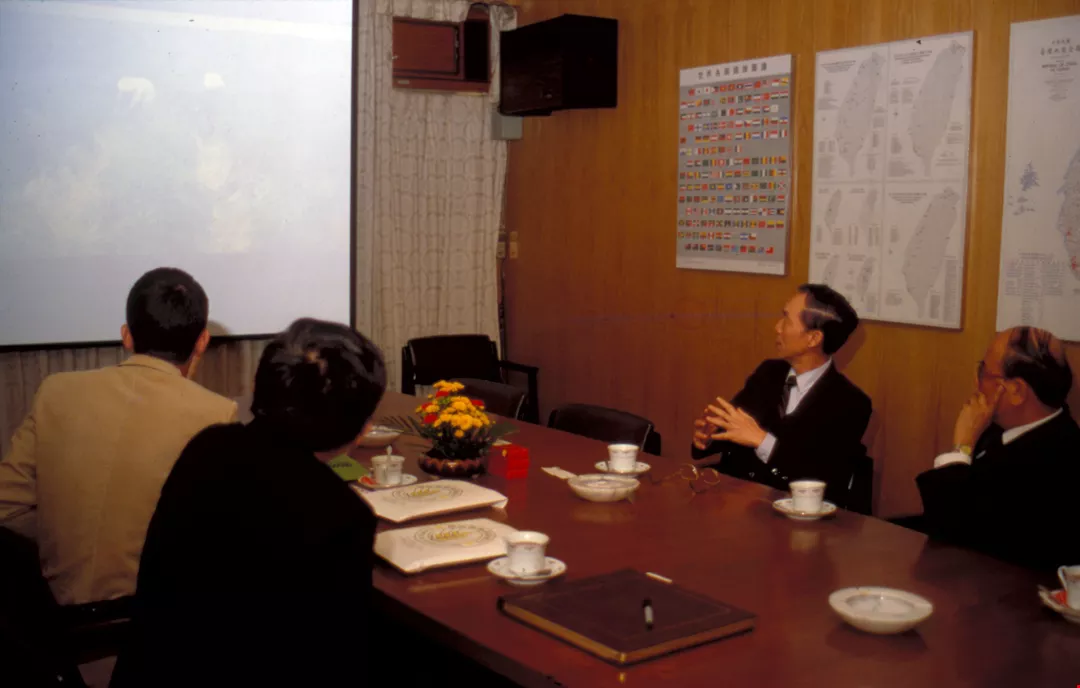
Agricultural problems are complex and intricate; every policy decision must be arrived at through careful planning. (Wang Yu-chou is second from right in photo.)
Agricultural problems are complex and intricate; every policy decision must be arrived at through careful planning. (Wang Yu-chou is second from right in photo.)




