

Where will the next wave in the infor-mation revolution originate? At a press conference at the end of the 2000 World Congress on Information Technology, Harris Miller, president of the host organization WITSA, declared that it wasn't Silicon Valley or Toyko, but Taipei, and that it was occurring right before his very eyes.
This enormous congress, held in Taipei in the middle of June, gathered together the brightest stars in global high-tech to talk about the theme "Information technology for a better world." Is mankind about to enter a future world as depicted in science fiction films? Will this be a boon or a burden? What role will Taiwan play in all of this? This conference offered much food for thought; now it is up to us to think carefully about these questions.
Just think about how frustrating it is in the middle of a busy working day, when every minute counts, and you miss the Metro because you are waiting in line to buy your ticket. What if one day, you just had to run onto the train, then the train's intelligent system immediately discerned your identity from your wrist watch, and deducted the fare from your bank account? Wouldn't that be wonderful?
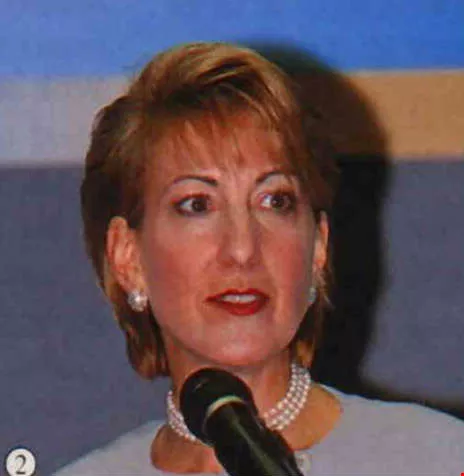
2. Carly Fiorina, president and CEO of Hewlett-Packard.
Everything online
Or how about this? In English class the teacher simply announces "Boot up!" The students turn on their palmtop Internet browsers and immediately they can converse with American children. Those whose English is not so good can make a guess at what is being said from the facial expressions and hand gestures of their counterparts. If that doesn't help, a simultaneous translation system can save the day. With obstruction-free communication, the ideal of a global village could be just around the corner.
It's also possible that you are out on a trip, and you suddenly think that perhaps you didn't close all your windows at home. That certainly puts a damper on your fun. But don't worry, you can just punch a few keys on your mobile phone, and check which windows have been left open. Punch a few more, and the windows are immediately closed, and you don't have to worry about a sudden thunderstorm drenching all your furniture.
Are you afraid of something going wrong when you are abroad? The global positioning system will guarantee that you don't get lost, and anytime you want you can send an electronic map to friends and family showing them precisely where you are. Detailed local 3-D street maps can help you find the nearest taxi; just punch a few numbers into your cell phone, and a taxi driver who picks up your signal can be there in minutes.
"This is an age where people can connect anytime, anywhere to useful e-services of all kinds." So declares Carly Fiorina, president and CEO of Hewlett-Packard. "Anything and everything will become intelligent. Anything and everything will become connected." The new information world is gestating in just such an online structure which includes every possibility and every form.
For a long time, information technology was mainly passive; you went online and downloaded data. Today, information technology offers interactive and communications functions, while e-commerce has greatly reduced the cost of business activities. In the future, when everything is connected, information technology will be an inescapable part of daily life. Your personal information will be included in various government or private databanks, to be monitored and processed by those who control these databanks. At the same time, each individual can build a little private Internet of their own, and put everything about themselves in for ease of management.
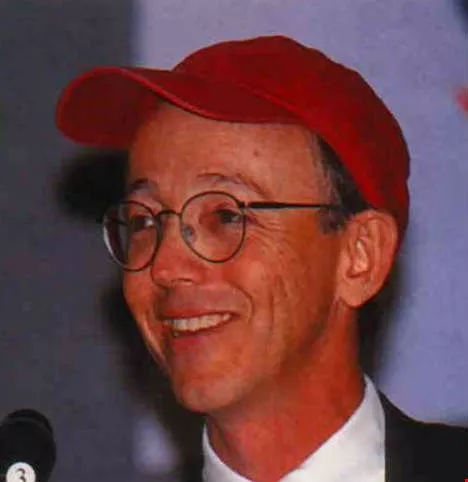
3. Robert Young, chairman of Red Hat Inc.
Child of the Internet era
Do these sound like fairy tales? John Patrick, vice-president for Internet Technology at IBM and chairman of the Global Internet Project, says that, to be sure, we've only just begun the journey to the new information world. But, given the ever-more rapid development of technology, the new Internet world may soon be knocking on our doors.
Patrick points, for example, to the fact that while currently most Internet use relies on clumsy personal computers or notebook computers, and users must wait to make a phone connection, in the future there will be various types of net platforms and wireless Internet browsers. When these become common, you will be able to go online through television, wireless application protocol (WAP)-standard phones, personal digital assistants (PDAs), and even digital watches. Moreover, you'll be able to stay connected 24 hours a day. It will be just like TV today-flip it on and you are ready to go. John Patrick estimates that over the next two years, the proportion of Internet activity that goes through PCs will fall from the current level of 98% to less than 50%.
Looking to the future, as DSL and other broadband technology matures, large amounts of visual and audio information can also be transmitted through high-speed fiber-optic cable. As WAP equipment becomes widely available, you will be able to get important Internet information anywhere, condensed by transcoding technology into a form suitable for display on small devices. The open-source Linux operating system, which has appeared in the last several years, will make it easy for all types of platforms to be conveniently connected to one another. And the list goes on and on. As key technologies are brought together, "technological fairy tales" will become reality.
Kurt Hellstrom, president of the mobile phone giant Ericsson of Sweden, anticipates that in the next three years, the number of mobile phone users in the world will double from the current level of 500 million. Wireless communication will transcend fixed-line Internet access to become the mainstream. In other words, says Hellstrom, "We are entering what you could call the post-PC era. Information will no longer be tied to the computer standing on your desk. Instead it will follow the user."
In March of this year, the New Zealand stock exchange initiated the first wireless WAP-enabled trading system in Asia. Investors can follow the share prices on their PDAs, and put in buy or sell orders at any time, without going through a broker. Not only will this speed up matters, it also greatly reduces the costs of trading.
Risto Linturi, initiator of the "Helsinki Arena 2000" program to make Helsinki a cybercity, says that currently a number of companies in Finland are working together to produce online home appliances. For example, Lonix is researching lightbulbs that can be connected to mobile phones and the Internet, so that homeowners can control them while away from home. Other products that will soon come on the market include remote-control refrigerators (that will also tell you what they have inside), air conditioners, and air filters.
"Think about sparsely populated Finland where everybody has mobile phones. The streetlights can be turned off when there are no mobile phones near by. All these things save resources." Linturi's new information world will also include wild animals. Talking about Kainuu, a part of Finland with many bears, he says, "Some of them have GPS-radio collars. We plan to show their positions in the virtual model. Then it will be easier to avoid accidentally meeting a bear."
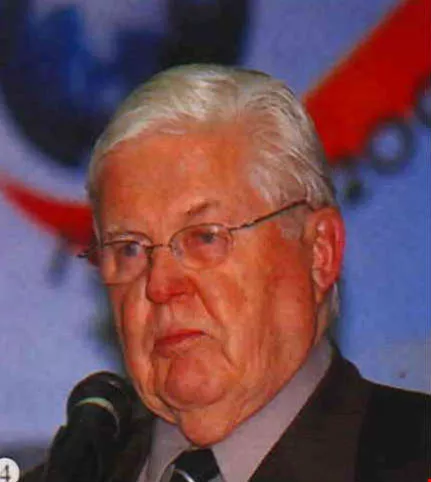
4. Robert A. Mundell, 1999 Nobel Laureate in Economics and a professor at Columbia University.
Sense and respond
The functions that will be available in the new information world are startling. The driving force behind them is a new value system and economic model that smashes tradition and overturns the past.
In his keynote address, Lester Thurow of MIT's Sloan School of Management noted that in the new economy, "knowledge is wealth." He observed that in agricultural society, fertile land was the source of wealth. In industrial society, someone with an oil field or machinery could easily turn a profit. Today, the new nobility of Silicon Valley like Bill Gates do not rely on natural resources or machinery. Where does their money come from? It comes from a group of knowledgeable, creative, outstanding employees.
Thurow pointed out that of the 100 leading companies in the world, 90 are American. Of these, half have been founded since 1965. He says that in the new economic era, what works is the American daring to take risks, the lack of concern with preserving tradition, and the willingness not to despise those who are trying to be pioneers, even if they fail.
One face of the intense drive behind the new economy is that each day Silicon Valley creates 600 new millionaires. The other face is that, within five years, half of all traditional retail shops will be washed out by e-commerce. Innovation and change will be the only ways to survive.
In this vein, Carly Fiorina quoted from Charles Darwin: "It is not the strongest of the species who survive, nor the most intelligent, but those who are most adaptive to change." Adapting to the environment requires constant reinventing of oneself, as reflected in an idea embraced by Hewlett-Packard: "Preserve the best, reinvent the rest."
IBM's John Patrick notes that in the past PC makers were quite pleased with their cyclical model in which they could produce new products "twice as powerful at half the price" every 18 months. In the future, this cycle could be reduced to 18 days or even 18 hours. The business development strategy of careful thought and step-by-step operations will be replaced by "sense and respond."
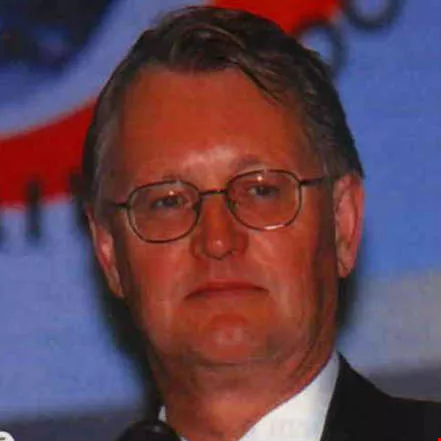
5. Kurt Hellstrom, president of Ericsson of Sweden.
Everyone an artist
New technology and new products every 18 hours. . . but is this all just to make money? The technology leaders at the conference say that the capabilities provided by new technology should be put into the service of a higher purpose.
Finland's Risto Linturi argues that in the Internet era, each individual gains more freedom and more independence. For example, many people are calling for an improvement of the content of the net. But he feels that the desire to express oneself is much stronger in people than the desire to learn from others. Therefore, in future, you may see information like this on the net: "Tomorrow at 6:00 pm I will change my carburetor. If you want to view and listen to my explanation, please connect to my homepage video channel."
In other words, through the medium of the web, everyone will be not only an observer, reader, or student, but can also be a filmmaker, author, and teacher. There will be no status distinctions, and no need for class confrontation. Everyone will be able to equally contribute what they can and learn from one another.
James Gilmore III, chairman of the US Advisory Committee on Electronic Commerce and the governor of the Commonwealth of Virginia, is a great advocate of Internet liberalization and minimization of government intervention. Speaking from the point of view of individual-state relations, he painted a picture of a future in which the Internet could create a global village of unobstructed communication. In the past, said Gilmore, each individual belonged to a certain country or government, and it was necessary to follow the rules set by that government. But the Internet has no national boundaries, and allows the individual to escape from government control.
He believes that it would be good thing to maintain the openness and freedom of the Net, and that governments should be happy to see its growth, and should not blindly interfere. Thus, for example, the recent effort by some European Union members to impose a value-added tax on Internet transactions, which would require citizens to turn over their passwords for inspection, is seen as a step backwards, even an infringement of human rights.
In the future, every citizen will be able to send an e-mail directly to the mayor's e-mail box, and, suggests Gilmore, layers of bureaucratic obstacles will no longer exist. If the citizen moves, she need only to make a change in an online form, and all relevant agencies-housing registration, health insurance, tax collection, social services, and so on-will immediately be automatically informed, saving the individual citizen a lot of running around.
Patricia Hewitt, minister for Small Business and e-Commerce in the United Kingdom, looks forward to the creation of an "e-government." For example, at tax time, government computers will automatically calculate citizens' tax information, and a citizen merely needs to review and approve the result. When someone is sick, they can register at the hospital online; they can even get a preliminary diagnosis and advice on which department of the hospital they should visit. Based on the citizen's location, the Net can tell them where to find the nearest and most appropriate medical resources, thereby saving patients headaches and also reducing the costs of medical care.
Taipei City Mayor Ma Ying-jeou, who aspires to create a cybercity, and Singapore's Lim Swee-say, minister of state for Communications and Information Technology and also for Trade and Industry, both noted that in a densely populated small area, those responsible for coping with the excess traffic flow hope that citizens will "go online more, go on the road less." Lim also pointed out that in the virtual world, Singapore, a small country with no natural resources, needs only to invest in developing and attracting human resources in order to thrive.
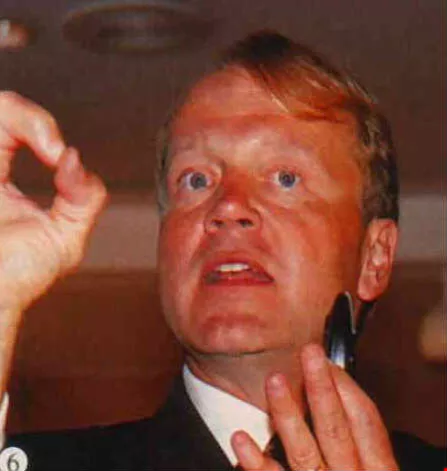
6. John Chambers, chairman of Cisco Systems Corporation.
Who needs all this information?
Will the new information world be all to the good? The technology nobility at the conference themselves raised points to ponder. George Newstrom, who is corporate senior vice-president at EDS and chairman-elect of the World Information Services Technology Alliance, spoke on the theme "Preventing the Technological Eclipse of Humanity." He expressed his concerns about the current creation of "technology for its own sake."
While conceding that technology is a wonderful thing, Newstrom said that the question is: "Can we grow up and learn fast enough to handle the awesome power and potential that technology offers?" There's much talk about obstacle-free communication, but can technology really replace the smiling face and the handshake of the face-to-face meeting?
Newstrom noted that in a recent study conducted at the University of Pennsylvania, 64% of responding parents felt that absorption in the Internet could cause their child to become isolated. Another 42% felt that the Internet could even create anti-social behavior in their children. With more and more children communicating with friends through Internet chat rooms or e-mail, the result of a lack of direct human contact could be a deepening of the sense of alienation in a child.
And this applies not just to children. Many adults, like Newstrom himself, are now accustomed to sending out e-mail to their colleagues. They no longer walk up and down the halls, popping their heads in the door to exchange a few words. Someone who stays in day and night on the Net, although they may come in contact with new worlds far removed from home, may become far removed from friends and family. We all know the stereotype of the Dad who is too busy to get together with his children and grandchildren. Newstrom wonders if in the future, even the voice and the smile associated with this person will disappear, and all that will be left is a soulless e-mail address.
Newstrom is especially concerned about the severe imbalance in the "digital ecology." He says that currently the world is dividing into two extremes. On one side are the people who live in the technologically-advanced world who are seriously worried about being overwhelmed by the tide of information. At the other extreme are citizens of the poor countries, numbering in the billions, who suffer from a severe shortage of information.
"Data, data everywhere, but not to help me think!" As Newstrom observes, people can now go home and turn on their computers and continue working at night, but their working hours are not correspondingly reduced. E-mail, which was originally supposed to make communication more efficient and raise productivity, is now a channel for being inundated by junk mail. Information knows no boundaries, but don't forget that people have limited energy and time. Do we really need so much information? Do we need to do so much monitoring and control? Must we participate in such intense and ceaseless competition?
In fact, even as the technology masters of the universe were describing a wonderful new world inside the conference hall, a group of protesters gathered outside in the rain. These unemployed workers held up slogans like "e-job=end of job" and "We protest technological hegemony." While the new Paradise promised by technology has yet to be realized, already workers made redundant in the new economy are facing hard times.
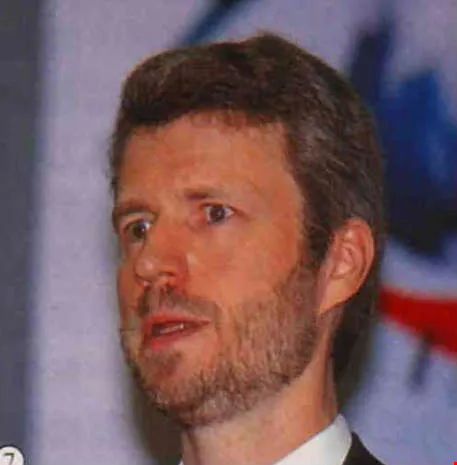
7. Risto Linturi, initiator of the Helsinki Arena 2000 program.
Need-based net
In her address, Carly Fiorina argued that "Education is the only way to bridge the digital divide, and create a world that we at HP call e-inclusion," in which "technology and opportunity are accessible to all." So far the company has invested US$1 billion to assist various countries to develop Internet education. Such steps can help reduce to a minimum the shocks brought by the new economy.
Virginia Governor Gilmore says that, compared to the Net Set caught up in the information explosion, it is the people with no knowledge and minimal information who really need to be looked after. Many cities in Virginia have already established information stations in public settings like government institutions, social centers, and libraries. These are available to citizens who cannot afford to buy their own information access equipment, so that they can enjoy free and equal access to information and knowledge brought by the new technology.
And IBM's Patrick looks forward to the day when there will be Internet kiosks everywhere. Blue-collar workers may just pop over to the net kiosk at rest time to surf for information or pick up their e-mail. "Smoking break" may well become "web break."
Adhering to the same idea of "obstruction-free communication, common sharing of information," Ericsson's Kurt Hellstrom states that backward countries will also benefit from the widespread use of mobile communications. Power shortages will no longer be an obstacle, and people living in the remote jungles or along far-flung coasts will be able to have their first experience of information technology. In fact, some companies have been using new technology to help out people in disaster areas. For example, during the fighting in Kosovo, the earthquake in Turkey, and flooding in Vietnam, Ericsson provided communications assistance to speed relief efforts. Also, the Cisco company set up networks and websites in Kosovo for refugees to find missing relatives.
Carly Fiorina expresses optimism that proper use of new technology would certainly bring benefits to mankind. In her speech she pointed for example to Hewlett-Packard's use of the Net to match up surplus food with areas that need it the most. Millions of pounds of food are distributed through this channel each day.
Perhaps the most compelling speech on the theme of "information technology for a better world" was the last of the conference, by Dr. William Magee, founder of Operation Smile. Operation Smile is a not-for-profit, volunteer medical services organization that has provided reconstructive facial surgery to more than 50,000 children in more than a dozen countries worldwide, so that they can smile again.
In his remarks, entitled "Information Technology Changing the Face of the World," Dr. Magee described his own experience with technology. Relying on advanced remote medical care technology (and help from the business community), he discovered that modern technology really can make humanitarian assistance more successful and more effective. Dr. Magee hopes that people in the technology world will make humanitarian concern a part of their structure of consideration: "Logic cannot change the world, only feeling can." "Knowledge has no heart, we cannot survive by relying on knowledge alone." Using the metaphor of the sword in the stone from King Arthur and the Knights of the Round Table, Dr. Magee said that he hoped that this powerful weapon of technology would be used for social justice and to serve the well-being of society. Not "might makes right," but "might for the right."
The three-day IT congress is over, and the technology superstars in attendance have once again scattered across the globe to continue extolling their technology dreams. But the beautiful
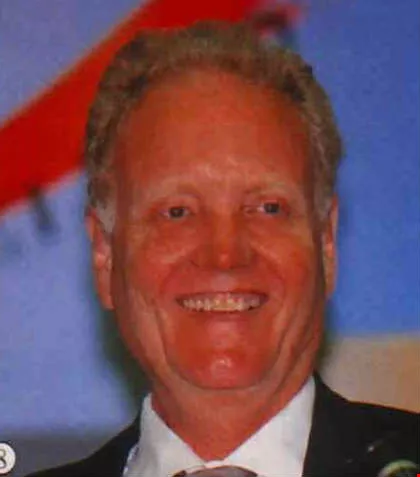
8. Lester Thurow, Lemelson Professor of Management and Economics at the Massachusetts Institute of Technology.
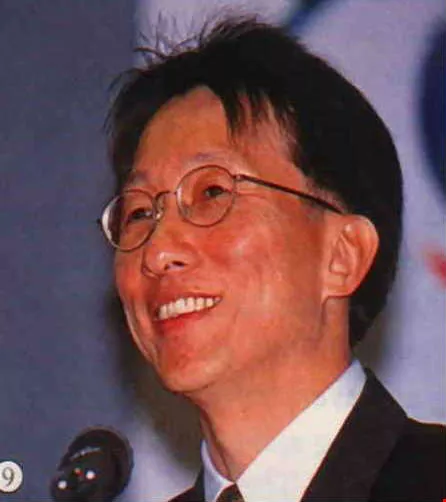
9. Lim Swee-say, Minister of State for Transportation and Information and also for Trade and Industry in Singapore.
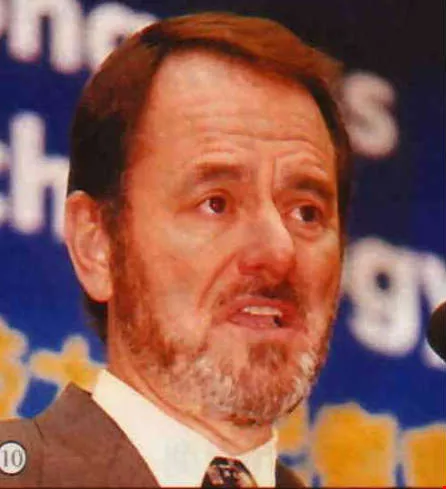
10. John Patrick, vice president for Internet Technology at IBM.
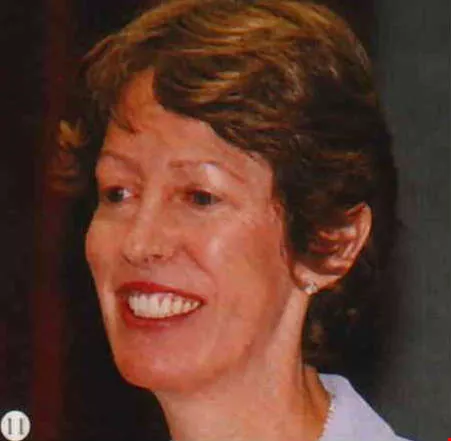
11. Patricia Hewitt, minister for Small Business and e-Commerce, UK.
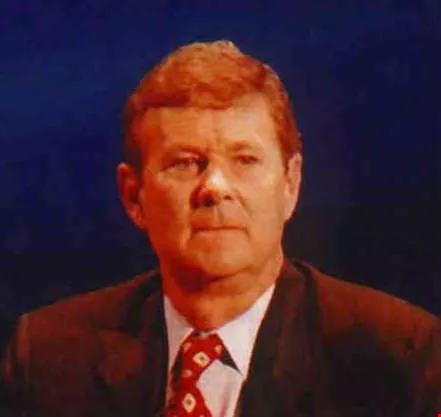
12. William Magee, founder of Operation Smile.
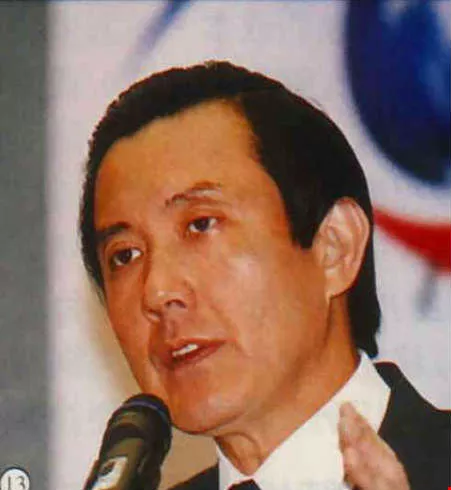
13. Ma Ying-jeou, mayor of Taipei.
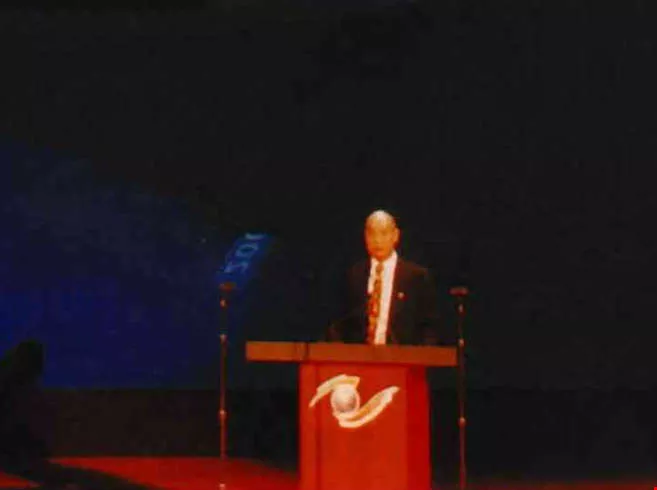
14. Congress Chairman Richard Yin, shown delivering opening remarks.
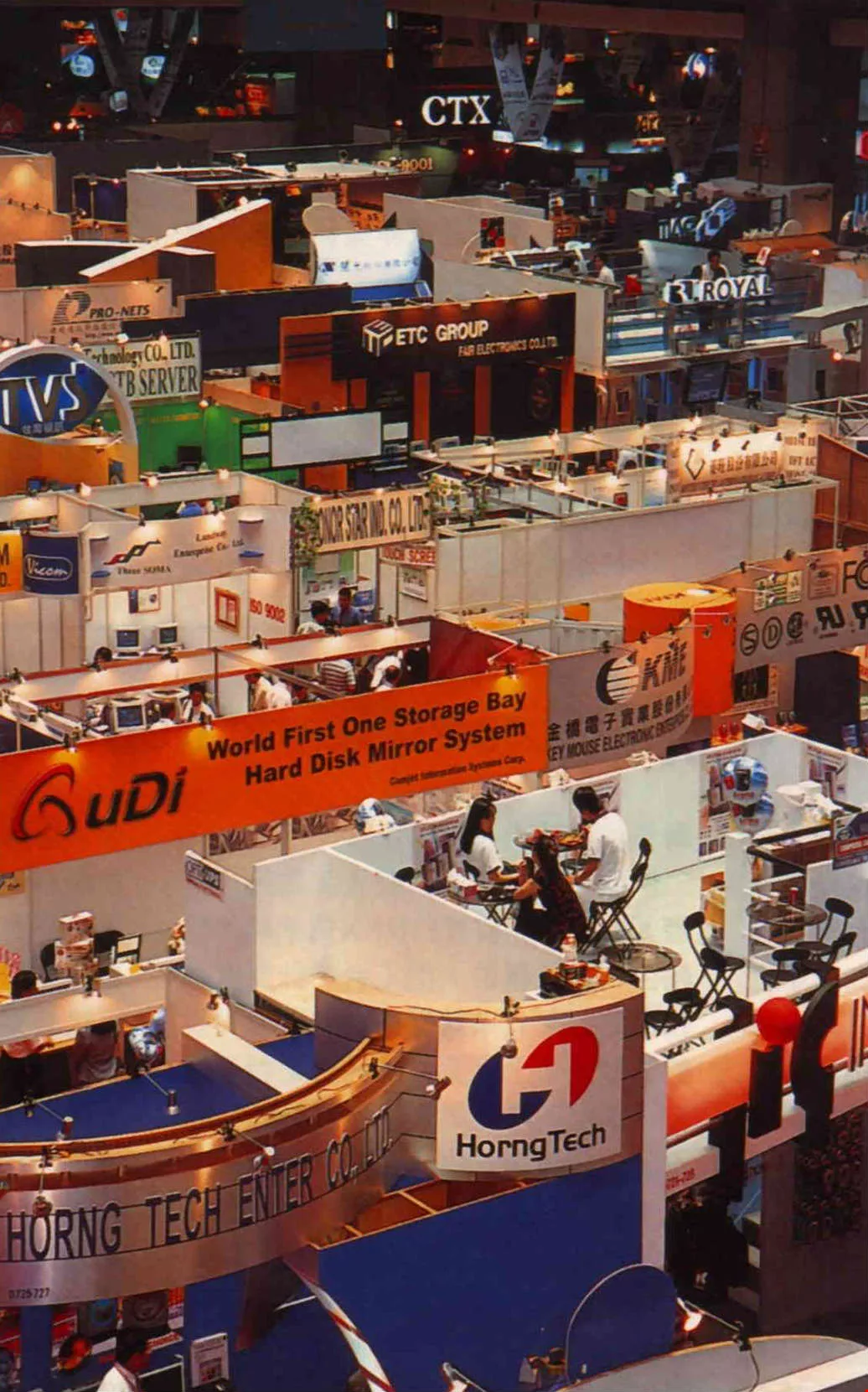
This year's Computex computer show, which just ended, had more than 70,000 visitors, a new record. Behind the World Congress on Information Technology which just closed in Taipei is the pillar of Taiwan's industrial power in information technology.


@List.jpg?w=522&h=410&mode=crop&format=webp&quality=80)


