Basic Skills Win the Game
Vito Lee / photos Chuang Kung-ju / tr. by Jonathan Barnard and Geoff Hegarty
December 2005


Among the first stances that students of martial arts learn is the horse stance. Sometimes they have to stand in that stance for an hour, with legs apart and shoulders at waist level. It's tedious, and it makes their limbs ache and shiver, but only those who can take it have a chance to become a true martial artist.
In the martial arts, you've got to start with the basic skills. That goes for academia, business, self-improvement, and politics as well--you can never leave the foundations behind. Respect for the basics shows a respect for substance and a willingness to reap the rewards of experience gradually. It's an assured style of thinking that pays regard to the essence of things. As we reflect over the last year at the onset of the new, we pay tribute to a host of people who have embraced this spirit of maintaining the basics. In a fast-paced era of ruthless strategies and superficial images, they maintain a touch of something from days gone by and also show far-reaching vision.
As we wait to see what the new year brings, perhaps these stories of holding on to the basics can provide some inspiration.
In the morning drizzle, a wet heavy wind blows down from the Yangming Mountains into the Tienmu baseball stadium. Next to the home plate, Yang Chih-wei, his brow beaded with perspiration, raises the bat grasped tightly in his hands, giving the appearance of a warrior reverently wielding his sword. The essence and power of the game of baseball are there in that movement: swinging the bat to strike the ball. But it's also the most difficult skill in the game to master.
Poise, accuracy and power
"From the day a player decides to take up baseball, he has to practice constantly until the day he retires, persevering daily in his quest for perfection. Swinging the bat takes power; but more than that, it requires a masterly level of skill. Unfortunately, it is more difficult to train for the latter than for the former," remarks Lin Hua-wei, baseball coach at National Taiwan College of Physical Education, who is standing next to Yang Chih-wei providing instruction.
For batting practice, Yang usually uses the practice net, working alone with the pitching machine, but sometimes he works with a pitcher. He's been in baseball teams since fourth grade elementary school, and has been through both the Little League and the Youth League. His daily practice swinging has developed the strength of his hands, which now grip the bat like a vise. But even wearing gloves the skin of his hands was repeatedly torn until it bled, until he grew thick calluses.
"Since my early schooldays, coaches have been telling us about the importance of the center of gravity when swinging the bat, but I never really understood the concept until college when the constant practice finally drove the idea home," says Yang. He straddles the batter's box with his feet apart, knees bent slightly, his eyes giving complete attention to the pitcher. At the moment the white ball leaves the pitcher's hand, he begins to count, 1, 2, 3, in his head, as he judges the ball's speed. At the same time, his body starts to function: first the lower part, his legs driving his hips, transmitting the power to his hands and then into the bat, swinging the bat with enormous force to strike the ball, while his weight moves smoothly forward from his right leg to his left, and his body rotates leftward by almost 270o. Lin Hua-wei points out that in order to ensure that a batter will maintain a constant center of gravity while he swings, a huge range of techniques have been employed. As well as constant verbal exhortations, some coaches have even resorted to tying ropes around their batter's waist, putting blocks in front of his left leg to prevent the body from following the direction of the swing. "If your center of gravity moves forward, not only are you likely to lose sight of the the ball, it also greatly reduces the force of your swing."
Even though baseball is Taiwan's national sport, and the nation has had a professional baseball league for the past 17 years, the lack of consistency resulting from batters not maintaining their center of gravity has been a constant source of disappointment. In the Asian Cup Professional Baseball League Campaign in October this year, the Sinon Bulls, representing Taiwan as this year's national champions, confronted the Japanese and Korean teams. Lacking the more solid basic skills of their opponents, some of the Bulls' batters frequently missed balls as they lost control of their center of gravity, some even falling. As a result, they came a disappointing third in the competition. Taiwan's senior international judge Liao Wen-ching sighs resignedly when he notes that there have been no significant innovations in core baseball skills for the last 20 years--and it is these basic skills that win games.
As Yang Chih-wei focuses on perfecting his swing, in a classroom at Taipei National University of the Arts in Kuantu there are also people going over another set of basic skills, practicing every movement repeatedly step by step. Here, however, they're not practicing for speed and power, but for slowness and relaxation.
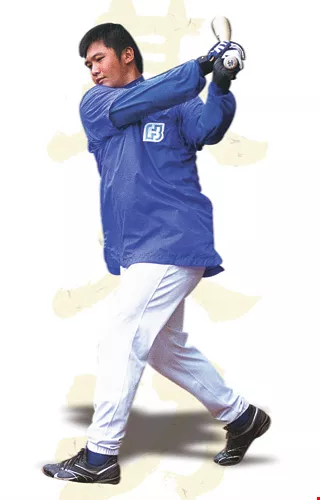
In over a decade of practice, he's practiced her swing more than a million times. Though he admits it's tough, Yang Chih-wei keeps hanging in there, determined to make it to the pros.
Inner tranquility
Coach Chi Lien-cheng trained under taiji daoyin master Hsiung Wei. Coach Chi stands at the front of the classroom, his back to his students, who are practicing relaxation through basic kungfu movements. "Relax your mind, relax your body, relax, sink down." He teaches his students to let stress drain from their bodies, starting from the top of the head, like water slowly dripping from a bucket. The students are bending forward at the waist and lowering their hips to the floor, eyes focused downwards, concentrating their thoughts. In this big silent classroom, the more sensitive among them can feel numbness and bloating at the ends of their fingers, and sense the qi--life energy--circulating through the body, flowing and vibrating in tune with the qi in the air.
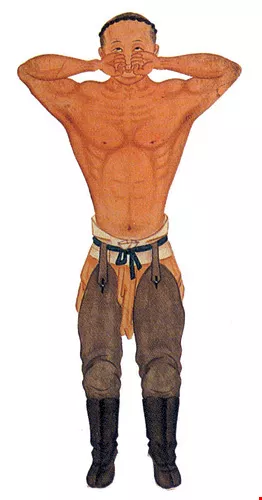
Wearing loose casual clothing, Chi Lien-cheng demonstrate the basic movements of taiji daoyin--moving slowly up and down while keeping the body absolutely vertical. Then he leans his body forward and at the same time slowly raises his arms, describing an arc in front of his face, and retracts his arms to his chest. With his upper body remaining upright, his knees bend smoothly and his hips slowly sink until his buttocks nearly touch the ground. From beginning to end, the soles of his feet are fixed firmly on the ground, and his breathing is continually adjusted to synchronize with the movements. Then he contracts his abdomen, forcing the qi to the dantian (a region three inches below the navel). His body moves slowly upwards, he breathes in and out twice, and pushes up the qi from the dantian to his chest. The qi travels up his spine, straightening his body.
Chi Lien-cheng says "If you want to master basic kungfu, hard practice is the first requirement." He recalls that 20 years ago when he began studying taiji daoyin, he had to do the basic movements 200 times without a break, and stand on a horizontal wooden bar for half an hour; so in the first day he lost two kilos. In contrast, some of the less stoic students in the classroom are in pain after doing the exercise only 12 times. Their arms ache and legs become so weak that they have to stop.
While baseball has been around for only about 200 years and emphasizes physical power, taiji daoyin, which stems from the 600-year-old tradition of taijiquan (tai chi), is undergoing something of a revival in Taiwan. Baseball and taiji daoyin focus on different types of power. The latter is gentle and slow, conserving and maintaining strength, health and inner tranquility by using constant twisting, turning, extending, stretching and shrinking movements, adjusting the breathing and the center of gravity, and interweaving the positive and negative. As the arms and legs move, circulation is stimulated and the internal organs are gently "massaged" by the circulating energy.
Building the walls of knowledge
Wu Mi-cha, professor of history at National Taiwan University, notes that "traditional Chinese martial arts emphasize assiduously training basic skills, and gradually this idea has migrated to other fields such as cultivating virtue, promoting one's career, governing a family or ruling a nation--everything depends on one's grasp of the fundamentals." The early Chinese emperor Tang (founder of the Shang Dynasty) is said to have had the following words carved on his bathtub to remind himself every day: "If one can examine oneself and cultivate virtue every day, one should keep doing so regularly to stay fresh. One should refresh oneself day after day." Despite his great wisdom, Confucius examined himself three times every day. The gongfu of cultivating one's moral character has to be practiced constantly. Time is needed to achieve anything worthwhile, and there are no shortcuts.
Wu Mi-cha says "Even learning Buddhism emphasizes practising basic skills; the basic skill of Zen is sitting in meditation." Even Western scholars understand that the persistent inculcation of basic skills is an important educational tradition in the East, providing advantages for the peoples of East Asia. While Chinese people regard practising the basics as an elementary life skill, they are always trying to improve methods and create new techniques after learning the basic concepts. This is the same principle used by the masters of Chinese kungfu sitting in meditation everyday, never departing from the fundamental skills of their art.
Wu says that the traditional martial arts use "impartational" teaching methods, passing knowledge from one generation to the next, in contrast to the modern education system, where learning is based on "inspiration."
Whichever style of teaching is used, they are not mutually exclusive, but will stimulate each other and develop. Basic concepts are still the main point of emphasis in modern education.
Wu Mi-cha, an expert in Taiwanese history, has a special set of requirements for the basic skills of postgraduate students who come to him asking for initial instruction. Wu says, "The primary element in studying history is textual criticism of the old documents." Taiwanese historical data since the 17th century has been recorded in three different languages--Chinese, English and Japanese--these three languages are the basic requirements for students wanting to do research in this area. Additionally, because Taiwan has had a complex interwoven relationship with previous colonial powers, including changes in world politics, political geography, its own politics, economics, and even navigation, students need to have a clear conception of these ideas. For a researcher, the office reflects the concepts of basic skills training: the brick-sized books lining the shelves in Wu's research office look as if they are supporting the sky of knowledge.
In fact, doing academic research is like laying brick on brick to build a wall. One confirmed fact after another is put meticulously in place, building up knowledge one course at a time; as in a real wall, a misplaced brick may make the whole structure unstable or even cause it to collapse. This is the basic concept of gongfu: to be successful, one must take one small step at a time, otherwise one will never be able to climb to the top--to reach the highest levels.
Tradition lost
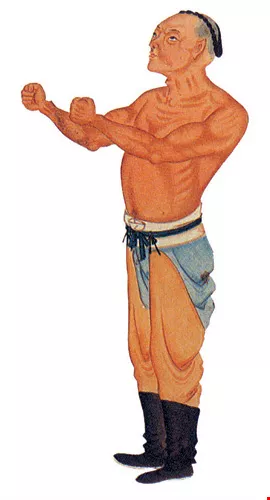
Snow falls heavily in a canyon as a martial arts knight practices his basic kungfu moves in isolation. But in modern society, where the pace of development comes ever faster, it is rare that one can cloister oneself to cultivate skills.
"To master the basic skills, you've got to have the right social and environmental conditions," remarks Lin Hua-wei, who recently returned to his former position as coach of Taiwan's national baseball team. He doesn't mince words: "Compared with Japanese and Korean players, Taiwanese players don't have the same foundation. It's an old problem." Because it takes as much as a decade to develop a player's talents, he will have many different coaches. "It's been more than ten years since I brought up the idea of drawing up detailed training materials for each level. But despite making a big fuss about it for so long, it's still just a concept. At every level coaches still teach their own way--sometimes they even teach superstitious nonsense. No one corrects their mistakes, so naturally the kids don't know who to listen to."
It is the lack of a spirit to improve continually that ails baseball in Taiwan. In the emerging field of Taiwanese history, too, Wu Mi-cha faces a problem that he simply doesn't know how to solve.
"The lack of basic data and materials is a big problem. The Japanese occupied Taiwan for 50 years, but no reliable research has been done on the workings of the Office of the Governor-General," notes Wu. "Consequently, if you try to look into Taiwan during the Japanese era, if you try to get a feel for a governor-general's administration, you immediately come to a dead end and are stymied."
Because the Japanese have conducted extensive research into Taiwan, almost every scholar of modern Taiwanese history needs to study Japanese, to be able to read Japanese documents. Nevertheless, Wu often encounters situations that leave him not knowing whether to laugh or cry.
"Some scholars include long lists of Japanese sources in the bibliographies at the end of their theses. But then they add, 'I can't read Japanese, so I was unable to consult these Japanese documents'!"
In this same cultural world where progress has been limited, in recent times there have been some calls to emphasize basic skills. "In recent years, we continually hear about 'creativity' and discussions of 'breakthroughs,' but we don't hear about 'basic skills' or the 'cultural basis for society,'" says Lin Hwai-min, artistic director of the Cloud Gate Dance Theater, which created a sensation this year with Cursive III. "The English word 'cultivation' relates both to education and to the tending of plants. When you plant something, you've got to be careful to give it water. You plant a sapling and think about how it can grow into a big tree. You don't just move in a big tree."
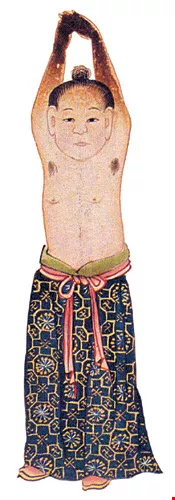
Better doing than talking
Open up your mind and gently pick up the brush with your fingers, and slowly adjust your grip as you practice the basic strokes of Chinese calligraphy. One Sunday morning in Peitou, the sun is warm and several parents rise early to take their children to Chang Mei-chu's "Calligraphy Hut" to spend a morning with their children as they learn and practise the basic calligraphic strokes. In an era when computers have become ubiquitous, the way the children slowly move their calligraphy brushes seems to stop the passage of time. Calligraphy requires a solid foundation of basic skills, and it also requires patience and humility. If you don't let things brew for a long time, you won't see results.
Yet "fast" is a hallmark of the digital age. In his bestselling In Praise of Slowness, British author Carl Honore writes that as soon as we remove all sources of stimulation we feel even more anxious and panicked. We feel the need to do something--anything will do--so as to fill up our time. The end result is that we lack patience, even to the point of lacking the will to think things through carefully.
"Our schedules as adults are jam-packed, so we just go ahead and keep our children constantly busy too--what with piano and art lessons and English study," says Ovid J.D. Tzeng, vice president of the Academia Sinica and a former minister of education. "Yet we hope they will do everything fast--study quickly, remember quickly and mature according schedule."
"From an educational perspective, the attitude of crassly 'pulling at seedlings to try to make them grow faster' is rife in our society," laments Tzeng. "This short-sighted pursuit of immediate gain reflects a pervasive anxiety, a lack of security that people feel in the face of high-speed competition. It's as if everyone has put on racing wheels, and you can't slow down--lest you get knocked over and trampled by the hordes behind you."
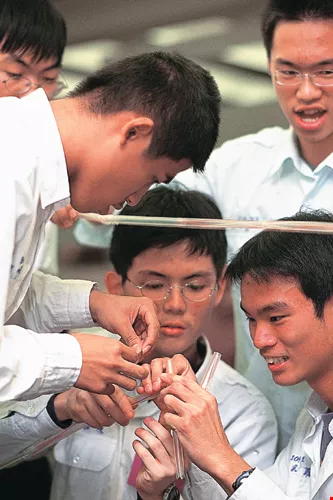
Every year at the Intelligent Ironman Creativity Contest there are inspired breakthroughs and long deliberations. Evidence of students' creativity and skill is on display everywhere.
Showboating
"Taiwan in the 21st century is a media society, 'an eyeball economy.' Everyone is scrambling to get in the eye of the camera and have their turn at the microphone. The microphone symbolizes successful exposure, and also power and profit," says incisive cultural commentator Nanfang Shuo, editor-in-chief of The Journalist. "The result is that everyone aims for the bizarre, thinking only about putting on a show. They talk only about strategy and power, and fight only for what they can see in front of them, never thinking long-term."
In such an atmosphere, it's no wonder that even politicians tend to be more and more shortsighted. "With such frequent elections, year after year, politicians are overcome with a crisis mentality. They have become willing only to make short-term investments. Infrastructure investment needs to bear fruit within two or three years. It's got to the point where they are sacrificing people's long-term interests. What is really needed is to compile data and conduct research, develop personnel, improve legislation, plan special programs. All of this is being overlooked because people are unable to attract the public's attention to push for it," says Wu Mi-cha, who was deputy minister of the Council for Cultural Affairs from 2001 to 2004. "This way of thinking is well described by the Taiwanese expression: 'When there is not enough food to go around fresh, why would you think about laying it in the sun to dry?'"
"The result is that there is a lot of talk, but the decision-making process is perfunctory, and even rather removed from core values. No one is willing to roll up their sleeves and get to work. The end result is that there is a lot of debate on policy and very little done of practical value," says Wu, who has observed the situation up close.

Read my liposome
Modern society puts a lot of stock in winning by stroke of genius, of victory going to those who do something first. But there is no guarantee that these frontrunners will remain in that position forever. Rather, only with basic skills and understanding will they be able to stick to their guns and react fast to opportunities. Hong Kee-lung is president of the Taiwan Liposome Company, which has recently had brilliant success with developing drug delivery systems. Hong, who recently received a personal achievement award in the Ministry of Economic Affairs' Awards for Industrial Technology Advancement, has a thorough understanding of the frustrations and doubts involved with solitary striving.
When his company's nanoliposome drug delivery system is used with anticancer drugs, it's like giving them a guidance system that locks them onto the target. On reaching the location of a cancer cell, the delivery system releases the drug with a degree of precision that avoids damaging healthy cells and increases the drug's reliability and effectiveness. It helps to extend a patient's life and to ease symptoms such as hair loss and nausea that often plague late-stage cancer patients undergoing chemotherapy.
Gradually garnering a lot of attention in the global medicine marketplace, these liposome delivery systems are among a small number of cutting-edge medicines made in Taiwan.
Hong Kee-lung, Taiwan Liposome's chairman, headed the Liposome Research Laboratory at UC San Francisco before returning to Taiwan in 1997. With over 20 years of experience, he was a leading nanotech medical researcher. Nevertheless, when Hong first returned with this technology to Taiwan, very few people thought much of it, and fewer still were willing to invest.
"The success rate of developing a new medicine is one in 5,000, and the process usually takes at least ten years," explains Hong. "Domestic investors are used to a fast return on their investment. Very few are willing to make investments of this ilk, where it seems that you'll never see the light at the end of the tunnel."
Convinced of the merits of liposome technology, Hong struggled to get financing from banks, and so had to go to relatives for funding in order to embark on the extended process of developing a new technology. To train his staff, Hong has engaged in long-term cooperation with the graduate school of pharmacy at National Taiwan University, thereby attracting students with a medical background to perform liposome research.
After 30 years of education and seven years building his team, Hong was then able to put his company's first product on the market. Achieving the first benefits after many years of financial obstacles, Hong Kee-lung's determination has finally reaped substantial rewards.
Defining professionalism
According to legend, after the Zen master Bodhidharma traveled from India to the Shaolin Temple, he chose to stare at a rock wall in Wukongfeng Cave. After nine years, his own shadow was "affixed" to the wall, and meditation became the principal method of Zen. Down to the present, it has retained its focus on concentration, settling one's mind and calming one's qi no matter the trends of the time.
"In English, it's called "the basics' or 'the foundation," says Ovid Tzeng. "In terms of a specialized field, it's the minimum foundation needed for high level research."
"Today, with professional fields growing more and more specialized, when you talk about the basics, you need a common unifying principle," says Nanfang Shuo. "In my view, that ought to be something like professional ethics and a set of overarching professional rules, so that professionals in every field will do the right thing and also advance with the times."
This kind of basic foundation exists in every profession and every field.
Sometimes it can be turned into various kinds of know-how that can be put into work guides and professional guides and left on a shelf for people to flip through at their leisure. More often, it is bound up with acquiring and practicing basic skills and becomes internalized. It's like how you can see a painter in his painting or determine the moral character of a person from his behavior.
Three minutes of a stage performance requires ten years of offstage practice. The social environment required to support that acquisition of basic skills is well worth pondering.
- Basic training
The basics are different for every field, but they have some features in common. When you get stuck in a rut, it's time to slow down and get back to them. Here are some tips.
- Getting started:
- Don't get distracted. Learning to concentrate and persevere is the first step.
- Start slow and build up speed. If you can't be consistent while going slow, you'll never be effective moving quickly.
- Start with a little and let things accumulate gradually. Don't get greedy.
- Keep it simple. Find your best methods while working on the easiest parts.
- Developing a technique:
- Break down your movements and keep an eye on the details. The smallest things might be key.
- Keep practicing until you know your craft by heart and have it completely internalized.
- Be persistent--let your skill become stronger with every passing day.
- Becoming a master:
- When you run into difficulty, polish the details of your technique.
- Make sure to harmonize the details that trickle in with the whole.
- Leave yourself some space to explore and occasionally break the rules.
- To meet today's demand for constant innovation, maintain an interest in other fields. You might find inspiration in outside knowledge.
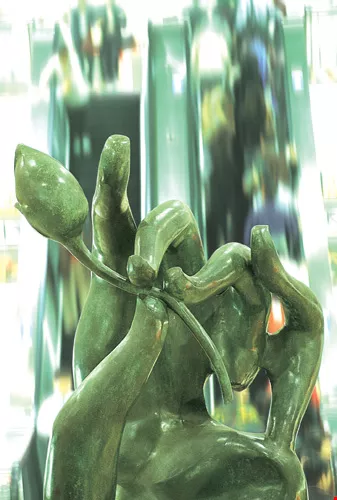
The Buddha held up a flower, and the enlightened understood. No matter how busy life gets, one should always leave some space for getting in touch with the fundamentals.
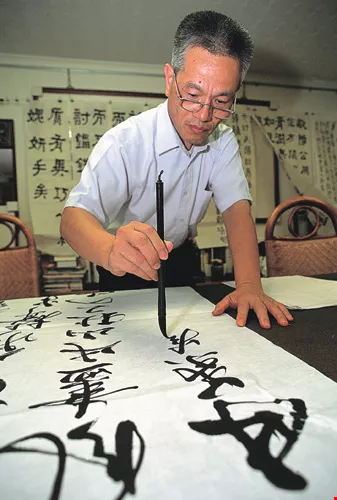
Chang Mei-chu started out using homegrown methods, and didn't come across a great teacher until he was 30. Now he is never far from his brush and paper, and has calligraphy students all over Taiwan and even in America.
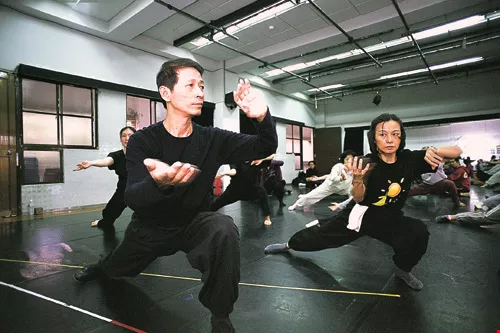
When martial arts moves are practised to perfection, mind and body become one. Leading students through the turning, rising and falling movents of taiji daoyin, Chi Lien-cheng (in foreground, left) focuses his qi and demonstrates the beauty of traditional martial arts.


