So You've Won an Award. Now What?The Road to Commercialization
Wang Wan-chia / tr. by Scott Williams
May 2011


An elderly man who doesn't get around very well leans on a cane and wobbles his way onto a bus. Approaching his stop, he grasps the cane in one hand and feels around for his change. If the cane slips from his grasp and falls to the floor, he has to bend over inside the swaying bus, much to the dismay of onlookers worried for his safety.
Seeing such an incident at first hand inspired Feng Cheng-tsung and Cheng Yu-ting, students in the Graduate School of Design at National Taiwan University of Science and Technology, to design something they call the "balance stick." The stick, a cane that remains upright on its own, won fourth prize from among 8,007 submissions from 52 nations at Germany's iF design exhibition.
Fortunately for Feng and Cheng, manufacturers showed immediate interest in their design. Though they hoped to commercialize the idea, they ran into difficulties when they attempted to manufacture it. But once you've won an award, you can't help but take on the challenges of commercializing your design....
The iF design awards are recognized the world over as among the most prestigious in the field. iF reworked its award categories in 2008 to encourage young designers, establishing a "concept" award limited to students and recent graduates that allowed them to register and exhibit award-winning work free of charge. The category is fiercely competitive, perhaps even more so than iF's corporate product design awards.
Taiwan performed remarkably well at the 2011 exhibition, earning 31 of the 100 prizes awarded, a figure that surpassed both South Korea's 24 prizes and mainland China's 15.
For the last three years, iF has also ranked the universities that participate from around the world. This year, National Taiwan University of Science and Technology (NTUST) and South Korea's Samsung Art and Design Institute shared the top honors. Some 14 other Taiwanese schools, including National Cheng Kung University and National Taipei University of Technology, also ranked in iF's top 100.
Taiwan's success at international design shows extends well beyond its recent iF concept award. In fact, over the last few years Taiwan has brought home more than 100 major design awards.
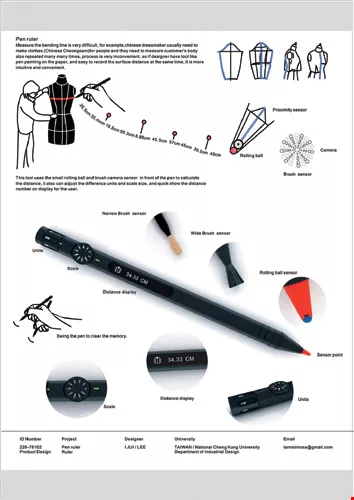
Lee I-jui, a PhD student in design at NCKU, earned a second place for his digital measuring device, the Pen Ruler, in the battle for an iF concept award. It was the best showing to date at iF for a Taiwanese student project.
Winning an award can send a de-signer's spirits soaring, but fewer than 10% of the award-winning ideas of the last few years have been successfully turned into products and brought to market. Are students' innovative designs doomed to remain "paper tigers" forever?
Cheng Jin-dean, an associate professor with NTUST's Department of Commercial and Industrial Design who has worked for Sampo and the US's renowned frog design and run his own design company, says that there are two major reasons why student designs are not widely commercialized: first, students don't understand the commercialization process; second, manufacturers have little interest in investing in design.
Another issue is that when awards panels evaluate entries, they start with the concept: whether a design provides a new, innovative and feasible solution to one of the many inconveniences of everyday life. Production of the design simply isn't a key issue.
Therefore, the primary concern of participating students is originality. It takes an experienced manufacturer to determine whether a design can be turned into a product, what sort of manufacturing techniques and costs it would entail, and the ultimate pricing of such a product.
Commercialization also requires finding a manufacturer with an "adventurous" bent. You have to estimate manufacturing costs, market size, and profit margins, and can't depend on sales materializing simply because your product is critically acclaimed. Manufacturers vary in their appreciation of good design and their willingness to devote resources to it. Even those stirred by a new design may not have the kind of business model that allows them to develop it. "Firms that have always made their living selling products for NT$30 apiece aren't going to switch overnight to producing highly designed products that cost NT$30 to manufacture and sell for NT$100," says Cheng Jin-dean.
Take Feng and Cheng's balance stick, for example. Stable, three-legged canes are an extant product category. Their weakness is their large footprint, which is poorly suited to stairwells and narrow arcades. The balance stick's single leg is easily maneuverable on all kinds of pathways. Moreover, the whole world is facing the problem of aging populations, making the potential market huge. Once news of the balance stick spread, nearly a dozen manufacturers from Taiwan, Canada, Denmark, and elsewhere scrambled to get in touch with Feng and Cheng about producing it.

Comic-book-style "Jump from Paper" handbags are wonderfully playful.
As originally conceived, the balance stick applied the same principle used in a tilting doll: a lead weight in the base would keep the cane upright.
But while working on development at a Taiwanese medical equipment supplier, the two classmates realized that a balance stick of the same length as a typical cane (110-130 centimeters) would need a 2-kilogram weight in its base to remain upright. Most canes weigh less than 400 grams, and the extra weight of the balance stick represents a serious burden to the elderly. As a result, the two designers are now looking for a more feasible solution.
While commercializing a product is difficult, it is not impossible. Chiu Chi-shen's FlexibleLove, also an -NTUST student project, is a case in point.
Chiu, a Miaoli native who began his studies at NTUST six years ago, made a surprising discovery at a factory near his hometown: pallets could be made from honeycomb cardboard instead of wood. Utilizing the mater-ial's extensibility and its weight-bearing capacity, he produced a chair that could be drawn out like an accordion. Collapsed, it was 23 centimeters wide and seated one. Extended, it stretched out to 720 cm and provided seating for up to 16 meaty individuals.
Chiu's avant-garde, environmentally friendly design earned him a write up in Wired magazine, which called his creation "the coolest chair in the universe." Priced at NT$12,650-23,150, FlexibleLove chairs have been on the market for five years and are available in 20 countries. Sales to date are in excess of 5,000 units and even the Museum of Modern Art in New York has one on display.
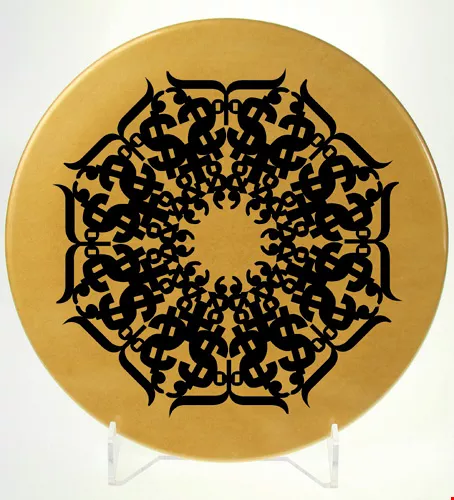
Three NTUST student projects, all soon to go into production: 1. Nest; 2. In Out Bottle; and 3. Letter Cutting.
The man behind introducing the world to FlexibleLove is a fellow -NTUST design alumnus-Vito Lin, CEO of Pinzaan.
Born in 1982, Lin noticed while still a student that many stunningly original works ultimately come to nothing because their creators lack marketing, manufacturing, legal, or financial support. His observation led him into the field of design distribution and he chose the modernist, paradigm-busting Flex-ibleLove as his first project.
Quickly deciding that FlexibleLove should be marketed to Western nations with high levels of discretionary income and demand for lifestyle products, Lin applied for patents and trademarks in the US and Europe. Because copyrights and trademarks are effective only in the region in which they are issued, Lin had to apply in each region individually. As a result he spent two-thirds of his startup capital (roughly NT$500,000) just securing his IP.
Lin then shot a short video that made a playful point of the chair's extendibility. He posted the -video, in which he wore black and put the FlexibleLove through its paces in a white room, on YouTube. The video spread like a viral pandemic, starting conversations and drawing orders from buyers around the world. "I knew that the Internet would be an effective way to get the word out," recalls Lin. "I just didn't think it would happen so fast."
Lin describes the relationship between Pin-zaan and his designers as being like that between record label and rock star. The company focuses on "discovering" highly designed products with potential. It conducts marketing studies on a given design, then attempts to commercialize it. He says Pin-zaan handles everything-marketing strategy, distribution, IP, manufacturing and brand management-itself.
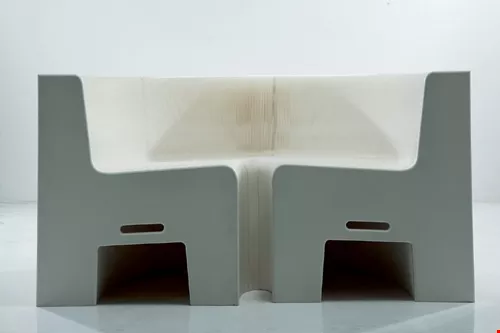
The National Taiwan University of Science and Technology student who developed an extendable chair successfully commercialized it, then introduced a more durable, water-resistant version made from kraft paper in 2009.
With so many original designs awaiting commercialization, how does Lin pick today's stars?
He says that even before a product is commercialized, its design tells you things, suggesting how its users look, what their lifestyle is, and whether the product itself will be cheap or pricey. Your very first look gives you a sense of whether the design has market potential.
Lin also looks at whether products have cross-cultural appeal. Those that do can be targeted at the global marketplace for potentially huge sales. Those that lack it may be limited to a local market. For example, the "divination block" erasers distributed by a certain Taiwanese company allow students taking exams to "ask the gods" for help when they run across a question they can't answer. It's a good gag if you're Taiwanese, but few people outside of Taiwan are likely to get the joke.
Pinzaan introduced another new product last September called "Jump from Paper." It originated with NTUST design graduates Rika Lin and Chay Su. Reacting to a wall full of designer handbags they couldn't afford to buy, the young designers decided to simply draw their own. The idea grew into their graduation piece for the Young Designers' Exhibition.
Vito Lin was drawn to the bags' American-comic style and the way they looked as if they'd just leapt off a sketchpad. He saw a market for the bags among university students and young office workers aged 18-35, a group that tends to be fond of fresh, interesting products. In Lin's view, such consumers wouldn't buy the bags for everyday use, but to attract attention and start conversations.
Having already identified target market segments, it was relatively easy to develop promotional materials and gain media exposure. Vito Lin used his friends to get the bags onto the Kangxi Lai le and University variety shows, which led to inquiries and, owing to the widespread influence of Taiwanese TV programs throughout the Chinese-speaking world, opened up opportunities in Hong Kong, Singapore, and mainland China.

Vito Lin targeted the high-end Chinese-style furniture market when he introduced the Dong Dong Chiang, a chair that converts from a stool to a six-legged recliner.
University design departments have begun taking action to promote the commercialization of student projects.
National Cheng Kung University's Department of Industrial Design, which has excelled at research throughout its long history, now ranks number two in the world in terms of articles published in the field's academic journals.
In recent years, the school has begun focusing on internationalization, using international internships and "study camps" to help students get comfortable using English in business settings and to foster a more global vision.
Chen Chien-hsu, chairman of NCKU's Department of Industrial Design, mentions a 2008 study-abroad design camp the department arranged in Japan. NCKU and Chiba University formed a joint team that went to work for Japanese cosmetics maker Ka-nebo designing a jar and packaging for a soon-to-be-released product.
The project had size specifications and a well defined target market, and had to account for an included cosmetic spatula, forcing students to learn how to be creative when dealing with multiple constraints.
Schools are also integrating student-industry cooperation more directly into their curricula. Tseng Jian-feng's "Industrial Design" course had students pick a product made by a particular Taiwanese sporting goods manufacturer-a caster board, kick scooter, or luge-and find a way to improve it.
Senior Li Jinghua chose to work on an old-style caster board, replacing the two boards and flexible material joining them with a one-piece plastic deck that would allow for integration of production processes. The manufacturer liked the idea, bought it, and put it into production.

The National Taiwan University of Science and Technology student who developed an extendable chair successfully commercialized it, then introduced a more durable, water-resistant version made from kraft paper in 2009.
Looking for ways to commercialize more of its students' award-winning concepts, NTUST studied the approaches used by the Samsung Art and Design Institute and the US's Art Center College of Design, and went on to establish a design center early this year. The center seeks to further students' understanding of design practice and organizes international "design camps." It also facilitates student-industry cooperation, develops cutting-edge concepts (like ePaper) and innovative designs, and brings innovators to the school to lecture on special topics.
One such lecturer is Chen Yanting, a 26-year-old NTUST graduate who received his masters from the Pratt Institute in New York last year. In addition to teaching second-year students about creative planning, Chen is also building the student-industry matching platform. He provides advice to students, helping forge a path from their concepts to actual commercialization.
Chen won numerous prizes as a student at NTUST, and now holds nearly 80 international design awards. This year he raked in an unprecedented three iF concept awards.
Following the design center's establishment, the school launched its first product: the 2010 IDEA award winning In Out Bottle-a storage jar with a silica-gel lid that pops in or out, creating a funnel to pour things in and a spigot to pour things out, with just a little push or tug.
"Going from concept and design to commercialization was an entirely new educational experience," says Chen. He explains that he only really appreciated how many food-safe silica materials there are, and the costs and benefits of single-color versus two-color printing, after he'd begun the manufacturing process. Commercialization also meant making adjustments to the thickness of the lid to achieve the best pouring.
Chen's Letter Cutting, a series of posters and videos that mix Roman script with Chinese paper-cutting techniques, also drew interest from companies interested in transferring the technique to lacquerware production.
In the end, getting a product to market is a bit like running a marathon. You not only need to be in good design shape, but also to commercialize your idea if you are going to bring home the gold. The second leg of the race is on! Taiwan's designers had better pick up the pace!

Three NTUST student projects, all soon to go into production: 1. Nest; 2. In Out Bottle; and 3. Letter Cutting.
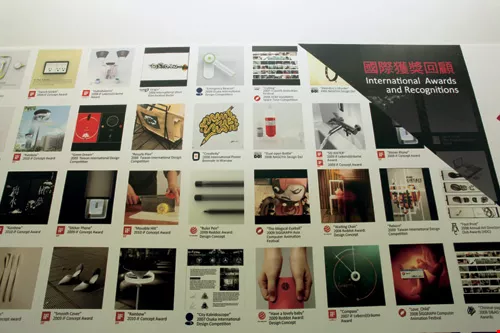
The student projects that win awards are incredibly innovative, but how many are actually capable of being put into production? That's the challenge Taiwanese design faces today.

Three NTUST student projects, all soon to go into production: 1. Nest; 2. In Out Bottle; and 3. Letter Cutting.
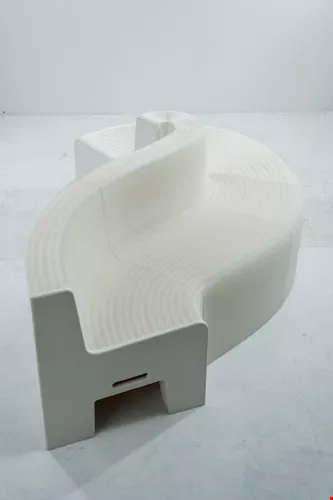
The National Taiwan University of Science and Technology student who developed an extendable chair successfully commercialized it, then introduced a more durable, water-resistant version made from kraft paper in 2009.


