

When a plant closes and workers are laid off, what are the rights and obligations of labor and management? How can the government help?
The closing of plants with large-scale layoffs is by no means unique to Taiwan. In fact, plant closings have been going on in the advanced industrial nations for well over a decade now. Indeed, given Taiwan's economic health and low unemployment rate, the situation here is not bad at all. Nevertheless, in order to minimize the damage from plant closings, many measures are essential.
In order to protect the interests of laid-off workers, many countries have passed "plant closing laws" to check up on the owners. The plant closing process may require proof that the operation is losing money, and could require the approval of a court of law. However, in Taiwan, given a number of practical considerations, the government still respects the operation of the market here. In other words, the management side has a great deal of leeway, and can unilaterally declare a plant closing.
The various protections offered to workers abroad through plant closing laws are in Taiwan scattered in a variety of statutes, such as the Labor Standards law, the Employment Services Act, and the Regulations on Labor Insurance.
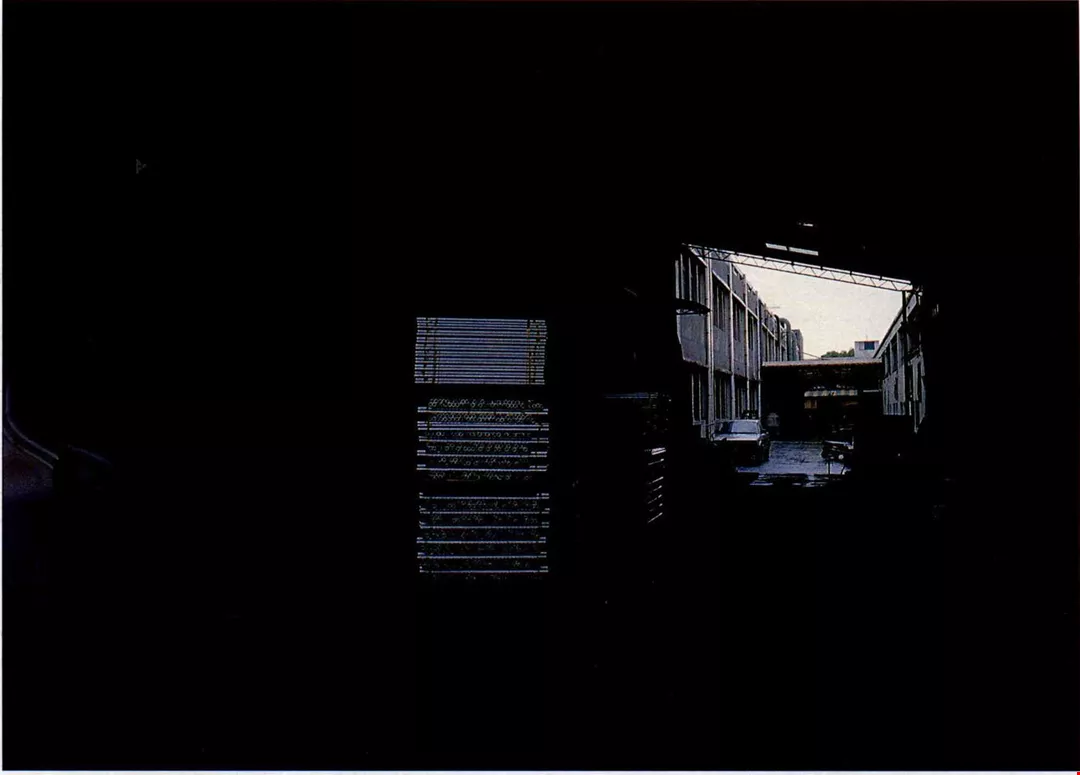
This formerly bustling factory is now empty; the workers have gone their separate ways. (photo by Shih Wei-kang)
Forewarning, notification, guidance
These protections, notes Ku Sung-mao, a section chief in the Council of Labor Affairs who deals with labor-capital disputes, can be divided into several categories. The first is "forewarning." This means that the owners should notify employees of an imminent plant closing a certain amount of time in advance. This should allow the workers to look for new jobs and make psychological adjustments.
In the United States, the forewarning period is generally 60 days. In Taiwan, as stipulated in the Labor Standards Law, employers must give ten days advance warning to employees who have worked for them for more than three months but less than one year; employees of more than one but less than three years should be given 20 days notice; and employers are supposed to give 30 days warning to employees of three years or more.
"Right now we are in the process of amending the law, and we are hopeful that we can extend the forewarning period for plant closings to 40 days,"says Ku Sung-mao.
The problem is, whatever the law may say, most employers worry that there will be instability if the workers are forewarned. As a result, they would rather procrastinate until the last possible moment before announcing the closing; anyway, they figure, they can compensate for not meeting the required number of days by paying more money. Unfortunately, such thinking defeats the original purpose of the law, which is to give employees time to adjust and look for new jobs.
Besides forewarning employees, management is also required to give "notification" to the government. That is to say, seven days before the plant closes, management is required to give a complete list of employees and their personal data to the local labor and employment guidance agencies, so that the government can notify workers by mail of employment services that are available.
However, this provision is only honored sporadically. While industrial parks, which have their own management offices, can see that this requirement is usually fulfilled, it is a different story for small operations of only 20 or 30 employees: If they want to close, then they just close without a trace, and who cares about notification or employment guidance?!
In many cases, the employees' first reaction upon hearing their place of work will shut down is, "How can you close the plant just on your say-so?" or "We're not going to let you get away with this!" Nevertheless, when it is clear that the "right to work" is irretrievably lost, and the plant closing is on the verge of being a reality, what the workers want then is to pick up severance pay.
When employers cut and run
The method of calculating severance pay is that workers are entitled to receive one month's average wages for each full year worked. So-called "average wages" is the average amount of money earned over the previous six months, including basic salary, overtime pay, and fixed subsidies. In theory, then, an employee with over ten years seniority should collect enough severance pay to cover a year of living expenses.
Even with severance pay, having one's plant closed is quite a blow as it is. But reality is often much worse: Many owners do not merely "close," they just plain "abandon" their factories and take off. Not only do employees lose their severance pay, often they lose months of back wages.
"When foreign companies close plants, they generally hope to leave a good impression, and will set aside severance pay in their budgets," says Shen Chan-chuan of the Kaohsiung branch of the Export Processing Zone Administration of the Ministry of Economic Affairs. Touring empty factories in the zone, he says with emotion, "But many local companies have no sense of responsibility."
When the owners leave them in the lurch, what are employees to do?
"If the owner does not appear, laborers can appeal to the various bureaus of labor affairs, and then we make a determination whether the factory has in fact closed based on whether or not it has 'ceased production and ceased operations,'" explains Ku Sung-mao.
With the certification in hand, workers can then go to the Central Trust of China to collect the "retirement reserve fund" deposited in the company's name. Money is first paid out to those who meet retirement qualifications, and whatever is left serves as severance pay for the remaining workers. As for back wages, applications can be made to the "back wages compensation fund" of the Council of Labor Affairs.
As the name suggests, the retirement reserve fund is supposed to be a reserve to be paid out to those who retire. Each company keeps a separate account, and management is supposed to make a deposit each month depending upon how many workers they employ. The back wages compensation fund is a form of social insurance: All companies deposit money into a single collective fund, and when one company folds and is unable to pay back wages, money can be appropriated from the fund.
Stand up for your rights
Of course. most of the time when workers have to have recourse to these monies, the amounts are still far below the levels stipulated in the Labor Standards Law, and can only be considered "better than nothing." What's more, though the law is well-intentioned, there is little supervision, so that it is difficult to ensure that owners meet their obligations. According to current regulations, if the owners fail to deposit the required funds, and the local labor inspection office discovers this, the owners may be fined. But because most owners figure that "if I'm caught it won't be too late to pay the money then," it is estimated that only about 20% of companies actually pay the required amounts.
It is especially important to take notice of the fact that a full 40% of employees--more than 2 million people--are not even covered by the Labor Standards Law at all. These include people working in wholesale and retail sales, services, finance and insurance, and more. That is to say, most office workers lack even the unreliable protections described earlier.
For an individual, being laid off is one of life's tribulations. From the government's point of view, the fundamental resolution of the problem is to see that people are retrained with some skill so they can reenter the workforce as quickly as possible. The Council of Labor Affairs in 1990 initiated its program of employment guidance for workers laid off by plant closings, and has continually broadened eligibility since then in hopes that more workers would utilize the service.
In the newest regulations, laid-off workers may get retraining, and can draw NT$6,000 in living expenses for each month in training. However, perhaps because only "the main income earner in the household" can apply, many women workers who earned less than their husbands are excluded from the program. Moreover, people in Taiwan have long been accustomed to finding jobs through friends and family contacts, and are not in the habit of looking for work through government agencies, so it is proving difficult to extend the service broadly.
Thus the system still has a number of shortcomings. However, no matter what, it offers a certain degree of protection. The important thing is that people should take notice of their rights and privileges even when times are good, and not wait until the moment they learn they will lose their jobs, because by then it may be too late!
[Picture Caption]
p.126
There are many laws designed to protect the interests of labor.Workers should understand these well even when times are good so that they are not caught unprepared if something goes awry.(photo by Shih Wei-kang)
p.128
This formerly bustling factory is now empty; the workers have gone their separate ways. (photo by Shih Wei-kang)


@List.jpg?w=522&h=410&mode=crop&format=webp&quality=80)


