Up, Up and Away
Reborn TransAsia Soars
Lin Hsin-ching / photos courtesy of TransAsia Airways / tr. by Jonathan Barnard
February 2013


In 2012 TransAsia Airways reaped nothing short of a “bumper harvest”!
As if to mock the tepid performance and growth of other airlines, TransAsia achieved a listing in International Business Times as “one of the 1000 fastest-growing global firms of 2011” (no. 707, to be precise). It was the only Asia-Pacific airline to make the list. In July it was also named by Aviation Week as one of “the best global airlines of 2012,” garnering a global ranking of six and an Asia-Pacific ranking of three and beating perennial favorites such as Singapore Airlines and All Nippon Airways.
The truth is that 10 years ago TransAsia was in such bad shape that it had to start selling off its airplanes to make ends meet. How was it able to transform itself in so short a time? And how has it been able to find a profitable niche in Taiwan’s airline industry between two behemoths with huge financial resources at their command?
On November 28, 2012, a shiny new A330-300 airliner landed at Taipei’s Songshan Airport and parked on the apron.
The A330-300 is made by Airbus, one of the world’s two main airplane manufacturers. Currently, some 93 airlines are using a total of 850 planes in the A330 series to fly among more than 40 nations. In Taiwan, China Airlines has 20 A330s and EVA Airways has 14.
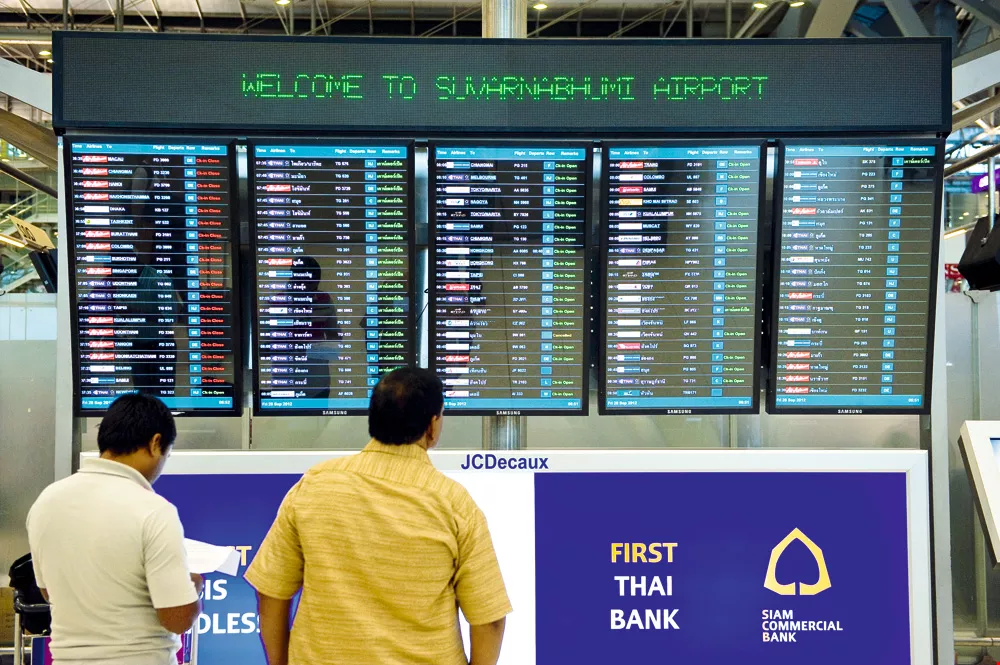
Bangkok, a major hub for air travel in Southeast Asia, may well become a new TransAsia flight destination this year.
But surprisingly this particular US$200-million jet was being purchased by TransAsia, which is not even a tenth as large as Taiwan’s two leading airlines. It was the first wide-body airliner the 61-year-old company had ever purchased.
In comparison to most airlines, which take a conservative approach when times are tough, TransAsia has had the courage to carry out an ambitious expansion plan in recent years. But rather than simply aiming to attract attention, the firm has a precisely calculated market strategy.
Alex Lu, an assistant professor of air transportation at Taiwan’s Kainan University, explains that TransAsia’s plan for purchasing wide-body aircraft has two aims: to aggressively garner new routes, but also to allow TransAsia to defend the profitability of its existing routes, by increasing capacity and efficiency. The A330 is twice as large as the airline’s preexisting A321s and A320s.
A special feature of the A330 is that it can fly short routes such as Taipei–Hong Kong and also take on longer routes like the nine-hour flight from Taipei to Sydney. The plane is first being used for popular flights, such as Taipei–Hokkaido and Taipei–Singapore. In the future it will be the airline’s greatest leveraging tool for establishing new mid-range and long-range routes.
Vincent Lin, chairman of TransAsia, who single-handedly directed the purchasing plan, points out that the A330 is a powerful weapon to use in seeking to gain new routes.
“It used to be that the Civil Aeronautics Administration would say, ‘If you don’t have any big planes, why should we give you routes?’ Consequently, when landing rights were divvied up among airlines, TransAsia was always getting the short end of the stick. Now we’ve satisfied the base requirement, so I hope we get better treatment from here on out!” Over the past year, Lin has repeatedly been in the news for his conflicts with the CAA over landing rights.
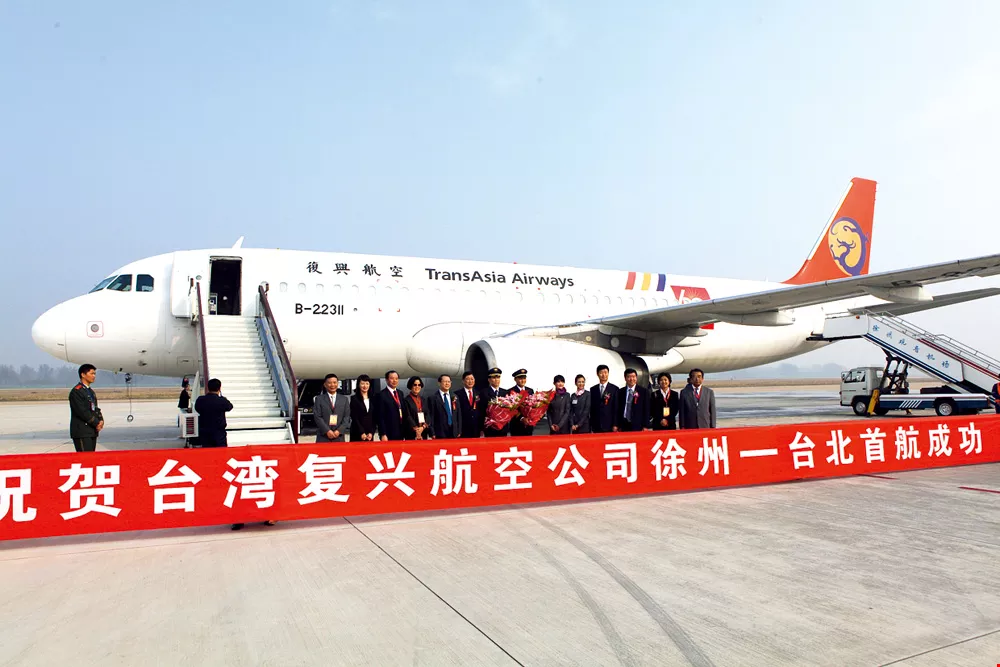
In November 2011 TransAsia launched its first flights to Xuzhou in mainland China.
Born in 1973, Lin is only turning 40 this year. He has been the key figure in turning TransAsia from a money loser in its corporate group to a “goose that lays golden eggs.”
With his law degree from the University of California’s Hastings College of the Law, Lin is the classic lawyer. Reputed to speak 150 words per minute, he has a lucid train of thought and a highly logical mind. He is far more eloquent than most corporate spokespersons.
The righteous lawyer in Lin really comes out when fighting for the company’s rights. In a much publicized battle with the ROC Air Force, Lin never gave any ground in forcefully making his case. The dispute can be traced back to March 21, 2003, when TransAsia’s flight GE543 received permission to land from Tainan Airport’s control tower, which was operated by the Air Force. Travelling at high speed along the airport’s No. 36 runway, the plane ran into a truck that was standing on the tarmac. The violent collision totaled the plane. As a consequence, TransAsia sued the Air Force for damages. Talks broke down, and the case dragged on for almost 10 years. TransAsia was victorious in its original suit and in two rounds of appeals, and it is now awaiting final judgment.
Lin points out that compensation in this case exceeds NT$500 million, along with more than NT$90 million in accumulated interest, the total of which equals one-tenth of TransAsia’s capitalization. If the company could have received compensation early on, he says, it would have had a huge impact on corporate efficiency going far beyond the simple dollar amount, but the Air Force continually delayed, wasting national resources.
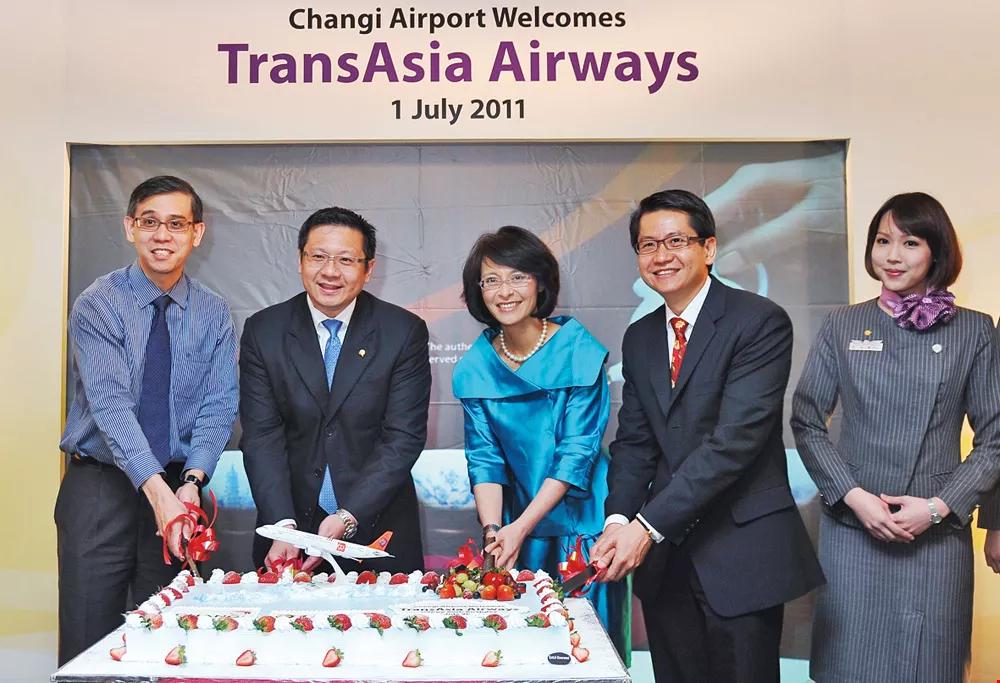
Over the past few years TransAsia has been aggressively fighting to obtain international routes and landing rights. The photo shows a celebration to mark the airline’s first flight to Singapore.
Despite his well established image as a battler for his company, Lin only took the reins at TransAsia in 2010, at which time he was the youngest-ever chairman of a Taiwan airline. His outstanding performance has really turned heads.
Apart from masterminding the ambitious jet purchasing plan, Lin oversaw TransAsia’s listing on TAIEX and secured private financing for the company totaling NT$898 million from sources such as Paradigm Transportation Holdings. Under Lin’s tenure, the airline has also established a travel agency and penetrated secondary air markets in mainland China, Southeast Asia and Northeast Asia.
Currently TransAsia flies 16 international routes, 23 cross-strait routes between cities in Taiwan and mainland China, and seven domestic routes. Each brings in about 30% of company revenue, with charters and other services bringing in another 10%. Nevertheless, revenues from the international routes are rapidly growing, and the airline also flies several exclusive routes, including those between Taiwan and Kushiro and Asahikawa on the Japanese island of Hokkaido.
Benefitting from these meticulously planned efforts, TransAsia has seen steady growth and earned international kudos in recent years. After grossing NT$5.7 billion in 2009, in only the first 11 months of 2012 revenues reached NT$8.7 billion. Total revenues for the year are expected to surpass NT$10 billion.
Although continually expanding, TransAsia hasn’t increased its debt load. Its debt ratio in the third quarter of 2012 was 42%, much lower than the 70%-plus that is the industry standard. TransAsia truly stands out for its “high growth, low debt.”
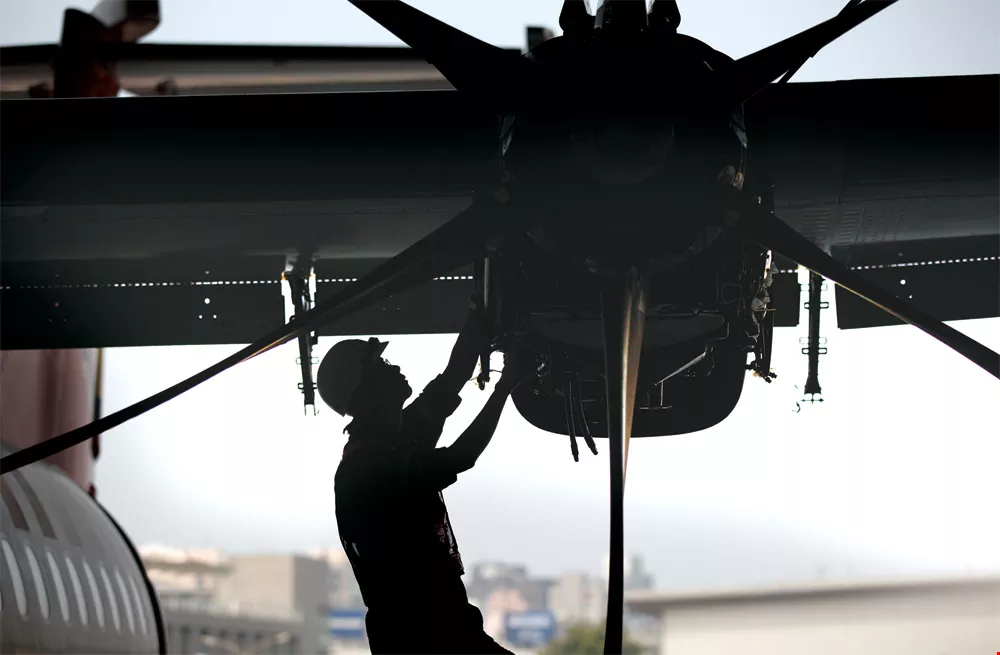
TransAsia pays particular attention to the safety checks and maintenance that are essential to air travel safety.
Vincent Lin, who took over his family’s firm, has relied on an active leadership style as he has transformed the image and market position of the company.
TransAsia was established in 1951, and in 1983 it was acquired by the Goldsun Group, which Vincent’s grandfather Lin Deng had founded. The elder Lin had grown up in Yilan County’s Yuanshan in a prosperous Taiwanese family much like the Wus of the Shinkong Group or the Koos of Taiwan Cement.
But after Lin Deng passed away in 1992, Goldsun and TransAsia took a turn for the worse, going deeper and deeper into debt.
In 2000, Lin Deng’s eldest son C.C. Lin, who had taken over the top job from his father, resigned, passing along the financial hot potato to his younger brother S.S. Lin (Vincent’s father), who had previously struck out on his own to found Taiwan Secom, a security firm. At that point TransAsia had been in the red for many years, with a debt ratio of 90% and total accumulated debts of more than NT$7 billion. It was flirting with bankruptcy.
In order to right TransAsia’s financial ship, in 2002 S.S. Lin hired Tony Fan, now chairman of the Taiwan Futures Exchange, to serve as chairman. As soon as the pragmatic Fan took up his post, the company began to sell off airplanes. Back then TransAsia had 23 aircraft, well more than it needed for its routes, and the fleet was depreciating in value to the tune of several hundred million NT dollars per year. The belt-tightening helped the company accumulate some much needed cash.
Meanwhile, under a plan developed by S.S. Lin, TransAsia began to focus hard on its flights between Taipei and Macao, a route that other airlines undervalued.
Direct flights between Taiwan and mainland China hadn’t yet commenced, and the long travel times associated with transferring planes at third locations annoyed business travelers to no end. Consequently, TransAsia formed alliances with Shanghai and Shenzhen airlines and began to offer “rapid transfers”: As soon as a TransAsia plane landed in Macao, a Shanghai or Shenzhen plane was ready to board at the next gate. The innovation cut an hour or more off of total travel times. And with tickets that were 10% cheaper than for flights that went through Hong Kong, mainland-via-Macao routes quickly attracted large numbers of business travelers. They were a major factor in pulling TransAsia from the brink of financial disaster.
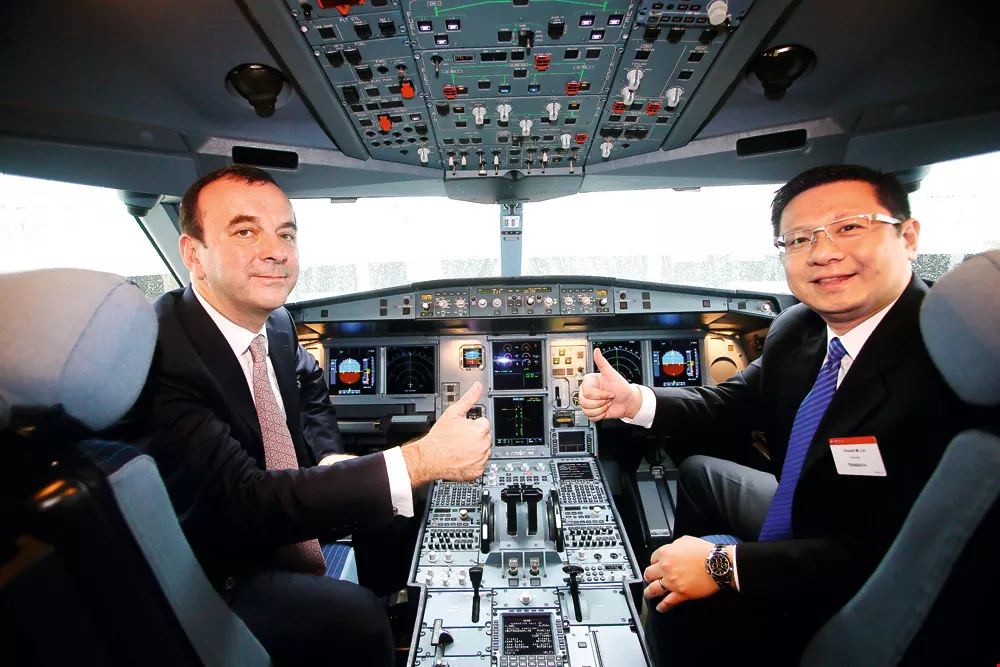
Vincent Lin, TransAsia chairman, and Jean-François Laval, Airbus VP for Asia regional sales, pose in the cockpit of TransAsia’s new A330.
At the end of 2009, with the introduction of direct cross-strait flights, TransAsia took big strides toward profitability after many years in the red. In 2010, S.S. Lin formally transferred authority over the company to his son Vincent, who had been groomed for the job by serving in various capacities within the Goldsun Group for many years.
Vincent Lin has carried on his father’s hardworking ways, arriving at work every morning at 8:00. Once a week he delivers a report to his father at breakfast, when they pore over the numbers together. Under Vincent’s leadership, TransAsia’s operational performance has steadily improved.
Budget airlines have emerged in Asia in recent years, gaining market share with their low prices. Lin is the first industry leader in Taiwan to respond directly to the challenges posed by those airlines with public appeals: “The government,” he argues, “ought to construct a supportive policy environment, leveraging the strengths of the three main listed carriers in Taiwan to quickly establish a Taiwan budget airline that can compete with foreign ones.”
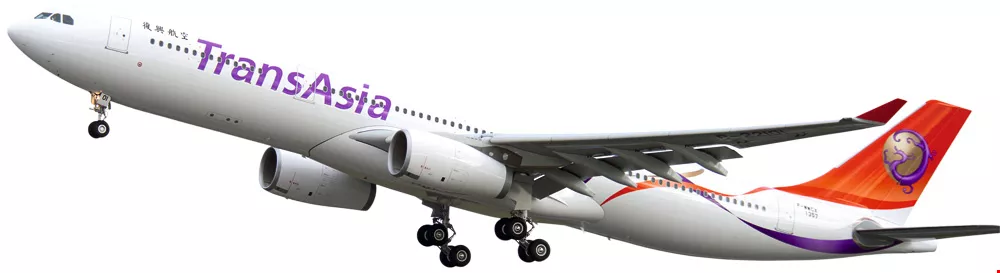
Now flying TransAsia’s Taipei–Singapore and Taipei–Hokkaido routes, this new A330-300 passenger jet will be a powerful tool in TransAsia’s campaign to gain international landing rights.
With the fierce market competition, Lin has stated time and again that TransAsia has no plans of establishing a budget airline itself. Instead, it is seeking to expand its market share with operational agility and high-quality service.
Taking a page out of the budget airlines’ book, from March to October of 2013 TransAsia will be offering “early-bird specials” on international routes. For example, an economy class round trip ticket to Singapore will only cost NT$3700 (before airport taxes at both ends). That represents a discount of 65%. And unlike budget airlines, TransAsia will still provide meals to all passengers. The promotion has excited a lot of travelers who wouldn’t have previously considered making that trip.
With regard to service quality, Wang Zhongming, TransAsia’s vice president for services, says that TransAsia’s cabin and check-in personnel are friendlier and more flexible than those of other airlines, and go out of their way to accommodate the needs of passengers. Their outstanding service has earned them awards from Global Views Monthly for two years running.
For instance, on one occasion a business-class customer who suffered from claustrophobia realized at the last minute that he had forgotten to take his medicine. Instead of boarding, he lingered at the gate. Upon seeing an anxious passenger with rapid breathing and sweat running down his brow, most airlines would have promptly made a PA announcement to remove his luggage and get him medical treatment. But TransAsia communicated by phone, avoiding a big scene and allowing the passenger to save face. He in turn greatly appreciated the airline’s delicate handling of the matter and has become a loyal customer.
The growing praise heaped on TransAsia has stirred expectations about its future, but Lin, who is himself a recent winner of a prestigious Eisenhower fellowship, insists that the “small is beautiful” ethos will remain at the heart of the airline’s operational philosophy. “Even if the company continues to grow, it will still embrace the core ideals behind that philosophy.”
After emerging from dark times to spread its wings and fly high, TransAsia, guided by the nimble business strategies of its third-generation chairman Vincent Lin, has already turned Taiwan’s airline industry into a three-way game. The airline has ambitious plans for new lines of business—by opening hotels, for instance—and it hopes to launch new routes that serve markets throughout the Asia Pacific, Australia and New Zealand, and even the Middle East and Eastern Europe.
All the signs are that this old, yet innovative company will continue to move ahead in elegant and dazzling ways, soaring high into blue skies.
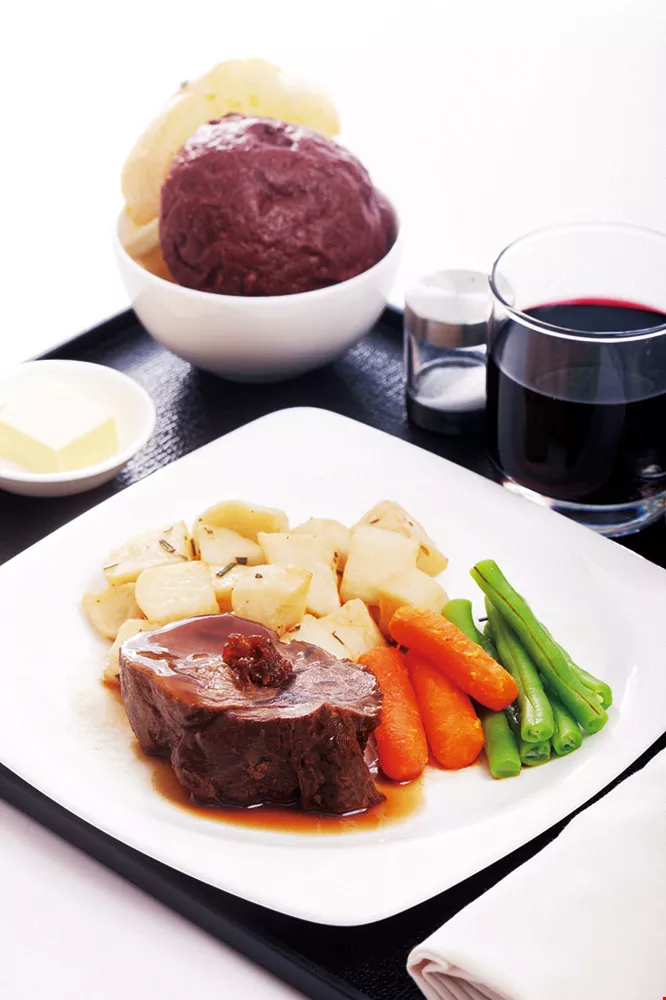
TransAsia’s high-quality food and warm and considerate service have earned the airline numerous industry awards.


@List.jpg?w=522&h=410&mode=crop&format=webp&quality=80)


