Lighting the Way to the Future:The TFT-LCD Industry
Vito Lee / photos Chuang Kung-ju / tr. by Minn Song
May 2005


Since the 1990s, a pitched battle for supremacy in thin-film transistor liquid crystal displays (TFT-LCDs) has been fought between Taiwan, Korea, and Japan.
This rivalry is not simply a matter of pride: its outcome will also be a decisive factor in the development of Taiwan's high-tech industry over the next ten years. Though Taiwan was a relative latecomer to the battle, it has progressed quickly. As Japan withdrew from the race for production capacity, a two-way battle between Taiwan and Korea became increasingly evident. This year, market trends show that Taiwan may surpass Korea for the first time, and become the world's largest LCD producer.
According to statistics from the Industrial Technology Research Institute, Taiwan's production value for flat-panel displays reached NT$706 billion last year, with larger-sized (13-inch and up) TFT-LCD panel production value reaching NT$430 billion. Production of related key components-including color filters, polarizers, glass, backlight modules, and driver chips-amounted to NT$210 billion. For 2005, the production volume for the industry as a whole is set to approach NT$1 trillion. The dream of creating two new trillion-NT-dollar industries that is part of the government's Challenge 2008 national development plan is close to realization.
Though they only came to prominence in the late 20th century, liquid crystals were actually discovered more than 100 years ago. Since 1998, LCD technology has been transferred to Taiwanese companies from Japan, and this acquired technology, together with Taiwan's own capital and talent pool, have been the main pillars of Taiwan's development of this new technology industry. And because 80% of the production process for TFT-LCDs is similar to that for silicon wafers, TFT-LCD production has emerged quite naturally as the successor to wafer fabrication as a bright new hope for Taiwan's industry.
Though it has achieved great success in just six short years, Taiwan's flat panel industry has already endured three boom-and-bust cycles. The balance among LCD monitors, notebook displays and LCD TVs has been shifting as the markets for the former two major flat panel applications have gradually reached saturation. All eyes have instead turned to LCD TVs. Besides taking aim at satisfying worldwide market demand for LCD TVs of 20 million units per year, Taiwan's flat panel vendors are looking to drive the replacement of cathode-ray-tube televisions with LCD versions, and thereby corner a global market of 160 million television sets per year.
Near the end of April, heavy vehicles scoot in and out of a large construction site beside the Southern Taiwan Science Park (STSP) in Tainan County's Hsinshih Township. Viewed in aerial photographs, this flat area of bare earth resembles a new cellular outgrowth forming out of the southwest side of the STSP.
The 247-hectare site, Taiwan's first industrial zone devoted to LCD TVs, is a joint project of the Tainan County Government, the STSP and the Chi Mei Group. Not only have companies in allied industries made frequent inquiries, but more than ten banks are offering syndicated loans to companies hoping to set up there. It represents the potential for a yearly production value of NT$200 billion and 30,000 jobs, as well as something even more important-development of the downstream segment of Taiwan's flat panel industry over the next ten years.
"This is Chi Mei Optoelectronics' most important step in the next phase of development," says Jack Lin, the vice president at the company who is in charge of development of the LCD zone, and also president of Linklinear Investment Co., Chi Mei's venture capital arm.
Since entering the industry in 1998, Chi Mei Optoelectronics has placed an emphasis on vertical integration. Then-chairman Hsu Wen-lung personally negotiated with Japanese vendors such as Nitto that controlled key components for flat panels, convincing them to set up shop in the STSP, while also helping bring glass substrate, driver IC, and polarizer film companies there.
"To sustain the flat panel manufacturing industry, aggregation is a must," says Lin. In fact, aggregation of the optoelectronics industry in the STSP has also convinced HannStar Display, another major flat panel vendor, to establish operations there. Meanwhile, in northern Taiwan, AU Optoelectronics and Chunghwa Picture Tubes are paired up in the Lungtan Science and Industrial Park.
In the past six years, Chi Mei has built up a business from scratch in this industry, in the process creating the optoelectronics industry aggregation in the STSP. As LCD TVs become the next territory over which companies will contend, the second focus for integration will be upstream and downstream vendors for television manufacturing. An intriguing difference from the previous round of aggregation is that many of the companies setting up in the LCD TV zone-an "auxiliary industrial zone" in the STSP-are not particularly high-tech in orientation. They include tool and die making, injection molding, audio equipment manufacturing, assembly, and logistics service firms. Yet this outgrowth of the STSP is proving quite important to the development of the park as a whole, with its focus on flat panels.
Seven years ago, Chi Mei's Hsu accepted the counsel of his staff to expand from the petrochemical industry where his roots lay into this unfamiliar new industry, asking simply, after listening to a presentation, "If it doesn't succeed, will Chi Mei go out of business?" He then allowed his staff to press ahead with the plans. Members of that staff still delight in speaking of the daring that Hsu displayed that day. Having invested more than NT$100 billion, the results Chi Mei has achieved are striking, with Chi Mei Optoelectronics not only the world's fourth largest vendor in the flat-panel field, but also the flagship business within the group.
"For Taiwan, this is a once-in-a-century target for investment," Hsu once said of the LCD industry, and the zone's development over the past six years has borne out his observation.
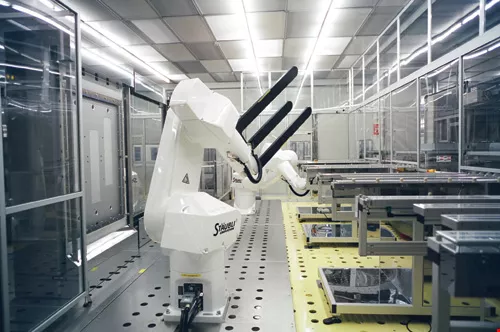
Whether it's the machinery and equipment or the staff, the demands of production of these fragile screens are extremely stringent-everything must be absolutely clean and absolutely precise. Robots in the factory responsible for transferring screens between processes. (courtesy of Chi Mei Optoelectronics)
New optoelectronics outpost
Possessed of unique optoelectronic properties, liquid crystals are sandwiched between two plates of glass to make LCDs, which with their better looks, lower power consumption, and slimmer form factor have made the disadvantages of traditional cathode-ray tubes-such as their bulk, weight, and power-hungriness-difficult for people to accept. Not only have CRT-based computer monitors been almost entirely replaced by their LCD-based brethren, but LCDs are also widely used for the screens in notebook computers and for the even smaller ones in mobile phones.
Liquid crystals were discovered in 1888 by Austrian Friedrich Reinitzer. However, it was not until 1968 that a commercial application was found, when major American TV manufacturer RCA used liquid crystals in the display panel on a piece of instrumentation. This move gradually attracted the attention of Japanese companies, including Sharp. Sharp was the first to obtain patented RCA technology for the development of other applications. Subsequently, it developed proprietary Japanese liquid crystal technologies, and for a time LCD technology came to be lauded as Japan's "national treasure."
Turning to Taiwan, though Chunghwa Picture Tubes initiated R&D in flat panel displays in 1983, it was not able to overcome technology obstacles. Thus it was not until 1999 when it received a license from a Japanese company with advanced display technology that Chunghwa Picture Tubes truly broke into this stellar new industry for the 21st century.
Why were the Japanese willing to transfer this vital technology?
In the late 1980s, as the Japanese bubble economy collapsed, the consequent depressed economic conditions made it difficult for Japanese companies to raise funds and expand production. Just at that point, Taiwanese companies with excellent access to capital made their entry, and Japanese companies began transferring technology to Taiwan through strategic alliances, in the process deciding the fate of Taiwan's TFT-LCD industry. Today, the "five tigers" of Taiwan's flat panel industry-AU Optoelectronics, Chi Mei Optoelectronics, Chunghwa Picture Tubes, Quanta Display, and HannStar Display-all maintain close technological cooperation with their chosen Japanese partners.
From 2002, the rivalry between Taiwan and Korea to best each other in production capacity emerged. Taiwanese vendors expanded production capacity more aggressively, and it is projected that at the end of this year, more than five fifth-generation and three sixth-generation production plants will be located in Taiwan. Though the fact that the newer the design of the factory, the larger the LCD screens that can be produced, can help reduce costs, the real competition is turning out to be in seeing who has the deeper pockets. Since 1999, when the Japanese transferred key technologies to Taiwan, major vendors have continually been making moves to raise capital both domestically and abroad, ensuring an uninterrupted flow of investment over the past few years. Last year, for example, the "five tigers" alone had plans to raise NT$360 billion.
The syndicated loans involved are so enormous that they have set records for the amount of capital absorbed by a domestic industry. Even Academia Sinica president Lee Yuan-tseh has expressed concern, believing that if the flat panel industry is overly optimistic about market demand, and investment in next-generation production lines continues unabated, the problems that could result if supply outstrips demand by a wide margin could also affect banks, and even trigger a financial crisis.

From tiny cellphones to big-screen TVs, the low weight, low power consumption, and high resolution of LCD screens, along with their low radiation levels and longevity, have made them the focus of a new generation of technology.
The battle for brainpower
At 8 o'clock on a workday morning, workers swarm like ants into the STSP-including Chi Mei's 12,000 employees and HannStar's 2,000. And each new job created within the STSP stimulates the creation of three more outside.
"As for top-level talent, most came to the flat panel industry from semiconductors," says Chou Chih-hao, vice president of HannStar Display's Tainan manufacturing site. Six years ago, Chou correctly foresaw the explosive growth potential of the flat panel industry, and made the jump from the semiconductor industry. After accumulating experience at HannStar's factory at Yangmei in Taoyuan County, he moved to the STSP when the company made plans for a new factory there, taking charge of the facility's construction.
Silicon wafers and flat panels share 80% of their respective production processes, with the demand for clean-room conditions and attention to precision and detail being extremely similar. The large influx of talent from the silicon wafer sector, as exemplified by HannStar's Chou, has been one of the keys to the rapid rise of Taiwan's LCD panel industry.
"The Hsinchu Science-Based Industrial Park and the Industrial Technology Research Institute possessed a wealth of talent in basic technology areas," recalls Chi Mei's Lin, who came to the flat panel industry from a traditional-industry backround at Chi Mei Corporation when Chi Mei Optoelectronics was established. "That and an environment that was favorable for technology entrepreneurs were factors behind the large influx of talent into Taiwan's flat panel industry early on."
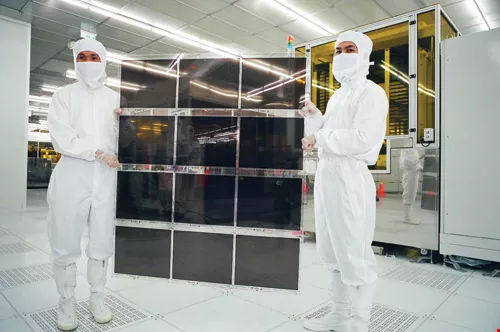
Whether it's the machinery and equipment or the staff, the demands of production of these fragile screens are extremely stringent-everything must be absolutely clean and absolutely precise. Workers in a cleanroom carry screens about to be cut to size. (courtesy of Chi Mei Optoelectronics)
Vision! Vision! Vision!
Only with light can something be seen. And metaphorically, the light cast by liquid crystal displays seemingly allows people to see the future of Taiwanese industry.
The backlight module is the light source for a flat panel. In the highly automated flat panel production process, backlight manufacturing remains labor-intensive. Walking into Kenmos Technology's backlight assembly plant, established just three years ago, one finds that close to 600 of the 758 employees are line workers.
Bringing together Chi Mei and the STSP, this "optoelectronics city" demonstrates an obvious aggregation effect, and has become the current first choice for traditional business groups seeking different investment opportunities. The businesses overseen by Kenmos's Tainan-born chairman Wu Chun-i span the transportation, automotive component, and hotel industries. In 2001, the Tayih Group and major Japanese backlight vendor Stanley Electric set up Kenmos as a joint venture, with the Japanese company dispatching Kumagai Shigenori, a highly experienced production manager, to serve as CEO. Kenmos has since become an important vendor in the optoelectronics zone at the STSP.
Browsing the directory of STSP vendors, one finds over 20 in fields related to optoelectronics. Besides "five tiger" members Chi Mei and HannStar Display, there are also many upstream vendors such as Kenmos. Some of these are joint ventures between Taiwanese and Japanese companies, and many are wholly owned Japanese companies.
"Perhaps we should say that from technology to capital to brainpower, this industry has always been highly international in character," says Applied Films Taiwan general manager Adam Chen.
Established in the STSP in June 2004, publicly listed Applied Films possesses cutting-edge thin-film coating technology that can be used in display screen and glass coating. The company holds a large share of the global optoelectronics market and of Taiwan's LCD industry. In step with Applied Films, major Western companies including Leybold, Merck, Dr. Schwabe, Festo, and Coatema have expressed their intent to establish R&D centers in Taiwan, demonstrating a willingness to deepen their commitment to linking their own development to that of Taiwan's optoelectronics industry.
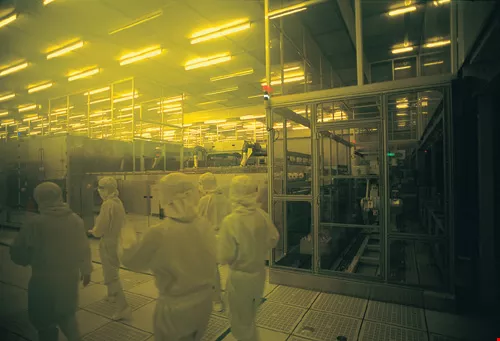
The production process for LCD panels is 80% the same as that for silicon wafers, the only difference being that the materials being processed are glass substrate sheets rather than silicon wafers.
The production capacity dilemma
After a mere six years, by relying on technology transfers, Taiwan's flat panel industry is rapidly approaching the status of a trillion-NT-dollar industry. Passing through the STSP optoelectronics zone, optimism is everywhere. However, a successful long-term approach has yet to be definitively established. The unpredictable character of the industry has already caused anguish for many in the flat panel industry. "In just six years, we've been through three boom-and-bust cycles," points out HannStar's Chou. "We have to be extremely cautious about this industry's future."
"When to invest? When can the money that's put in be recovered?" asks Photonics Industry and Technology Development Association (PIDA) vice president Frank Ma. "This market is constantly in flux. Faced with the uncertainty in the industry, it's extremely difficult to achieve the right timing."
Not only that: in this emerging industry, Taiwanese companies, with their traditional strengths in expanding production capacity and reducing costs-a disposition memorably illustrated by Acer founder Stan Shih's "smiling curve" graphic showing R&D, production, and marketing along the path in the shape of a smile-are also facing the same difficulty in lifting R&D and marketing capabilities up to create the desired "smile".
The most evident fact is that for every NT$100 invested in the LCD industry, only NT$15 is spent on purchases in Taiwan itself. For the rest, imports are chosen, making it abundantly clear that compared to the nearly 50% rate of domestic content in Korea's flat panel industry, Taiwan's industry is lacking in self-sufficiency.
This lack of self-sufficiency makes it hard to build profitability. On the one hand, Taiwanese vendors must pay technology and equipment fees to international upstream vendors, while on the other, Taiwan is still largely focused on contract manufacturing. Value-added profits are taken by downstream brand vendors and channel vendors. Therefore, despite collectively boasting the world's second-largest production capacity, Taiwan's flat panel vendors all proceed gingerly.
For example, it would appear that more than 90% of the backlight module needs are supplied to flat panel vendors by Taiwanese companies. However, those Taiwanese companies depend completely on Japanese firms for key components-including polarizers-accounting for 70% of their total costs, and they have no scope for negotiating lower prices.
This problem has been exacerbated by a steady decline in profit margins in the flat panel industry since the latter half of last year, from previous levels near 30%. With the world's chief glass substrate suppliers setting up operations in Taiwan, China Optoelectronics Technology Corporation, Taiwan's first firm to successfully mass-produce TFT glass substrates, announced in March 2005 that it was shutting down its furnace, as it could not make the technical breakthroughs needed to satisfy the demand for ever-larger panels.
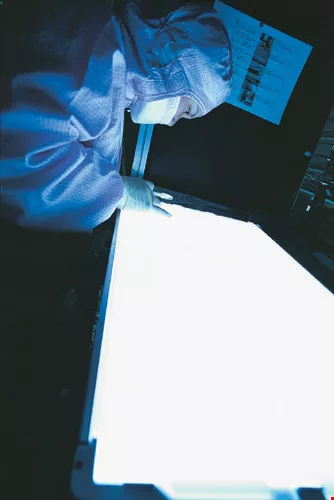
A backlight is a key component used to provide a light source behind an LCD screen. Its production is labor-intensive.
Ups and downs
Lacking cutting-edge R&D capabilities, as well as strong brands and channels, Taiwan's wide-ranging contract manufacturers find themselves facing a familiar dilemma in the flat panel industry. In addition, Taiwan's "five tigers" are small compared to South Korea, whose Samsung and LG share nearly 40% of the global market. Their consequent lack of economies of scale has become an increasing concern over the past two years. With numerous industries shifting their manufacturing operations offshore, Taiwan's flat panel makers are naturally moving to China as well. However, restricted by government policies, most of their China factories are mainly focused on assembly. The technologically more demanding front-end processes remain in Taiwan.
It is forecast that by the end of 2005, Taiwan's share of the global flat panel market will approach 40%, adding yet another world #1 ranking to its collection.
Still, the excitement at the industry's rapid growth in the past six years obscures signs of a looming brainpower shortage.
"Senior engineers with more than three to five years of experience with LCD technology are scarce worldwide," Lin points out. "And this talent is concentrated in Taiwan, Japan, and Korea, making it difficult to lure them away." Eugene Verdon, president of Corning Display Technologies Taiwan, the world's leading supplier of glass substrates, also believes that the short supply of brainpower is the biggest worry for Taiwan's flat panel industry.
"It's not that Taiwanese are not smart enough or industrious enough. It's simply that this industry is extremely demanding on people, and that applies to both quality and quantity," Verdon says. "Looking at Taiwan's population growth rate and related figures, and it certainly looks like there may be a steep falloff in the availability of needed skilled workers in the future."
In the current phase, Taiwan's biggest rival is of course Korea," says PIDA vice president Ma. "Korea entered this industry six years before Taiwan. It has greater upstream and downstream integration, and greater self-sufficiency. Korea also benefits from the brands and global channels of market leader Samsung and of Philips LG. These factors make Korea's flat panel industry far more complete than Taiwan's."
Besides South Korea with the breadth of its downstream and upstream integration, and Japan with its cutting-edge technology and strong brands, China has been making moves in recent years. China will likely turn the flat panel industry into a four-way battle.
In 2003, China's largest CRT manufacturer, BOE Technology Group, seeing that the CRT market was in decline, decided to develop LCDs. Later, BOE purchased Korean company Hydis' LCD panel manufacturing division and immediately became China's biggest flat panel manufacturer.
Like Taiwan, Japan, and Korea, China has designated display devices and liquid crystal devices as explicit targets for attracting foreign investment and fostering technological development. The Chinese approach of acquisitions and technological cooperation with Japan or Korea is highly reminiscent of the course pursued by Taiwanese firms six years ago.
After much Taiwanese desktop and notebook computer manufacturing moved to China, flat panel assembly plants are following their customers across the Taiwan Strait. If the LCD TV industry cannot gain traction in Taiwan, another wave of manufacturing relocations to China is likely to take place.
With Japan and China intent on joining a competitive fray that has been largely focused on Taiwan and Korea, the two-way battle for supremacy may at any time develop into a four-way tangle, further complicating the scenario.
Can the light from liquid crystal screens also show Taiwan's high-tech industry the way to another golden decade? The answer may very well soon be revealed.
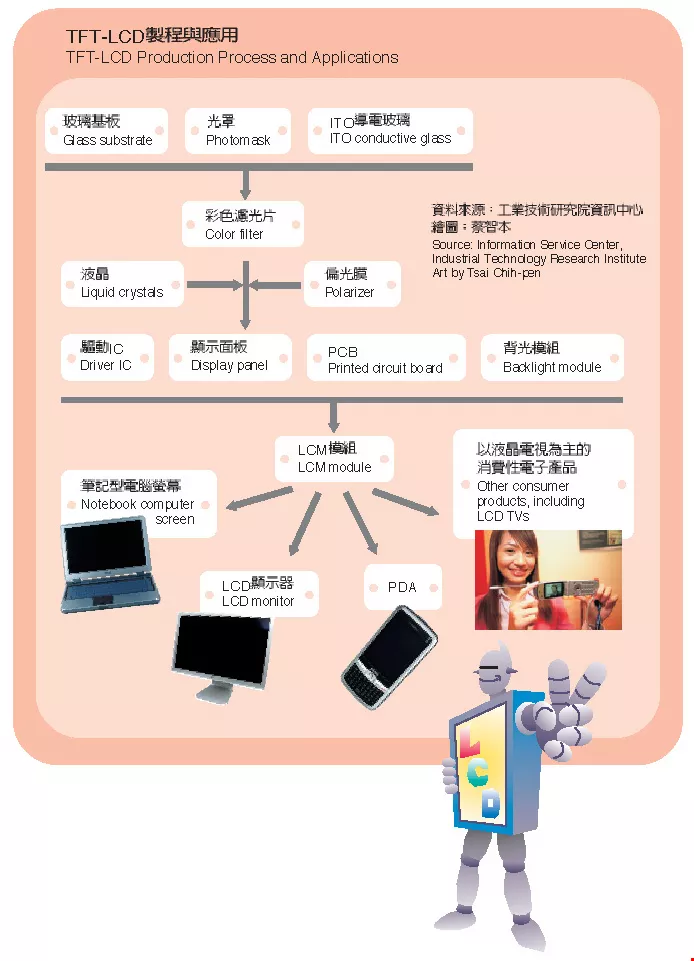
TFT-LCD Production Process and Applications Source: Information Service Center, Industrial Technology Research Institute Art by Tsai Chih-pen


From tiny cellphones to big-screen TVs, the low weight, low power consumption, and high resolution of LCD screens, along with their low radiation levels and longevity, have made them the focus of a new generation of technology.
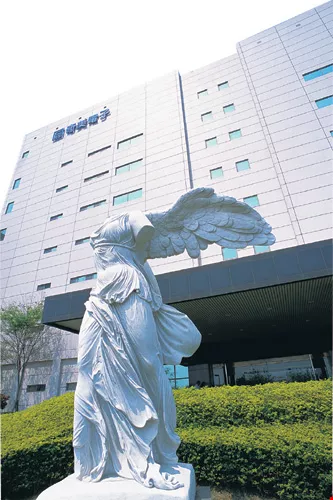
Walking by the Chi Mei compound in the Southern Taiwan Science Park, it's hard to miss the statues of the Greek gods that stand around. This replica of the Louvre's statue of Nike, goddess of victory, helps create an aesthetic balance in this sprawling compound.


@List.jpg?w=522&h=410&mode=crop&format=webp&quality=80)


