

Taiwan is in the midst of a new wave of entrepreneurship.
As a result of the government’s elimination of the minimum capitalization requirement for new companies and its incentive program of “creating new jobs through entrepreneurship,” there has been a sharp increase in the number of new SMEs founded in Taiwan since the global financial tsunami of 2008. In 2011 alone, an impressive 99,000 new small firms were registered. The main industrial categories leading the way in this wave of entrepreneurship are services firms, Internet firms, and cultural and creative enterprises.
This prairie fire of entrepreneurship has swept not only the private sector but also government and academia. All have joined the ranks of those trying to nurture new businesses—coming up with fresh ideas, shaping business models, and devising ways to inject venture capital and loans into new firms to help them stably develop. These efforts have sparked great new vitality in the market here in 2013.
On this Monday morning we are at appWorks Ventures, a venture capital firm located in a high-rise office building on Taipei’s Keelung Road. The occasion is the awards ceremony for a marketing competition for business incubation teams. More than 60 members representing 25 teams are in attendance, wide-eyed and intensely focused as they wait for the results to be revealed.
The intent of the competition is to bring these would-be Internet entrepreneurs, less than 30 years of age on average, face to face with the public. It gives them first-hand experience in directly selling a product to consumers, removing the barriers that normally separate office workers from the outside world. This particular exercise involved selling coffee beans. Each team was given two weeks to attain the highest possible sales volume and maximum profit.
In the end a team called “Factory Planet” was the champion. They achieved gross sales of over NT$50,000, with net profit of over NT$40,000, double that of the team that finished second.
The winners didn’t use any especially mystifying tricks. Team leader Hong Jiasong simply took the direct marketing approach, using the “soft sell” to get friends to buy his product. In return for NT$5000 each, he not only sold them coffee beans but gave them the sense of having contributed to helping him realize his entrepreneurial dreams, and he repaid them by going to the home of each “customer” to personally make them a thank-you dinner.
When Hong, very handsome and confident, went onstage to receive his award, people joked that his real business acumen was little more than “playing on his good looks,” getting smitten female friends to cough up their money in hopes of winning his affections. But the sponsoring organization praised him for “understanding how to package his product and give it a larger meaning” and for creating “added value.”

Since 2005, Taiwan has witnessed the rise of open-air markets for people making creative, artistic, or cultural goods on a small scale. These have helped drive progress in Taiwan’s design industry, and many young people enjoy the chance to personally sell work they design themselves. Prime examples of these markets include those held on the weekends at the Red House in Taipei’s Ximending area (right photo by Jimmy Lin) and 44 South Village (left photo).
It is estimated that there currently are more than 200 incubation programs across Taiwan. There are three main features to this incubation tide:
First, governments at all levels have mobilized people and provided resources for starting businesses.
In 2008, in the face of the international economic crisis, the government devised a strategy of “creating jobs through entrepreneurship.” Under this rubric, the Ministry of Economic Affairs and the Youth Development Administration (formerly the National Youth Commission) have greatly upgraded their entrepreneurial guidance. But it has not been only these obvious agencies involved. In fact, today more than 30 government units—including the Ministry of Education (MOE), the Ministry of Culture, and various local governments’ industrial development bureaus, have joined in the task of business incubation, offering a variety of loans and guidance projects.
Secondly, young people are the focal point.
According to the MOE, more than half the universities in the country now offer courses in starting a business, and nearly 100 tertiary educational institutions have opened incubation centers. The goal at this point is just to plant seeds in students’ minds and to nurture creative ideas. Later, those who want to pursue an idea can directly enter the incubation center, just before or just after graduation, to get help with their specific projects.
Back in 2009 the MOE launched the U-Start program, under which students can participate in start-up competitions. Following an evaluation process to ensure that an idea is in fact novel and practicable, awards of NT$250,000–600,000 are given out. A total of 40 teams with potential for success can be funded each year.
Thirdly, private businesses have set up multiple platforms for exchanging ideas and information and for linking up entrepreneurs with “angel investors.”
Incubation of new business ideas in the private sector has been extended to the field of “social enterprises,” and the guiding concept for entrepreneurship has been elevated to the level of “humane and sustainable development.” Encouragement is being given to diverse entrepreneurial forms such as organic foods, fair trade, and preservation of distinctive cultural and natural assets.
On another front, the franchise model, seen as a bellwether of traditional entrepreneurship, also reached new heights in 2013.
In early April, amid great fanfare, the 14th Taipei Venture Franchise Exhibition was held at the World Trade Center. Tom Hsu, chairman of the Association of Chain and Franchise Promotion, says that this year nearly 250 franchise brands sponsored 620 booths at the event, an increase of 20% over 2012. In fact, this is now the largest exhibition in the entire Asia-Pacific region dedicated exclusively to franchising.
According to the Ministry of Economic Affairs, if we look back at the data since 2004, there was steady growth in terms of new SMEs each year until 2007. In 2007–2008, as a result of inflation and the financial tsunami, start-ups plunged. The figure rebounded rapidly, however, and even in 2012 the euro crisis not only did not dampen the flames of entrepreneurship in Taiwan, working people were inspired to take the attitude that “offense is the best defense.” In January and February of 2013 there were nearly 13,000 new company registrations.
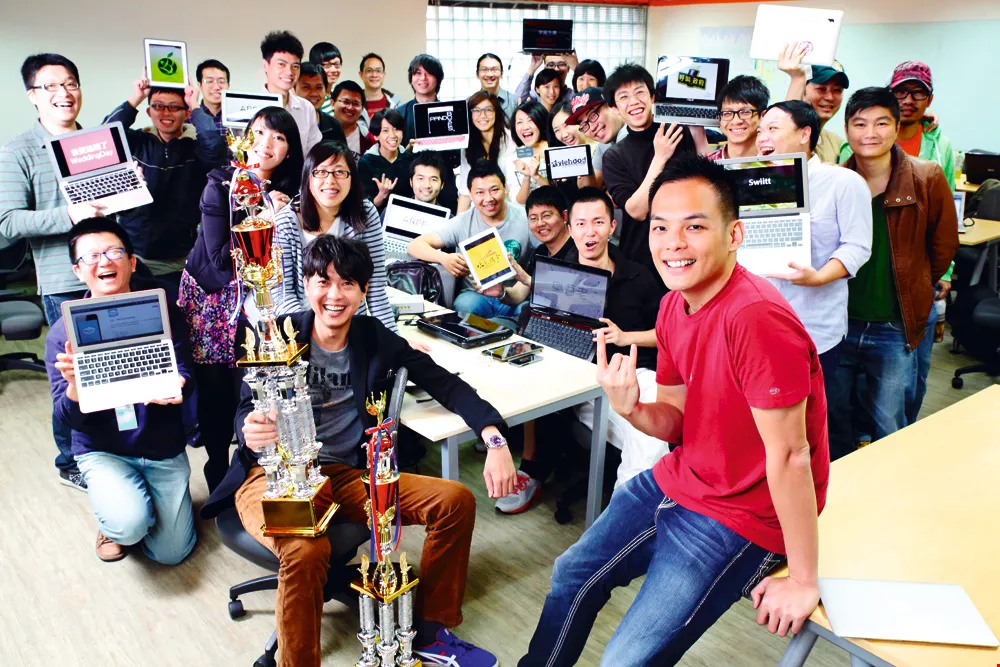
The private sector, government, and academia have all been active in opening business incubation centers, guiding the younger generation to bring their creativity into play. The photo was taken at a sales competition for would-be entrepreneurs held by appWorks Ventures.
While Taiwan has always been an entrepreneurial island, the wave of business vitality that we are talking about here is a phenomenon specific to the last 10 years, during which time energy has accumulated to reach today’s critical mass. What can we say about the environment that has nurtured this group of entrepreneurs?
If we use age to make our first cross-section, the main figures in this entrepreneurial wave are mostly from “Generation 30”—people born after 1975.
They are the richest generation in Taiwan’s history, and have lived in an era in which people can afford to consider aesthetics and brand names in their lifestyle choices. They also have the highest levels of education of any generation in our history, with about one in seven holding a master’s degree or above.
Unlike their parents, for whom entrepreneurship was a necessity or for whom getting a job in a big corporation and working there up to retirement was the definition of success, Generation 30 lives in a society with advanced technology and the Internet, has been continually exposed to globalization, and has seen the possibilities of the enormous outside world. Their philosophy of life is more casual and focused on self-realization, and that in turn has affected their career choices. There is a general desire for an employment model in which quality of life, rather than money, is the important thing.
Back in 2003, as these people were graduating from university and getting their first taste of the working world, Taiwan witnessed its first peak of micro-entrepreneurship. So-called “SOHO” (small office/home office) types working out of their own homes seemed to be everywhere, and the idea that anyone could start an Internet company working part-time at home was widely embraced.
In 2005, street markets of individual artists and designers selling “style choices” sprang up all over Taiwan. Often little more than gatherings of small portable stands or even goods just laid out on the ground, these markets supported hundreds of designers a year, and sparked a national fad that has been described as “the design craze.” Their success made it clear that there is a significant consumer market for the “cultural and creative industries.” Universities rushed to set up new curricula and departments of design and related fields, and the number of students studying in these fields has tripled in only eight years.
In 2007 new ingredients were added to the pot. There was worldwide inflation, the rise of green energy, and the mainstreaming of the idea of “lifestyles of health and sustainability.” In Taiwan, organic and environmental enterprises rapidly developed markets for their offerings. The motivations behind entrepreneurship in this period expanded from simply individual ideals to “saving the planet.”
The entrepreneurial generation that has grown up in the world of Facebook and YouTube understands how to employ Internet communication tools. Brick-and-mortar stores can launch Internet sales, while Internet stores can turn back around and open their own brick-and-mortar shops. The line between the virtual and the real is blurred, and psychologically these young people have no problems in crossing back and forth with ease.
“In the past, entrepreneurship was concentrated in the manufacturing sector, with high capital barriers to entry and high pressure to maintain large cash flow,” says Lilian Chang, managing director of SOHO Creative Management Consultants, who has provided advice to over 10,000 entrepreneurs and has nurtured the rise of over 300 brands. “Today the starting points for entrepreneurship are much more diverse and a lot of it is simply based on imagination. Moreover, there are a lot of consultants around who will help people with startups, and an atmosphere conducive to entrepreneurship has been generated throughout society.”

There’s a lot more uncertainty these days with an office job, so a growing number of people are preferring to start their own businesses. The franchise exhibition held in Taipei in April attracted big crowds who were there to find out what having their own franchise would require.
A lot of people might wonder what profit opportunities exist for these new start-ups. After all, Taiwan has a limited domestic market and exports are primarily from the manufacturing sector.
Steven Yang, head of Research Division VI at the Taiwan Institute of Economic Research, points out that the key to success is finding “demand that has not yet been satisfied.”
Take for example the fad for American-style diners that has swept Taipei in recent years. Back in 2006, there were only a dozen or so restaurants of this type in all of Taipei. But, with the rise of a new market of people who sleep late on the weekends or of families who go out together for brunch, in a mere seven years the number of these eateries has jumped to over 100, and virtually all of them are packed to the limit on weekends and holidays.
So the question becomes how to seize on “demand that has not yet been satisfied.”
Yang points to three areas of entrepreneurial space where there is still much unsatisfied demand among modern people, which he describes as “tools,” “badges,” and “tranquilizers.”
The term “tools” refers mainly to Internet platforms and communications software which satisfy the desire for social networking among users. If you can simply come up with a unique platform where people can interact, there will always be unsatisfied demand from people who seek novelty or who lack friends.
Meanwhile, the “badge” industry, the leading force in the design sector, sells what we might call “mood” or “image.” Products such as a sleek pen with a strong sense of design, a fisheye camera, or a handbag can provide consumers with the sense of satisfaction that derives from expressing their personal tastes.
Finally, by the expression “tranquilizers,” Yang is referring mainly to service businesses such as coffee shops or homestays. These are focused on the desire for an “ideal existence” among people who have become exhausted by the daily rhythms of modern life, and they provide spaces where people can find rest and relaxation on demand simply by paying for it.

Changes in lifestyles have led to new consumer trends and entrepreneurial opportunities. American-style diners have become hugely popular in the Taipei metropolitan area in recent years, and there is also an expanding market for locally grown organic food products (right photo by Jimmy Lin).
As we discovered after many interviews with scholars and experts, there are five major entrepreneurial trends in Taiwan to pay attention to:
(1) Internet start-ups emphasize management of online communities, and these are the kinds of investments that venture capital firms are looking for.
Cloud technology allows consumers to purchase goods and services across platforms and locations, while the prevalence of smartphone ownership creates mobile profit opportunities. Entrepreneurs with creativity and the right technology merely need to master the “3C’s” of “content, community, commerce,” and, equipped with nothing more than a notebook computer, can do business anytime, anywhere.
(2) Established firms are branching out into new areas, and second-generation company heirs are establishing new brand names.
An enormous number of small and medium-sized enterprises (SMEs) arose in Taiwan back in the 1970s, and today these are facing challenges of upgrading and transfer of control to the next generation. Manufacturers who mainly did OEM work must begin to consider how to differentiate themselves and establish brand names. The “second entrepreneurial wave in established firms,” led by the sons and daughters of the founders, is rapidly gathering pace.
The first-generation founders of these firms were often hands-on types who managed right on the factory floor, and the prize for which they battled was cold hard cash. The second generation consists of young people who grew up with money and plenty of schooling, and they are motivated more by developing a brand and creating something that has some cultural content.
(3) People before profits! “Social enterprises” are increasingly in vogue.
Many entrepreneurs are focused not on maximizing profits, but on contributing to society, loving the planet, and giving the disadvantaged a hand. They want to have work that gives their lives meaning. This idea fits right in with Taiwan’s traditional culture of enthusiasm for the public good. Social enterprises can make profits within the context of sustainability.
“Sandwishes Studio” was the 2012 winner of the top prize for cultural and creative industries under the U-Start Program of the Ministry of Education. The founders were three students at Taipei National University of the Arts, who worked as art therapy volunteers at the Happy Mount care center in the Bali District of New Taipei City and then went on to develop a line of art therapy teaching materials and creative products based on the work produced in their class, with some of the money going back to the original makers.
(4) The rise of “cultural and creative enterprises” (CCEs) means that the commercial character of new enterprises is different.
The main obstacles that CCE entrepreneurs face are (a) they don’t want everything (or even most things!) to be about money, yet they usually have such small financial resources that they need to quickly start turning a profit; and (b) they see the objects they produce as individual “works,” not “products” that will go into the market.
However, after several years of development, these dreamers have learned to be more practical. Many designers have now realized that self-expression alone will not necessarily resonate with consumers, and without that resonance, they will never attain industrial scale.
(5) Passion for “living small” can drive significant trends.
Small firms with distinctive products or personalities are popping up everywhere. Whether they sell coffee or clothing or whatever, what their founders want to earn is “a life,” and what their customers want to buy is “creativity.” Few of these small entrepreneurs, with shops hidden away in lanes and alleys off the main commercial thoroughfares, have any grandiose ambitions. They only hope to have a steady enough stream of customers to keep them in business, so that they can find meaning and enjoyment by doing something they love.

Many of Taiwan’s older small and medium-sized enterprises are getting a makeover as the second generation takes over management and pursues innovative strategies like creating their own brand names. One example is the clothing label XuXu Wear, the brainchild of the father and daughter of the Xu family, owners of the textile trading company Black Lion Enterprise Company.
But passion alone does not a business make. Even more critical to success are the character and psychology of the individual entrepreneur.
Lilian Chang points out that digital tools speed up the tempo of modern life, and consumers are more likely than ever to put a premium on novelty and to rapidly tire of the latest fad. But the logic of the “three-year business rule” still applies just as it always has.
The first year in business, entrepreneurs make mistakes of inexperience. They must simply grit their teeth and hang in there, or else get swept away. The second year, they must resolve various managerial issues, and in this process they can learn to be more adaptive. The third year, entrepreneurs become expert problem solvers. Most of those who are able to get through these three years can survive and grow.
Apple Computer founder Steve Jobs once said, “The ones who are crazy enough to think that they can change the world, are the ones who do.” Today’s new breed of entrepreneurs, who have the courage to be themselves, embrace a philosophy that combines quality, branding, design, quality of life, and the public good. Their passion drives them forward, and they hope that in the end, as a result of their being here, the world will be a better place.

Changes in lifestyles have led to new consumer trends and entrepreneurial opportunities. American-style diners have become hugely popular in the Taipei metropolitan area in recent years, and there is also an expanding market for locally grown organic food products (right photo by Jimmy Lin).


