Putting the Community into Radio --Wu Yi-feng and "Full Scene"
Teng Sue-feng / photos Lin Meng-san / tr. by Brent Heinrich
September 1995


This is the first community radio station in the Taiwan area designed to serve women, the elderly and youths.
If you turn to 91.3 on your FM radio dial, you'll hear an old lady chatting about her four daughters-in-law. If you stay tuned, you'll discover that there are no commercials, and no pop singers come on the air to flog their new jingle.
If you've gotten used to hearing the frivolous gimmicks of commercial radio, the Full Scene radio station may sound strangely sedate.
What's different about this station becomes clear when the program ends and the host drops a hint to listeners to send their donations to the Full Scene postal account. Station founder Wu Yi-feng says his station wants to play the role of a "neighborhood temple." Don't even temples need some offering money to keep going?
Two years ago there began a dramatic change in the milieu of Taiwan's broadcast media. Unlicensed underground radio stations began to proliferate beyond control. Public policies concerning broadcasting were completely reexamined, and from 1993 on, radio frequencies have been progressively opened up. In the past two years, 35 frequencies have been set aside for medium-power broadcasting, and 46 frequencies have been set aside for low-power broadcasting.
Many people with money, power and professional ability want to "put together a radio station and play around with it." Whether they be from the financial sector or political parties, or are veteran broadcasters or members of the arts starting up their own private operations, the vast majority are interested in stations broadcasting to urban areas with a relatively wide range of listeners and high impact. Medium-power broadcast frequencies in Penghu, Hualien and Taitung face a lack of interested individuals.
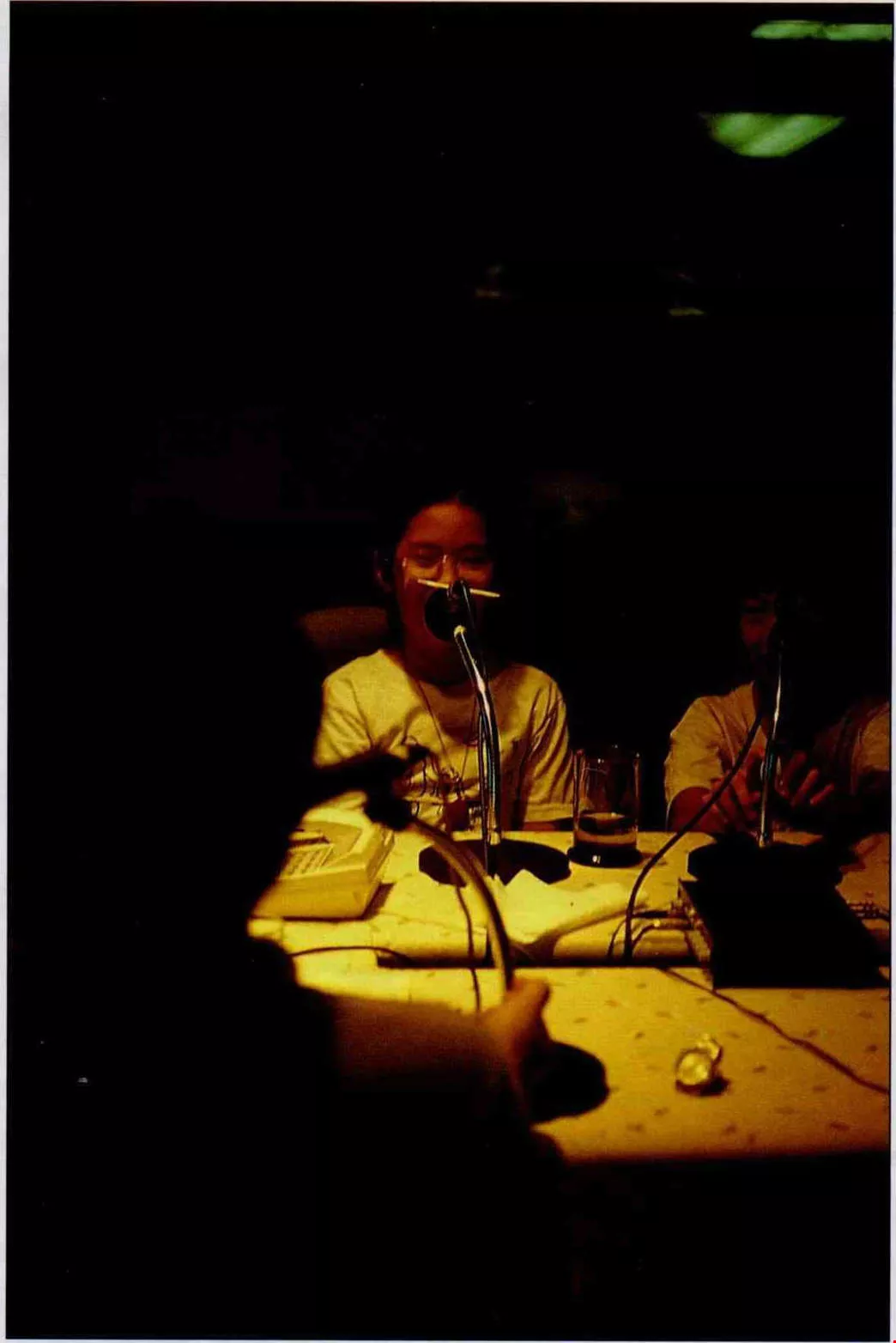
Children come to the radio station to hear a teacher tell a story. Their giggles fill the station and get broadcast out to the world. Listeners are also infected by the merriment of the little ones.
Playing around with a station
For Taipei, most low-power broadcasts have a reception radius covering only one-third of the city. In September 1994, nine radio frequencies were opened up. In an atmosphere of not particularly fierce competition, six prospective broadcast groups like Full Scene, with narrowly specialized focuses such as blue-collar workers, women's issues, or religion, submitted business plans and were granted broadcast licenses by the Government Information Office's Radio Review Committee.
All the new radio stations big and small, plus all the old stations add up to a sum of 114, packing Taiwan's airwaves with an energetic clamor.
Theoretically, radio is the medium most suited to serving the community and bringing together a common consensus among minority groups, because the necessary equipment and capital is minimal. Many Chinese-language stations overseas have this capability. Nevertheless, whatever the theories say, when these ideas have been put to the test abroad, there have been very few examples of success. Because of this, many people are full of anticipation as to whether Full Scene, which began broadcasting in June of this year, will be able to carve out a different destiny.
Full Scene broadcasts from atop a financial complex on Taipei's Chunghsiao East Road, reaching the four districts of Sungshan, Hsinyi, Ta-an and Chungshan (most of the downtown area), but if no hills are obstructing access, almost anyone in Taipei City can pick it up.
There are an astounding number of radio stations in Taiwan. Full Scene's offices, its name and its personnel are brand new, and many amusing events still take place. Even the broadcast hosts have to spend a good deal of time figuring out just whose "turf" they are on.
Yu Mei-jen, who often appears on Full Scene's programs, has on more than one occasion had the "All People's" radio station in her mind, and carelessly let slip from her mouth, "This is 'All People...'" That's not right. Immediately, she quick-wittedly rephrased herself: "This is 'Full Scene Radio,' the station All People love to listen to."
If the hosts are prone to blunder, the listeners are still getting used to things too. Some callers refer to the station as "Full Breeze." Others have mistakenly believed the station was run by the "police," which in Chinese is pronounced the same as "scene."
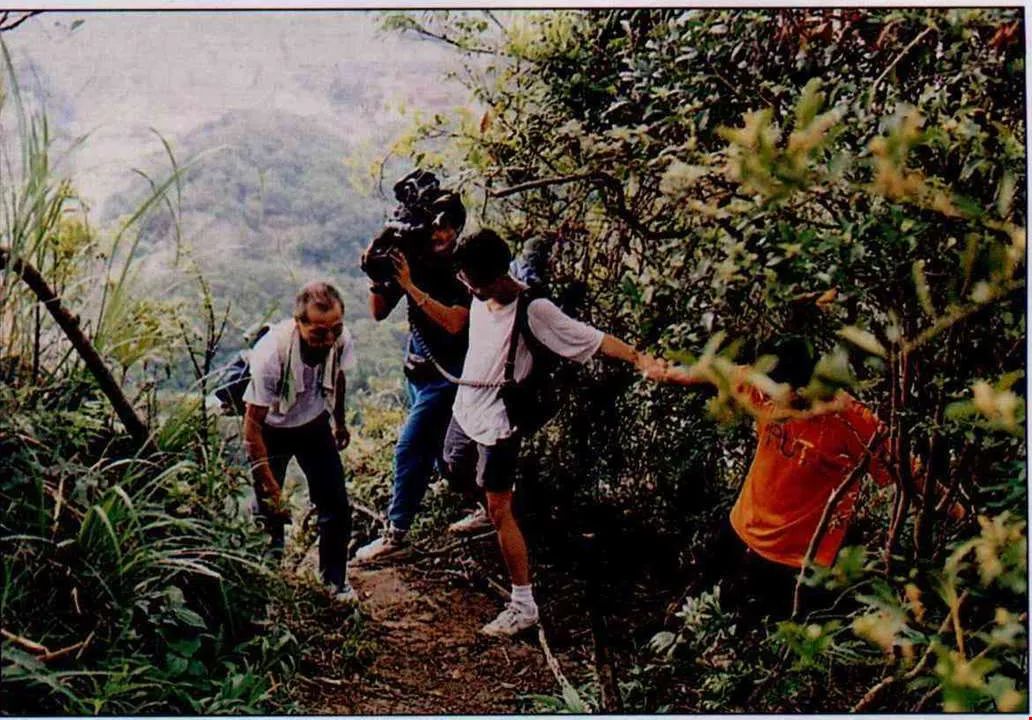
The Full Scene studio likes to film ordinary folk. "Uncle Ah Shui." at first just liked to go hiking in the mountains for exercise. Now he goes into the mountains to fix the paths. (courtesy of Full Scene Film/Video Studio)
Your house and mine
There are simply too many things brand-new radio stations have to do. They have to get the word out about their existence, recruit hosts, seek out guests and plan programs. What does Full Scene have the others do not?
Firstly, if you're interested in gabbing over the airwaves, they offer something more than just calling in to voice your thoughts on a radio talk show. Full Scene will let you play the part of host. You don't need a lovely speaking voice or remarkably clear enunciation. And you don't need to be famous. Certain segments are open for "everybody" to be MC. Many of this station's hosts are speaking into a microphone for the first time.
In the early morning program "Meet Your Neighbor," they invite the residents, business people and office workers in the neighborhood to come get acquainted. If you live in the Sungshan area around Chunghsiao East Road Section 5, they warmly invite you to drop on by the station if you have the time. In "Come Be the Host." they freely hand the mike over to foundations and groups within the community. Whether they be a bunch of friends who go fishing together or an association of folk dancers, they can all come and introduce what they do to the world.
"Gossipy old hens" who like to stick their noses in other people's affairs are usually not very welcome. But a community is a group of people concerned about each other, so the program "Neighborhood Gossip" invites people who are passionate about the public welfare of Taipei to tell everybody why they are so "inquisitive" and to enjoy themselves being nosey.
"Young Time" lets youths speak their own minds. A few middle school graduates from the same class may call up their old teachers and ask them to tell their true feelings about "our class."
From 8:30 in the morning until 10:30 at night-- the vast majority of these fourteen hours of programming is talking about what's happening in your house and mine. One old lady brought the wives of all four of her sons onto the show and talked about how mothers-in-law and daughters-in-law get along. A bunch of kids laughed non-stop as they listened live in the studio to a teacher from the Caterpillar Foundation telling a story. Mama Wu, who lives in the Taipei suburb of Tienmu, spoke about the emotional changes her middle school son is going through, while at the same time making preserved eggs and tofu, bamboo sprout salad, and marinated turnips. so that the workers at the station could have a tasty lunch.
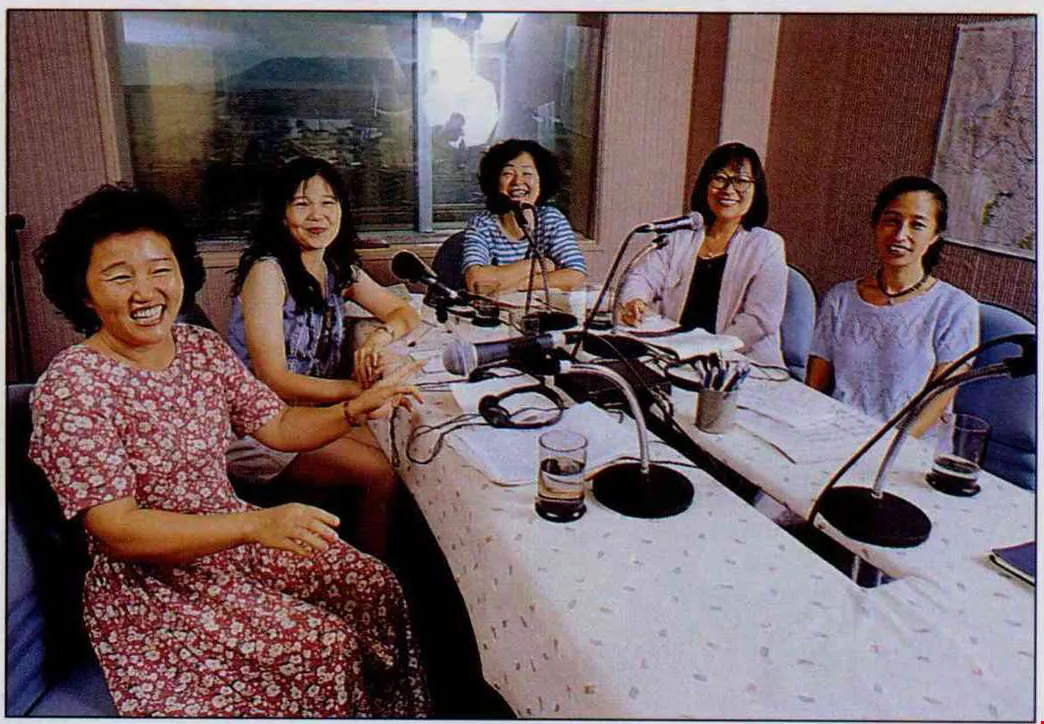
A group of mothers who live in the Taipei suburb of Tienmu come to the station to introduce their community organization. Usually when they are together, they hold reading sessions or serve as guides on the hiking trails in the Chihshanyen area.
Replanting the big banyan tree
The target market of the station is the Taipei community, but Wu Yi-feng, both the station manager and boss of the Full Scene Film/Video Studio, does not come from Taipei.
Thirty-six-year-old Wu, who hails from Toucheng in Ilan County, got his start as a documentary filmmaker. As he traveled to many different places all over Taiwan documenting the vitality of the people of this land, Wu Yi-feng began to notice that the resources of Taipei were the richest, but human relationships were the most lacking. With an attitude of "fulfilling Taipei's potential," he asked for permission to set up a radio station, so he could take the "banyan tree" of the countryside that cools and gives people a space to converse, and transplant it to Taipei City.
If you look at the business card of Wu Yi-feng or the other personnel at the station, there is no title at the top. At the right, it reads "Full Scene Film/Video Studio," and on the reverse side "Full Scene Community Radio," then on a single line in small print, "A non-profit, public-service community cultural station," and next to it a big banyan tree.
The film studio and the radio station are in fact two sides of the same coin, with fourteen workers giving each other mutual support. The station and the studio are located just down an alley from each other, and Wu Yi-feng often runs back and forth.
One Full Scene cohort, Wu Nien-chen, director of the movie A Borrowed Life, has helped found three different radio stations. When a large number of radio bands were opened for public use, many of his friends talked with him about starting a radio station, and every time he leapt into the project "with both hands and both feet."
When he was on the air discussing the concept of community radio with Wu Yi-feng, Wu Nien-chen said that his generation of people in their 30s and 40s felt a certain inexpressible "excitement" about radio. The radio plays the role of the gatherings that took place in the entrances to little alleyway temples when they were children--all the news about everyone's neighbors gets passed along this channel.
The only thing is that right now radio stations are too ambitious. We know when a child in a remote little town in America falls down a deep hole and the fire department spends 72 hours rescuing him. But we don't hear about the old lady next door who is paralyzed and bedridden for long periods of time, whose family have no time off to care for her, whose back is covered with bedsores.
As for what impact Lee Teng-hui's visit to America will have on cross-strait relations, let the other stations talk about that," says Wu Nien-chen. He believes that Full Scene should "see itself as something small, and if you can do something little very well, it will turn into something big." He wants to talk not about huge issues, but just the small topics of everyday life--for instance, how to store winter clothes, how to cope with dengue fever, what avenues are available for women starting a second career, or how to accompany your teenage child through his or her "embarrassed" phase. And if some kids in the neighborhood of the station want to play some baseball and need a few extra players, they can recruit some new friends over the radio.
Thinking of the station as an alleyway temple is very compatible with Wu Yi-feng's concept of growing a banyan tree. They want to open up a space, so that women, children and old folks can come relax in the shade.
For the whole month of June, they talked about "helping your child take the joint entrance examination," introducing each university, department by department, and explaining how to choose the right major. When the Taipei municipal government organized a dance party in the street as an alternative to motorcycle racing, Full Scene set up a booth behind the stage, giving the young people who came to dance a chance to speak their minds.
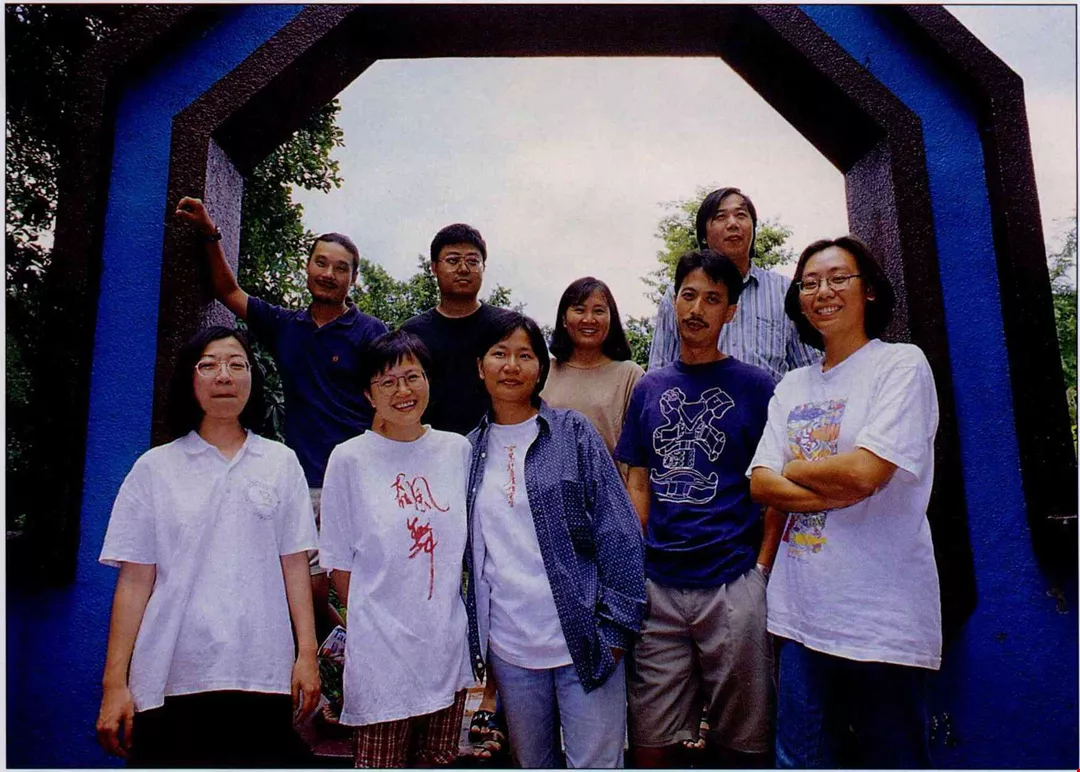
By means of a radio station and a film studio, Wu Yi-feng (second row, right) and this group of caring people are spreading the seeds of community concern.
For only NT$500,000...
This is a radio station run by idealistic people. But Wu Nien-chen feels some anxiety because even though it's very touching to do something idealistic and to work with pure emotional zeal, if the station is to keep on operating, how long can it be supported by passion alone?
What he worries about is where the money will come from. His apprehensions are a bit banal, but very realistic. If your stomach is empty, it's hard to bring your ideals to fruition.
Full Scene is currently using the simplest means to overcome a difficult problem. Wu Yi-feng used up all his savings operating his radio station. When the money ran out, he took out a mortgage on his home.
In the past, in order to be able to spend a relatively long time filming a documentary, the Full Scene film studio would split seven workers into two crews. One crew would spend about a year and a half filming a documentary. The other crew would go out and "get business." producing commercials and short public service films. Three or four short films a month would pull in about NT$400,000, barely enough to keep operating.
Wu Yi-feng is very insistent that making a profit should not become the station's goal, so he does not accept commercial advertisements. He hopes that private enterprises, small business people, hardware store owners and restaurateurs can give long-term support by funding programs and sponsoring public service messages. And friends who agree with the Full Scene concept can offer small donations. With long-term patronage of NT$200 or NT$2000 a month, a little will add up to a lot, and it will be "everybody's station."
They have calculated that if they ever receive NT$500,000 in donations in a single month, it will be enough to cover office rent and salaries. Nevertheless, right now they have some distance to go before reaching this goal.
Is the donation method feasible? Wu Nien-chen himself is skeptical, but every so often he regains his confidence. He reminds himself of how many temples there are all over Taiwan. It goes without saying that the big temples do well. As soon as a single tour bus pulls up, the donation boxes are full. And the little alleyway temples are maintained very well too. Every year they have enough money to put on a new roof and add a fresh coat of paint.
Wu Nien-chen reasons that small temples only have two sources of income. The first is unsolicited offerings from worshippers, who occasionally pass by and drop in a little change. The second is people who visit in search of divination or spiritual charms (fu) to protect the safety of their family, and give donations to the elders of the temple.
Now the station, just like the little neighborhood temples, is waiting for the support of the community's residents.
A community experience of 400 shows
Full Scene's community experience has been accumulated by running all over the island of Taiwan presenting documentary films.
Wu Yi-feng got into making documentaries because he was bad at math. In his third year of college, ignoring the objections of his family, he went from being a junior in business administration at Feng Chia University to being a sophomore film major at National Culture University, a move which sent his dad into a rage.
In 1988, Wu Yi-feng and a few of his good friends formed the Full Scenc Film/Video Studio. In the last seven years, they have made such serialized programs as "A Lamp Among the People," "Moon Children" and "Images of Life."
"Moon Children" was originally selected as material for a show to be aired over public television. But this "magnum opus" of more than 70 episodes laboriously filmed over two years was held up by administrative procedures at public television, which wanted to air it reduced to 44 minutes, in two segments.
But Wu Yi-feng felt that reduced to this length, the story would lose its sense of completeness. Even though he was willing to forego production fees and give them a third episode for free, public television would not agree. For a filmmaker, no circumstance is more discouraging than this.
Unable to let viewers see the pictures on television, Full Scene began looking for an alternative path. In September 1990, "Moon Children," which depicts the lives of white-haired, white-skinned albinos, whose eyes are sensitive to light, had its premier at the National Film Archives. The small theater of 70 seats was packed, and standing room was completely filled as well.
Many members of that audience asked Wu Yi-feng to visit their school or neighborhood and show the film. And the folks at Full Scene actually do take their videotape to campuses, community activity centers, temples, neighborhood groups, mothers' reading circles.... If someone invites them, be they ten, twenty or a few hundred people, they're sure to show up. In the past few years, at locales all over Taiwan, they have shown the film more than 400 times.
"The most important use of a documentary film is communication," says Wu Yi-feng. Its creation must "return to the immediate reality of people's lines."
Wu Yi-feng's personality, which colleagues describe as "impetuous," often causes him to wander right into his subject's world, and find himself incapable of pulling out.
In Hsintien, retired educator Li Wen-shu opened the China Children's Center. For the past 18 years, he has let children come there after school free of charge to read, write and play games, and Li also teaches them calligraphy.
Li's 30-year-old son had for many years been suffering from a condition in which his liver could not metabolize cooper ions. While Wu was filming Li, Li's son reached a critical condition several times, and he was in urgent need of a new liver. Wu helped them set up a press conference, and they succeeded in finding a kind-hearted donor. Nevertheless, the son passed away soon after the operation. Wu Yi-feng rushed to the hospital, held Li's hand and wept together with him. Watching through the camera's lens, the audience joins them in shedding tears.
Live at the scene of life
Wu Yi-feng is currently devoting all his energies to editing a series on senior citizens which the studio filmed two years ago. After two weeks of work, he had not spliced together five minutes of film. "Every time I look at it, I have to calm myself down," he says.
Because there are few helping hands, Full Scene radio and Full Scene studio often give each other mutual support. The radio station has gradually gotten on track. Wu Yi-feng, busy with post-production work, temporarily lets a few young people handle the broadcasts. They all understand they must live out the philosophy of "go out into the community, go out into the field."
Huang Shu-mei, who is responsible for community activities at the station, was a student of Wu Yi-feng's a the World College of Journalism and Communications. originally they had two classes a week, but because Wu was too busy, it was changed to four classes once every two weeks. Finally, he decided he should not be "misleading the youth" in this manner, so he told his students that whoever was interested in making films could come to his home on Saturday. Six students, including Huang Shu-mei, started going to his house every Saturday to watch and discuss movies. They continued this kind of class off and on for three years.
After she graduated, Huang Shu-mei stayed on at Full Scene to work. Her feeling of accomplishment in work comes from going out into the field and finding people who are worth reporting about.
After finishing the series "A Lamp Among the People," which featured autistic children and cerebral palsy sufferers, a group of disabled yet deeply vital young people, they wanted to report on some more "tranquil" folk. They wondered if there really were any of those people who voluntarily tended street lamps and swept the roads every day?
They settled on an area, and Huang Shu-mei started to go interview the neighborhood constables at district, rural township and township public service offices.
The neighborhood constables have a meeting at the crack of dawn and then spread out in all directions, taking a look at things. "Every day at five o'clock in the morning, I'd get out of bed and rush over to take part in the neighborhood constables' meeting. During the winters it was really cold, and it made me really mad at Wu Yi-feng," says Huang Shu-mei. Even the neighborhood constables doubted whether there were really any such people.
Originally, it was just a tentative idea, but to their surprise, in the Taipei suburb of Yungho, they really did find a 62-year-old gent named Chang Huo-hsiang. Every day around 4:50 in the morning you can see him along Anlo Street in Yungho," dressed in khaki shirt and trousers, clutching a broom and a dust pan, sweeping the road, or crouching down in the gutter, clearing out the garbage in the grates. He became the protagonist of the first installment of the series "Images of Life."
Now when preparing a program, Huang roams around all over in the very same manner. In the morning program for old people, she wants to let the elderly reminisce about the good old days, to open up their hearts, and share their secrets of longevity. One day at the break of dawn, she pedaled her bicycle to the Yungchi park in the vicinity of the station and looked around. She heard a group of old folks singing a song, and she walked over and struck up a conversation with them, introduced herself, and then invited them to be on her program. Through them she met an old person who could sing Beiguan-style Taiwanese opera who came to perform on the program and received a great response. "In the field, connections keep expanding wider and wider," she says.
Waiting for faithful devotees
The salaries that Full Scene is able to pay are not high. Step by step the staff have expanded to the present 14. Wu Yi-feng says, "They wouldn't leave even if I tried to kick them out." Even if they are hurting for money, they still can scrape together some time to give free filmmaking instructions to people who are interested in documentaries. According to Wu Yi-feng's way of thinking, we must pass a love for the land from one generation to the next.
Lin Hsiu-mei was originally a substitute teacher at Forest Elementary School, and after she had finished teaching, she would hang around, because she "liked this kind of culture." Now she is in charge of training the station's volunteer workers. One method of sponsoring the station, besides giving money, is to be a volunteer worker. The news has gotten out--about 200 people have registered as volunteers. They train volunteers to do sound-control engineering, and at the same time to listen to the program, and become familiar with the station's philosophy.
Lin Hsiu-mei explains, "Wu Yi-feng always says not to feel that people who hang out at Full Scene are better than everyone else. Certainly we shouldn't feel that there is a halo over Full Scene's head, or that we shoulder a huge responsibility. Everything comes back to the individual's decision."
Wu Yi-feng, who loves to play baseball, has one great wish--to coach a neighborhood baseball team of young people. He says that if you want to understand the youth, you have to look at things from the same angle, and play with them. Recently they have been playing baseball every day in a nearby school playground from five until seven in the morning. The children's mothers all think it so strange: "They can get up so early in the morning if they're going to play ball!"
Life can be very easy--playing a ball game, jabbering away at the gates of a temple, or cooling off in the shade of a tree. Full Scene has built a "little alleyway temple" radio station. Now they are waiting for some faithful devotees to come make themselves at home, whenever they have the time.
[Picture Caption]
p.102
(left and right) The crowded "paradise" of Taipei is lacking in human relationships. The fact is we're not looking for much, just a corner in which to sit and chat. (right photo by Hsueh Chi-kuang)
p.104
Children come to the radio station to hear a teacher tell a story. Their giggles fill the station and get broadcast out to the world. Listeners are also infected by the merriment of the little ones.
p.105
The Full Scene studio likes to film ordinary folk. "Uncle Ah Shui." at first just liked to go hiking in the mountains for exercise. Now he goes into the mountains to fix the paths. (courtesy of Full Scene Film/Video Studio)
p.105
A group of mothers who live in the Taipei suburb of Tienmu come to the station to introduce their community organization. Usually when they are together, they hold reading sessions or serve as guides on the hiking trails in the Chihshanyen area.
p.106
By means of a radio station and a film studio, Wu Yi-feng (second row, right) and this group of caring people are spreading the seeds of community concern.

@List.jpg?w=522&h=410&mode=crop&format=webp&quality=80)


