Mini-Mags Score in a Tough Environment
Lin Hsin-ching / photos Chuang Kung-ju / tr. by David Smith
August 2012


A long-running joke in cultural circles warns that “the surest way to do a friend wrong is to suggest they start a magazine.” It is seen as a “money burner,” and unless you have a huge readership and piles of advertising revenue, it’s extremely hard to keep such a venture going for long.
But just since April, Taiwan has seen the launch of several new mini-magazines featuring a tight focus on small readership segments. They ignore major news stories and instead zero in on matters of personal interest to individuals. This approach has turned out to be surprisingly successful, for we are now witnessing an eruption of mini-mag popularity in an otherwise anemic market.
A new mini-magazine with an incredibly stark design hit the racks of convenience stores and bookshops this past April. The cover carried nothing but a small photo against a plain white background. Anyone browsing the magazines couldn’t help but do a double-take.
This new magazine is called C’est si bon, and its fourth edition is scheduled to hit the stores in August. Each edition thus far has sold about 15,000 copies, and collectors are already stumbling over themselves to get their hands on the first edition, which focused on the theme “Let’s Breakfast.”
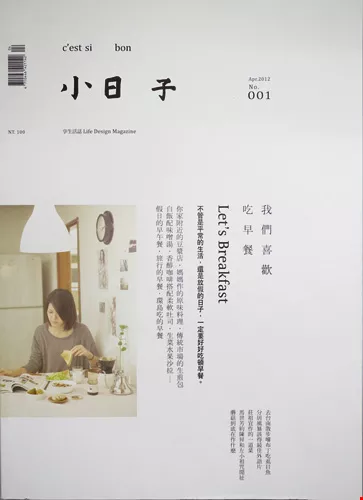
Beneath a plain exterior, editor-cum-publisher Huang Weirong’s C’est si bon sketches out the experience of daily living.
C’est si bon publisher and chief editor Huang Weirong explains: “There’s more than one approach to the topic of breakfast. A big commercial magazine is sure to focus on the size of the national market, and on business opportunities. A health magazine will tell you how to eat for a better and longer life. But we don’t care about the GDP or whether something is healthy or not. We just talk about what kinds of breakfast we like.”
The second edition, “Good Urban Hangouts,” is full of all sorts of idiosyncratic takes on this and that, e.g.: “I don’t want customers coming to my shop for conversation, I just want them reading and listening to music”; “I close my coffee shop at 6 p.m. so I can have dinner with my family”; or “After moving into the Minsheng community, I came to enjoy strolling around and just hanging out.”
This is a “life design” magazine that pays attention strictly to “the self.” Huang points out that business magazines stress corporate competition, investment returns, and other things connected with the quest for success. Life and leisure magazines, meanwhile, usually focus on providing “tips,” and tend to be too cutesy and chock full of ads. What the market sorely lacks is publications that spur a dialogue between the reader and his or her inner self.
Says Huang: “A magazine is a ‘mood product.’ Our target audience is a new generation of readers with a strong desire for a personal style of their own. For them, ‘quirky opinions’ that might seem like fluffy reading material but nevertheless make a specific point, are more likely to strike a responsive chord.”

Chan Wei-hsiung has great hopes for his magazine enterprise, and is launching a plethora of mini-mags. His cutting-edge sports magazine Soul has been highly praised.
The lifestyle mini-mag Practice was also launched in April, and features a similar style. It was founded by Ray Huang, the president of Revolution-Star Publishing and Creation, whose guiding philosophy in setting up the magazine was that “life is a never-ending series of practice sessions.” In that spirit, the publication serves as a reference book for readers as they go through the different stages of life.
However, published as a type of “theme book,” Practice has clearly been launched with an ear to the ground regarding market preferences. For the founding issue—“Being Alone”—the publishers pulled off something of a coup by arranging for a dialogue on “hotel rooms as private space for creative thoughts” between the author Lo Yi-chin and the hugely popular independent songwriter Cheer Chen. Also, it was in Practice that unmarried celebrities such as Crowd Lu, Vincent Fang, Xia Xia, and Patricia Lan offered first-ever public peeks into their private homes.
According to Ray Huang, Practice makes use of people who were already working on staff at his publishing company. Resources are somewhat limited. “It’s kind of like being in the post-season playoffs in major-league baseball. We face the pressure of being in a must-win situation. There’s no room to mess up. So no matter who writes the articles, or who we interview, we’ve got to line up heavy hitters to maximize our chances of success.”
Practice sells for a somewhat pricey NT$199 and will be published at irregular intervals that may sometimes extend to three or four months between issues. But it is very popular, nonetheless. The founding issue sold 20,000 copies. “Being Together” has been selected as the theme of the second issue, to be released in August 2012.
Ray Huang explains: “Lots of relationships involve people being together. They might be husband and wife, lovers, co-workers, or partners, for example. The theme of “Being Together” is a lot more difficult to address than “Being Alone.” We’re going to go with an even more difficult theme for each successive issue, so that readers will look forward with anticipation to what’s coming next.”
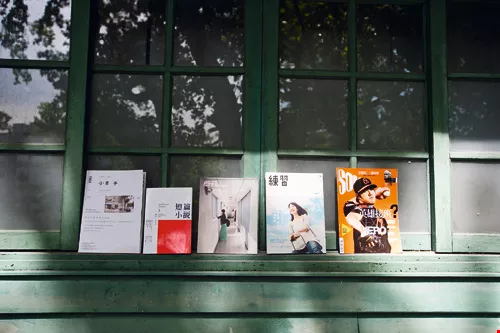
The many mini-mags that have recently appeared have in common a small core team and a focus on the minutiae of daily living. They have won popularity by tapping into the demand for individualism in today’s society.
Veteran publishing professional Chan Wei-hsiung, deputy chairman of Xue Xue Institute, is more ambitious still, having brought together a group of people who pooled NT$24 million which they are using to publish a series of 15 mini-mags, each with a different theme. They first tested out the market with the sports magazine Soul, the music publication Gigs, and the purely literary Short Fiction.
“I’m very optimistic about the future for mini-mags,” says Chan, who explains that “mini” means a small staff, a small print run, and a focus on “the small self” as they say in Chinese, i.e. the individual, rather than any group of people or institutions. The size of staff and print runs are especially important for keeping costs under control. The editorial and circulation departments at a large magazine typically have anywhere from dozens to 100 or more people, so circulation has to top a certain number to offset the big costs involved.
A mini-magazine, by contrast, generally has a staff of no more than three, which cuts way down on costs and eases internal communications. Such a grouping is well equipped to react to social trends and nimbly adjust operations.
Chan stresses that having a small staff does not mean that a mini-mag is necessarily dominated by a single point of view. In today’s society, a magazine can work via the Internet to solicit articles and get layout work done. “Net-working” is the term coined to describe the phenomenon, and it has become quite commonplace. It is no longer necessary to hire people in-house to get their services.
Says Chan: “People with something to contribute these days like to start up their own business or work as freelancers. They don’t like to be tied down, so a mini-mag can tie up with them to build up a bigger talent pool. This can dramatically enhance a magazine’s depth and diversity.”
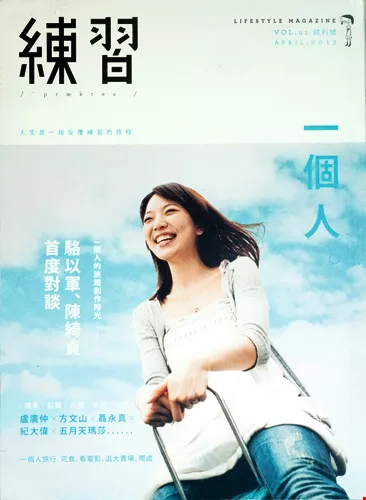
Practice, which follows a “theme book” concept, is the fruit of three years’ planning by publishing whiz kid Roy Huang.
Mini-magazines are a sharp contrast from the large magazines that have focused for decades now on society as a collective whole. When people read articles about Taiwan’s brain drain, for example, or in-depth features arguing that “what other countries can do, there’s no reason we can’t,” they are taking part in the collective life of Taiwan society.
But a mini-magazine couldn’t care less about what we ought to know as members of society. It simply trains a laser-sharp focus on the reader’s individual experiences, feelings, preferences, and desire for self-fulfillment.
“Taiwan society is in the process of a huge transition from a collective to an individual focus,” says Chan. A collective focus puts top priority on society as a whole. The value placed on the individual’s pursuit of happiness is very much subject to the dictates of the larger society. In a society focused on the individual, however, each person determines his or her own fate, which in the end is the result of everything the individual attempts to achieve over the course of a lifetime.
In his opinion, mini-magazines “focus sharply on small readership segments” and “speak from the heart.” And because they are small, the world is no longer dominated by a small number of truths. The innate differences between individuals begin to be respected, and the reader has the freedom to be himself.
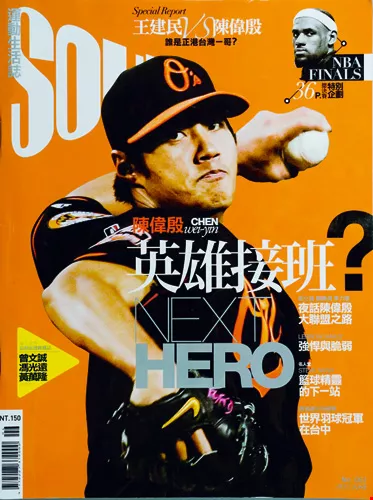
Chan Wei-hsiung has great hopes for his magazine enterprise, and is launching a plethora of mini-mags. His cutting-edge sports magazine Soul has been highly praised.
But how might a sports or music magazine tie in to the individual self?
In Chan’s view, sports and music are connected with the existence and the “trembling” of the human body. The athlete must rigorously control the body to achieve a world-class performance. A thrilling display in the arena is a microcosm of the drama of life. Meanwhile, in rock-and-roll music, we use the body to remember musical notes. Sports and music are always communicating to listeners and readers their own internal conflicts.
A magazine produced in line with this strong focus on the self will necessarily strike people as something quite novel. Soul, for example, which takes its inspiration from the US magazine Sports Illustrated (3.3 million copies per issue), is the first monthly sports magazine in Taiwan to eschew elaborate reporting on the play-by-play of competition. It is also the first such publication to care not a whit about won-lost records. Instead, it directs readers’ attention to the personal lives of athletes, including their dreams and their struggles to achieve them.
The theme of the June issue of Soul is “Next Hero?” The hero in question is the “new pride of Taiwan,” Baltimore Orioles pitcher Chen Wei-Yin. The magazine feature article describes his pitching style: “In contrast with the incurably eccentric Yu Darvish (whose goal is to achieve unexcelled mastery over every single type of breaking ball pitch in the game), Chen does not look like an effortless genius. He doesn’t strike awe in the eye of the beholder by his mere aspect, nor does he have a bunch of tricky pitches up his sleeve. He simply impresses people as the sort of person who can really get a job done right.”
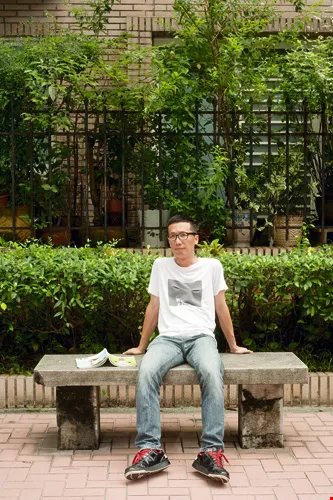
Practice, which follows a “theme book” concept, is the fruit of three years’ planning by publishing whiz kid Roy Huang.
Chairman Simon Hung of the Magazine Business Association of Taipei feels that print magazines must shift gears to deal with the challenge of today’s digital readership.
“Big magazines that focus on the business world and general news still account for the bulk of magazine sales in Taiwan, but their sales are falling,” says Hung. He argues that in the Internet era, when information is ubiquitously available, general interest magazines may gradually be driven out of the market.
He points out that 56 new magazines were launched in Taiwan in 2011, while 15 others were closed down, and almost all the new magazines were characterized by a small staff and a tight focus on health, food, fashion, lifestyles, photography, or some other such interest with a close connection to the individual’s everyday life.
Chan Wei-hsiung, for his part, uses a metaphor about “being in the sun” versus “being in the moonlight” to describe the difference between digital reading versus print media reading. He points out that people involved in online publishing realized long ago that online readers are an impatient bunch, and that any given news article is best limited to 800 Chinese characters or fewer. When people read something on a light-emitting screen, they tend to absorb information quickly and depart quickly. That is why Facebook and Twitter, which cater especially to short-form communications, have proved so popular.
Reading print media, on the other hand, is like being in the moonlight, where a person can relax and appreciate subtleties. Reading something in print is a much different experience. “Similarly, digital music is everywhere, but a live performance is just so much more powerful, because our eyes and ears are not our only sensory organs. We still have to use our tactile sense to feel the power of music.”
A print magazine can be quite subjective and idiosyncratic. It can be full of passion, with a feel of youth and the sweaty pulse of life present in every single line. Or it can be quite literary, and lure the reader imperceptibly into an entire universe created by the written word. The success of mini-magazines in a down market has not come at the expense of the mainstream. Rather, it is simply a reflection of the contrast between “analog versus digital” reading styles.


@List.jpg?w=522&h=410&mode=crop&format=webp&quality=80)


