Intemperate Zone:Natural Disasters Revive Mountain Land-Use Issues
Coral Lee / photos Chuang Kung-ju / tr. by Phil Newell
November 2004


This summer two typhoons hit Tai- wan in close succession, washing away homes and crops, destroying roads, and killing people, demonstrating again the awesome power of nature. Besides rescuing citizens and repairing roads, another response to the disasters has been renewed discussion about excessive use of mountain slopeland. The Executive Yuan has announced that it will begin studying new land-use regulations, and in future it is possible that development, agriculture, and residential construction will all be banned from mountain slopes.
These days when you mention mountain agriculture, most people think of rampant overuse of slopeland, pollution of reservoirs and water sources, and landslides. Less and less do people associate fruit and vegetable farming in mountain areas with the traditional ideal of the sturdy hard-working farmer, but rather, increasingly, with gold-diggers who think of nothing but their own profit.
But several decades ago, the image of highland farming was not like this at all.
In the 1960s, the development of high-altitude agriculture added a glorious page to the history of Taiwanese farming. It was a matter of pride for Taiwan that people had successfully learned how to grow temperate-zone fruits in a sub-tropical country. And people were even more proud of the legendary exploits of, and spirit shown by, retired soldiers and officers in paving the way for development of mountain areas.
Mountain agriculture has been witness to the history of economic development in Taiwan and to the complex environmental problems and disputes of the past 20 years. What will happen to it now?
"The Tachia River has been almost completely filled in by soil and rock. The government is considering whether to close off the mountains!" On July 2, Typhoon Mindulle brought with it heavy rains, setting off flooding and landslides in the mountain areas of central Taiwan. The Tachia River was unable to handle the water, because as a result of past diasters-the 921 earthquake, and typhoons Toraji and Nari-the riverbed had steadily risen. Not only were the riverside hotels in the Kukuan hot springs area either washed away or flooded out, but five power stations along the Tachia River were inundated and severely damaged. Also, the Central Cross-Island Highway was cut, including the re-collapse of the stretch from Kukuan to Techi, which had been closed since the 921 earthquake, on which enormous funds had been expended for repairs, and which had not yet even been opened to traffic again.
In a review of these catastrophic events, a special committee led by the Council for Economic Planning and Development (CEPD) pointed a finger of blame at mountain agriculture, recommended that the Kukuan-Techi section of the highway should not be rebuilt, and urged that mountain agriculture should be gradually abandoned nationwide, with the areas affected turning instead to ecotourism, to give the land a much needed chance to rest and recuperate.
Even as the shadows cast by the July 2 floods remained, in mid-August Typhoon Aere brought more bad news. This time the worst affected areas were in northern Taiwan-Hsinchu and the mountainous parts of Taoyuan. Roads collapsed in many places in the water catchment area of Shihmen Reservoir, and huge amounts of rock and deadwood were carried by floodwaters into the reservoir itself. This caused siltation to such a degree that the water became turbid, and water quality was so poor that supply had to be halted, leaving hundreds of thousands of households in the Taoyuan area without running water for more than two weeks.

Near Chingjing Farm, a recreational site, you can find the highest-altitude Starbucks in Asia as well as the highest 7-11 in Taiwan, not to mention countless restaurants and homestays. Will all this also pass into history as a result of new government land-use policies?
Mountain agriculture at fault?
A meeting of officials and scholars convened by the premier found three main causes for the stagnation of the reservoir water: poor reforestation work, mountain agriculture, and mountain road-building. Although some scholars disagreed-arguing instead that the unusually large amount of rain and the natural steepness of surrounding slopes had caused even primeval forest to collapse-the debate again drew attention to excessive land use in the mountains, especially for orchards, which have expanded rapidly in recent years. Everywhere people wondered if it was worth losing a reservoir just so we can have peaches from Mt. Lala.
As a result of these calamities, the Executive Yuan has reevaluated land-use policy, and come up with a conservative-leaning policy that is quite different from past responses of simple disaster relief and rehabilitation. Chang Jing-sen, vice-chairman of the CEPD, which is in charge of land-use policy, states that the period of continuous high growth in Taiwan is over; moreover the environment has taken all the punishment it can, and the land is sick. What is needed is recovery. Conservation should be the main function of medium- and high-altitude areas. In those areas that do not need rehabilitation, the government should just bite the bullet and abandon the roads, and people who live in mountain areas should be offered incentives for moving out.
In an era of strong environmental consciousness, when reports of disasters are frequent, naturally a land-use policy that gives the environment central importance is going to get a generally positive response. But because the government actually promoted mountain agriculture for half a century, now hundreds of thousands of farmers and workers in related industries depend on it for their livelihood, and there is also the question of the cultural and historic needs of Aborigines who call the mountain forests home. How can the gains and losses of "bringing agriculture down to earth" be apportioned? Is there no way to better manage mountain agriculture?
Perhaps we can get some clues to the answers to these questions by scanning over the history of mountain agriculture. The story begins with the construction of the Central Cross-Island Highway (CCIH) and the creation of farms run by the Veterans Affairs Commission.
VUps and downs... and ups
Back in the 1950s, in order to create transportation links across the Central Mountain Range to connect eastern and western Taiwan, the government began to carve the CCIH out of the mountains. In the early stages, it was very difficult to transport materials to the project; supply of vegetables was especially problematic. So the government called on retired veterans to begin growing crops in the mountains, both to supply the road construction project and also to help develop new food sources for then food-short Taiwan. In 1957, the first highland agriculture project-Fushou Mountain Farm-was established near Lishan. Later, more projects of the same variety were launched along the route followed by the CCIH.
"Back in the 1960s and 1970s, increasing food production was an important target of economic planning," says former Council of Agriculture chairman Peng Tso-kwei. Developing mountain and marine food sources and developing marginal land were central to achieving this objective. The government even established a special Bureau of Mountain Agriculture and Animal Husbandry, as well as another agency to develop land reclaimed from the sea.
In the early days of the "agriculture into the mountains" policy, there was no sign of temperate-zone fruit. However, when some workers at Fushou Mountain Farm saw that pear trees planted around the former Japanese police station in a nearby Aboriginal community at Huanshan grew well, they decided to import apple, pear, and peach trees from Japan for trial planting. With help from experts at National Chung Hsing University's department of horticulture and plant pathology, after many setbacks they finally met with success. They subsequently began supplying saplings to local Aborigines, and the area under orchard cultivation steadily spread beyond the area covered by the original farm.
As one fruit farmer who is familiar with development in Lishan relates, because temperate fruits commanded high prices and yielded higher profit margins, the Aboriginal reservation land nearby was quickly exploited for orchards, and in a short time the mountain forests were transformed into fruit orchards to the fullest extent possible.
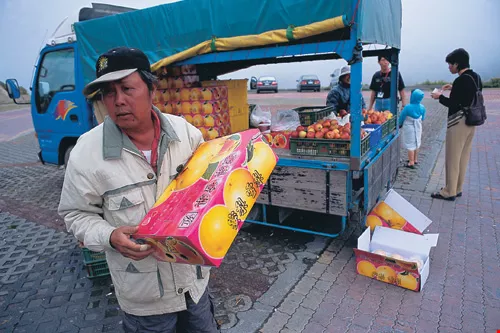
The successful planting of temperate-zone fruits in a sub-tropical country was a triumph for Taiwanese agriculture. But times have changed, and scenes like this may soon disappear. The photo shows a fruit seller at Wuling-the highest-altitude point on any main road in Taiwan-on the highway to Lishan.
Unusual conditions
Chen Chung, formerly a professor of horticulture at National Taiwan University, who served for more than 20 years at the university's own experimental mountain farm, points out, "Taiwan has great advantages for the development of mountain agriculture." Taiwan is located at the junction between temperate and tropical zones, with an ocean on one side and a continental landmass on the other. Within the confines of the island, two tectonic plates have pushed up mountains as high as 4000 meters, and, conveniently enough, have created a large plateau roughly 2,000 meters above sea level, where the climate is like spring all year round.
"If it were not for these unusual conditions, development of mountain agriculture in Taiwan would never even have got off the ground," explains Chen. Mountain agriculture in Taiwan got started in Jen-ai Rural Township in Nantou County and in the Lishan area, both located on this 2000-meter-high plateau which also embraces the upstream portions of several rivers. Most of this land is of moderate slope, so there are no concerns about landslides. This is also the stretch of land where Aborigines chose to settle after they were pushed out of the lowlands.
"Besides the climatic and geographic advantages, this area has a unique background in terms of human history," states Chen Chung. If hundreds of years ago Chinese had not flooded into Taiwan and occupied all the lowlying land, the Aboriginal peoples would never have been forced to move to high altitudes. When the Nationalist government retreated to Taiwan in 1949, overnight the island was flooded with two million refugees and soldiers, creating an immediate shortage of arable land, and spawning an urgent need for development in the mountains.
This unique natural and human background allowed mountain agriculture to flourish for some time. But the casual nature of land management in the mountains in those days led directly to the environmental destruction we see today.
Back in the 1950s, when veterans were urged to open up farmland in the mountains, the Forestry Bureau opened up state-owned forest land to development, including land that lay on ever steeper gradients. The bureau also stipulated rules under which fruit trees were considered a kind of "forestation," so that-given the high profitability of temperate zone fruits-the transformation of forest land into farmland became increasingly intensive over time.
While the Forestry Bureau was opening up state-owned woodlands on one hand, farmland in the Lishan area belonging to the Veterans Affairs Commission, and as much as 60-70 % of land reserved for Aboriginal peoples, was also being transformed. Although the law stated that Aboriginal land could not be rented, sold, or transferred, because of Aboriginal inexperience in business, many Aborigines entered into private contracts with Han Chinese from the lowlands. The new contractors in turn often passed the land onto others, with much of it falling into the hands of large corporations. There were similar developments with the land turned over to veterans by the Veterans Affairs Commission.
This mismanagement of state-owned and Aboriginal reservation land sowed the seeds for the intractable land disputes that were to follow.
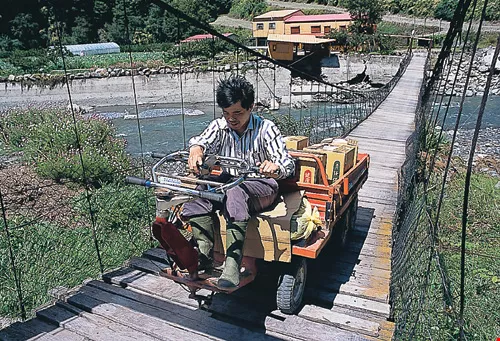
Huang Chun-hsiung, a farmer at Hoping Farm in Lishan, has switched over to growing organic vegetables in response to the competition brought about by Taiwan's accession to the WTO. Trying to squeeze the maximum profit out of his small stretch of land, he also runs a homestay for tourists. In the photo he is about to turn several crates of organic veggies over to a delivery service to be carted down the mountain.
Reservoir dogging
"By the 1970s, land development along the Central Cross-Island Highway was more or less a done deal. But then came the completion of the Techi Reservoir, which came into conflict with the way people in the mountains made their living," says Li Pao-lien, a fruit farmer of the younger generation in Lishan who closely follows environmental issues. Because Lishan lay in the water catchment area for the new reservoir, cultivation of slopeland of an incline of greater than 28 degrees (which is to say, in violation of regulations)-posed a severe threat to water quality and the life expectancy of the reservoir. Consequently the government sought to recover the land. Once news of the policy came out, farmers were furious: "They figured that they were there first, and the reservoir was a late-comer, so the reservoir shouldn't deprive them of their livelihoods," recalls Li.
Fu Wen-ta, who has been running a fertilizer business in Lishan for over 30 years and is also chairman of the local tourism association, has for many years been acting as a spokesman for farmers' rights. Taking out a copy of a "Contract for Rental and Reforestation of National Forest Land," made with the Forestry Bureau in 1970, he points out that the list of "forestation species" explicitly includes pear and apple trees. He says, "After you plant the seedlings, it takes 15 years to reach peak profitability. This is a long-term investment-how can they just take the land back because they feel like it?"
Given resistance from farmers, it's not hard to imagine just how far government efforts to get back control of the land have gotten. Li Pao-lien notes that in 1979 and 1995 the government launched two campaigns to take back about 1000 hectares of land being used in violation of restrictions. The first wave was right in the middle of the period of greatest prosperity for the temperate-fruit industry, and nothing came of it. Orchard-owners were so opposed to this effort that it was generally believed that a sudden surge in major forest fires in the early 1980s could be connected to farmers who set the blazes as a way of striking back.
Starting all over, experts drew up a new land recovery plan. During this second effort, the government offered farmers compensation of NT$900,000 per hectare if they would abandon their orchards during the first year, NT$700,000 per hectare the second year, and NT$400,000 the third year, with compulsory appropriation of the land the fourth year. But after four years, the government had only recovered 200 hectares or so, accounting for only 20% of the land being farmed in violation of land-use limitations. The local government, unable to enforce the law, just gave up, listing the orchards as "illegal land use" but letting them carry on business as usual.
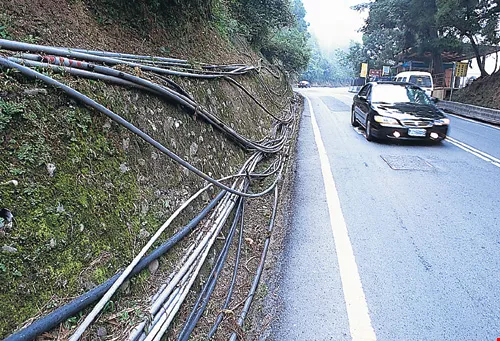
It is common along mountain roads to see a slew of water pipes, most of them hooked up by ordinary citizens without authorization. They symbolize the failure of effective resource management on Taiwan's mountain slopes.
Who gets the money?
"One reason is that the compensation was too low," say many farmers. In catchment areas for other dams, compensation was NT$8-10,000 per tree, which translates into NT$4-5 million per hectare on average. So why were Lishan farmers considered in a lower class? In addition, the media mostly cited protesting farmers and collusion with elected officials as the main reasons for the lack of success of the land take-back, but in fact behind the dispute over compensation there were other difficulties not generally known to the public.
Li Pao-lien says that as a result of deals made over the years, use of most of the land around Lishan had long been transferred from the original owners-veterans and Aborigines-to Taiwanese from the lowlands.
Therefore, the compensation for land taken back by the government would not have ended up in the hands of those farmers who had for so many years paid rent, invested in the land, and borne the burdens of natural disasters. "They stood to lose everything they had and get nothing in return, so of course they were opposed," says Li Pao-lien. The problem is that these land rental deals were illegal from day one, so farmers could not justify themselves on these grounds; instead, they simply turned up the volume on their other claims.
In the 1980s, with the rise of environmental consciousness, the increasing severity of illegal land use in the catchment area of the Techi Reservoir (which supplies tap water to the whole greater Taichung area), and continued inability on the part of the government to take back the land, some scholars recommended another tack-liberalization of apple imports. Because competition from foreign apples would drive down prices for Lishan apples, the incentive for farmers to continue would disappear. However, though apples did indeed fall out of favor as a result, they were replaced by cabbage instead.
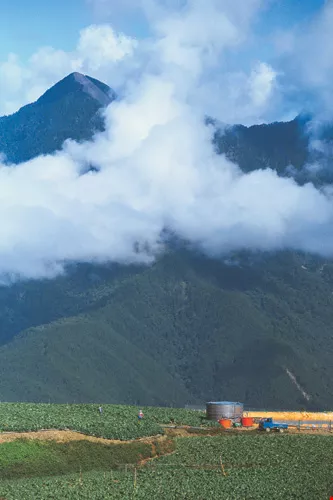
Compared to nature, people look pretty puny. We will survive longer if we are more modest and restrained in exploiting the mountains.
Out of the frying pan, into the fire
Cabbages are recognized as the single crop most damaging to soil conservation. They have shallow, weak roots, and the surface soil lacks plant cover. There is a harvest every two or three months, after which the soil is turned up for new planting. As a result of these factors, soil erosion is three times worse than with fruit trees, and 15 times that of natural primeval forest. But because cabbages, a very popular treat in Taiwan, cannot be grown in the lowlands in summer, prices increase sharply then, inducing farmers to plant them all along the Northern and Central Cross-Island Highways.
According to Council of Agriculture statistics, produce from land above 500 meters is worth over NT$20 billion per year, and accounts for 15% of Taiwan's agricultural production. However, now that incomes are higher and imported fruit is easily available, many question whether the cost of rescue and reconstruction after natural disasters, often measured in billions of NT dollars, is worth it for the sake of a few apples and pears.
In the near future, as result of policy decisions at the central level, the Veterans Affairs Commission will take its four large farms-all quite legal-out of mountain farming, and it is estimated that after three years these will have been turned entirely over to man-made forest. However, given the fact that the VAC now controls less than 100 hectares of farmland, many people are skeptical that this action will have much impact, considering that nationwide there are 150,000 hectares of mountain land being farmed legally as well as 50,000-plus being farmed in violation of restrictions.
"The government should first deal with the illegal land use. They can't try to close legal operations all at once," says Li Ming-chi, head of the Lishan farmers' association. The government hasn't done anything over these many years to teach farmers how to care for farmland, to conserve soil, or to switch over to higher-grade crops. But every time there's a disaster, that same government blames the farmers, who in turn get more stubborn than ever. And what about those middle-aged folks who have set down roots in the mountains? Could they adapt to life down in the lowlands? This is a major reason why they prefer to stay in the hills, despite incomes from orchards having fallen by more than half in recent years, to around NT$40-50,000 per hectare, and growing difficulty in getting laborers.
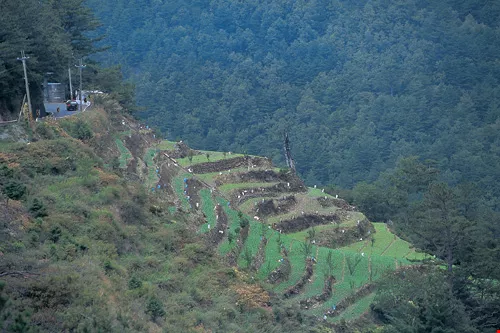
Cultivation of steep slopes constitutes "land use in violation of restrictions," and creates a high risk of soil erosion and landslides. In recent years, cultivation of high-altitude vegetables (which have shallow, weak roots) has become widespread, posing an even more serious threat than the fruit orchards of the past.
The forest for the trees
Although the problems produced by mountain agriculture-the result of historical factors, policy choices, and environmental change-are very complex, there is a larger question as well: Would pulling mountain agriculture up by the roots really solve the problem of mountain-forest conservation in Taiwan?
"If agriculture is sent down the mountains and farmers move out, you can bet that the problem of illegal logging will get even worse," says Lin I-jen, an assistant professor in the Graduate School of Ecology at Providence University who specializes in forestry and Aboriginal issues. For many years now illegal loggers have been cutting trees along the upstream parts of rivers, and when a heavy rain hits they just wait downstream to pick up the logs that are carried by the rushing water; the government has never been able to catch them fast enough. Taking this year's July 2 floods as a case in point, Lin says that the Taitung County government earned upwards of NT$100 million from selling driftwood, which makes you wonder how much more the illegal loggers are getting. If the mountains are left empty, illegal loggers will be able to work all the more easily.
Mountain tourism is also a major problem. The government is currently working to increase tourism, and is encouraging citizens to spend more on domestic vacations. Many of Taiwan's best-known attractions, such as Chingjing Farm, Mt. Lala, and numerous forest recreation areas, are located high in the mountains. Local governments trying to come up with unique local features to appeal to visitors often turn to their mountain vistas and unusual mountain produce. If highland tourism continues to grow, inevitably it will be impossible to reverse destruction of the mountain forests.
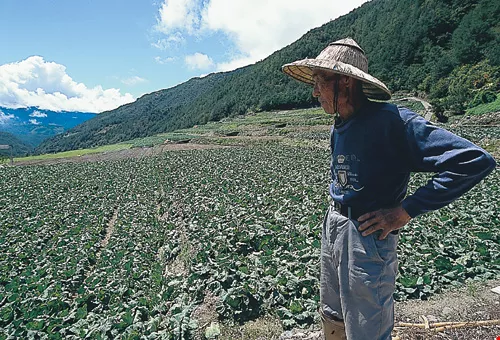
Many mountain farmers are people of no great wealth, working perfectly legally on flat or gently sloping farmland, depending for their living on the vagaries of nature. Halting mountain agriculture would have a major impact on their lives.
Dammed for eternity?
Besides excessive land use, illegal logging, and heavy tourism, mountains also suffer from dams.
"The Shihmen Reservoir destroyed the Tahan River, and the Techi Reservoir has brought enormous problems to the Tachia River," say environmentalists. Dams and weirs built to facilitate the collection of gravel for construction have also had a very severe impact on river ecology. In recent years, the power stations along the Tachia River have been rendered much less productive by excessive silting of the riverbed. After the July 2 floods many people advocated not repairing the power stations, which were inundated, at all. Others, considering the instability of the local geology and fears of future landslides, suggest tearing down the dams and removing the generating plants, giving the river a chance to recover. But the Ministry of Economic Affairs is adamant that it will not close the power plants. Environmental scholars question this stance.
If getting mountain farmers to come down from the hills really is the only solution, persuading and resettling them will also present thorny problems. This aspect too has been the subject of much discussion.
Lin I-jen, a long-time observer of life in Aboriginal communities, says that in the past the government just offered compensation to resettle mountain residents, which was ineffective. This is because the tribal villages include both poor and well-off people, and compensation is dispensed through a complicated political and economic mechanism, as a result of which "generally the money doesn't get into the hands of poorer Aboriginal people." He feels that environmental protection isn't only about the natural ecology-you've also got to consider the social and human aspects.
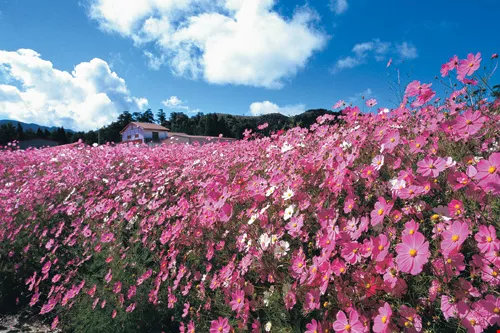
Standing in an autumn breeze, touched by sunshine, cosmos flowers startle one with their beauty. Fushou Mountain Farm has been moving more and more toward tourism and recreation in recent years; can "recreational farms" be one answer to the problems posed by mountain agriculture?
Aborigines protecting the forests
"The connection between Aborigines and the land goes beyond economics, it touches on their space, history, and culture, and is part of the collective memory," says Taiban Sasala, chairman of the Commission of Indigenous Affairs of the Kaohsiung City Government. In the past the Kala tribe of the Atayal people was forced to move to make way for construction of a dam, and members of the Truku, Bunun and Puyuma peoples have all lost hunting grounds and sacred lands to national parks and nature preserves.
The question, for scholars and others concerned about mountain forests, is how to work with Aborigines to protect Taiwan's mountain forests.
"The core natural resources in Taiwan's forests should be put in the care of the Aborigines, that's the only path to sustainability," says Lai Chun-piao. At present, all 18 forest recreation areas are to be managed by hiring outside contractors. The Aboriginal communities have no opportunity to share in the resources. Lai strongly argues that only if the mountain forest resources and profits are shared with the Aborigines, and non-profit, genuine ecotourism is promoted, will it be possible to address the problem of Aborigines living off the mountains. This will allow the Aborigines to stand with dignity on the land of their ancestors, and protect the mountain forests for all of Taiwan.
"In ecological studies, the idea that all things are interrelated is a very important concept: Gain for any side will necessarily create loss for some other," says Lin I-jen. So it is necessary to learn how to find consensus with people who have different opinions from oneself-that's the only way to collectively work out a path to sustainable development.
The environment, the economy, and society are the foundation stones for sustainable development. There is no better indicator to keep your eye on than mountain agriculture.
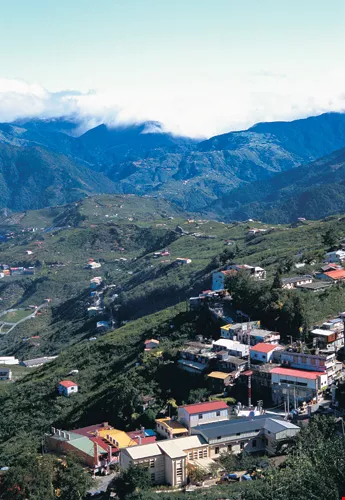
The long ridge line dotted with buildings and houses tells a story of the vicissitudes of mountain agriculture around Lishan. The relatively flat area in the picture is a plateau at 2000 meters above sea level.


