Capital Investments--Taiwanese Firms in Beijing
Laura Li / photos Jimmy Lin / tr. by Phil Newell
August 2001


It is mid-May, and the air over Beijing is still choked with dust blown in from desert storms. With Beijing pressing to win the bid to host the 2008 Olympics, Chang'an Boulevard is sparkling. The Chinese capital's economy claims to be-or at least aims to be-centered around the knowledge-based economy. When it takes off, what effects will this have? As Beijing's economic power grows, given the cross-strait deployments of Taiwan companies, what will be the effect on Taiwan?
"In the 1980s it was Shenzhen, in the 1990s everybody focused on Pudong. In the new century, keep your eye on Zhongguancun!" In the minds of most people, Beijing has always been home to scholars and royalty. But in the 21st century, the disdain of the traditional scholar for commerce is long-forgotten, as Beijing tries to turn knowledge into cash.
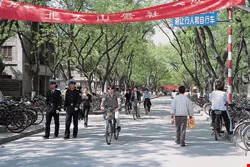
Two of China's leading universities-Peking and Tsinghua-are located in Zhongguan. Today they are the cradles of corporate CEOs. The photo shows a view of Peking University.
Visions of gold
In the suburbs of Beijing you can find the Haidian Park area of Zhongguancun or Zhongguan "Village," not far from Tsinghua and Peking universities. Having begun with "Electronics Street" ten years ago, it is today one of China's four "Silicon Valleys," right up there with Shenzhen (in Guangdong Province), Pudong (Shanghai), and Xi'an (in Shaanxi). Most Taiwan companies have their sights set on greater Shanghai and the Yangtse River delta. But Zhongguancun-which is not a village at all, but rather a non-contiguous set of parks for high-tech industry-boasts more foreign sales headquarters and R&D facilities than anywhere else in China, and sets the tone for the "capital economy."
Deng Depei of the Beijing Municipal Office of Taiwan Affairs, who as an engineer was doing semiconductor research back in the 1960s, knows very well the position of Beijing in China's industrial development.
"Beijing's strengths are its strong academic presence and large number of talented people, so it can serve as a center for innovation and R&D," says Deng. In the Haidian Park area alone, there are 56 universities or technical colleges, of which 23 are considered core universities backed by the central government. Each year these schools send another 13,000 grad students into the workforce (more than twice the number produced in all of Taiwan), as well as 2600 PhDs. The whole region is a tireless producer of trained manpower for business.
Besides universities, Haidian Park has more than 200 research institutes, including the Chinese Academy of Sciences, with more than 37,000 scientific personnel. Each year institutions from here apply for some 7000-8000 domestic patents, ranking number one in China. To get the maximum value out of local brain trusts, Beijing Municipality frequently sponsors get-togethers for tech people, and every year there are more than 20,000 cooperative ventures in the tech field, with trade volume in excess of RMB8 billion (NT$32 billion, or almost US$I billion).
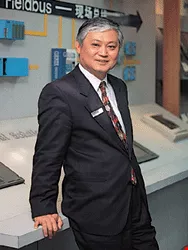
Chaney Ho, general manager of Advantech in Beijing, has been honored in Taiwan for his management prowess. Ho says that Taiwan firms today have a meaningful opportunity to come to China to cultivate skilled people and raise industrial standards.
Not a taxing environment
Beijing has lots of bright people, but also lots of rules. Taiwan business people, who have a reputation for taking the end run around orthodox procedures, have been a little put off by this city. However, recently the Taiwan Electrical and Electronic Manufacturers Association announced the results of a survey showing that Taiwan business people see the Trans-Bohai area (including Beijing, Dalian, Tianjin, and Qingdao) as the area of lowest risk for investment. In contrast to the high crime reputations and frequent investment disputes in Shenzhen and Dongguan in Guangdong, Beijing's relatively straight-laced character is reassuring.
"When the 'Develop the Greater Northwest' policy takes its next step, you will be able to move without obstruction from Beijing to Xi'an," Deng Depei predicts. Once Russia and Eastern Europe begin to grow economically, and form connections with China's northwest, in five or ten years "the Trans-Bohai region will replace the Pearl River Delta and the Yangtse River Delta as the hottest spot for Taiwan investors!"
Beijing got a relatively late start trying to attract investment, so it is naturally more generous in offering incentives. Take for example wafer fabs, which Beijing has been courting heavily. Beijing Mayor Liu Qizeng declared that companies which establish chip factories in Beijing can not only enjoy the "two exemptions and three reductions" (tax incentives) offered by the national government, but can also enjoy "zero rent." Only when a company succeeds enough to seek a listing on the stock market will Beijing Municipality collect all the back rent. If companies think investing in Beijing might be a risky proposition, Beijing will make a "matching investment" of 15% of the company's registered capital in order to ensure "risk-sharing."
To promote the development of the software industry, the national government is floating the idea of exempting those in the industry from personal income tax, and Beijing is going even further. It proposes "awards" to high-ranking software company personnel to help them purchase homes or cars. The astounding incentives being dangled in front of skilled people are a real plus for foreign R&D companies.
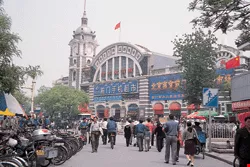
Everywhere you walk in Beijing, you see the desire of this historic city to join the new century. It is no surprise to see an electronics market located in an old train station.
Taking on the big boys
In fact Taiwan business people have been in Beijing a long time. The capital has 1700 projects from Taiwan, which is the third-largest source of foreign investment there (behind the US and Hong Kong). Though committed Taiwan investment (RMB1.3 billion) ranks only sixth and accounts for only 4% of total foreign investment, this figure is suspected to be a low estimate. If you include the amounts invested by "shadow Taiwan businesses" through banks in places like the Virgin Islands or Cayman Islands, "Taiwan investment in Beijing accounts for about 15% of the total," estimates Deng Depei.
In terms of industry type, most of the 1700 Taiwan firms in Beijing fall into traditional industrial categories like traditional Chinese medicine, textiles, food products, and trade, and most are maverick enterprises with the boss running the show virtually single-handed. There are very few large high-tech firms.
When you ask why, it is partly because after all this is Beijing, with its freezing winters, and Taiwanese are rather too accustomed to southern climes. Also, land and labor costs are higher here, so it is not suited to mass production. The types of activities that are suited to Beijing-marketing and R&D-are not the long suits of Taiwanese companies. And when you add that this place is crowded with "fire breathing dragons" like Compac, Microsoft and Intel, and "national brand" powerhouses like Founder, Tsinghua Unisplendour, and Legend, this is just not a receptive place for Taiwan firms.
However, a few high-tech Taiwan firms with deep pockets and global vision have staked out their claims to a piece of Beijing, building up their strength in the very heart of "Red China."
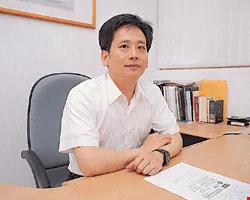
Chou Chih-yuan of Global View has been in Beijing since 1993. He got on the ground early, and his strategy has been correct. Today his company's products are huge sellers throughout the PRC.
Do you R&D?
As you leave Beijing airport and follow the Bei-Four Beltway to the Haidian Park area of Zhongguancun, all along the way you are welcomed by billboards saying "That VIA Feeling, In the Heart of China," and from time to time an Acer sign springs into view as well.
VIA Technologies set up shop in Beijing only two years ago, drawn by the local market and the wealth of talent. VIA's R&D department began operating a year ago, and its original target for the first phase (the first two years) was to recruit 200 R&D people and create a strong foundation. The long-term hope is to have an R&D staff of 2000 working here, which would be on a par with the Beijing research institute founded by Intel.
However, after one year in action, VIA Beijing only has about 50 or 60 people. Chief Administrative Officer Tom Hsu says that because most European and American conglomerates set up their China headquarters in Beijing, they are squeezing the labor market and making it hard for Taiwan firms to recruit skilled people. This is reflected in a common refrain at the top Beijing schools: "Come, come, come to Beijing University. Go, go, go to America." So the supply of skilled people is not nearly as large as was anticipated.
Fortunately, after a year of exploring the scene, Hsu has a much better grasp of the municipality's manpower market, such as which professors can deliver what kind of students, what research is being conducted and by whom, and so on. The earlier you hit the campuses, he has found, the more successful you will be.
Global View general manager Chou Chih-yuan, who has been permanently stationed in Beijing since 1993, is an even more experienced headhunter. He explains that while it cannot be said that there are few skilled people in the information industry in Taiwan, most of them have been "sucked up" by Taiwan Semiconductor and United Microelectronics. A company like Global View, which produces electronic dictionaries and needs lots of programmers, is better off finding their staff elsewhere. When you look around the world, except for India, Beijing is the place you will find the largest number of skilled software people.
A wasteland
Chou Chih-yuan's impression of Beijing in the early 90s was a "wasteland." Not only were there few international firms, you couldn't even sniff out a high-tech footprint at Peking University or Tsinghua University. One employee who graduated from Tsinghua in the late 80s says that there were few computers at the school in his day. In his five years in college he spent only 100 hours on computers. Students wrote out their programs on paper, and professors had to judge at a look whether the programs would work. When he saw the quite ordinary computer books brought from Taiwan by Chou, this employee was like a child in a candy store.
At that time Chou figured that the mainland had plenty of smart people but no cash, no information, and no experience, whereas the situation was exactly the opposite in Taiwan. "The fit was almost too perfect!" Chou recruited some top-level hard science students and started training them from scratch.
Chou adds that in the past the situation in the mainland was polarized. At one end were a few elite individuals developed by and for the Ministry of Defense. At the other end was a huge supply of poorly educated labor. Meanwhile there was a dearth of middle-ranking technical personnel. In the last few years policy in the mainland has reversed course, and the system is now producing large numbers of the middle-ranking staff people that business needs.
In 1995, 800,000 students entered university in all of China. Last year the figure was 1.2 million. The number of MA holders has also increased dramatically. Thus, though foreign companies have been pouring in and recruiting people, labor costs will probably still stay at a reasonable level. Currently, an employee at a foreign-owned R&D facility in Beijing earns about RMB4000-5000 per month (somewhat over NT$20,000), less than half the amount in Taiwan.
The problem is not affording skilled people, but getting the legal right to hire them. According to PRC regulations, students who test into Peking University from other provinces or cities must return to their home areas after graduation. Only state-owned enterprises are allowed to recruit people who do not have their legal residence in Beijing. At one point the cost of a Beijing residence permit on the black market reached about RMB100,000, so you can see what a precious commodity it is.
"The vast majority of the people who come applying for jobs are students from outside of Beijing, and they always ask: 'Can you take care of the residence problem?' If you can't, they leave." Like other companies, when seeing these prime candidates walk past their doors, Global View had no choice but to accept the next best thing, and hire personnel who jumped over from state-owned enterprises.
Since last year, however, Beijing allows 64 enterprises to apply for Beijing residence on behalf of employees. Most are privately owned mainland companies like Founder and Legend. Global View is the only Taiwan firm on the list. This distinction means that they can recruit freely, and finally solve a problem that has been plaguing them for many years.
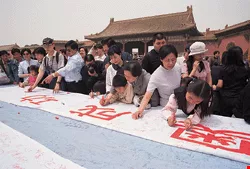
Over the long May Day holiday, China's more than one billion people take to the road for travel. Tens of thousands visit the Imperial Palace, where this year many added their names to the signature drive for Beijing's Olympic bid.
Train in vain
Chaney Ho, general manager of Advantech, the leader in industrial-use computers, had the foresight to bring his company to Beijing 10 years ago. He says that the quality of the engineers in Beijing by no means takes a back seat to Taiwan. For high-tech people like these, the militarized management of traditional Taiwan industries doesn't pass muster. They aren't even necessarily attracted by money alone. "You have to respect your employees, and be able to talk with them about culture, the future, and career planning," says Ho, who, having been recognized with a national management award in Taiwan, knows of what he speaks.
Beijing employees are certainly smart, but sometimes they need a guiding hand from senior Taiwan managers. Unfortunately, at present Taipei only allows mainland tech people to come to Taiwan for one month of training. This is not enough time to be of much benefit to the company.
Chou Chih-yuan points out that although the reform process has been going on in the PRC for over 20 years now, workers still don't have the knack of capitalism. When the work day ends, Beijing employees go home on time, and those who work overtime might be ridiculed as "capitalist running dogs."
"If they would let Beijing staff come to Taiwan for a year, these people would see how they burn the midnight oil at the Hsinchu Science-Based Industrial Park, and how employees have the commitment to be on 24-hour call. This would do a lot to improve results," says Chou Chih-yuan.
Beijing and Taipei are microcosms of the overall labor situations on the two sides of the Taiwan Strait. VIA's Tom Hsu says that Taiwan should still remain in the lead for the next three to five years, because it still enjoys several advantages that take some time to build up: a lot of veteran research people, experience with commercialization, and rapid access to information and international exchanges.
Taiwan also has more freedom. R&D people have to be creative, and creativity is rooted in pluralization and freedom. The mainland is still a one-party dictatorship, and everything from politics and religion to films and the stories on the evening news are strictly monitored by the Communist Party. The political atmosphere in Beijing is even more rigid than elsewhere. How can creativity flourish under such circumstances?
Tom Hsu estimates that after a few more years, when mainland students begin returning home from overseas in large numbers, bringing back the latest technology and personal contacts to found their own enterprises, then Taiwan businesses will face a real threat. Venture capital companies from the US and Taiwan are already putting their money on start-ups in Zhongguancun. Everybody is hoping to hit the jackpot with newly founded companies, and find a golden egg like those laid by Peking University's Founder and Tsinghua's Unisplendour.
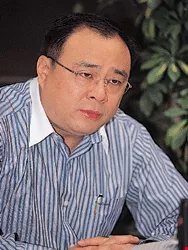
VIA's Tom Hsu, responsible for recruiting high-tech R&D people in Beijing, feels that Taiwan will still have the lead in human resources for several years to come.
A vacuum market
Besides the availability of skilled people, another attraction that Beijing holds for Taiwan firms is the market. Both Advantech and Global View have had considerable success in market development, mainly because they both came here early. Global View, for example, saw in 1995 that the only electronic dictionaries available in the mainland were imported models costing RMB1000 or more. The low-budget mini-electronic dictionary market was a vacuum. So Global View came out with the Wenquxing (named after a constellation that especially influences literary geniuses), which cost less than RMB300 while offering 80% of the functions of the high-cost models. The result was, as expected, a success, and last year the Wenquxing range sold more than three million units in the PRC, for more than a 50% market share, and six times the company's sales volume in Taiwan.
In the same vein, VIA is trying to gain a foothold in the market through low-priced PCs, by pushing its new C-3 CPU in the mainland.
Frank Jeng, who retains a "baby face" despite being in his 30s, is VIA's marketing director for Asia. He figures that, now that the PRC is pushing a policy of "rejuvenating the country with science education," demand for computers at primary and middle schools alone will be two or three million units a year. But educational institutions are short on shekels, so price is necessarily a critical consideration. The most expensive part in a computer is the CPU, so the prospects for VIA's C-3 CPU, which promises reliability at low cost, are good.
Besides price, VIA has not forgotten to appeal to nationalist sentiment. Their slogan "In the Heart of China" can be seen all through Beijing. And why not? After all, VIA is the only ethnic Chinese company capable of manufacturing CPUs.
"China's information industry is already among the top three in the world, whether you are talking about hardware manufacturing, software production, or market size. So why should the critical technology be stuck in the hands of foreign manufacturers?" It remains to be seen whether VIA can position itself on the "national brand" side of this equation. Nonetheless, the rivalry between Intel and this "Intel of Asia," as VIA is nicknamed, has been heating up, providing quite a spectacle for the information industry.
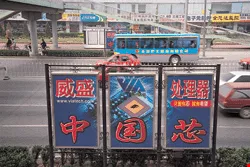
VIA Technologies, which aims to be "the Intel of Asia," has been actively moving into China in recent years. The slogan "That VIA Feeling, In the Heart of China" is a familiar one in Beijing.
Slow to heat, slow to cool
From Beijing, you really can feel how different the markets are on the two sides of the Taiwan Strait.
Chou Chih-yuan points out that in Taiwan Global View dictionaries sell to a market heavily populated with "gizmo lovers" who always want something novel. The company has to keep coming up with new gimmicks to adapt to this "shallow plate" market. But the market for the Wenquxing in the mainland is very different. There, products that are four or five years old are still good for sales of 100,000 units or more.
"The mainland market is deep and broad," says Chou, making the apt comparison to a big cauldron of water. It is slow to heat up, but once heated, it stays warm for a long time. Another feature of such a market is that information spreads correspondingly slowly, so companies who rely more on word of mouth (like Global View) can be just as well known in remoter areas as the big corporations that tend to get all the press.
So, as always, that enormous China market still casts its spell. But in Beijing, where political monitoring is most rigid, Chou Chih-yuan does not forget to tread carefully. He notes that electronic dictionaries include all kinds of politically sensitive information, from definitions of words to chronological tables of history and world events. His company has specialists go over every potentially offensive bit of information with a fine tooth comb, and produces different dictionaries for the PRC, Hong Kong, and Taiwan. (They can pull this off thanks to the large supply of software people in Beijing.) It is said that if a Taiwan company steps on the wrong toes in this area, it will be blacklisted.
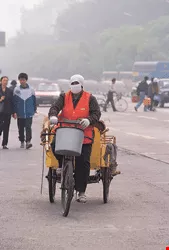
China's market economy is growing by leaps and bounds, creating a growing gap between rich and poor. Pictured here, a street cleaner pedals a tricycle cart under the hot sun.
Complement, not supplant
So, with all those skilled people and that giant market, will there come a day when Beijing replaces Taipei as the geographical center of Taiwan's commercial universe? In particular, when Taiwan powerhouses like VIA relocate to the mainland, will there be a domino effect at home?
"There's no need for concern," says Frank Jeng. When he entered VIA's Hsintien (Taipei) headquarters back in 1993, the company had only 100 employees. Now there are 1500 working there, and domestic operations continue to expand. "No matter what kind of organization you are talking about, the brains follow the decision-makers." Jeng figures that as long as the decision centers remain in Taiwan, R&D will be here too.
It's simply that as the company expands, VIA needs to use all the available resources. Thus, over the last two years the company acquired a US graphics-chip maker and also an American CPU manufacturer, and has set up an R&D center in the States. Taiwan, meanwhile, is the bastion for chipsets-the main money spinner-while in the future Beijing will mainly get newly developed telecom and graphics products. The main problems will be of coordination among the three elements-Taiwan, mainland China, and the US-rather than of competition or substitution.
Of course, looking to the long term, as more and more companies like Intel and Acer establish beachheads in China, wafer makers looking for orders are going to have to set up factories in the mainland sooner or later. But this will be an extended process. "There is no particular special technological advantage that can be maintained with eight-inch wafers, so they might as well be tossed over to the mainland," avers Frank Jeng, "while the 12-inch, which is the real unique money-maker for Taiwan, will naturally stay here." Taiwan business people will always have Taiwan in mind, it is argued. It is better to give them the freedom to array their forces as they want and bring back large profits to Taiwan than it would be to tie their hands until they lose their competitive edge.
Looking back over the struggle of Taiwan companies to establish themselves in the mainland, from the early export processing operations in Shenzhen to the more recent high-tech investments around Suzhou, Taiwan companies have been engaged in their own "northern expedition." They have finally reached the capital, where they struggle against competitors from around the globe. Can Taiwan companies escape the old formula of manufacturing for more well-known multinationals, and establish themselves as a power in their own right? The issue may very well be decided in Beijing.


@List.jpg?w=522&h=410&mode=crop&format=webp&quality=80)


