Creating a Chinese Radio Empire in America: Arthur Liu
Dolly Wang / photos May Wang / tr. by Phil Newell
October 2001


In little Taiwan, jam packed with its own media, not many people have heard of Arthur Liu, a man from Taiwan now living in the US who owns 30 radio stations. But when his name comes up in US television and radio circles, people are certainly impressed, and there are many legends surrounding the recent entrepreneurial rise of this media veteran.
Who after all is Arthur Liu? How did this man, who went to the US as an ordinary overseas student, create an American legend in the highly competitive radio industry? Starting from nothing, how did he take control of a part of the American broadcast empire for people of Chinese ancestry?
People who were pop music fans back in the 1960s in Taiwan should find Arthur Liu is no stranger to them. Back then, for eight years he hosted programs featuring Western pop music on Youth Radio, the police radio network, and the Broadcasting Corporation of China. He was a progressive trendsetter in that era.
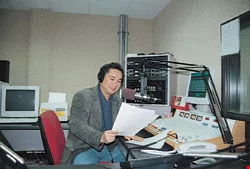
Kenny Chi is another of the star program hosts at AM1300.
The father of Taiwan rock and roll
"He did more than anyone to bring Western pop music into Taiwan," says Robert Tsai, a pop singer who used to perform on Taiwan television. He still vividly recalls how greatly he admired Arthur Liu back then. "I was in high school in those days, and I got hooked on pop music by listening to his program. I used to constantly write him letters asking for the lyrics, and he never got tired of sending them out to his fans." Liu's generosity and enthusiasm remains as great today as ever. An American working at the Los Angeles Chinese-language radio station AM1300 says about Liu: "He's like an old friend who really cares, and you can freely tell him what's on your mind."
It is this generosity of spirit, along with seriousness of purpose, determination, and, as Liu himself says, "luck," that have allowed Arthur Liu to become a model of success.
Arthur was born into the Chinese journalism aristocracy. His father was a well-known reporter for the Central News Agency in mainland China in the 1930s and 40s, who also, together with a number of other important first-generation reporters, founded the well-known journal Newsdom. Guests at the Liu house were all in the news business. But Liu's father by no means encouraged Arthur to go into this field, and so he studied agricultural chemistry at National Taiwan University. But it proved impossible to resist his natural inclinations, and he ended up in the broadcast world anyway.
Liu attended National Taiwan Normal University Affiliated High School, which had a relatively lively, open atmosphere. He fell in love with English and Western music. Besides listening to "Studio Classroom" (a radio English teaching program) every day, he also got hooked on broadcasts of Western pop music from Australia and the Philippines. When he was in university, he found an opportunity to host a Western music program at Youth radio station, which became a hit among many young people. Once, at an anniversary celebration at the station, he received two carloads of fan letters, which should give you an idea of just how popular his program was.
From his university days, through his formal employment following completion of his military service, Liu hosted pop music programs for a total of eight years at three different radio stations, never losing his enthusiasm for the genre. When he turned 30, he decided to go to the US to pursue courses in media studies. After acquiring a master's degree in communications from Syracuse University, he went to work at ABC, one of the US's three major broadcast television and radio networks. At that time he was making only US$400 per month, only a forth of what he would have made working in a restaurant. But he wanted to learn, and he was willing to bite the bullet; money was not a primary consideration.
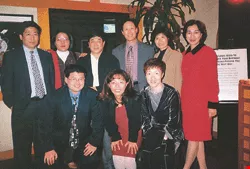
Arthur Liu along with broadcast professionals from several of his stations: (front row, from left) Jimmy Yuan, Alice Liu, Millie Shen; (back row, from left) Felix Kuo, Ino Hung, Arthur Liu, Kevin Chu, Judy Lu, and Vivian Lee.
Big fish in a big pond
In 1972, Arthur Liu, now familiar with the corporate culture of American television, established Sino TV Incorporated in New York. Four years later he founded the Sino Radio Broadcast Corporation, and began producing original Chinese language programming. At the same time he came out with Sino Daily Express, and gradually established extensive contacts in the media world, with particular attention to information from the world of American TV and radio. Ultimately, in 1982, a prime opportunity arrived, and he applied to purchase a radio station whose license had been suspended: 105.9 FM in New York.
Because this kind of opportunity is rare, at that time 29 different companies were competing for the license. The review process was very rigorous, and very slow-it ended up consuming ten years-but Liu's "Multicultural Broadcasting Company" hung in there. Finally, in 1992, the Federal Communications Commission announced a new law designed to stop frivolous bids (the law forbade those who acquired licenses from giving compensation to other competitors), and Liu was left alone in the race without having to make large compensation payments to anyone. With this added bit of luck (a factor Liu never fails to feel grateful for), added to his persistence, professionalism, and commitment, Arthur Liu finally got the license for 105.9.
With decades of broadcast experience, after getting his own station he set up his broadcast equipment on the Empire State Building to get a clear signal, and promptly began to rearrange programming. He systematically found program hosts who could really make minority listeners feel at home, and the station became immediately popular with the many minority groups that exist in New York City. Business was getting on track.
From 1993 to 1995, by rolling over his debts, using small capital operations, and buying and selling radio stations, Liu managed to purchase his second New York radio station, as well as three AM stations (KAZN 1300, KMRB 1430, and KMNY 1600) in Los Angeles. He was still targeting the minority-group market, and he rented some of the broadcast time to various groups for programming in Vietnamese, Korean, Russian, Spanish, Eastern European languages, and so on, acquiring a stable rental income.

Arthur Liu is considerate and accommodating, with none of the arrogance or pretensions you might expect in a boss.
Hitting the jackpot
Liu's ship really came in when, in 1998, another FCC rule change brought him a fortune. There was originally an FCC limit on the number of radio stations that could be owned by an individual or corporation. When this was lifted, it became possible for a nationwide Spanish-language network to acquire what it had long desired, a station in New York. Liu's operation fit their requirements perfectly, so they were willing to pay the astronomical price of over US$100 million, or dozens of times what he paid for it.
On the one hand to reduce taxes, and on the other out of pure interest, after getting the money for the New York station, Liu purchased 15 radio stations on the American West Coast. Last February, he sold another radio station, and purchased 13 other radio stations with this cash. Today, he and his wife are the exclusive owners of 30 stations, broadcasting in New York, Washington, Virginia, Maryland, Florida, Atlanta, Dallas, Seattle, San Jose, San Francisco, Sacramento, Los Angeles, and other cities and states. Moreover, through satellite links and alliances, Liu's Multicultural Broadcasting Corporation has created a nationwide network of minority-market radio stations, broadcasting daily in dozens of languages. He also has three Chinese language TV stations in New York.
As Liu explains: "When you buy media, you have to look at the operations multiple. You can sell a television station for about ten times operations value, and a newspaper for seven to eight times, but a radio station you can sell for 14 times the value!"
Of course a lot depends on the skill and intelligence of the individual.
As a professional himself, Liu trusts professionals. He spends up to half a million US dollars per year on legal consultation fees, and he gives considerable discretion to the general managers of each of his radio stations. Kevin Chu, general manager of Liu's three stations in LA, and West Coast vice-president for Multicultural Broadcasting, is smilingly described by his employees as "thinking more of the owner's interests than even the owner himself!" Chu, who 12 years ago entered the Cantonese station KMRB 1430AM, part of the Multicultural Broadcasting Company, says of Arthur Liu: "He is that rare item, a good boss. He's flexible, open-minded, smart, and is principled." Chu is very willing to give everything he has for a boss who puts such trust in him.

AM1300 in San Francisco is the most successful of Arthus Liu's stations, thanks to its talented staff. Sales manager Felix Kuo (right) not only handles sales, but co-hosts a popular program with Nick Kao.
National Chinese-language program
As for Liu himself, although in the eyes of most people he is now a wealthy media baron, he remains a considerate, old-fashioned, principled individual, with a rare sense of commitment to his friends, old acquaintances, and employees. Although he is now 65, an age when many people wish to retire, he talks about broadcasting with the enthusiasm of a young man.
Liu says he knows no limits, and no fear. In the future, besides continuing to buy and sell radio stations, and crossing over into cable and satellite television, he hopes to establish a one-hour long Chinese-language program that will be broadcast on a nationwide network. He has also invested nearly US$1 million to purchase a radio station on Long Island where students can practice producing programs of their own, to develop "loyal professionals" for years to come. There he sows and nurtures the seeds for the medium he loves so much, and waits for the future harvest.
http://www.mrbi.net
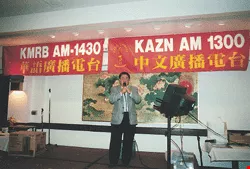
(right) Arthur Liu, whose Western pop music radio shows were a big hit back in 1960s Taiwan, bought 30 radio stations in the US in the 1990s, becoming a mogul in Chinese-language media there, and writing an amazing page in broadcasting history. (left) One of Liu's broadcasting towers.


