A Feast of Food and Art--Silks Palace
Teng Sue-feng / photos Lan Chun-hsiao / tr. by Scott Gregory
August 2008


The National Palace Museum's world-renowned Jadeite Cabbage and Meat-Shaped Stone are among the most visited items in the collection. At a glance, you'd think they were a real vegetable and a moist piece of Dongpo pork.
In the past, visitors could only admire these pieces through the glass display cases. Now, with the opening of the Silks Palace restaurant, they can also get a taste of the cuisine that is itself a national treasure.
Opening just before mainland tourists were permitted entry to Taiwan, the NPM's Silks Palace was the envy of many restaurateurs. They knew it was sure to be a success.
"It was just coincidence. Three years ago when we began the Silks Palace project we didn't have such foresight," says Steven Pan, general manager of the Formosa International Hotels Corporation. Having been sent away to school overseas, his education in Chinese culture stopped at the junior high level. Upon returning to Taiwan 18 years ago to manage the Grand Formosa Regent hotel, he rediscovered his roots. Three years ago, when he heard that the NPM was looking to contract out a restaurant space, he became determined to place a winning bid. It was only after bidding on the job that he learned he was the only one to do so. Other potential bidders were most likely scared off by the size of the necessary investment and the length of time needed to recover it.
The NPM is one of Taiwan's top tourist spots, but there has always been a lack of adequate dining facilities. The museum had always wanted to build a restaurant complex but was limited by a lack of funds, so in the end it decided to contract out the project.
The contract stipulates that Formosa International pay the museum NT$10 million for the exclusive right to develop the project, as well as give 5% of its gross income to the National Treasury as rent. It must also give the museum 1% to promote cultural activities. In all, Formosa International made an investment of around NT$450 million. Assuming the restaurant nets NT$300 million a year with a profit of 25%, it will take seven to eight years to recoup its investment.
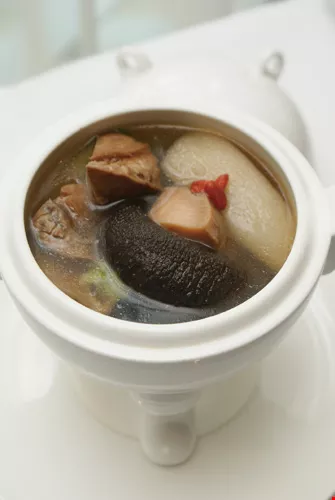
Silks Palace offers a National Treasure banquet featuring "jadeite" bok choy cabbage, "Buddha Jumps the Wall," Dongpo pork, and "Curio Box" desserts. It's a feast for the eyes and the tastebuds.
Anticipation
Silks Palace's opening might have happened to come just as a wave of mainland tourists is expected, but locals are also curious about this new international-level cultural point of interest.
Located to the west of the museum's main exhibition hall, Silks Palace is a five-story restaurant complex with nearly 5,000 square meters of floor space. Its exterior was designed by renowned architect Kris Yao, who has won numerous awards for the High Speed Rail station he designed for Hsinchu. To make the building blend into its mountainous surroundings, its outer wall is a translucent glass curtain that reflects the blue sky, the green of the mountains, and the NPM's facade. In the evenings, the warm glow it gives off is truly inspiring.
Behind the glass is latticework designed to look like the crackled glaze of Song-Dynasty Ru ware porcelain. The turquoise glaze of Ru ware, which crackled during firing, has been compared to the color of the sky peeking through clouds after rain. Yao used the crackled glaze as a theme for the walls, the main entryway, and the screens between tables, giving Silks Palace a rich, Chinese feel.
The interior was designed by the Japanese designer Yukio Hashimoto, who previously created interiors for Lan Ting and Silks House at the Grand Formosa Regent Taipei. The dining hall on the first floor, with a six-meter-high atrium in the middle, has the feel of an old Chinese lodge as seen in kung fu films like Dragon Inn or Crouching Tiger, Hidden Dragon. To the sides of the walkway are two-story-high pillars inspired by jade cong artifacts from the Neolithic Liangzhu culture of more than 4,000 years ago. Cong were ritual implements used in ancestral worship. Hashimoto modeled 18 pillars on the implements and had them rise up into the second story, neatly combining a tradition of reverence with a modern dining space.
The first-floor dining area, which has 40 tables and seats 250 people, features hanging lamps modeled on bronze bells from the Western Zhou period. On the back wall are two classic paintings of banquets-one, with no artist's name stamp, is a scene of Tang-era palace pleasure-seeking, and the other, by the Huizong Emperor of the Song Dynasty, is of refined gentlemen sampling tea and reciting poetry.
On the second floor, on two sides of the atrium, there are ten private rooms themed around paintings and works of calligraphy in the museum's collection. The Song Xue Room, for example, features a silhouette of the Northern Song artist Zhang Zeduan's Along the River During the Qingming Festival, with light penetrating through the images of city life. The Lan Ting Room contains a lightbox with a blown-up image of calligrapher Wang Xizhi's Orchid Pavilion Preface. The Dong Po Room features calligraphy of Su Shi's poetry commemorating the Battle of Red Cliff. These replica artworks give dining an elegant air.
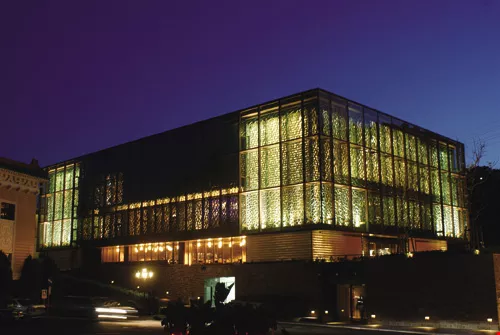
In the early evening, the shimmering lights of Silks Palace make for a poetic scene. After a day taking in the sights at the National Palace Museum, tourists can head there for an unforgettable meal.
A luxurious feast
The cuisine served is also befitting of such a refined and artistic space.
The first course in the National Treasure banquet menu is a real version of that mouthwatering Jadeite Cabbage-baby bok choy specially selected from Changhua with two sergestid shrimp from Pingtung's Tungkang on top to resemble the katydid and locust on the jade piece. So much like a work of art that it's almost a shame to eat, it is also tricky to make. It cannot be overcooked, or it won't be able to stand upright. There is craft in the small ladle-shaped dish that holds it up, as well. It was designed after a Han-era washing utensil called an yi.
However, in recreating art, some sacrifices are made in flavor. Many food reporters have commented that the bok choy stalk, scalded in soup stock, is a little tough and doesn't take on all the flavor. The XO sauce can only be served on the side-pouring it over the top would ruin the visual effect. Diners are left to use their knives and forks to cut off bits of the bok choy and dip them in the sauce.
The second dish, the Minnanese "Buddha Jumps the Wall," is served in a tureen patterned after a Warring-States-era grain tripod with two handles. Silks Palace used a delicately glazed porcelain rather than the rough bronze of the original. The tureen has the impressive look of the ancient tripod, but it is not easy to hold and more than 20 have been broken while being served. It was a big problem for the waiters, who had to be trained in placing it on the table steadily.
The main course in the National Treasure menu is the Meat-Shaped Stone, which uses top-quality trotter meat that is stewed for two to three hours, cooled, and carved into shape.
There are other special dishes, such as the "Yunlin Goose" described by Yuan-Dynasty artist Ni Zan. This famous traditional dish is said to have originated when, to thank Ni Zan for designing Suzhou's Puti Zhengzong Temple, Master Tianru of the temple had a chef specially prepare for Ni a goose with honey, salt, and onion pepper and then steam it with alcohol and chicken broth. Bright and aromatic, the crisp and tender boneless goose meat has a hint of chicken. The Hangzhou poet and gourmand Yuan Mei recorded its recipe in his work The Sui Garden Menu and praised the labor-intensive dish.
With a total of six dishes, a dessert called "Classic Desserts in a Chinese Curio Box," and a "Duke Mao Tripod" fruit platter, the set meal is NT$3,200 per person (not including 10% service charge). Reservations are required. Having already received bookings for 2,000 Japanese tourists, Silks Palace is proving to be a success.
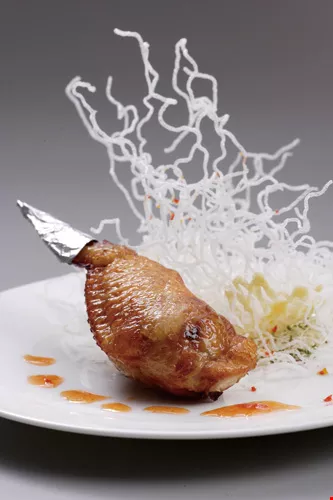
Silks Palace offers a National Treasure banquet featuring "jadeite" bok choy cabbage, "Buddha Jumps the Wall," Dongpo pork, and "Curio Box" desserts. It's a feast for the eyes and the tastebuds.
Taste of Taiwan
The first basement floor, which will open for business in August, will feature a small market for popular Taiwanese refreshments like "frog egg" tapioca milk tea, shaved ice with fruit, and NT$80 lunch sets with Cantonese-style meat dishes.
The second basement floor is slated to feature a 400-seat food court with assortments of Taiwanese snacks starting at NT$250. Taiwanese fruits such as guavas, wax apples, and star fruits will be available for NT$50 for sampling by mainland tourists.
Whether it's the snacks for the masses or the imperial banquet delicacies, Silks Palace has it all. Carefully thought out and based around a cultural theme, the restaurant complex is set to win over the crowds of mainland Chinese tourists.
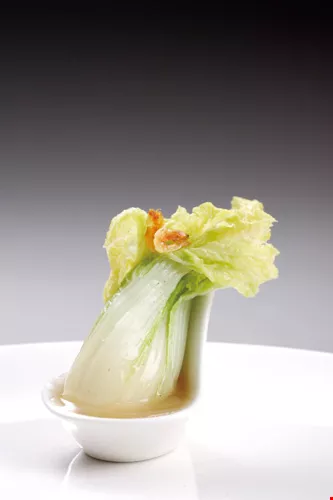
Silks Palace offers a National Treasure banquet featuring "jadeite" bok choy cabbage, "Buddha Jumps the Wall," Dongpo pork, and "Curio Box" desserts. It's a feast for the eyes and the tastebuds.
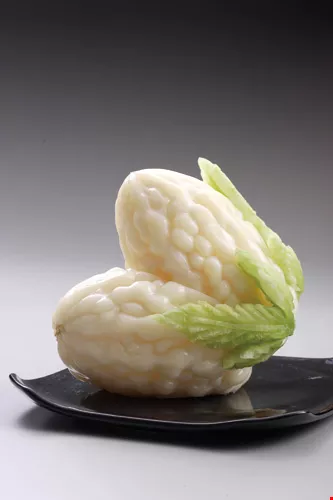
Silks Palace offers a National Treasure banquet featuring "jadeite" bok choy cabbage, "Buddha Jumps the Wall," Dongpo pork, and "Curio Box" desserts. It's a feast for the eyes and the tastebuds.

Silks Palace offers a National Treasure banquet featuring "jadeite" bok choy cabbage, "Buddha Jumps the Wall," Dongpo pork, and "Curio Box" desserts. It's a feast for the eyes and the tastebuds.
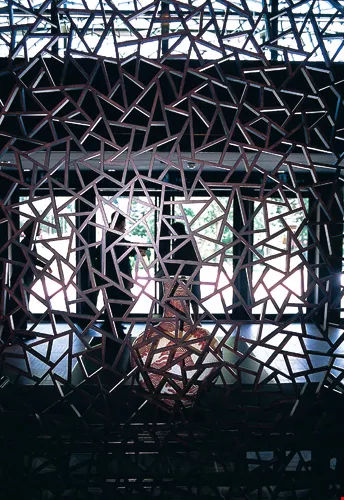
Based around the crackled glaze of Ru ware porcelain from the Northern Song Dynasty, Silks Palace's interior design has a strongly Chinese feel.
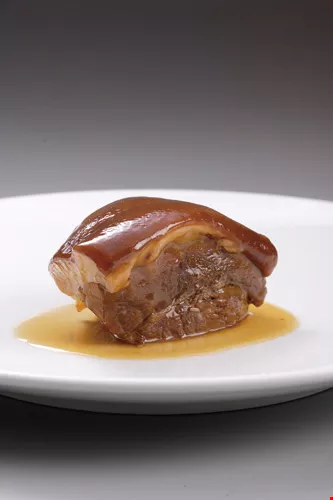
Silks Palace offers a National Treasure banquet featuring "jadeite" bok choy cabbage, "Buddha Jumps the Wall," Dongpo pork, and "Curio Box" desserts. It's a feast for the eyes and the tastebuds.
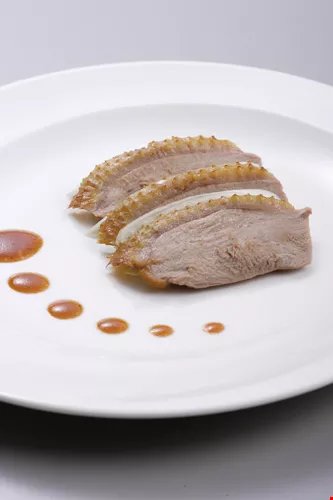
Silks Palace offers a National Treasure banquet featuring "jadeite" bok choy cabbage, "Buddha Jumps the Wall," Dongpo pork, and "Curio Box" desserts. It's a feast for the eyes and the tastebuds.
@List.jpg?w=522&h=410&mode=crop&format=webp&quality=80)


