Creating a Business--The Story of Inventor Chung Yu-lin
Yang Ling-yuan / photos Jimmy Lin / tr. by Minn Song
October 2004


At the 32nd International Exhibition of Inventions in Geneva, one new invention not only won a gold medal in the power category, but also received the prize of the Incubator of Inventions of Russia. This invention, an explosion-proof lithium ion battery that has won five patents, boasts an elegantly simple design, with some improvements to the internal structure of the battery preventing chemically unstable lithium from exploding during charging or discharging. In one fell swoop, it eliminates worries about mobile phones possibly catching fire in one's pocket. Many international vendors were delighted to hear of the breakthrough, hoping to obtain manufacturing rights for this product. However, the product's inventor Chung Yu-lin resisted the lure of considerable licensing fees. He says, "This is a Taiwanese invention, and of course we should keep it for ourselves to see it through to completion."
Under the Chengmei Bridge in the old section of Taipei's Nankang District is a seven-story building displaying the four characters for the Chinese name of Xtreme Technology. In this old low-rise residential area, the building, representing the fruit of yet another real estate investment by Xtreme Technology chairman Chung Yu-lin, stands out for its newness.
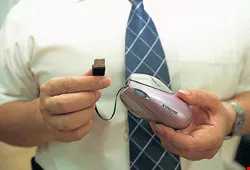
The retractable-cable mouse, which recently debuted on the market, has already drawn queries from numerous vendors.
Inspiration for invention
Entering the reception area of the building, one sees a wall crowded with diagrams illustrating inventions that have received patents. From multifunction travel chargers and portable air cleaners to precision high-voltage inverters for LCD-TV backlighting lamps, there are a total of 20 products depicted, nearly all Chung's creations.
Among these inventions, some are playful ones that evoke a smile-such as the "Taiwanese promotional flyer and paper box" which proved a big hit at the recent International Exhibition of Inventions, New Techniques and Products in Geneva. For this invention, Chung imitated a practice of older Taiwanese: folding ad flyers into paper boxes for holding bones at the dining table. All that's needed is to add a few fold creases on the flyers when sent to the printer, and it's easy to fold them into paper boxes-and intrigue foreigners.
Another invention that has received patents in several countries is a "retractable-cable mouse," which Chung Yu-lin was inspired to create when he saw computer users annoyed by the proliferation of cables on their desktops but unwilling to spend money to buy a wireless mouse. He therefore invented an approach for neatly storing the cable, one which was much handier than that typically used for the cords on home appliances and better suited for use with handheld electronic devices. Currently, this mouse is being mass produced and sold under Xtreme's own brand. As for a much-acclaimed mousepad that can serve as a backup battery lasting eight hours, it has recently been supplied to Japan's DoCoMo.
Finding inspiration in daily life for products is simply a routine form of "recreation" for Chung. Xtreme's flagship product is in fact a high-voltage inverter, which accounts for NT$300 million in revenues for the company each year. It is mainly used for LCD backlight lamps, and Xtreme supplies more than 60% of demand in Taiwan each year. Xtreme has established factories in China's Guangdong and Shenyang for this product, employing more than 800 workers in these manufacturing operations.
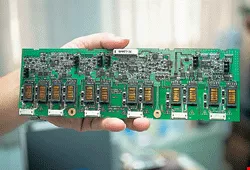
An inverter, made by winding copper wire just 0.3 millimeters thick, may help drive the international competitiveness of Taiwan's LCD TV industry.
The benefits of long plane rides
Most inventors know only to hide themselves in their laboratories, making R&D a mental challenge, but paying scant attention to commercialization or implementation issues. As a result, their homes are stacked full of design schematics, patent certificates, and models, but they cannot produce a marketable product. Chung Yu-lin however is not only full of ideas, but is deeply versed in the principles of industrial product design, and is familiar with production line operations. Each invention is subjected to his continual efforts to improve its design, to search for low-cost raw materials, and to find a mass production approach that doesn't require the purchase of extra production equipment. As might be expected, the final products are inexpensive but well-made, accounting for their appeal to buyers. This is precisely the quality shared by Taiwan's successful small and medium-sized companies, and is the secret to Xtreme's success.
Fond of mental gymnastics, Chung finds that the biggest obstacle he faces is a lack of time. Each time he is hit by an inspiration and comes up with an idea, he can only roughly record it in the notebook that he carries with him, and then wait until he has a chance to travel to Europe or the US on business. Then on the long flight, he can ponder on and organize these ideas. The last 20 inventions of his were the accumulated result of dozens of flights he made over a period of three years. And there are more than 200 other ideas that still await his next long-distance journey.
Established ten years ago, Xtreme's Taipei headquarters currently employs more than ten people in its R&D department. But in fact, they are only developing chairman Chung's personal ideas. Although the company has established an "innovation award" in the hope of encouraging employees to propose new improvements or novel products, no awards have been given over the past three years. Rather, it is Chung's two children who, influenced by what they observed, invented an abdomen exerciser attached to a chair, as well as a warning device to prevent one's car from running into the car just ahead. Chung hopes that these two inventions can be developed as quickly as possible into marketable products, so that his children can experience a sense of accomplishment that comes with invention.
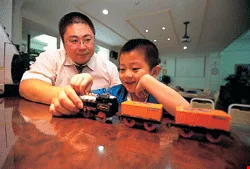
Chung Yu-lin still cuts his six-year-old son's hair himself. For Chung, stimulating children's creativity is far more important than demanding good grades on schoolwork.
High-voltage inverters
Ten years ago, the 23-year-old Chung took the NT$60,000 originally set aside for gifts to his fiancee's family, and invested it all in starting up a company. This company had only two employees, with himself serving as manager and clerk and his new wife the bookkeeper and operations worker. The two worked together to do contract manufacturing for the inverters on flash bulbs for point-and-shoot cameras. In under six months, they had earned more than NT$2 million.
Three years later, Taiwan's instant camera industry had declined, and contract manufacturers of components moved to China. However, Chung could not bear the thought of giving up the new equipment he had just purchased for roughly NT$10 million, and had no choice but to abandon his plans to move production.
Under the pressure of trying to keep the company afloat, Chung's only hope was to think of some way to develop new technology, turning the inverters for camera flashbulbs into ones suitable for use with LCD backlighting lamps. At the time, only Japan possessed the ability to produce inverters that could withstand the stress of producing 2,000 volts 80,000 times per second. Chung first cloned Japanese products and then re-engineered their internal structure. The result was an inverter that could withstand up to 5,000 volts, with a price that undercut Japanese models by 20%.
This product enabled Xtreme to become the biggest supplier to Ambit Microsystems, a major global manufacturer of computer components. Six months later, Xtreme had achieved profits of NT$10 million, and subsequently went on to become a business partner of Taiwan's largest private-sector enterprise, the Hon Hai Group.
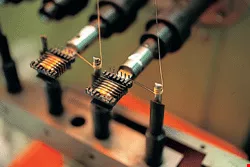
An inverter, made by winding copper wire just 0.3 millimeters thick, may help drive the international competitiveness of Taiwan's LCD TV industry.
No shortcuts to success
Though business has been good, looking back at the road that this "ideas man" has traversed in building his company, it is clear that success has not come easily. With a leg made lame by illness, and possessing only a vocational high school education, Chung had a more difficult time in finding employment than most people. Hampered by physical disabilities and limited educational credentials, he found it impossible to enter the electronics industry that was his interest. However, he did not give up, traveling from Taitung where he was born to the faraway Taoyuan Industrial Park. He went from factory to factory making inquiries, and finally at the gate of one foreign technology company learned from a security guard that an engineers' recruitment test was to be held the next day. Though Chung was the top scorer despite having to compete against college graduates, he could only become a technician without the title of engineer-and at a salary only half that of the latter. He was not bitter, but instead channeled his efforts into demonstrating his abilities. Then when an opportunity arose, he moved to another company.
Finally, for his third job, he was hired for a pivotal position at an inverter contract manufacturing company, but then the economy hit a sluggish phase. Chung was one of the few employees to escape being laid off, and was doing the work of several employees. But though he saved the company from failing, and gradually stabilized its business, it was just at that point that he had the idea of starting his own company.
"At the time, I believed I had the basic abilities needed to start a company, and very much wanted to devote my efforts to work that that was truly mine." After gaining the understanding of and establishing mutual trust with his previous employer, Chung went into the same business of contract manufacturing of inverters. However, he was scrupulous in not poaching his previous employer's customers, even as he expanded his two-person company into a factory employing more than 50 people in just three or four years. He was also occupied by additional investments in more than ten different industries, including real estate, computers, import/export trade, automotive care, and energy-efficient light bulbs. With no educational background in business management, Chung considered his investment ventures to be casual favors to friends, but the result of sacrifices he made was the loss within two years of all the money he had made. He was thus forced to focus again on his own line of business.
Another dream to pursue
"When you're involved in the high-tech industry, you have to constantly pay attention to the rapid changes in the market," he notes. Though Chung is chairman of the company, he still personally visits customers often. He does this not only to maintain friendly relations with them, but even more importantly to obtain information about the state of the market. Last year, when he learned that the LCD-TV market was about to take off, Xtreme moved to preemptively develop enhanced versions of high-voltage inverters suitable for use with LCD-TV screens, and moreover obtained patents for the technologies it developed to accommodate this industry shift. This year, the company began a strategic reduction in supplies of inverters for notebook computers, shifting workers to production lines for the new product. The company has signed contracts to supply LCD-TV inverters to AU Optronics, Chi Mei Optoelectronics, Samsung, and LG Philips. Xtreme will become the leading supplier for this product in Taiwan, and perhaps even worldwide.
In its current incarnation, Xtreme can already hold its own against listed companies. In addition, many companies have inquired about acquiring Xtreme. However, their hopes have been disappointed in the face of opposition from Xtreme's employees. As for the future, once Chung finds a successor, he wants to fulfill another wish: to build in the suburbs a factory for people with physical disabilities. This factory will be fully accessible to them and will enable the physically disabled, who normally find it so difficult to find work, to have a place that will welcome them. At that point, he will provide all of his inventions to employees to manufacture and build a business around. Meanwhile, he will devote himself to the joyous pursuit of new ideas and inventions.


@List.jpg?w=522&h=410&mode=crop&format=webp&quality=80)


