Dappled Skies over Sun Moon Lake
Teng Sue-feng / photos Lan Chun-hsiao / tr. by Scott Williams
August 2008


A July survey by Beijing's Central Uni-versity of Finance and Economics asked Beijing residents to name the place in Taiwan they most wanted to visit. Nantou County's Sun Moon Lake topped the list (29%), followed by Taipei (26%), Mt. Ali (16%), the National Palace Museum (5%), and Kaohsiung (4%).
Mainland Chinese have a strongly positive impression of Taiwan's largest natural lake and tend to compare it favorably to Hangzhou's famous West Lake. At 8.2 square kilometers in area, Sun Moon Lake is about 5.6 km2 larger than West Lake, but is far deeper. A mountain mere, the lake reaches depths of up to 27 meters and is a popular tourist destination. One major annual event sees over 10,000 swimming across the lake.
In recent years, the lake area has undergone a transformation. Reconstruction following the Chichi earthquake has tempered and matured the pretty-but-gawky pearl of Taiwan's mountains, bringing it an air of elegance and sophistication. It is definitely worth a visit.
Whether they arrive from the north or the south, visitors to Sun Moon Lake need more than a quick half-day stop to take in all the area has to offer.
The beauty of Sun Moon Lake can be found in the gauzy mists and the clouds at dawn, in its red-gold sunsets, in the deep silences of its nighttime lakescapes, in the reflection of the surrounding jade green mountains on its mirror surface viewed from the Tzu-en Pagoda high above it.
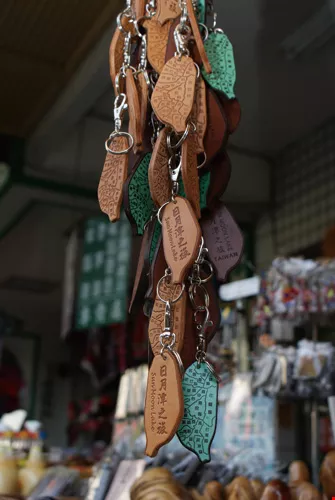
You can catch a boat from Chaowu Pier to Lalu Island, a site sacred to the Thao people. If you disembark at Ita Thao on the way back, you can take in a Thao dance and do some shopping.
A mountain pearl
One of the best ways to enjoy the summer is by staying out of the sun. Taking a leisurely stroll along one of the lake's wood-and-stone-paved nature trails at three in the afternoon can be incredibly relaxing. Bugs hum. Trees cast shadows on the trail. The richness of the natural world is everywhere in evidence.
Eight nature trails of varying lengths have been built around the lake in recent years. They range from the 180-meter short Tachu Lake Trail to the much longer Shuishetashan Trail, a complete circuit of which takes seven to eight hours. The area can offer dramatically different views depending on the time of day and the route. Dawn, dusk, bubbling springs, "floating fields," fishing boats, archeological sites, Mt. Shuishe and the hills around Chichi all have something unique to offer.
At dinner, visitors should be sure to dine on local specialties such as predatory carp (Culter erythropterus) and sharpbelly (Hemiculter leucisculus), a Thao delicacy. Predatory carp grow to more than 30 centimeters in length, and larger fish are preferred because they are less bony. Try one steamed with fragrant manjack fruits (Cordia dichotoma) for a very tasty treat.
The predatory carp's Chinese name (loosely, "curve-waisted fish") comes from the small bend in its abdomen, but the fish owes its nickname of "president fish" to how much former President Chiang Kai-shek is said to have enjoyed eating it on a visit to Sun Moon Lake. A six-dishes-and-one-soup meal including the carp, lake shrimp, and wild boar, together with wild veggies such as mushrooms, vegetable ferns (Anisogonium esculentum), bird's nest fern (Asplenium nidus), and cabbage is a bargain at only NT$1,200. To achieve complete contentment, finish the meal with a cup of minty, cinnamony Red Jade black tea.
Hike up Mt. Maolan the next morning to watch sunrise. Afterwards, you can head north to the Puli Winery to sample a glass of Shaoxing or Nu'erhong rice wine, then visit the outwardly ornate, inwardly sedate Chung Tai Chan Monastery. Or continue soaking up the tranquil atmosphere of Taiwan's rural villages with a turn south to visit Chichi's narrow-guage railroad, Shuili's Snake Kiln, and other nearby attractions.
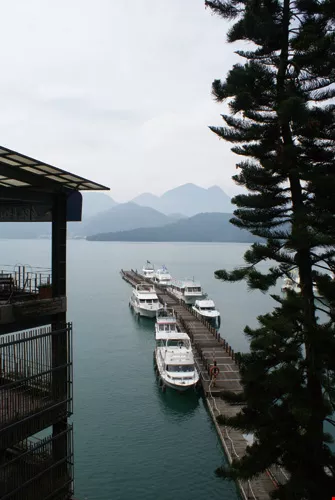
You can catch a boat from Chaowu Pier to Lalu Island, a site sacred to the Thao people. If you disembark at Ita Thao on the way back, you can take in a Thao dance and do some shopping.
Reborn in fire
The fact that Sun Moon Lake currently attracts about 3 million visitors a year from Taiwan and abroad represents something of a rebirth.
The Chichi earthquake that devastated Taiwan nine years ago was centered nearby and badly damaged the lake area, where it brought down several large hotels. It also destroyed many local homes, leveled a pavilion on the Thao tribe's sacred Lalu Island, and badly damaged both the Shuishe Pier and the road around the lake.
Seeking to rebuild the area's tourism industry, the Ministry of Transportation and Communications established the Sun Moon Lake National Scenic Area in 2000. It then began the long reconstruction process, focusing on the creation of an alpine lake leisure industry and the preservation of the local Thao culture.
The completion of the fabulous Lalu Hotel in 2002 after five years of work represented a major upgrade to the lake's tourism infrastructure, transforming the area into a luxurious world-class destination. Built by the Shining Group at a cost of NT$1.8 billion, the five-star hotel sits on a Lalu Peninsula site where former president Chiang Kai-shek once had a home. The hotel features a fresh, exciting design that is completely integrated with its environment, and has become a model for other area hotels undergoing post-earthquake renovations.
Late last year, Chinatrust Hotels unveiled its new Fenisia Hotel. The name derives from the Spanish words for "phoenix" and "Asia," and is intended to suggest Sun Moon Lake's rebirth after the earthquake. Chinatrust Hotels spent NT$1.5 billion to create the Fenisia, and brought in a Japanese company to do the actual construction work. The resort's natural hot springs feature water from a 1,500-meter borehole and have received high praise from its Japanese guests. Occupancy rates run at about 40% on weekdays, and up to 80% on weekends.
Aerial-lift tourism?
Sun Moon Lake shares a problem common to all of Taiwan's scenic areas-too many visitors on holidays and too few on non-holidays. In fact, the numbers vary by 40%.
But area businesses are expecting things to get better. They have been on a building binge in anticipation of a surge in the number of mainland tourists, who are expected to fill up rooms on weekdays.
Among these is a major hotel project initiated by the Nantou County Government and located on the Lalu Peninsula's highest point. Called the "Sun Moon Villa," the hotel has been modeled on the sail-shaped Burj Al Arab in Dubai and is being constructed using a build-operate-transfer business model.
An aerial lift system that had been in the works for seven years finally got underway in April 2008. When completed in early 2009, the NT$820-million lift will be the first in Taiwan to have been planned, built, and operated by the private sector.
The lift-line will originate next to the Youth Activity Center on the southeast shore of the lake (elevation 764 meters). From there, it will climb to Mt. Puchi (elevation 995 meters), an offshoot of Mt. Shuishe that rises behind the Thao village of Ita Thao, traversing 800 meters in the process on what will be the longest single section of the system. After rising to an elevation of 1,035 meters, cars will crest the ridge, then descend to an elevation of 875 meters over a distance of just 300 meters, arriving at a station just behind the mountain viewing pavilion in the Formosan Aboriginal Culture Village. The system will include 16 support towers along its length.
Once complete, the lift will carry up to 3,000 passengers per hour on a 1.8-kilometer 20-minute ride offering aerial views of the whole lake and Formosan Aboriginal Culture Village.
Taiwan has become infatuated with the idea of aerial lifts as a stimulus to tourism in recent years. But do they really attract tourists and boost local industry, or do they just destroy the environment? Are they more environmentally friendly than trains and automobiles? The truth is, we don't yet know.
Stanley Yen, president of Landis Hotels and Resorts, is strongly opposed to the construction of aerial lifts in environmentally sensitive areas of Yushan, Mt. Hsueh and other national park areas. But he sees them as a viable alternative to the never-ending construction and expansion of roads, rail lines, and parking lots in highly developed scenic spots like Alishan and Sun Moon Lake, provided, of course, that environmental impact studies are carried out beforehand.
Though the lake's pleasure boating industry is limited to just 139 boats, these are nonetheless damaging the environment with their motors, loud PA systems, and excessive numbers of passengers.
After making a trip around the lake on a pleasure boat in June, Premier Liu Chao-shiuan stated that the government would encourage operators to replace their diesel engines with cleaner means of propulsion to reduce noise and pollution levels.
Taiwanese view Sun Moon Lake as a treasure. The loss of its serene and intensely poetic atmosphere would be more than any amount of tourist income could replace.


