Dr. Luo I-Chun: A Compassionate and Fearless Epidemiologist
Kobe Chen / photos courtesy of Luo I-chun / tr. by Scott Williams
November 2014


Ebola is a devastating virus that has slain more than 4,000 people this year. The virus is poorly understood, and the research community has yet to develop a vaccine or cure. Almost all that is currently known about it is that it is transmitted through sweat, urine, blood and other bodily fluids. A truly terrifying disease, it kills nearly 70% of the people it infects.
The United States reported its first case of Ebola in October. The victim died just ten days later, becoming the first person outside of Africa to be killed by the disease and sending shockwaves throughout society.
While most travelers have been avoiding Africa since the outbreak, Taiwanese epidemiologist Dr. Luo I-chun flew to Nigeria to learn from professionals on the scene and improve Taiwan’s disease prevention efforts.
When officials in Nigeria, West Africa’s transportation hub, discovered the nation’s first case of Ebola in late July, they acted quickly to head off a potential epidemic and in mid-September announced that Ebola had been eliminated from their country. Dr. Luo I-chun, an epidemiologist with Taiwan’s Centers for Disease Control, traveled to Africa in early September to check up on Taiwanese businesspeople there and gain a first-hand perspective on the measures taken to prevent the spread of Ebola.
The trip was the first-ever Taiwanese-initiated fact-finding mission to an epidemic zone. Within Asia, only mainland China, Japan, and Taiwan have so far dispatched doctors to Africa to help treat Ebola. Luo deserves admiration for the courage he showed in making the trip.
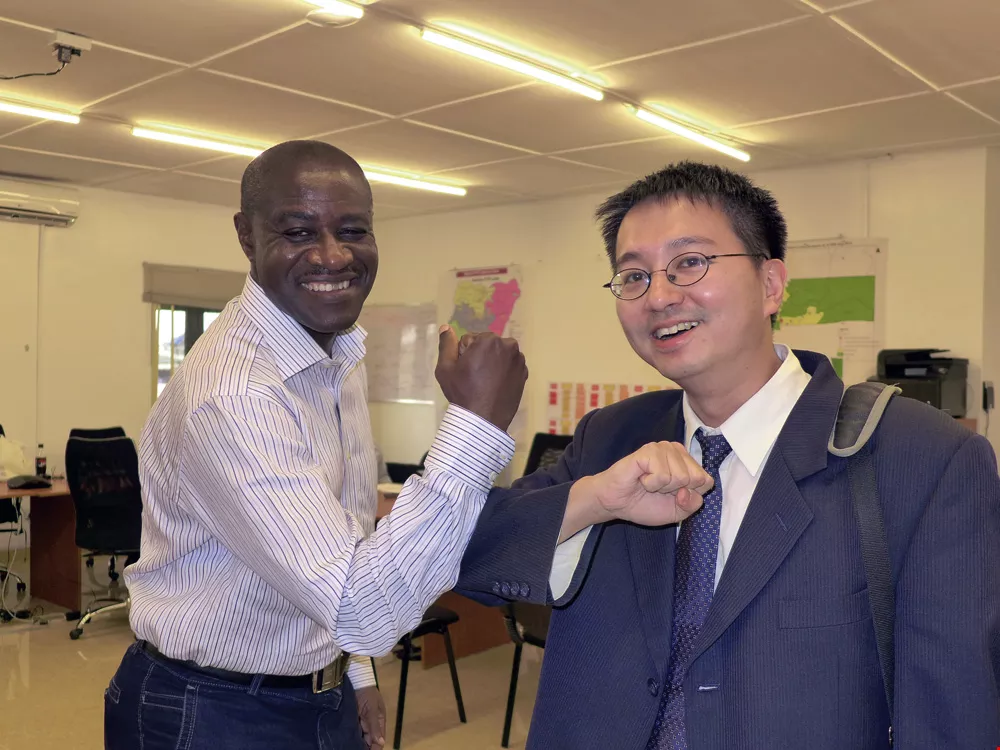
Minimizing direct skin contact is an important first step to avoiding the spread of Ebola. Nigerians now bump elbows rather than shaking hands or embracing.
Nigeria is a major producer of crude oil, an important West African transportation hub, and the focus of much international media attention.
“The international media are more frightened than the locals,” says Luo. He explains that Ebola is but one fear among many for locals used to living with relatively frequent terrorist attacks, cholera outbreaks and floods.
On his September trip to the country, he learned that Nigerians no longer shake hands to greet one another. Instead, they avoid direct skin contact by bumping elbows with one another when wearing long sleeves or steepling their hands when wearing short sleeves.
There have been several outbreaks of Ebola since its discovery in 1976, and the disease’s frequent appearance as a plot device in literature and film has spread its reputation far and wide. The current outbreak has been exceptionally deadly, largely because Ebola has now spread from sparsely populated Central Africa to the urban centers of West Africa.
The fact that many Africans turn first to traditional healers or treat themselves at home when ill has worsened matters by delaying reporting and exposing non-professional caregivers to the risk of infection.
Making matters worse, entire villages often attend the funerals of community members. When villagers then touch the corpse to offer their blessings, it greatly increases the risk of transmission.
Fortunately, Ebola isn’t very contagious. While flu patients typically pass the disease to as many as ten people, Ebola patients infect an average of only around two. The disease’s rapid progression—some patients pass away before they have a chance to come into contact with other people—further limits its spread.
Even so, international aid and coordination were crucial to Nigeria’s success in containing its outbreak.
At the time of the outbreak, there was already an international medical team in country working on efforts to control Lassa fever and polio. The team diverted experts and resources to establish an Ebola prevention center the moment the first patient was discovered.
“You can’t just treat the disease,” says Luo. “You have to stop its spread as well.” He says that Nigeria’s prevention center brought the outbreak under control by quickly acquiring patient information, tracking patients’ contacts, and even using GPS to monitor the epidemic’s progress.
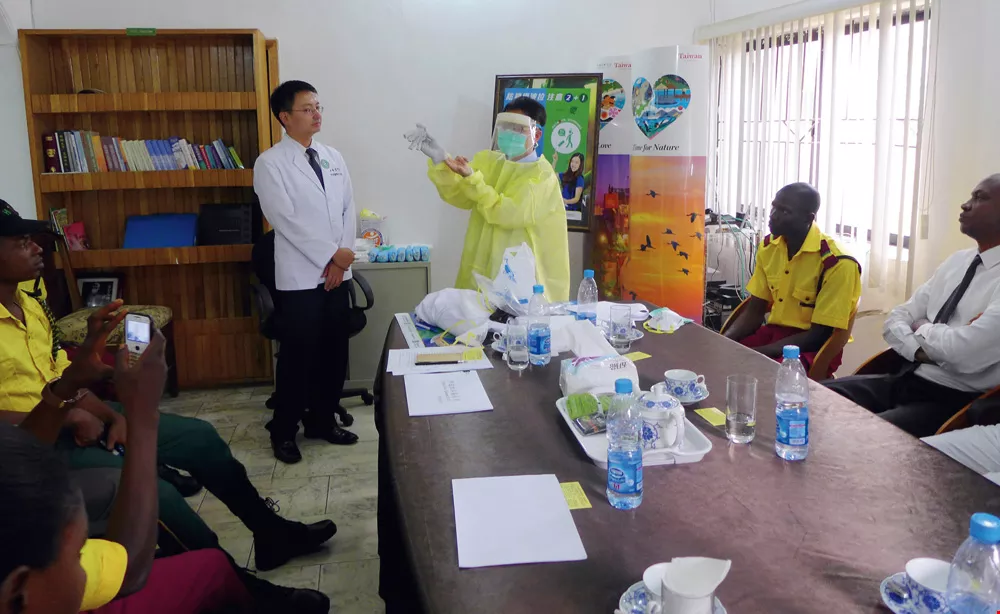
Luo (wearing a white lab coat) and Dr. Tsai Huai-te demonstrate the proper technique for donning protective gear to employees of Taiwan’s representative office in Nigeria.
Luo’s September trip to Africa wasn’t his first. In fact, he visited Malawi in 2001 as part of a medical mission, working on HIV/AIDS prevention there in lieu of military service in Taiwan.
He had just completed medical school and was brimming with enthusiasm for his work. His experience on the ground showed him just how unfair the world can be. “HIV/AIDS patients in the US and Taiwan have a variety of treatment options and can live almost normal lives.” He contrasts that with Malawi, where, he says, an HIV/AIDS diagnosis is effectively a death sentence.
A lack of medical resources and antiquated notions of prevention have resulted in an HIV/AIDS infection rate of 15% among Malawi’s adult population. “The disease is more prevalent in Malawi than high blood pressure and diabetes are in Taiwan.”
Luo was even more shaken when several of the local medical personnel with whom he was working contracted AIDS and passed away, one in just four months. Upset by his seeming powerlessness in the face of his partners’ suffering, he set his mind to finding something he could do for them. He ended up arranging seminars aimed at teaching medical workers how to protect themselves in a clinical setting in hopes of avoiding similar tragedies.
“When I went back to Malawi in 2012,” says Luo. “I knew the classes had been effective because many of the people I’d taught were still healthy.” His partners there even christened him the “founder” of HIV/AIDS prevention in Malawi for his efforts to provide them with information on the disease.
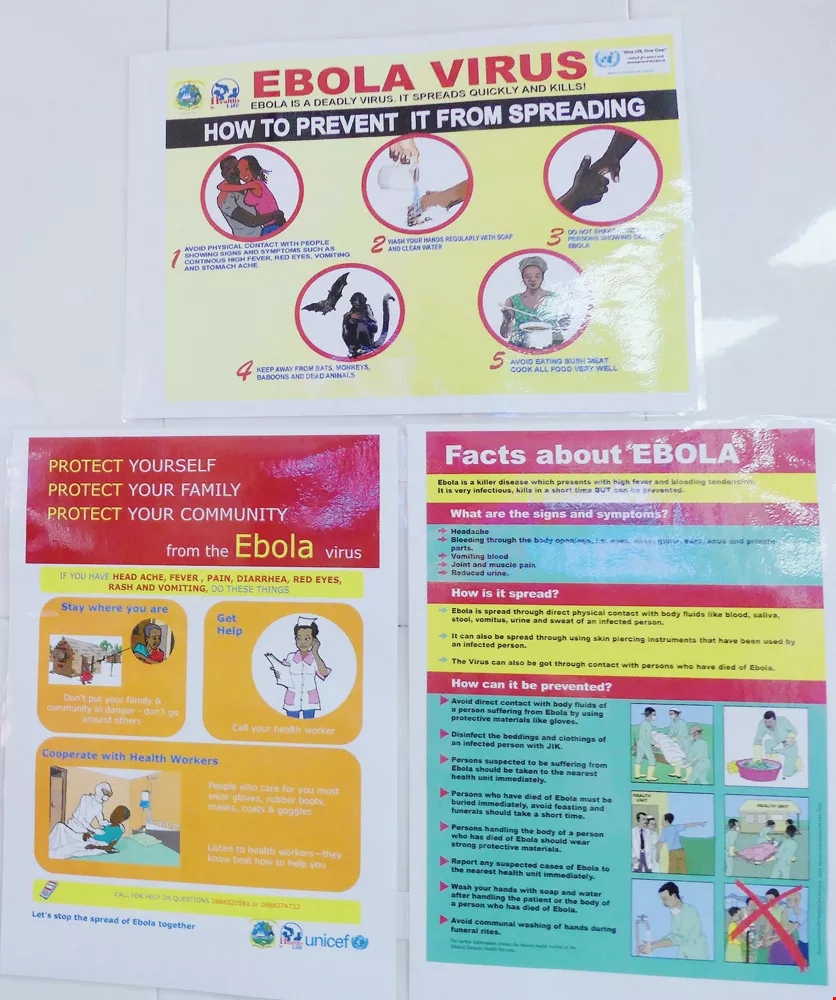
Posters in Nigeria's supermarkets offer advice on controlling the spread of Ebola.
Luo’s year in Malawi has affected his entire life since. He experienced the truth of “an ounce of prevention is worth a pound of cure” at first hand, and realized that when the public has an accurate understanding of prevention, it becomes possible to limit the spread of even deadly diseases and save lives.
After working back in Taiwan for a few years, Luo decided to join Taiwan’s Centers for Disease Control as an epidemiologist. In 2008, Taiwan’s CDC sent him to the United States’ Centers for Disease Control and Prevention for further training and to get him up to speed on international prevention practice.
In 2009, the US’s CDC was seeking a doctor with Africa experience to join a team it was sending to investigate unexplained deaths of children in Nigeria. Luo immediately signed up.
He soon discovered that local villagers were using their homes to process ore from a nearby mine, exposing their children to poisonous lead dust and in some cases killing them. The team negotiated with local elders, religious leaders and the government to build a smelter at the mine site, thereby keeping ore out of the village and preventing more children from being harmed.
Though that trip lasted only one month, it made Luo realize that “little things can have a big impact in Africa,” and made him still more committed to his disease prevention work.
Standing with patientsBecause he had previously visited Nigeria and had built relationships within its medical system, he was able to visit the normally restricted Nigeria Centre for Disease Control.
Luo realized that although Taiwan had created a solid disease prevention system following the SARS outbreak, Nigeria’s CDC nonetheless had two valuable lessons to offer.
The first involved focusing on clearing up rumors and bad information. “In Nigeria, inaccurate information has killed more people than Ebola.” Luo says that at one point there was a rumor going around that drinking a large glass of salt water at midnight would prevent you from contracting viruses. Many people ended up dying from acute renal failure as a result. Taiwan has not been immune to this kind of dangerously bad information and recently saw rumors circulate that certain herbal remedies could prevent an Ebola infection.
“Countering bad information is even more important than treating the disease.” Luo recognizes that panic can cause the disease prevention system to collapse and therefore accepts all media requests for interviews, appears on talk shows and makes himself available for conversations with well known radio and TV personalities. He doesn’t care if he is criticized for doing so because, “When there’s a lack of accurate information, rumors will fill the void.”
The second lesson has to do with taking care of the non-medical needs of victims. When an infectious disease begins to spread, the public begins to worry about coming into contact with people who have the disease. Victims feel even more distressed when avoided by neighbors, classmates and colleagues. One Liberian Ebola patient ended up committing suicide because her entire village had continued to shun her even after she recovered from the disease.
Such stigmatization makes some patients unwilling to seek treatment and can even cause them to flee their homes, spreading the disease still further. In one Nigerian case, a man who feared he had contracted Ebola traveled to a city 600 kilometers from his home to seek treatment in secret. His subterfuge was discovered two weeks later when the doctor who treated him died from the disease.
Nigeria’s CDC therefore created a psychological support team consisting of psychologists, psychiatrists, counselors and social workers. Team members provide companionship and counseling to quarantined patients with a positive diagnosis to alleviate some of their distress. Social workers offer guidance to individuals whose diagnosis hasn’t been confirmed and to those on the mend, visiting their neighborhoods, workplaces and schools in an effort to minimize discrimination.
Taiwan could further enhance its own disease prevention efforts by creating taskforces to clear up misinformation and provide psychological support to patients. Understanding the public’s perceptions and reactions is essential to minimizing the potentially deadly social costs of disease.
Disease prevention is an endless journey, with improvements to be made at every step along the way. Luo maintains the passion and idealism of youth in spite of having worked in the field for more than a decade and witnessed countless deaths. Always active and perpetually curious, he never ceases looking for new and better ways to address outbreaks of disease.


