A Mini Silicon Valley in Taipei
Jamie Lin’s appWorks Ventures
Eric Lin / photos Chin Hung-hao / tr. by Scott Williams
May 2013


appWorks Ventures is currently the most active Internet-oriented venture capital firm in Taiwan, as well as its largest private incubator. Its underlying premise is that the best way to speed entrepreneurship is to bring together capital and “incubation.”
Dubbed Taiwan’s “most ardent Internet advocate,” company founder Jamie Lin is an entrepreneur, incubator, and, as “Mr. Jamie,” the author of a widely read blog.
Born to a prominent Taiwanese family, Lin began establishing his own Internet startups while still at university. After graduating, he pursued an MBA focusing on finance and entrepreneurship at the Stern School of Business in New York. He says that founding companies is simply an expression of his love for the Internet, and hopes that the web will help build a better world.
Jamie Lin is a busy man.
He gets up at 5 a.m. to write on his blog before heading to work, arrives at the office at eight o’clock to work with the teams training in the company’s incubator and meet with his company’s investment targets, then heads over to a radio station in the early evening to host a program. He finally makes it home again at 9 p.m. and is in bed at 11 on the dot.
He has spent the last three years living this kind of highly disciplined life, his days packed and sleeping just six hours per night.
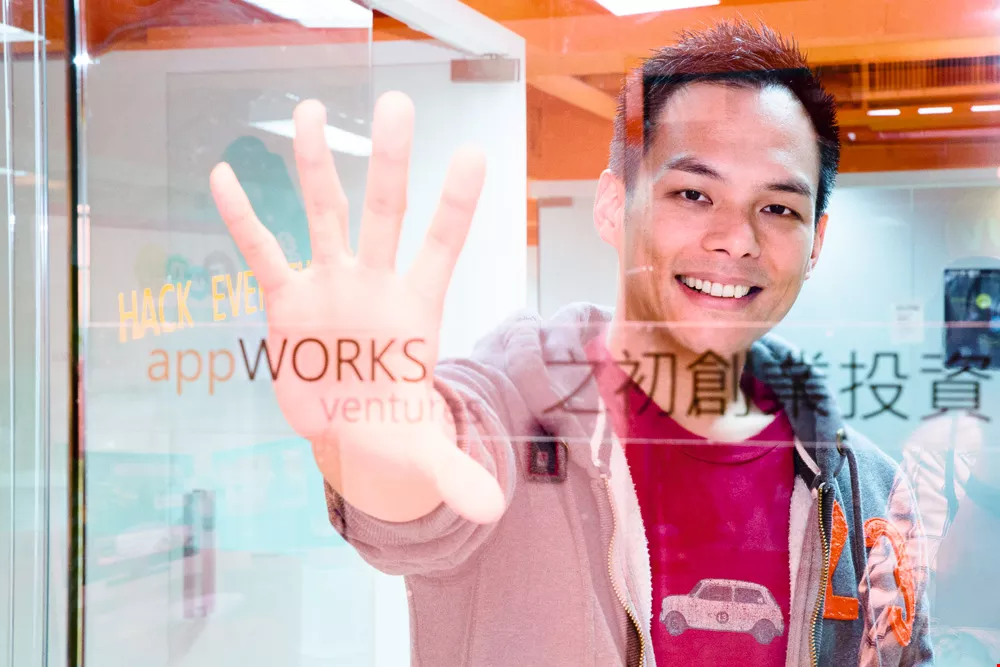
Jamie Lin, founder of appWorks Ventures, raised a large amount of capital and established an incubation center to create a “Mini Silicon Valley” in Taipei.
Lin calls his company zhichu (loosely, “the beginning”) in Mandarin, explaining that the word connotes many things and embodies his wide-ranging ambitions.
In fact, the Three Character Classic begins with a statement that contains that very zhichu: “People at their beginning are naturally good. Their natures are similar, but their habits make them different.” Beginnings are very important to venture capital firms, which cultivate young companies, help entrepreneurs incubate their ideas and passions, and guide them in a direction that enables them to be even more intellectually productive.
Lin chose “appWorks” as his company’s English name to mark it as an applications-oriented Internet company, and to suggest that it is vigorous and capable. Over the last three years, appWorks has trained more than 150 teams in its incubator and invested in 16 companies.
appWorks is located in a wide-open 215-square-meter office on the fifth floor of the old United Daily News building on Keelung Road. Some of the 25 teams currently undergoing training sit at desks with laptops, while others gather in small groups in front of monitors to talk over issues, sharing their ideas for solving web-related problems.
Every Monday is innovation presentation day. Teams present the business proposals they’ve been developing to the group and everyone discusses them, looking for flaws and ways to fix them. The company also offers an incubation lecture on Wednesdays, inviting executives from well known Taiwanese companies to share their entrepreneurial experience and their company’s approach to management.
Intriguingly, directions on the wall by the office’s entrance point visitors to the seventh floor. There, budding entrepreneurs with six months of incubation courses under their belts can continue to participate in appWorks’ mutual support model for starting businesses.
appWorks’ approach is so similar to that employed by Silicon Valley venture capital firms that its offices are known in the business as “Taipei’s little Silicon Valley.”
When asked about the biggest differences between appWorks and other venture capital firms and incubators, Lin says that while he’s neither scholar nor senior executive at a transnational firm, he has personally founded several companies. He likens himself to the coach of a baseball team in that coaches have usually played themselves, understand the ups and downs players experience, and are always on the lookout for talent.
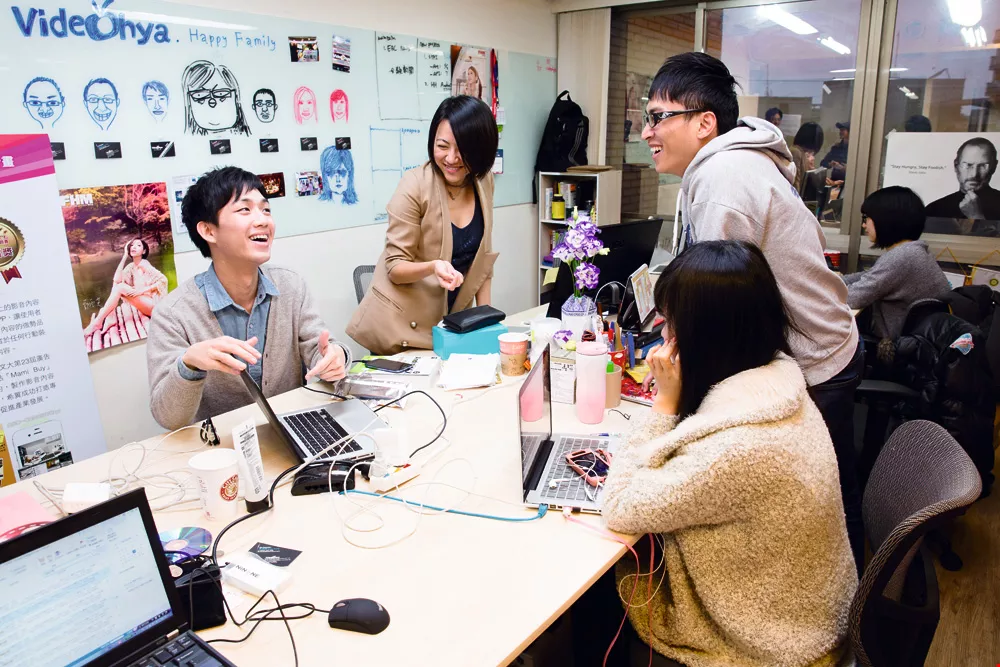
The open floorplan of appWorks’ offices contributes to discussion and makes it easy for teams of entrepreneurs to ask for help and receive support from one another.
Lin was born in 1978, into a family of prominent doctors. His father, Lin Fang-yue, has been president of both National Taiwan University Hospital and Veterans’ General Hospital. His mother, Jean Lin, is the founder of Jean’s Clinic of Plastic Surgery. His maternal grandfather, maternal great uncle, and younger sister are all physicians, but Lin himself chose to study chemical engineering at National Taiwan University. During his junior year, he leapt aboard the pre-2000 dot-com bandwagon and founded two companies with classmates: Hotcool.com, an online retailer of computer parts, and Intumit, a knowledge management firm.
After getting his MBA in the US, he worked for venture capital funds HSS Ventures and All Asia Partners, and participated in the founding of Sosauce (a travel club) and Muse Games (a maker of 3D games). Lin’s path may seem to differ from that of most of his family, but he says his entrepreneurial spirit came from them, and notes that his mother also founded and runs her own company.
Unfortunately, Lin’s career in the US was sidetracked by the financial crisis of 2008 just as it was taking off. Then based in New York, he got to see at first hand how Wall Street’s financial giants had enriched themselves through financial games to the detriment of the nation. With his “American dream” in tatters, he began thinking about where he wanted his kids to grow up, which gave rise to the idea of returning to Taiwan to share his venture capital experience.
He started preparing for his return in 2009 by creating a daily blog on Internet entrepreneurship and beginning to actively develop his professional network. Within six months, he had made a name for himself in Taiwan’s Internet industry, had developed a loyal following, and had would-be entrepreneurs knocking on his door seeking assistance.
He then announced plans to establish an incubator, and soon had applications from 33 teams. Lin flew back to Taiwan for interviews, chose 11 of the teams, rented and decorated an office, then headed back to the US to visit several major Silicon Valley incubators. Having wrapped up his whirlwind of preparations in just three months, he opened for business.
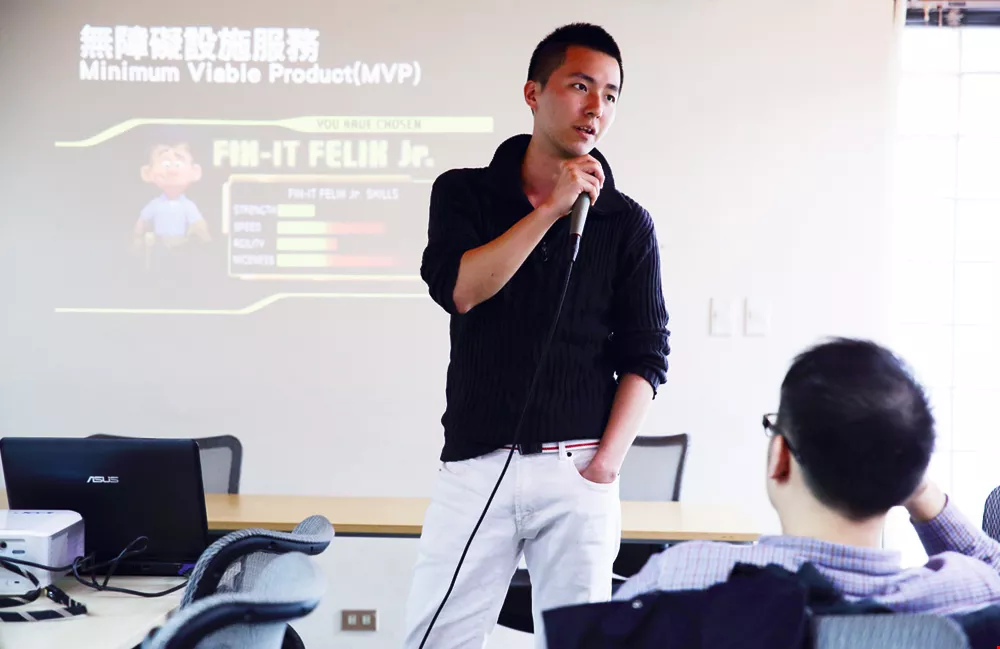
appWorks uses the Internet to recruit young entrepreneurs into its incubator classes. Every Monday, the teams training in the incubator report on their progress then brainstorm with other teams.
Lin’s next step was to put himself in the limelight, making media appearances aimed at raising interest in Internet entrepreneurship. Investors soon began taking notice, and in 2012 he began raising capital from outside sources. appWorks started its formal operations later in the same year, managing a NT$320 million venture capital fund for Cathay Financial Holdings, Phison Electronics, the United Daily News Group, and Fasttran Moving.
appWorks is currently invested in 16 companies, four or five of which are already profitable, including game portal PubGame, restaurant reservation service EZTable, and advertising platform Tagto. appWorks typically invests a few million NT dollars in its targets, and has invested a total of NT$130 million to date.
The company employs a model in which it provides entrepreneurs with guidance, gets a priority option on investing in teams it incubates, and finds investors for its entrepreneurs, thus providing investors with the opportunity to buy into promising prospects. The model, which sets multiple parties to work achieving a particular vision, has attracted large numbers of ambitious young people eager to get into the incubator.
appWorks received a total of more than 600 applications for the six incubation sessions it has run to date. Its acceptance rate averages 25–30%.
People over ideasWhat do the teams the incubator adds to its roster bring to the table? Unique ideas? New business models?
“We choose people, not ideas,” says Lin, who looks for three traits when interviewing prospective teams.
The first is determination. “I think my old boss looked down on me, and I want to show him.” “My relationship with my father isn’t good. He’s not proud of me.” Lin says that statements like this, which might cost an applicant in a typical job interview, show determination, which is a plus when starting a company. He explains that it usually takes a startup at least three years to get off the ground and typically only people of iron will can stand the grind.
The second attribute is the ability to execute, which is necessary to produce the product you’re aiming for, bring on board the partners you need, and hire the talent you want. The third is understanding the ins and outs of a particular industry in a way that other people don’t, which helps you stand out from the crowd.
The company’s venture capital side is entirely different from its incubator. Its focus is on increasing the rate of return on its investments. “To that side of the business, success means earning big money on a given percentage of our venture investments.”
Opening doors for yourselfThe entrance to appWorks’ office is adorned with something blogging entrepreneur and best-selling author Seth Godin (Purple Cow) once wrote: “Don’t blame the system or the teacher or the parent that didn’t open the door. Have the guts to open the door yourself.”
Lin firmly believes that conviction is a force that we internalize, and that constant exposure to sayings that exhort or remind us of something can stiffen our resolve. So appWorks appeals to ambitious young people with sayings like “Entrepreneurship needn’t be lonely,” “Capital can be injected when you need it most,” and “Investment isn’t a trade, it’s a relationship.”
Lin argues that since consumers are a black box, entrepreneurs should avoid both excessive excitement and excessive pessimism. In his view, Internet entrepreneurship should aim to change the world, to make it a better place. That, he says, is what gives your life value and meaning.

@List.jpg?w=522&h=410&mode=crop&format=webp&quality=80)


