

The topic of “affluenza” was the subject of a noted US documentary in the 1990s, and a book was later published about it in 2001. The word—a relatively recent coinage that combines the words “affluence” and “influenza”—refers to a contagious condition sweeping the globe that involves unreasonably long working hours, tremendous stress, endless material pursuits, overconsumption, emptiness, and anxiety.
The feeling that one never has enough afflicts not just the rich. Poor people also fall victim. The antidote is to be found in nature. One need only focus in on the small things. A blade of grass or a flower petal will do the trick....
The book Affluenza: How Overconsumption is Killing Us and How to Fight Back provides an affluenza self-diagnosis test that asks: “Are you unable to identify more than three wildflowers that are native to your area?”
What wildflowers do you have around you? Up in the lonely mountains, or out on a deserted seacoast, what flowers will you find?
Wildflowers are a link between man and nature, and the simplest of all portals to an understanding of the untamed world around us.
Kuo Yi-ling, editor in chief at Business Weekly magazine, accompanies an aunt and uncle on an early autumn day in October to the trailhead at Mt. Shizitou in the Taipei suburb of Xindian to hunt for Swertia shintenensis, a flowering plant in the gentian family. Her uncle, once a C-suite executive at an electronics company, after retirement became an avid flower hunter along with his wife. Together, they now scour the mountains to observe and photograph the flora there.
The power of nature can cure whatever may ail, be it body or soul. Kuo’s uncle exclaims: “Look how gorgeous nature can be!” He marvels at the curled petals of Clematis lasiandra, the sapphire-blue berries of Lasianthus fordii, and the walking-cane shape of the forest ghost flower (Aeginetia indica). But he sighs at how few people ever bother to stoop down for a closer look, and the fact that the land where wildflowers grow is increasingly gobbled up by building sites or smothered in herbicides. Wherever herbicides have been laid down, the topsoil goes dry, barren, and hard.
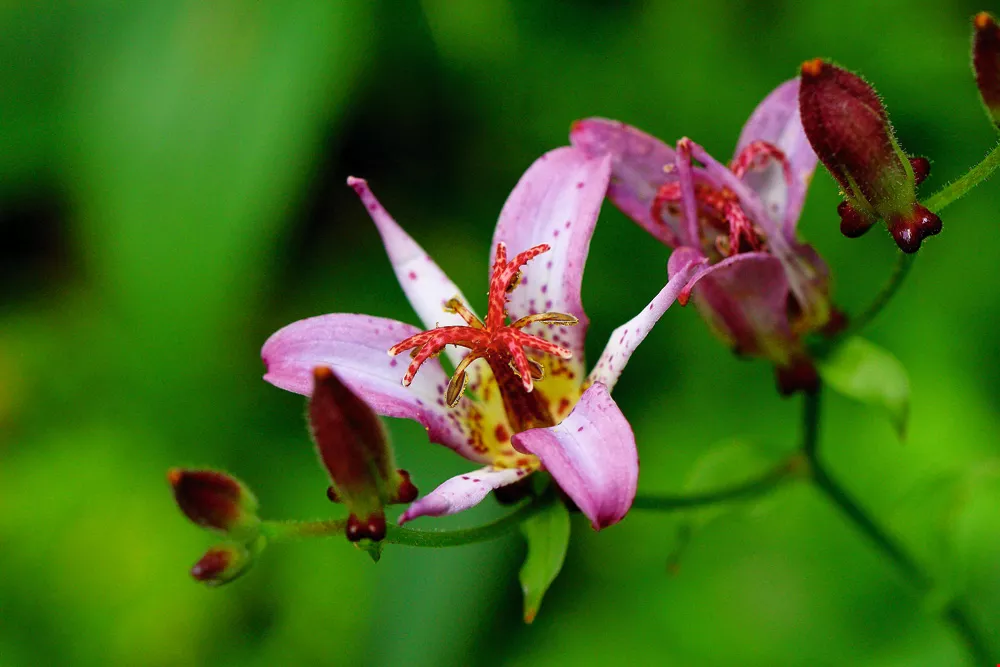
Tricyrtis formosana, which is endemic to Taiwan, blooms from September to November from the lowlands on up to an elevation of 1,000 meters.
It’s hard to say how many people are into wildflowers and other plants, but the number is silently growing. Among them is a blogger going by the handle of Candy Candy, who brings an unmatched passion to the flower hunt. In a period of just over a year, she has posted about a hundred articles describing her treks across the land. To get a look at the albino form of Tricyrtis formosana, she climbed four mountains over three consecutive weeks, ran across all sorts of snakes, and was on the verge of giving up before making the find. To track down the ghostly white Cheilotheca humilis, she took time off work and hiked for three hours in the 5℃ cold of the mountains around the Northern Cross-Island Highway, finally catching up with her quarry in a damp fir grove. To observe Mitrastemon kanehirai, a parasitic plant that has been designated as a national treasure, she made four trips to Mt. Dongyan over a month and a half, hiking ten kilometers each time. Over the four trips, she watched and recorded as the plant sprouted, grew, and flowered. “Once I get fixated on a plant, it’ll be on my mind day and night. I’ll gladly go anywhere and negotiate any obstacle to see it.” Apart from flower hunting, perhaps love is the only thing that can inspire such passion.
All year round, Candy Candy and others like her set their schedules by the life cycles of the flowers. When the object of their attention is set to bloom or bear fruit, they stir to action, and once they find what they’re looking for, they will often burst into tears, not unlike a star-struck fan upon happening across an entertainment idol on the street.
Flower hunting is a new phenomenon that is spreading across Taiwan. For our purposes, let’s call the people who do this “flower chasers.”
National parks, forest recreation areas, and the Society of Wilderness have been training flower chasers for many years, and the people they’ve trained are now spreading the seeds of concern for nature.
Chen Huizhu, a retired teacher of Chinese at Kaohsiung Municipal Cianjhen Senior High School, started out by attending training sessions at Kenting National Park Headquarters, and is now a volunteer guide at Shanlin Xi Forest Recreation Area. Lin Jinsong, who goes by the online handle of Cobra Sow and used to work in the electronics industry, joined the Society of Wilderness and now teaches a community college course where he takes students out to observe nature. “Old Mr. Ku,” a former volunteer guide at Yangmingshan National Park, is extremely knowledgeable about plants, and can answer all sorts of questions concerning trees, flowers, and the like. Meanwhile, a number of Facebook groups and pages with a special focus on plant life have attracted tens of thousands of followers, and even organize periodic nature excursions.
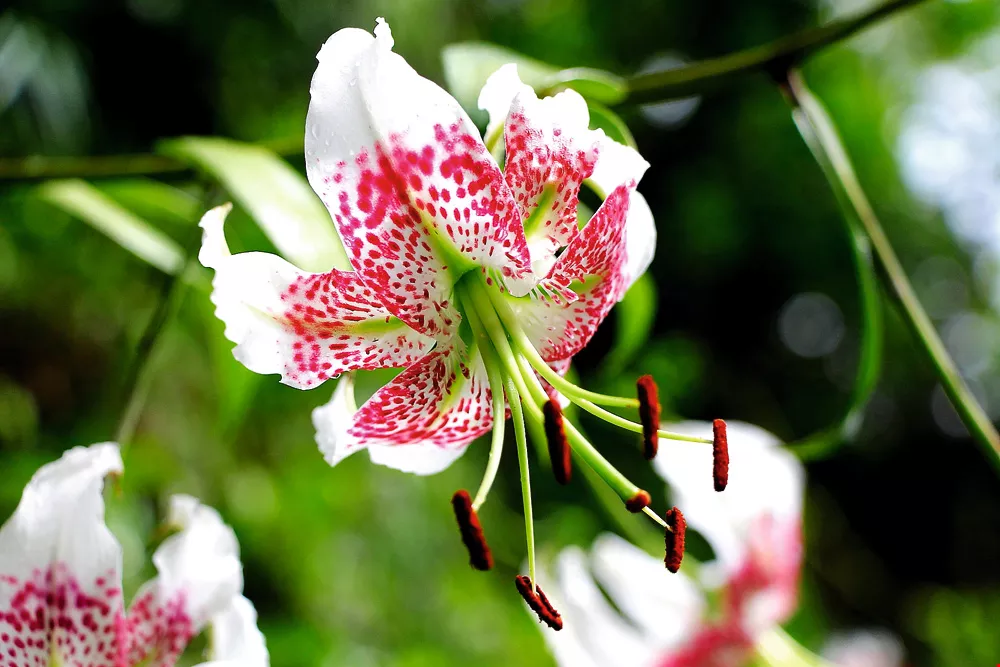
The search for wildflowers and other naturally occurring flora is an antidote to affluenza. Shown here are specimens of Swertia shintenensis (main photo), Lilium speciosum var. gloriosoides (inset, above), and scandent monkshood (inset, right), all highly prized by flower enthusiasts.
Some flower chasers are just casually interested, but others take it quite seriously. Some in this latter group, in fact, develop into true experts, publish books, and act as a bridge between academia and enthusiasts. Take Huang Lijin and “Teacher Yezi,” for example. Huang Lijin published three books in less than four years, while Yezi combined his passions for flowers and photography in a 2013 book. Now he is soon to publish another.
Huang pokes a finger inside a flower’s corolla tube and comments: “The pollination mechanism inside this flower is just like a teeter-totter....”
“Flowers are reproductive organs. To spread pollen and procreate, they’ve evolved all sorts of weird shapes and pollination mechanisms. Salvia nipponica var. formosana is an interesting case in point. When an insect gets into the corolla tube to drink the nectar, it bumps up against the infertile stamens on the lower lip of the corolla. This triggers the fertile stamens on the upper lip to swing down and drop pollen on the insect. The flower then relies on the insect to go out and spread the pollen, thus achieving reproduction.”
Crouched before a Salvia nipponica blossom, Huang can go on talking for a half hour. A plant guide for the Society of Wilderness, she and some friends jointly established WEE, a partnership that hires itself out to schools and companies to teach nature exploration courses. From time to time, university students majoring in horticulture or forestry take part in the activities.
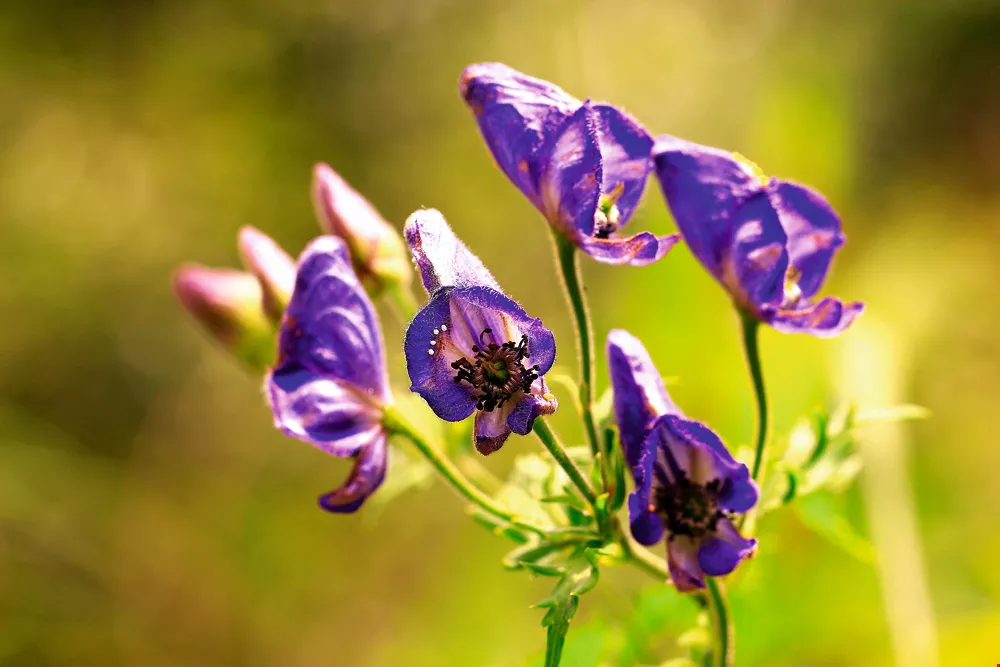
The search for wildflowers and other naturally occurring flora is an antidote to affluenza. Shown here are specimens of Swertia shintenensis (main photo), Lilium speciosum var. gloriosoides (inset, above), and scandent monkshood (inset, right), all highly prized by flower enthusiasts.
Nature is like a window upon a different world—the “here” and “there” of which Haruki Murakami has spoken. Says Huang: “Our awareness of nature is slowly awakening.”
A former Chinese major in university, Huang has taken systematically to the task of writing about the world of flowers, and must even delve into academic literature. And there is Yezi, a low-profile type who refuses interviews but has said of himself: “I pour parts of myself into the undertaking, and stack the pieces up in nature to find the original me.” He too majored in something totally unrelated to plants. Unfamiliar with the basic taxonomic scheme used by botanists, he was nevertheless spurred by a love for Taiwan’s ecological richness to build up formidable photography skills that now enable him to put the living world clearly on display. His blog, which has attracted over a million hits, features a huge collection of plant photos, plus writings pulsating with wit and feeling. This is something that academic literature cannot do.
But one would be remiss to let two great pioneers, Zhang Biyuan and Zhang Huifen, go unmentioned. The field guide to the wildflowers of Taiwan that they published in 1997 is something of a “flower chaser’s bible.” After purchasing this book, Bill Lin, president of the PayEasy shopping website, started carrying it along on trips into the hills. He learned to identify plants, and eventually founded a popular Facebook group for plant aficionados. And another publication that few flower chasers go without is a two-volume illustrated guide to the wildflowers of Taiwan by Zhang Yongren, whom many consider the most learned among the nation’s many amateur flower enthusiasts.
So what is so enchanting about wildflowers? In the opinion of Yezi, there is an untamed beauty to the flowers one encounters in the wild, and a power that moves the viewer. Like a troupe of children reveling in unrestrained freedom, they are unfazed, no matter how the wind may blow, the sun sear, and the rain soak. If you get up close, and take a long hard look, you will find that each petal has a tale to tell.
For Candy Candy, wildflowers are incomparably more beautiful than the cultivated variety. Huang, too, is underwhelmed by greenhouse beauties, but feels a deep respect for the hardiness of wildflowers. However, the search for a particular wildflower often brings frustration. Ji Yiyi, a nature photographer who frequently posts photos to Facebook groups, once photographed a big patch of Formosan bletilla orchids (Bletilla formosana) blooming in the hills, then went back a week later only to find that someone had removed every last one.
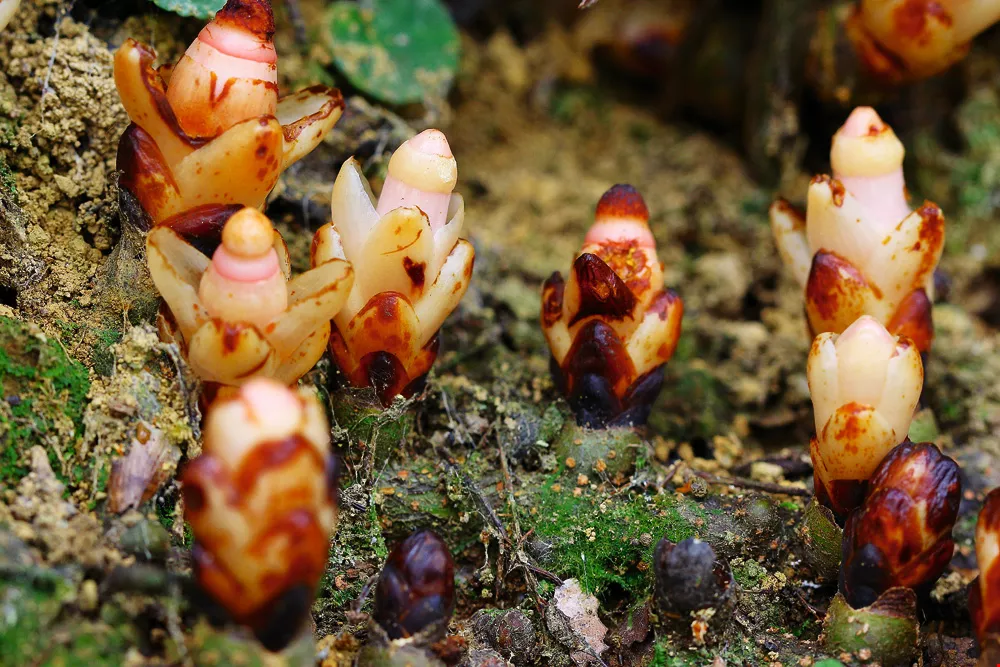
Mitrastemon kanehirai is a parasitic plant that has been designated as a national treasure.
Many who get sufficiently hooked on flower chasing will eventually start hankering for glimpses of wildflowers that are uncommonly beautiful or rare.
Swertia shintenensis is an especially prized flower. A board has been erected at the trailhead of Mt. Shizitou to inform visitors that this is the best area in Taiwan to search for S. shintenensis. Taiwan has four flowers in the genus Swertia, of which S. shintenensis is the only one that grows in the mountains at low elevations. First discovered in Xindian during the Japanese colonial period by the botanist Bunzo Hayata, S. shintenensis features deep purple petals and unusual nectar guides composed of sunken grooves. Flower chasers arrive in droves every autumn as S. shintenensis is blooming to see the nectar guides covered with crawling ants. However, the range of S. shintenensis is not limited to Xindian; many of the more accomplished flower chasers avoid the crowds at Mt. Shizitou and head instead to the rugged Front Peak of Mt. Wulai, or to Mt. Dongyan in Taoyuan.
Other flowers that rival the esteem commanded by S. shintenensis include Lilium speciosum var. gloriosoides in the mountains near Pingxi, Bostrychanthera deflexa at Erziping, the golden spider lily (Lycoris aurea) of the northeast seacoast, the red-hairy azalea (Rhododendron rubropilosum) of Mt. Hehuan, Cheilotheca humilis from the Little Qilai Trail, and scandent monkshood (Aconitum fukutomei var. formosanum) from the Siyuan Pass. But among the cognoscenti, even this list isn’t so terribly special. Those who really know their stuff are more demanding; they will go on monster treks to find rare and endangered wild plants like the jewel orchid species Anoectochilus formosanus or the Formosan lady’s slipper (Cypripedium formosanum). These rarities seldom grow in accessible places like hiking trails. In fact, their locations are secrets that experts guard tightly to make sure hordes won’t come and poach until there are no flowers left. Such secrecy is certainly necessary. The rarest of rarities—Cypripedium segawai—is found in only three spots in Taiwan, and the locations have been declared top-secret information by the Taroko National Park Headquarters.
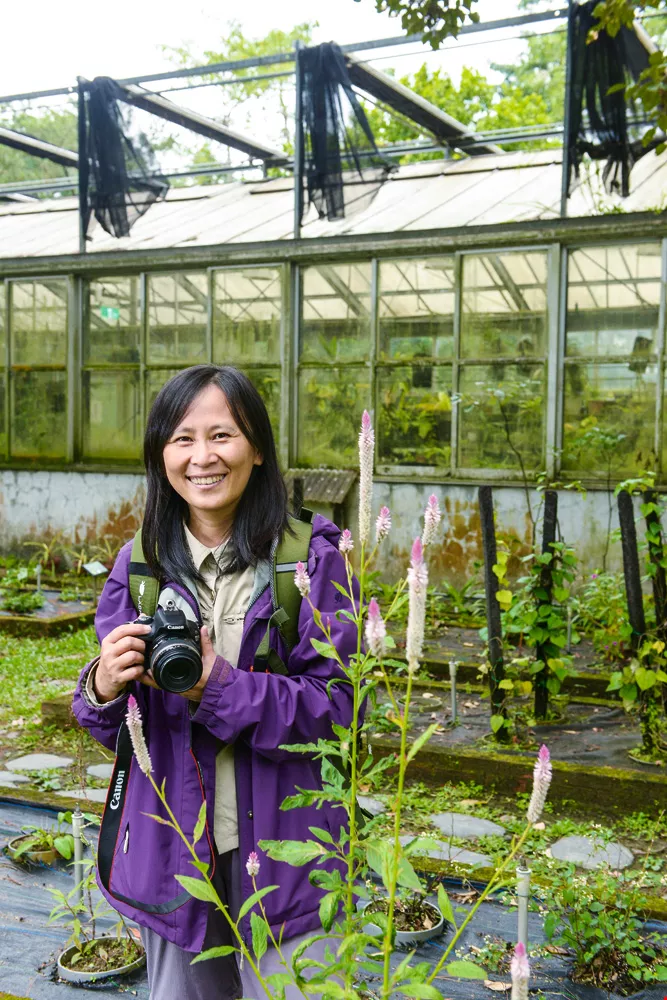
Huang Lijin, a plant guide and member of the Society of Wilderness, is a bridge between academia and enthusiasts.
Huang, however, isn’t into rarity for its own sake. In her opinion, a person should get to know plants by observing the ones that grow in their immediate environment. Precisely because they are nearby, you can get to know their whole life cycle, observing not just the beautiful blooms, but also the fruits of autumn and the withered leaves of winter. There is beauty at each stage. If you want to understand nature and its secrets, you have to know how to sit pat and observe closely.
Sitting pat and observing closely are acquired skills. When the Society of Wilderness first adopted Fuyang Eco Park in Taipei, nearby residents had been playing badminton on carpeting that they had laid down there. After volunteers removed the carpeting, seeds under the soil soon sprouted. Though tiny, the patch of land managed to support an entire ecosystem. As it turns out, beauty with the power to heal the body and soul is all around us, close at hand if you’re only willing to take an attentive look at your surroundings.
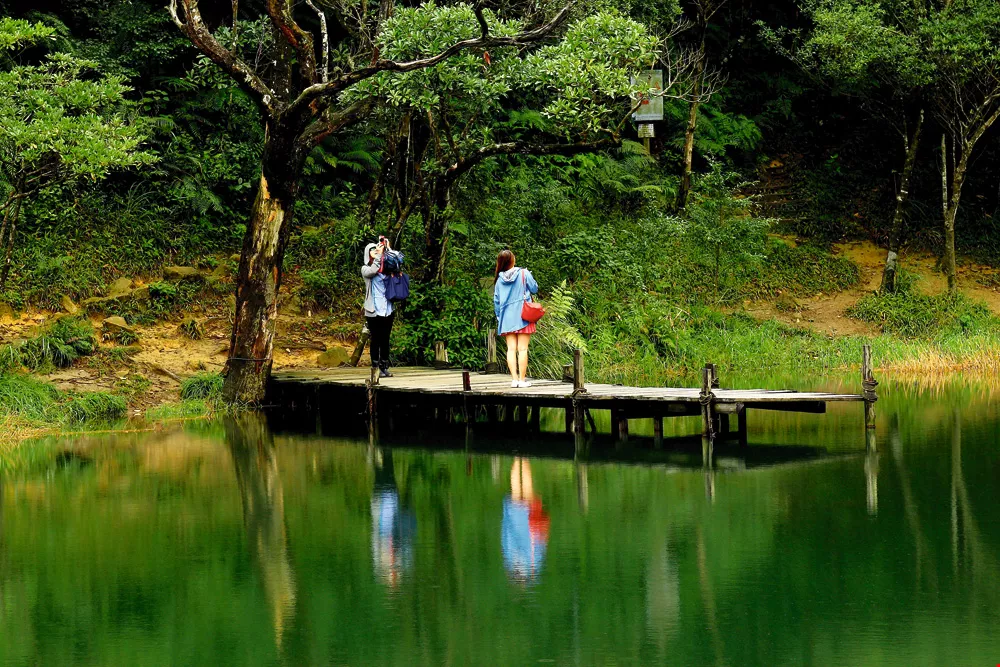
The mysteries of nature lie in wait for us to take a closer look. Shown here is Dream Lake at Mt. Xin.
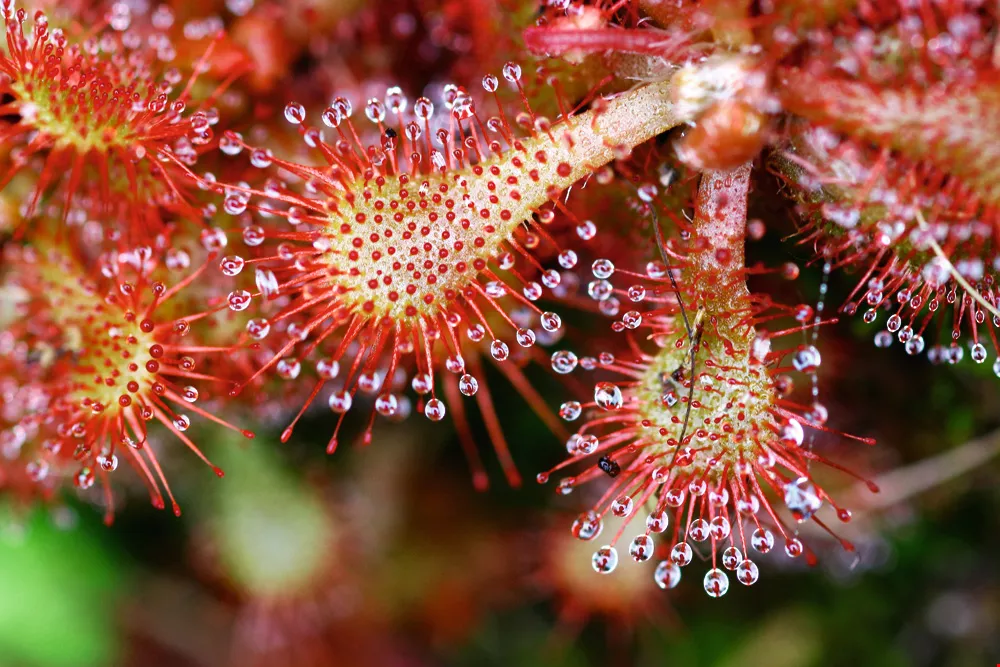
The beautiful spoon-leaved sundew (Drosera spatulata).

@List.jpg?w=522&h=410&mode=crop&format=webp&quality=80)


