

Taiwan proudly stands head and shoulders above the rest of the world when it comes to agricultural technology. Nevertheless, with a small domestic market and imported fruit making a beachhead and winning customers, the nightmare of poor sales will not go away. Every so often senior agricultural officials and local village officials are depicted leading others in eating bananas or drinking orange juice, which makes people worry about the farmers but also makes them laugh. Thus "international marketing" has become the biggest challenge at the current stage of agricultural policy.
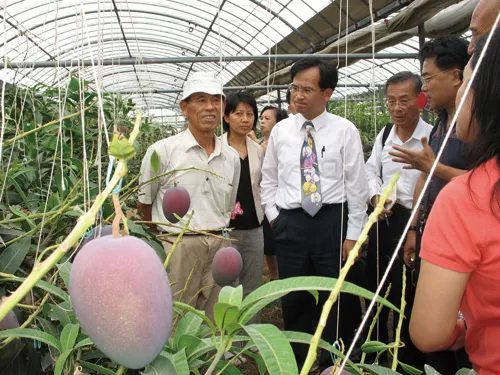
Japan is the dream market for Taiwan agricultural products. Prices are super high but standards are likewise very rigorous. To get an understanding of the relative strengths of Taiwan agriculture and of its competitor, Tainan County commissioner Su Huan-chih (center, wearing tie) has been taking "Irwin mango sales promotion teams" on annual trips to Japan for many years. The picture shows the Ookubo Mango Orchard, entirely made up of greenhouses, and its owner Toshio Kuroki (left).
NT$5,000 for two
Tainan County commissioner Su Huan-chih, who four years ago went ahead and broke into the Japanese market, says that after the opening up of this channel the price of Tainan mangoes has risen. Furthermore the Council of Agriculture and the Bureau of Foreign Trade have listed the mango, with the butterfly orchid, Oolong tea, and Taiwan tilapia, as four flagship agricultural products most able to compete in international markets, and have actively assisted fruit farmers in obtaining international certifications, like EurepGAP. All this has provided the Taiwan mango with more and more selling points.
Last year Su led an "Irwin mango sales promotion team" to Miyazaki Prefecture, the home of Japan's "Eggs of the Sun" mango. For Miyazaki mangoes, the emphasis is on "full ripening." Currently they are the most expensive mangoes in the world. A package of two can fetch ¥16,000, the equivalent of NT$5,000!
The delegation originally intended to visit the production area but after the Japanese government and local Miyazaki Prefecture officials got wind of this, an order was issued barring the fruit farmers from access, in order to avoid revealing technology to market competitors. Luckily, the delegation was able to locate a Japanese farmer named Toshio Kuroki through the Japanese Agricultural Cooperative's Agricultural Travel Bureau. Kuroki had come to study in Taiwan 28 years before, had returned to Japan to successfully plant and raise mangoes commercially. Kuroki recalled with gratitude all that his teachers had done for him, and the fact that the "eggs" were nothing other than Irwin mangos originally introduced from Taiwan. Bucking official opinion, welcomed the Taiwan visitors to take a look at the Ookubo Mango Orchard he was operating.
"Full ripening"
The Ookubo Mango Orchard occupies half a hectare of land and is turned over entirely to hothouse planting. During the summer heat or the winter snow, the temperature is always maintained at 25°C. With this high-cost investment, moisture and insects are effectively kept out and the anthracnose and fruit fly damage problems solved. The fruit need not be wrapped in bags for protection and the blooming period can be extended. To facilitate management, each fruit tree is pruned short and the fruit thinned to leave only 80 mangoes per tree. In addition, the calyxes are hooked together. Some orchards set up a small net beneath the trees to catch falling fruit. This is what is called "full ripening" production.
Mango cultivation only began in Miyazaki 20 years ago and it took ten years of research to achieve current results. Although the planted area is only 12.5 hectares and there are only 70 farm households engaged in the work, the yearly value of the crop is NT$600 million. Miyazaki Prefecture has established a special "Mango Bureau" that controls everything having to do with mangoes. There are also specialized warehouses, and grading and packing plants. Independent grading and labeling is done for mangoes produced by each and every farmer and the name of the producer is stamped on the box so consumers can trace the fruit back to its source.
Su Huan-chih stresses that the Japanese domestic "production record" system has been well implemented. The products sold in the direct sales center, down to the smallest bulb of garlic, all have their own production record attached. There is also an electronic reader set up in the store where you can immediately look up information. The names and pictures of the farmers are also displayed in the center. On the one hand, this encourages a sense of pride among the famers and, on the other, lets the public buy with peace of mind. It is very well worth emulating in Taiwan.
Jockeying for market position
In fact, to open up the overseas market, Su Huan-chih has set up a logistics center in Yuching for Tainan agricultural products and in July 2005 started using a steam heat treatment plant. "Steam heat treatment" involves applying steam heat at 46.5C to fruit for 30 minutes and then cooling the fruit down. The temperature and time are strictly controlled. The heat does not cook the fruit, but destroys almost all larvae of the oriental fruit fly (Bactrocera dorsalis), which was introduced from overseas several decades ago. This meets the demands of countries that are free of the fly. However, this treatment inevitably affects the mangoes' flavor, making them noticeably less sweet and fragrant than the fresh fruit.
Mexican mangoes have the biggest market share in Japan, while Philippine and Indian mangoes have also been permitted to enter the market. As for Taiwan, only the Irwin mango is marketed in Japan, leaving a lot of room for growth. One can foresee a global battle for positions in the Japanese mango market taking place each year during the height of the mango season in June and July.
To win this international fight, Taiwan's government agricultural agencies and trading companies conduct rigorous testing for pesticide residues. Fifteen days prior to harvesting, the Agricultural and Food Agency of the Council of Agriculture, together with exporters, examines samples taken from each orchard. Only orchards meeting the standards can be picked. When the mangoes are sent to the steam plants each batch of fruit is sampled and tested again. In addition, since 2007, each mango is individually labeled. Consumers can go directly to the Internet to get information about the producer of each mango as well as about the fertilizer and pesticides that have been used.
Su Huan-chih thinks that if successful, international sales could greatly strengthen the population and the business structures of Taiwan agricultural communities and that the number of young people desiring to return to the villages to become specialized farmers could trend upward. There are already young people from Tainan who have abandoned high-tech jobs in the Southern Taiwan Science Park and returned home to engage in farming. Their energy and confidence remains the Taiwan agricultural industry's greatest hope.


@List.jpg?w=522&h=410&mode=crop&format=webp&quality=80)
