Yulon Motors Brings Electric Cars to Taiwan's Roads
Coral Lee / photos Jimmy Lin / tr. by Phil Newell
June 2010


It has been said that the global fi-nancial storm has forced a reshuffling of the deck in the automotive industry. Major carmakers, anxious to shake off their conservative image and seize market share among the new generation, have heavily invested in development and production of fully electrically powered vehicles. If this is truly the case, the financial crisis has at least made one positive "contribution."
With the century-old auto industry returning to the starting line, governments around the world have adopted subsidy policies in hopes of getting their own firms off to a fast start. Taiwan's own Yulon Group last year came out with its own brand of electric vehicles, Luxgen, including electric SUVs (the Luxgen EV+) and a compact car (the Tobe), hoping to grab the lead in the new age of electric vehicles. What advantages and opportunities do these electric vehicles, combining "intelligence" with performance, have that will allow them to become symbols of a Taiwanese "green car" industry?
Looking back over the story of electric vehicles (EVs) in recent years, it turns out that the earliest highway-capable purely electric car (i.e. not a combined gasoline and electric hybrid) to go into series production for the mass market was put out not by some behemoth auto manufacturer, but by Tesla Motors, a small company created by the founders of Google, Sergei Brin and Larry Page. Incorporating the Google spirit of innovation while rejecting the manufacturing logic of the traditional auto industry-i.e. "using a Silicon Valley approach to reinvent car making"-they came out with a sports car called the Roadster. There is virtually no difference in terms of function between this 250-horsepower car and a gasoline-powered one. It can go up to 300 kilometers on one recharge and can get from zero to 100 kmh in five seconds. Though the price is high at US$100,000, it has drawn buyers among Hollywood stars and even the California state governor.
While Tesla went in for a high-end sports car, German carmaker BMW came out in 2008 with a very different type of car: the fully electric MINI E, an urban compact car. Over the previous few years the BMW group had been focused on hydrogen-fuel and hybrid vehicles, so there was a lot of eye-popping and jaw-dropping when they came out with the MINI E. This new development raised the intensity of competition in the global EV market to a new level.
The MINI E, with a 200-horsepower motor, can accelerate to 100 kmh in only 8.5 seconds, has a top speed of 152 kmh, and can go 250 kilometers on a single charge. It is currently being field tested by consumers in three American cities, on a lease-only basis (i.e. it is not yet for sale to the public).
Another car which began field evaluation this year is the Mitsubishi iMiEV, which is also along the lines of an urban-environment car. Besides the fact that, like the Tesla Roadster and the MINI E, it functions comparably to a gasoline-powered vehicle, its most unique feature is that it has separate recharging sockets on both sides of the car: On one side is a portal to plug directly into the power grid (as used in the home). The other is a high-speed recharger, which can bring the car up to 80% power in only about 30 minutes.
Besides the manufacturers that have already put these three EVs on the road, numerous other firms including Renault, Peugeot, Nissan, GM China, and Volkswagen showed off EVs of their own at last year's Frankfurt Auto Show. Most of them have announced that they will produce, or even be selling, electrically powered vehicles within the next two years.
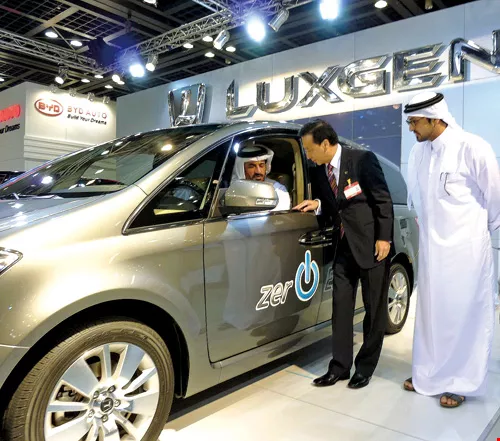
At the end of 2009 Yulon Motors, participating in the Dubai International Motor Show for the first time, caused a sensation with the world's first electric SUV, the Luxgen EV+. Renowned motorsport personality Mohammed Ben Sulayem even came to give it a tryout. Second from right in the photo is Luxgen CEO K.C. Hu.
Taiwan is by no means absent from this current flourishing in the EV field. In 2005 Yulon, the doyen of Taiwan's automotive industry, began investing in R&D of EVs. Driven by chairman Kenneth Yen's sense of mission for Taiwan to produce cars under an independent brand name, in 2009 the firm came out with three models of SUV under the Luxgen label. Each model comes in both gas-powered and electrically powered versions.
At the end of 2009, for the first time ever Yulon participated in the Dubai International Motor Show, the largest in the world, where the company created a sensation with the Luxgen as the world's first electrically powered MPV that can be mass produced. With Yulon being the only firm there to show an EV, not only did local media sit up and take notice, but Mr. Mohammed Ben Sulayem, current vice-president of the Federation Internationale de l'Automobile and a legendary rally driver, paid two visits to the firm's booth and even personally requested a trial vehicle.
"With a seven-seat capacity and weight in excess of two tons, we have created a new benchmark in EVs, says Lee Chun-chung, vice-president of the Hua-chuang Automobile Information Technical Center Company (a Yulon affiliate), which is responsible for Luxgen R&D. He explains that EVs come in three basic types. The first is those that are comparable in performance and speed to gas-powered vehicles, which means you needn't fear being run off the highway by the latter. The second type is those which, though they cannot come up to the level of conventional cars in terms of speed or function (for example having a top speed of only 40-50 kmh), are perfectly suitable for city driving. This type also includes cars with a top speed of 70-80 kmh, which in some European countries don't require license plates. The third type is electric carts, like golf carts and bumper cars.
Lee explains that like the Tesla Roadster and MINI E, the EVs developed by Yulong-both the SUVs and the compact Tobe-are in the first category, which has high barriers to entry. But unlike Tesla or BMW, Yulon has thrown itself into high-horsepower SUVs.
When the Luxgen MPV goes into mass production, says Lee, it will have a 180-kilowatt electric motor with 240 horsepower, will be able to go from zero to 100 kmh in 8.6 seconds, will have a top speed of 145 kmh, and have a range of up to 350 kilometers (at 40 kmh) on a single charge. After series production begins, the pricing strategy will be to have separate prices for the vehicle and the batteries. The vehicle will cost roughly the same as, or slightly more than, a similar gas-powered one (NT$1.1 to 1.2 million), while the battery will be either leased or paid for in installments, so that the amount that consumers pay for batteries each year will be about the same as what they would pay for gasoline.
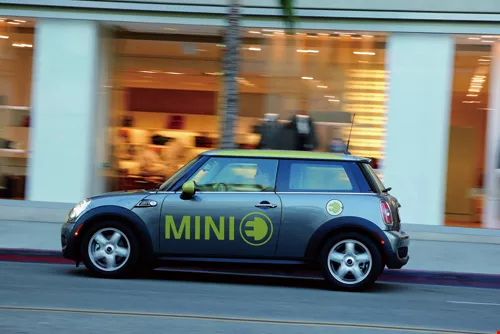
The BMW MINI E, with a classic shape, is a small two-seater designed for urban driving. It is currently being road tested in California, New York, and New Jersey. The cars are not yet for sale; customers can only lease them at present.
Why is it, then, that despite the fact that EVs can come up to speed with gas-powered vehicles in terms of performance, production volume at major manufacturers remains a paltry 500-600?
"The gas-fueled car has been in mass use for over a century," explains Lee, "while electric cars are just getting started. No manufacturer as yet has any experience with the kinds of problems EV users will face, and there is no concrete data." He adds that given these unknowns, at the current stage no one can say anything certain about future production volume. First firms have to collect and analyze all the information from field testing and solve all the problems that come up. Only then can they begin selling to consumers.
Because recharging an electric car is not as fast or easy as refueling a conventional car, and recharging times differ-from half an hour to over 10 hours depending on equipment-the relationship among recharging stations, users, and the use environment presents a completely novel challenge. For example, if you get halfway on your journey and discover you will soon run out of electricity, how can you know where the next recharging station will be? How long will you have to recharge in order to complete your journey? Is there anyone already using the recharging station? How long will you have to wait? If there is a bottleneck at any one of these links, the effect will reverberate through the whole chain.
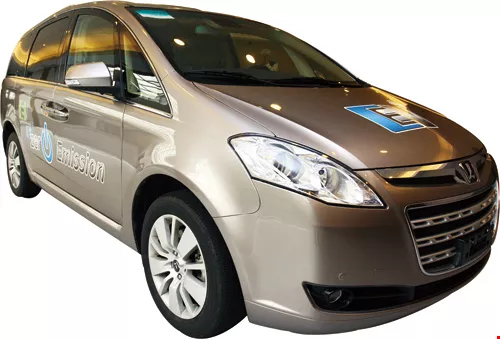
Luxgen's electric MPV is similar to comparable gas-powered vehicles in terms of speed and performance. The plan is to charge separately for the vehicle and the batteries, with the former being about NT$1.1 to 1.2 million (US$30,000 or so) and the batteries being either leased or paid for in installments.
"The core principle of recharging is that so long as a car is stopped, recharging can take place." If the vehicle is at a location where it will be parked for an extended period, like at home while you sleep or at the office while you work, recharging can be done. This takes care of 80% of the problem of recharging, because the Luxgen can go 200 kilometers on a single charge (calculated using the US Federal Test Procedure for fuel consumption in gas-powered cars), which should be more than enough to deal with the daily itinerary of a typical office worker. As for longer journeys, if there is a need to recharge on the road, this can be handled at shopping centers, restaurants, rest stops, and public or private parking lots. How will recharging fees be calculated? Current plans for public recharging spots call for combined calculation of parking and recharge fees, which consumers can pay using credit cards or the Taipei Metro's Easycard stored-value payment card.
Will this kind of scheme suffice to meet users' needs? In order to ensure that it does, there will have to be field testing and adjustments. Lee reminds us: "Only when EVs have been tested in daily use and all kinds of customers feel satisfied under all kinds of extreme conditions, will manufacturers be able to begin selling EVs to the general public with complete confidence."
According to the EV strategy laid out by the Ministry of Economic Affairs, there will be a first phase involving three years of field testing (2011-2013) in 10 regions across Taiwan, with subsidies for 3000 EVs. As for which 10 areas will be selected, this will depend on proposals made by local governments and corporate groups. In the second phase, (2014-2016) the program will be expanded islandwide.
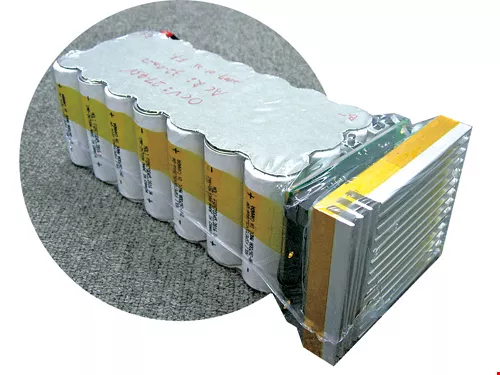
Under the hood of Luxgen's electric SUVs, an electric motor and electronic control system have replaced the internal combustion engine, while more than 6000 batteries are tucked underneath, resting on the car's frame.
Another key to mass commercialization of EVs, besides range, speed, performance, and recharging, will be to ensure an adequate supply of batteries.
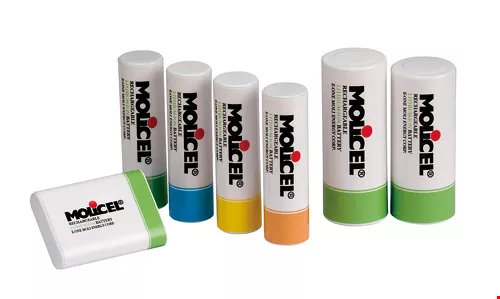
As Lee demonstrates, if even only 1% of the 70 million cars bought annually around the world were EVs (i.e. 700,000), and each car (assuming small cars only) used only batteries consuming 20 kilowatt-hours of electricity at full charge, the total battery usage would be roughly equal to all the cellphones and notebook computers in the world. Imagine what demand will be like when the market share of EVs reaches 5% or 10%! Yulon president Chen Kuo-rong has noted that the total annual production of Taiwan's largest maker of vehicle batteries, E-One Moli Energy Corporation, which is 100 million batteries per year, could only supply 16,000 electric vehicles. That's a long way off from the government's plan to produce 60,000 electric vehicles a year. Therefore the government should come up with some policy to deal with this issue so that carmakers can have peace of mind when deciding whether to invest in expanded production.
However, when demand expands, it is very possible that there will be further progress in battery performance.
There are many different kinds of EV batteries around, with each having its advocates and special advantages. Right now, Yulon is using Li(NiMnCo) batteries (lithium plus nickel, manganese, and cobalt). "The best thing about these batteries is that they have high energy density and are small in size. But they are relatively unstable, meaning that they are more susceptible to exploding due to shorting out," says Lee. In contrast, the C-LiFePO4 (carbon-coated lithium iron phosphate) battery being developed by Pihsiang, a major Taiwanese manufacturer of mobility devices (such as four-wheel electric scooters for the elderly, electric wheelchairs, and power-assisted bicycles), is much more stable; however its energy density is only 60% that of a Li(NiMnCo) battery.
"Energy density determines battery size and range per recharge, and is the most important consideration for us." Lee explains that energy density is power divided by volume. The higher the density, the smaller the volume per given amount of power. This means that Yulon could alter the rather clumsy current design requiring squeezing more than 6000 batteries into the frame of the vehicle. Higher density for any given volume would also allow longer journeys on a single recharge.
"From the point of view of the battery maker, naturally safety comes first, after which they consider performance and then cost. But from the carmaker's point of view it is only logical to give the highest priority to performance." If, for example, SUV batteries that take five or six hours to recharge can only go 40 kilometers or so, consumers won't be satisfied no matter how safe the battery is.
As for the problem of instability, "It's like having a hyperactive child at home: so long as the child is properly handled, there is not necessarily any danger, and they may even exceed your expectations." In this respect, Yulon is relying on its design of the battery arrays and its battery management system.
Under the hood of Luxgen's electric SUVs, an electric motor and electronic control system have replaced the internal combustion engine, while more than 6000 batteries are tucked underneath, resting on the car's frame.
Lee's opinion is that "Taiwan has many advantages in developing the EV industry." In his view, Taiwan started too late in developing traditional internal-combustion-engined vehicles, when the opportunity had already passed. But given the energy revolution and the reshuffling of the deck in the global automotive industry and its supply chain, Taiwan has a new chance. In fact, key parts in both the Tesla Roadster and the MINI E have been developed by Taiwanese firms (the motor is supplied by Fukuta and the Gongin Precision Industrial Company, while the controller device comes from Chroma ATE Incorporated, and the batteries from Pihsiang Energy Technology Company [PHET]). This means that Taiwan has a technological lead over its competitors elsewhere in the world.
Secondly, the development of EVs requires advanced IT technology, which is Taiwan's strong suit. Cloud computing will be essential to solving problems for drivers, especially with respect to recharging: Where is the next recharging station? How far am I away from my destination? Do I have enough time to get a cup of coffee after lunch, or is my car's recharging already complete? This kind of information can be accessed by intelligent gear on board the vehicle or via the owner's cellphone or notebook computer.
Third, Taiwan's environment is highly suited to EVs. Taiwan is small, and through trial operations recharging stations can be set up across the island. Also, environmentally minded consumers here are highly receptive to electric vehicles. And when you add in government incentives (such as the free parking and free recharging that Taipei County are thinking of offering), it will be even easier for EVs, which after all will require a major lifestyle transformation, to gain wide acceptance.
"But these advantages won't always exist," says Lee, identifying the crux of the problem. Because major car manufacturers around the world are developing EVs, Taiwan has to seize the next two or three years to spread EVs to the mass market, and get into high-volume production. Besides upgrading the technology, costs must be rapidly reduced in order to seize market share and maintain competitive advantage.
"Once EVs are in wide use, the whole business model, including the supply chain, recharging methods, cloud centers, and battery operations, can be reproduced, and at that point people all around the world will be looking to Taiwan."
Facing the coming of the EV era, in mid-April the Executive Yuan approved an action plan for developing intelligent electric vehicles. NT$9.7 billion has been budgeted over the next six years in five areas: field testing, creating a user-friendly environment, offering buyer incentives, setting environmental standards, and providing guidance to the industry.
So what does Lee think of the "beef" the government has come up with? He is basically positive, but still feels that, considering that the EV industry is starting from zero and trying to grow from tiny production volumes to mass production, the incentives being offered are inadequate. But as time presses in, something is at least better than nothing. Yulon will continue to push forward, hoping that infrastructure like recharging stations and cloud centers will be in place within three years. At the appropriate time policies can be adjusted, and Taiwan will still have a good chance of coming out in front.
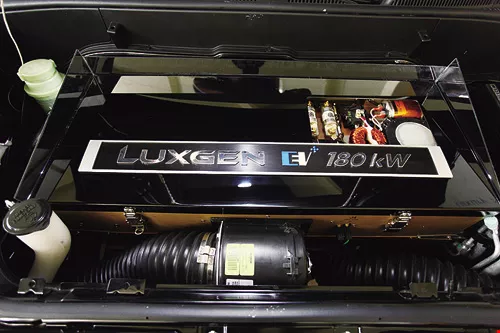
Besides having the benefits, like all electric cars, of producing no emissions and making only a small amount of noise, the Luxgen EV+ also comes with intelligent on-board electronics, allowing linkage with a cloud network to find out, for example, information about recharging stations in your area.
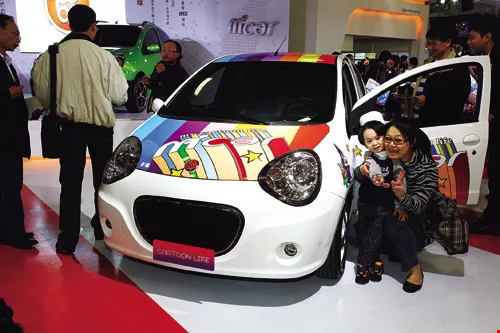
The Tobe M'Car was developed jointly by Yulon and mainland China's Geely Automobile, as an upgraded version of the Geely Panda. An electric version is now available, and with a sales tag of NT$500,000 to 600,000 (not including batteries), the price should be competitive.
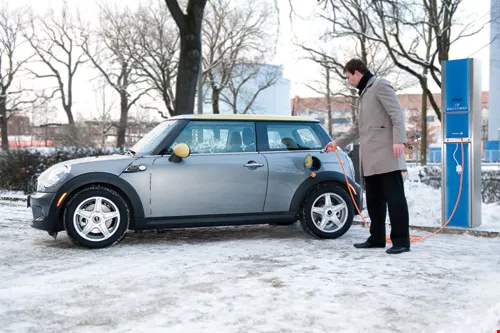
There are two ways to recharge electric vehicles. For the first, which is slower, recharging can be done at home or anywhere else in the normal 110 or 220-volt power grid. The other way, much quicker, requires a special socket (about 400-500 V). The photo shows the MINI E at a dedicated charging stations.


@List.jpg?w=522&h=410&mode=crop&format=webp&quality=80)


定稿-1@List.jpg?w=522&h=410&mode=crop&format=webp&quality=80)
