Sensory Therapy-The Answer to Your Economic Blues?
Lin Hsin-ching / photos Hsueh Chi-kuang / tr. by Phil Newell
February 2009


"She says, let's have Valentine's Day early this year, and a few extra roses never hurt anyone.... She says that the seats in the luxury lovers' boxes at theaters are not as soft as my shoulder.... She says, sometimes staying at home with me is more romantic than going out anywhere...."
This is the track from an advertisement called "Use 'love' to beat the recession" put out by PayEasy, the biggest women's online shopping site in Taiwan. The handsome guy and beautiful girl, in a romantic setting with touching voiceovers, enabled it to win the "most popular" award in the "Happiness Advertising" contest sponsored by the Taiwan Public Service Advertising Council.
In these days of economic recession, which have been characterized as the era of the "three lows" (low interest rates, low salaries, low confidence), everywhere you look there is bad news, and many people have accumulated a whole barrelful of frustration, disillusionment, and stress. "Healing series" goods and services (the term comes from Japanese) like this advertisement can bring a temporary sense of happiness, and go against the rising tide of the times. The "healing series" economy, which we might also call the "therapeutic economy," has not only the supplanted the recent discourse on the "M-shaped society," it has become an important new trend in the consumer market.
The therapeutic economy provides "hand warmers" during an economic ice age that allow people to temporarily put their troubles aside. In fact, "healing" has proved even more effective than PayEasy's "love" as a force for combating the recession, with healing-series products generating eye-catching returns against a backdrop of withering sales for other kinds of consumer goods.
Ms. Chen, who began studying classical music as a child and is now a music teacher, suddenly fell into a nightmarish dark mood back in 2005. Each day when she opened her eyes she felt as if her heart were weighed down by a lead block, keeping her pinned in depression, with little interest in talking to people or going out of the house. Even listening to or playing Bach and Mozart, her favorites, could not carry her out of her profoundly unhappy state.
Then, at a gathering at a friend's house, Ms. Chen happened to pull off the shelf a CD of Tibetan spiritual music-Sweet Melody of Joyful Aspiration, by the 17th Gyalwa Karmapa, Ogyen Trinley Dorje. She never expected that it would open for her a pathway out of her seemingly inescapable negative emotions.
"After just a few notes, I felt like I was being carried away, as if my soul were flying out of my body, floating upwards. I had never felt anything like it before. I borrowed the CD and listened to it over and over at home. Then I cried and cried for a long time," narrates Chen. "My depression seemed to be greatly relieved by the whole process."
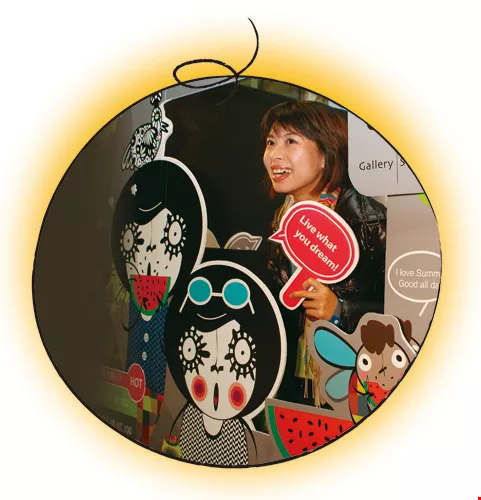
Although tickets for UniPresident's Simple Life Festival were not cheap, because the show featured a number of singers that represent the LOHAS spirit, it still attracted nearly 50,000 people.
Healing hits its stride
The scene for Ms. Chen's sharing of her musical healing experience was a press conference sponsored by Wind Music, which mainly markets New Age music. In January 2001 the company came out with its Zen Relaxation series of products. As well as inviting Ms. Chen to the product launch, they asked researchers at the Industrial Technology Research Institute and psychological counselors to discuss studies demonstrating that "listening to music definitely is helpful to relieving stress."
Although the price for the boxed set of therapeutic music is rather high at NT$1950, R&D director Liang Hsiu-ting argues that in a time of economic turbulence people will feel more troubled and dismayed than usual, so they need music to be relieved of their sadness. Therefore she is quite optimistic about the product, expecting to be able to sell at least 10,000 sets by the end of the year.
Liang's confidence is by no means unfounded. In fact, since the economy began turning sour in the second half of 2008, there has been a surge in popularity of products that claim to have physical or psychological benefits.
One example is the Self-Help and Spiritual Book Exhibition held in October 2008 by online bookstore Books. com.tw. Within less than a week after the event began, they already had more than 10,000 online purchases of related books and audio or video products.
Also, in 2008 total sales of online games, for which the appeal is based on "having a lot of fun without spending much money or having to go out," broke through NT$10 billion for the first time. Other goods and services that are connected to the idea of emotional reassurance or relief-such as fortune telling, professional counseling, and collectible figurines and toys that are either very cute or good for venting stress, as well as large-scale outdoor activities that can take one's mind off of daily life for a while-have all prospered in this recent stretch of time.
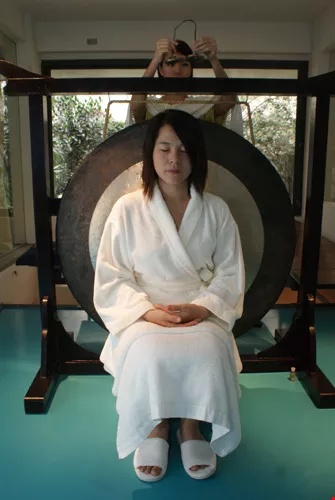
This is Canjune's "calming gongs" therapy, usually performed before an aromatherapy session. The penetrating sound of the gongs helps clients to free their minds of extraneous thoughts and set aside their worries, to achieve true relaxation.
That's the way the bubble bursts
It is not only in Taiwan that the "therapeutic economy" has brought business opportunities. Huang Jennjia, who teaches in the Department of Mass Communications at Tamkang University and who has done research in consumer anthropology in Japan, explains that this concept originated in that country, and that it refers to goods and services known as "healing series" products. This suggests the application of medical ideas from physical therapy to recovering from psychological injury, to relaxing, and to increasing stress resistance.
Huang relates that Japan is the most socially organized and urbanized country in the world, and Japanese culture is relatively introverted and repressed, with particular emphasis on self-discipline and group conformity, so that there is a great deal of accumulated stress. This may be why Japan has long had izakaya, karaoke, and pachinko, where people can appropriately dissolve the pressures of work and feelings of melancholy in drinking, belting out some tunes, or losing themselves in the mind-numbing cacophony of a pachinko parlor.
In the early 1990s, Japan's high-growth "bubble economy" suddenly burst, sending the country into economic doldrums lasting over a decade. Such a dramatic change was a serious blow to Japanese psyches. In response, "healing series" products claiming to help put people's minds at ease came to prominence, helped by strong coverage in the media.
Huang Jennjia points out that today "healing" claims are advanced for products in virtually all aspects of life in Japan, including attire, dining, housing, transportation, and entertainment. One example-perhaps the prime example of warm-and-fuzzy TV advertising-was an advert for the Shinkansen (high-speed train) of Japan Railways. Featuring detailed and beautifully filmed symbols of Kyoto such as cherry blossoms, maple leaves, and traditional buildings, the ad was so moving that people mired in the pressures of everyday life could hardly resist the temptation to spontaneously order a ticket and go on a trip.
In the basements and on the roofs of the train stations along the Odakyu Electric Railway there are many privately run "urban gardens." These give people who have been cooped up in an office all day the chance to get in touch with nature and work off some stress through physical labor.
"In Tokyo you can even find places called 'oxygen bars.' The decor inside is like a high-class salon or spa, very fashionable. Customers can sit in luxurious chairs under soft lighting and read or just relax, all the while taking a hit from an oxygen mask whenever they want. They are quite popular," says Huang.
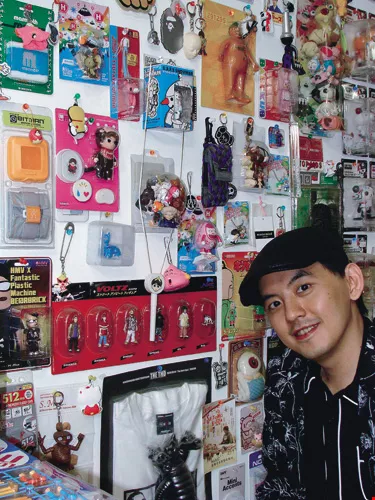
The well-known TV program host Mickey Huang not only collects toys and action figures, has had a tailor-made cabinet built for some, and has others hanging all over the walls. It is this childlike innocence that allows him to keep coming up with surprises in his professional career.
I hurt therefore I shop
Goods and services under the "healing series" name first came into Taiwan in about 2000. Although they had stable support from a given group of consumers, they remained far less popular than in Japan. It was only when the global financial storm cast a sudden chill over the economy in 2008 that products advertising themselves as therapeutic steadily grew into a popular trend. Not only are they a new force to be reckoned with in the consumer market, they have become a cultural phenomenon that is getting a lot of attention.
How can shopping for certain products bring people peace of mind, and relieve anger and insecurity? Huang Jennjia says that from the perspective of consumer psychology, buying is a way in which some abstract concepts can be put into concrete form. When a certain product is endowed with or associated with a particular meaning, buying that product becomes a method of physically connecting with that meaning.
He says by way of illustration that roses and chocolate are often associated with "love," so they are seen by both givers and receivers as conveying this meaning. By the same logic, healing products are associated with a sense of peace and well-being, so people do in fact connect to that concept by acquisition.
Psychiatrist Billy Pan of Wan Fang Hospital says that in fact almost all economic activities not related to the essentials of daily life (food, clothing, housing, transportation) have some effect in terms of relieving stress, healing psychological wounds, or improving mood. It's just that when the economy turns sharply for the worse, people need to cut back on random extravagance, yet they are already accustomed to using consumption as a mood enhancer, so they end up focusing their spending on products specially endowed with therapeutic significance.
"When you get right down to it," says Pan, "it's also a kind of worship of the latest fashion."
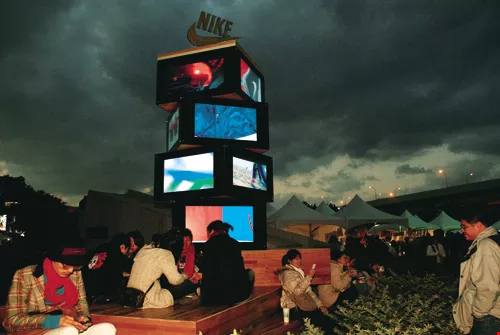
Economic recession brings lots of stress, resulting in popularity for "therapeutic" products that promise a sense of well-being. The photo shows a "Simple Life Festival" event sponsored by the Uni-President Group.
Sensory therapy
Of all the various healing series products out there, the ones that have the most direct effect, and are most easily acceptable to people, are those that achieve their psychological impact through one of the five physical senses: hearing, vision, smell, touch, and taste.
Visually, you can find examples among entertainers or celebrities. Huang Jennjia points out that entertainers who have been pigeonholed as "therapeutic" are normally not the glittering, sexy variety, but people with refreshing and approachable looks, who always have a smile on their faces, and who make people feel comfortable.
A classic example of a "therapeutic" celebrity would be Teresa Teng, whose gentle voice and friendly smile face captured the hearts of countless fans across Asia. As for more recent arrivals, he says that Lin Chih-ling, Taiwan's top fashion model, has that "girl next door" look.
In terms of olfactory effects, recently powerful and expensive perfumes have been on the way out, while natural aromas like herbs and flowers have been gaining acceptance. For example, aromatherapy, which has been quite popular in recent years, uses essential oils distilled from plants for incense burners. Going one step further, the senses of "smell" and "touch" have been combined in the use of essential oils in massage.
One of the most representative operations in the aromatherapy industry is Canjune, well known among Taiwan's office workers and among Japanese tourists to Taiwan.
When you walk into a Canjune shop, the whole room is filled with greenery and flowers, and your nose is met with a refreshing orange fragrance. Coming straight in from breathing city dust and smog, in an instant the pressures that have coagulated over the day seem to melt away. Before the treatment begins, the therapist plays a little game derived from the common practice of Taiwanese parents of placing a variety toys before an infant in the belief that the infant will select a toy that subconsciously reveals what profession it will be most suited for as an adult. At Canjune, the therapist brings out tens of bottles of essential oils for the customer to select from, without telling the customer which oil has which claimed effect. The selections by the customer are said to reveal the subconscious troubles by which she or he is vexed.
Daphne, a regular Canjune customer, wrote on a blog that for a time she just couldn't get to sleep. But after she went to Canjune and randomly selected "CT6" essential oil (the main ingredients of which are sage, petitgrain, and lemon mint), which promises to be restful and soporific, she enthused: "It was right on the money!"
Canjune general manager June Wen says that in the process of selecting oils and relaxed, heart-to-heart conversation with the therapist, the customer will often, without even realizing it, reveal the sources of their stress and their physical and psychological condition.
Wen explains that aromas can directly enter the brain's "peripheral system." This area of the brain not only has the hypothalamus that controls pituitary hormones, it also controls mood. Therefore, the most direct method is to use fragrances to affect the operations of the brain.
Although aromatherapy can be expensive, with the procedure at Canjune costing from NT$1600 to NT$6000, because it can rapidly relieve anxiety and stabilize emotions it is very popular among office workers between 30 and 40 with a sound income. In 2008, though the economy was in a downturn, Canjune still had growth of between 10% and 20%.
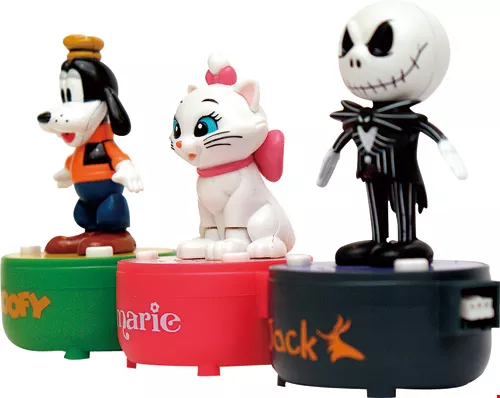
These tap-dancing toys modelled on Disney cartoon characters leap into life at the touch of a button and rattle of a routine to bring a smile to your face.
Meadow music goes mainstream
Music, which appeals to the sense of hearing, is another widely used stress reliever. Besides the New Age, world, ethnic and spiritual music forms that most people are familiar with, even in the pop-music market the "healing style" is starting to make an appearance.
Well-known music program host Mickey Huang notes that there have always been so-called "healing singers" like Winnie Hsin and Fish Leong, or the early singer Chen Shuhua (known as a "spokesperson for the urban woman"). When you were lovelorn, hearing their songs would always give you a feeling of shared experience.
"But these songs were generally only about romantic problems. For example, if you were heartbroken and heard Winnie Hsin's 'Such a Painful Realization' you would get an especially strong feeling. But in terms of dispelling the little frustrations of everyday life, the New Age music that has become popular in recent years has the most therapeutic effect," avers Huang.
He points out that "grassy meadow music," as this genre is known in Chinese, literally means "music that makes you feel as if you are listening in a grassy meadow." The tempos and rhythms are moderate, the voices inclined toward the soft and gentle, and the subject matter depicted in the songs is mainly positive and sunny. The images projected by the singers also differ from the flash of pop idols; usually they appear on stage in jeans and t-shirts with just a few guitars.
"Grassy meadow" music seeks to give the listener a stress-free listening experience. Among the representative groups and singers working in this genre in Taiwan right now are Cheer Chen, Sodagreen, Natural Q, 929, Bear Babes and Nylas.
Mickey Huang opines that grassy meadow music will become more popular during an economic downturn. For example, at the "Simple Life Festival" sponsored in part by Uni-President Corporation in November of 2008, a large number of singers working the grassy meadow genre were invited to perform. Even though the tickets were NT$1200 each, tens of thousands of people attended.
Also, the concert held in the Taipei Arena in January of 2009 by Cheer Chen was sold out within 48 hours of the tickets going on sale. "Even Jay Chou can't hope to move tickets that fast," laughs Huang.
Besides therapy that directly appeals to the five senses, other goods and services that can have a curative effect for consumers fall into one of three approaches: temporarily taking the individual off the beaten track; trying to provide an answer; and connecting the consumer to emotive personal or collective experiences.
The best example of going off the beaten track is computer games. In the non-stop course of smashing through obstacles, fighting monsters, and seeking treasure, game-players enter a different world where they can forget the troubles of the real world.
In terms of "seeking to provide an answer," fortune telling, tarot readings, and psychological counseling all have the function of providing direction to the lost. They become tranquilizers craved by the public when people are flustered and confused and don't know where to turn.
United Counseling Center founder Alan Chou relates that since the global financial storm touched off by the collapse of Lehman Brothers in the US in the fall of 2008, many financial and high-tech firms have come to them to ask for classes in stress relief and mood control for employees. Business was up nearly 30% over the same period in 2007.
Chou points out that psychological counseling courses allow these people to get some relief by commiserating with others in a similar predicament, so that they don't feel so alone. The courses also offer practical suggestions to help them through their troubles.
"For example, a lot of high-tech people were formerly so busy that they neglected their families and health, so you tell them that a leave without pay is in fact a great opportunity to take a breather from work," explains Alan Chou, "Sometimes just changing the way you look at things opens up whole new horizons."
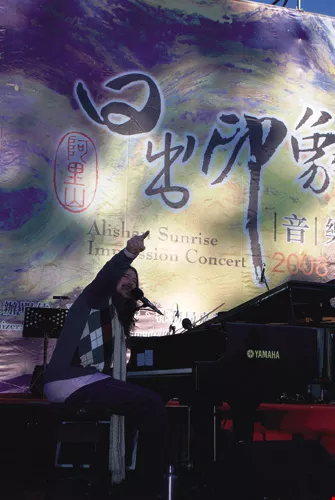
The Alishan Sunrise Impression Concert, now entering its seventh year, this year invited Canadian New Age artist and environmentalist Matthew Lien to provide the musical backdrop to the rising sun, hoping to bring some light and hope into the lives of the Taiwan public as it struggles through an economic downturn.
Tapping into memories
In times of economic distress, comedies often become the mainstream of film, stage, and other forms of popular culture. For example, during the Great Depression in the US in the 1930s, movies in the genre of "screwball comedies" really hit the big time, because people who were crushed by the weight of daily life needed comedies to give themselves something to smile about, however temporarily.
Today, many decades later, in the face of an economic storm no less severe than in the 1930s, although comedies are still the mainstream coming out of Hollywood, the leading roles are those of ordinary office workers and couples. The reason is that in a downturn, nobody wants to see the extravagance of the upper classes. But light comedies that are close to real life have a better likelihood of giving people hope.
But besides comedies, even more perceptive works of a healing nature are able to tap into the common memories of, and find resonance with, large numbers of viewers, and to touch them deeply through a combination of laughter and tears. The most popular domestically produced films of 2008-Cape No. 7 and Orz Boyz-are representative of this.
The former depicts the complex relationship between Taiwanese and Japanese, and illustrates the feelings of a person from southern Taiwan who goes to Taipei to seek his fortune but returns to his hometown in disappointment. Many people with similar experiences were deeply touched by the film. With the addition of the simpler human touch that characterizes the people of southern Taiwan and the beautiful scenery of Hengchun and Kenting, the whole thing had the effect of taking people away from the less-than-ideal present. Thanks to nothing but word of mouth, the film miraculously took in NT$520 million at the box office.
Orz Boyz tells the story of two mischievous and imaginative young boys, depicting their friendship through humor and absurdity. It evokes viewers' memories of childhood innocence and romance.
Mickey Huang, who is full of praise for Orz Boyz, says: "Watching this movie made me think of my grandmother, who has been dead for many years, and also of childhood and my gang of friends. Something like that which can make you laugh and cry at the same time, and is filled with nostalgia, offers a kind of reassurance and comfort that is impossible to put into words."
Whether it be sensory therapy, or goods and services that draw on memories, offer explanations, or create imaginary worlds, perhaps, given the commercial operation of capitalist society, it is only natural that consumption is one of the most convenient and effective options to turn one's mood around.
In this winter of our economic discontent, when most industries are going into hibernation, the "healing series" industry seems to have clear skies ahead. Although these products that bring a sense of well-being may just have a temporary band-aid effect, at least they provide a breather to find the strength to get up and get moving once again. As for the future, will they just blow away with the first warm wind? Or is this their chance to set down firm roots? It depends on whether those in the industry can correctly gauge the pulse of society, and keep coming up with an endless supply of creative ideas to touch people's hearts.
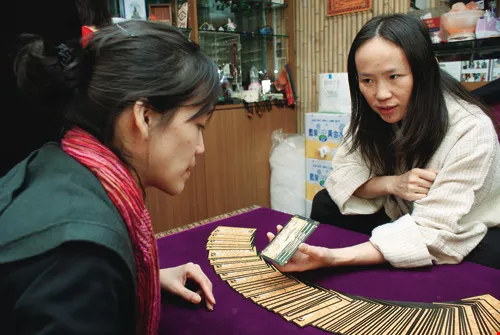
In a period of uncertainty and insecurity, business booms for tarot readers, fortune tellers, and psychotherapists. The photo shows Rafica, a well-known tarot reader in eastern Taipei City, giving a reading to a customer.
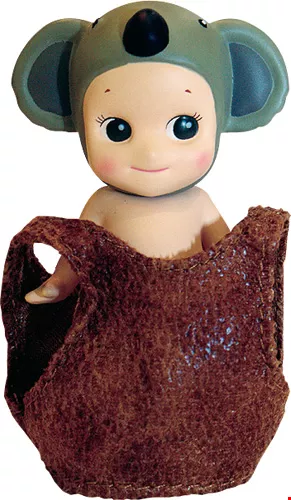
"Sonny Angel," from Japan, has big lovable eyes and an innocent childish smile-enough to perk up your spirits as soon as you look at him. He is pictured here in his koala bear costume.


