

With the rise of instant messaging, many office work-ers now spend big chunks of time chatting away online, which undermines productivity. But business owners are also worried that the use of instant messaging and other peer-to-peer data transmission software can facilitate the leaking of confidential information.
One solution to the problem is the corporate firewall products developed by L7 Networks, a company headed by 29-year-old Wei Huan-yun.
The entrepreneurial young Wei has created technologies to help bosses manage their employees, yet he himself is not one to be fenced in. Indeed, Wei has benefited from generous support over the course of his development--from his parents, teachers, and investors. In high school he took up electric guitar, wrote song lyrics, and started up a band. An avid traveler, he once drove all around Turkey. From his days at Chien Kuo High (the top boy's high school in Taipei), companies in Taiwan bankrolled his entrepreneurial ventures as he made his way through school and into PhD studies at National Chiao Tung University (NCTU).
Wei firmly believes that "youth should be lived full throttle." And make no mistake--his youth has not gone to waste.
The 30 or so employees at L7 Networks aren't big on wearing ties, and the boss doesn't work in a fixed location. The employees' lounge has electric guitars and a set of jazz drums. When he's in the mood, the boss shares drum playing tips with his employees. It's an unusual scene, but those familiar with Wei Huan-yun only smile as if to say, "That's just the way he is." Wei himself doesn't beat around the bush: "If I had half the talent of Glenn Tipton, I'd leave this all behind in a heartbeat and go play music."
But he didn't take that route. At the Hsinchu Science-Based Industrial Park, a mecca for tech whizzes and a melange of other extraordinary talents, he doesn't really stand out from the crowd. Recent graduates from top universities at home and abroad flock to Hsinchu in pursuit of fat paychecks and generous bonuses in the form of company shares.
The only unusual thing about Wei is that here in Taiwan, where young high-tech CEOs are a rarity, he is one of a fortunate few in his age group able to rely on market-proven technical prowess to attract deep-pocketed funding for his business venture.
The story begins with Wei as a young student fighting to read his way through a mountain of academic papers.

Wei Huan-yun, an entrepreneur still in his 20s, has been able to open his own business at the Hsinchu Science-Based Industrial Park, which is a magnet for high-tech talent in Taiwan. Knowing that he is extremely fortunate, he cherishes the experience.
Solving real problems
Always a successful student, Wei originally thought upon entering grad school in the Department of Computer and Information Science at NCTU that he was headed for academia, but he made a discovery during the course of long hours in the labs and libraries: "Most thesis papers are baloney. They don't solve real problems."
But training in computer science can be applied in any number of ways. It takes a lot of exploration to pick a pursuit. While at NCTU Wei poured himself into the study of hot IT-industry topics, working together with lab mates in such fields as cable television, wireless telephony, and broadband networks. Wei eventually decided to concentrate on network security, and used the ITRI-NCTU Network Benchmarking Lab to hone his skills. "The people there were all the cream of the crop. To use a martial arts analogy, it was like sparring with the top fighters in the country."
In 2002 he and six buddies took part in the TIC100 Technology Innovation Competition organized by Advantech Foundation. Their entry--a network firewall at the cutting edge of global technology that offered protection at all seven layers of the network as opposed to the usual three-layer protection--took grand prize honors. In November of that same year, Wei's team ventured beyond the ivory tower to face real-world competitors in the first National Business Start-Up Award contest, organized by the Ministry of Economic Affairs. Wei and his cohorts beat out many entries from strong industrial firms to take third prize.
Firewall technology has raced ahead by leaps and bounds in tandem with the spread of networks. Wei's team was a formidable competitor despite its newcomer status, and attracted close attention in the market with its combination of high performance, high efficiency, and reasonable prices. Network technology players D-Link, ZyXEL Communications, and Advantech all expressed interest in hiring them.
Given Taiwan's position as a global leader in the design and production of broadband modems and LAN switches, development of network equipment has a direct bearing on maintaining Taiwan's international competitiveness, and network security is a key link in the chain. For various reasons, it was clear that big things might well be in store for Wei's technology.
"Back when I was just getting started on my PhD dissertation, those companies were already wanting us all to go to work for them," recalls Wei. But he was getting more and more excited about the dream of starting a business of his own.
Wei stuck to his venture startup plans, and several companies eventually put up NT$60 million in capital for him to go into business. They were gambling that Wei's fledgling technology would solve a lot of people's problems.
The market didn't react with the expected enthusiasm, however, when the company was founded in 2003. By the following year, the initial investment capital was almost all spent. Pressed to write his dissertation and grow the business at the same time, the once-confident Wei watched as the company ran out of money and his founding partners one by one jumped ship.
Having cast aside a regular work desk for a set of jazz drums, this young boss has his own new style.
Betting the farm
In two short years, Wei leapt from the commonplace into the clouds before falling onto hard times. Always the cock of the walk from an early age, he couldn't understand why people weren't buying a product that everyone had been so high on.
Wei had never caused his parents any worry, and always demanded much of himself due to his family's unusual circumstances. Wei's parents, both government employees, placed all their hopes on him because his older sister suffered from mental retardation and his older brother from mental illness. The hopes of others pushed him to excel, but with his business venture foundering, those same hopes exacerbated the pressures upon him.
Fortunately, Wei's financial backers had all been through entrepreneurial hardships of their own, and furthermore knew quite well how quickly fortunes can turn in the networking industry. The board of directors wasn't at all fazed. They simply sat down with Wei and convinced him to redefine his market niche. The company reworked its product line, shifting away from multifunctional products and going instead with low-price, easy-to-install items targeted toward small- and medium-sized businesses wanting to buy network equipment without investing much cash or time.
Zeroing in on the threat of productivity losses and information leaks posed by increasingly popular instant messaging systems, L7 Networks took the traditional approach to firewalls and turned it on its head. Instead of focusing on "keeping the bad guys out" (i.e. intercepting incoming viruses), the company turned its attention to strengthening internal management and enhancing productivity.
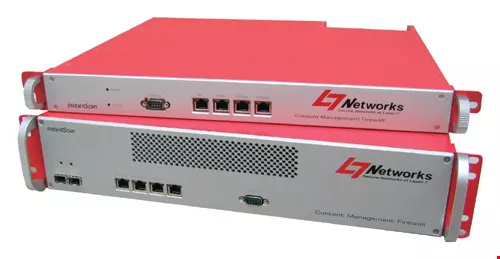
Wei started to turn the company around in the second half of 2005 with the launch of the InstantScan Content Management Firewall, a product that manages inbound and outbound traffic on a company's intranet while performing chat recording.
"Let's say you buy from one of our competitors," says Wei. "If your company has 100 computers, you have to install the product on all 100 machines. But if you use InstantScan, you only need to install it on one computer, and you can make all the settings in one quick session, so it's convenient and inexpensive." Among the various versions of InstantScan offered by L7 Networks, the biggest seller is InstantScan-100 (for companies with up to 100 computers).
After launching its new product in 2005, L7 Networks saw its sales figures begin to climb. The company eventually posted NT$28.5 million in operating revenues for the year, with the figure expected to hit NT$100 million in 2006, so L7's backers will have no problem recouping their investment.
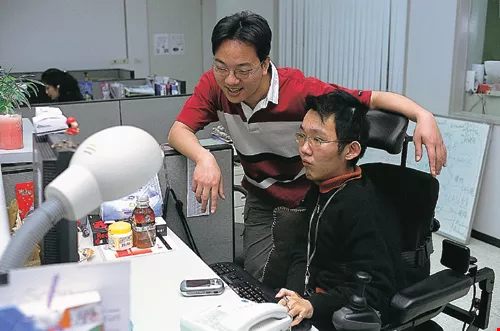
As well as competing, you have to give something back! By employing a graphic and website designer with severe physical handicaps, Wei Huan-yun, who himself comes from a difficult family background, takes positive action to help disadvantaged people earn their own living.
Just the beginning
Having gotten through three tough startup years, L7 Networks can now look to the future.
Says Wei, "Plenty of young people in the US, Japan, Europe, and mainland China have started bigger businesses than we have. We're up and running now, but we haven't yet achieved success. If we're going to succeed, we've still got more work ahead of us."
L7 Networks Fact FileEstablished: September 2002Capital: NT$90 millionTurnover: NT$28.5 million (2005)Employees: 36Main products: InstantScan range of content management firewalls.


