A decade in the making: Automotive chips and humanoid robots
This willingness to stay low and spend a decade honing its craft is nowhere more evident than in the development of automotive chips. Realtek first started working on automotive Ethernet in 2013. They were soon faced with a tightening of automotive reliability requirements for semiconductors from PPM (parts per million) to PPB (parts per billion). Yen specifically explains that previously, the market allowed a few defective units for every million sold. However, because cars sit outside exposed to the sun and rain, automotive chips must meet an incredibly high standard—only 200 defective units are permitted per billion.
Realtek dismantled and then rebuilt its entire quality-control and design systems from the ground up, implementing an IATF 16949 quality management system and functional-safety standards such as ISO 26262, while submitting to the exacting oversight of automakers. After lying low for nearly a decade, it began shipping in volume around 2020 and quickly vaulted into the ranks of major global suppliers of automotive chips.
Yen reveals, “R&D costs alone take up nearly 30% of revenue. We use profitable product lines to incubate new technologies and train our colleagues to develop a feel for technology development.”
The automotive “neural network” unexpectedly proved key to connecting the joints of humanoid robots.
Because humanoid robots need highly reliable, high-quality components to interact with people, major US and Chinese manufacturers have proactively incorporated Realtek’s automotive Ethernet, switch, USB hub, and Wi-Fi/Bluetooth chips into their robots. “A robot is like the human body. We do not make the brain, but we want to build its entire nervous system, carrying the brain’s commands to every joint and sending feedback back to the brain.”
Since getting its start with Christmas-light chips in 1987, Realtek has expanded from Ethernet and computer audio decoder chips into components for automotive applications, AI, and humanoid robots. Over nearly four decades, it has shown that when “real expertise” is maximized, even a tiny chip can take on the world. This low-profile, resilient Taiwanese crab will continue to move through the world’s neural networks, demonstrating the formidable strength of Taiwan’s technology.
“It is genuinely difficult to achieve all five,” Yen notes. After weighing the options, compromises must be made in certain areas, because a product is not made just once but continuously iterated. His words seem to echo the philosophy that enables the crab to take on the world.
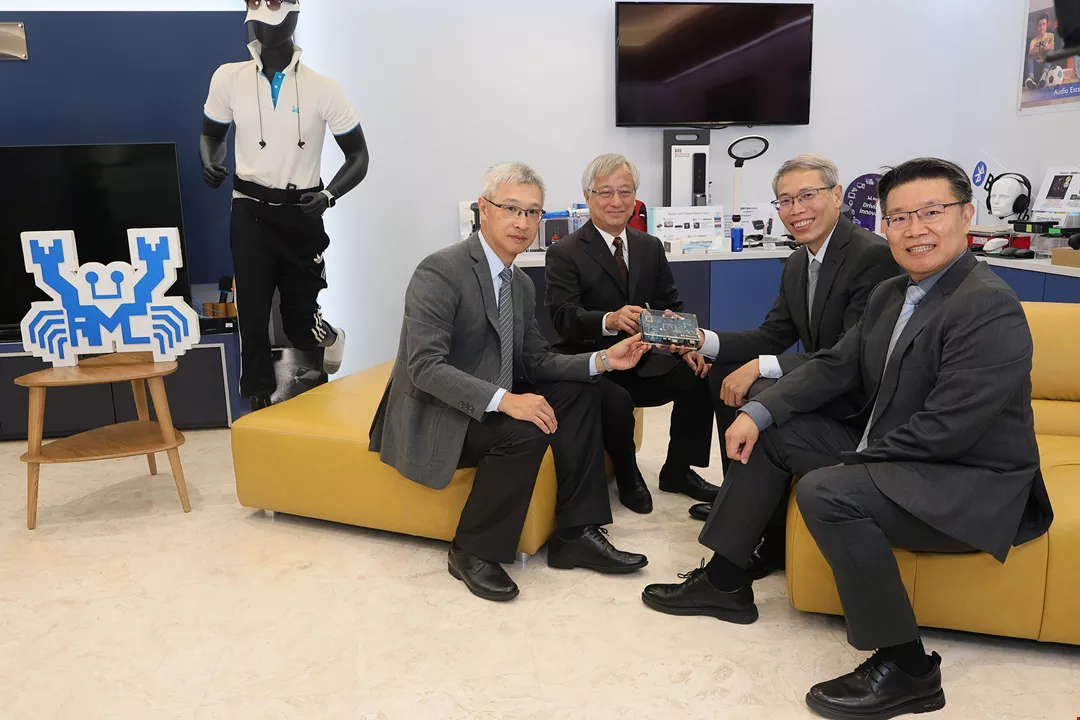
Realtek pursues innovation through two central R&D centers that efficiently integrate research and development resources. From left: Senior Vice President Lin Ying-hsi, Vice President Huang Yee-wei, President K.Y. Yen, and Vice President Yeh Ta-hsun.



@List.jpg?w=522&h=410&mode=crop&format=webp&quality=80)


