

About the size of a pizza, the V-Bot vacuum cleaner is Taiwan's first smart robot to be sold to the public. According to the International Federation of Robotics, household cleaning robots accounted for 90% of the service robot market in 2005. The next three years are brimming with potential, with sales perhaps reaching over four million units.
In the alleys of Tucheng there's an unassuming little firm, Matsutek Enterprises, which used to make air cleaners on an OEM basis specially for Honeywell. In 2002, Honeywell sold its consumer products division to Kaz, Inc., and Matsutek's CEO Jason Yan, fearing a drop in orders, urgently brainstormed for a new way forward.
"I had heard that people were working on smart vacuum cleaners. Since air cleaners and vacuum cleaners both use motors, fans and filters, getting into this area shouldn't be hard for us," says Yan. In late 2002, when the US firm iRobot and the Swedish company Electrolux started selling their smart vacuum cleaners--Roomba and Trilobite--in Taiwan, Yan snapped up two Roombas for research.
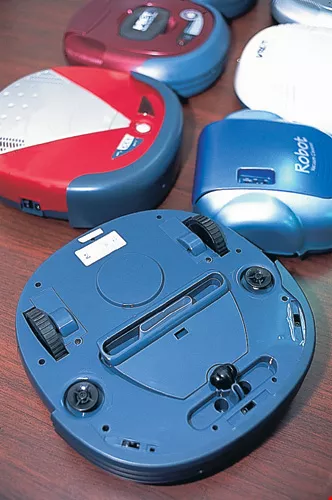
The intelligent vacuum cleaner developed by Taiwan's Matsutek Enterprises is very smart! When it runs low on power, it plugs itself in.
Starting from R&D
Yan, who graduated from the Department of Industrial Design at Tatung University, found that iRobot had over ten patents for Roomba's structure, parts, function and programming.
But at that time Yan was unsure of exactly what the patents covered, and after half a year of research he invested over NT$10 million into product development. He sent his prototype, equipped with infrared sensors similar to Roomba's, to an American lawyer to check whether it would violate any of iRobot's patents.
The lawyer was concerned about the two symmetrical infrared sensors installed in the base of Roomba's chassis and charging dock. The charging dock emits two constant infrared beams, forming a region of overlap, with which the robot can judge its position and distance from the charging dock, gradually adjusting its direction of motion before finally returning to the dock. The lawyer believed that the prototype's infrared angle sensor may be a patent infringement, so Yan, accepting the lawyer's opinion, was forced to scrap his entire scheme and start over. He switched to using an infrared parallel emission sensor that anyone can use.
Comparing the two, Yan says that the infra-red angle sensor allows accurate measurement of distance, while the drawback of the parallel sensor is that if the vacuum cleaner is cleaning a floor that's non-reflective or too strongly reflective, or if it's on a carpet with crisscrossing black and white patterns (since black makes the robot think there's an obstacle and it will change direction), the distance gauged by the sensor will be inaccurate.
"Although with iRobot's small size at that time, they may not have initiated a lawsuit, we didn't want to take any chances." Yan also filed patents for V-Bot's side brush, dust-spillage prevention and automatic obstacle avoidance designs in the US, Taiwan, South Korea and China, spending about NT$5 million. "It's money well spent, making me feel more at ease about selling in the American market."
iRobot is without doubt a leader in the field of smart robots. Rodney Brooks, robotics expert and former director of MIT's Artificial Intelligence Laboratory, founded the company in 1990 along with two of his top students. Most robots the company built over its first decade were for military purposes, as well as for space exploration and landmine clearing.
After the 9/11 terrorist attacks, one of the company's robots ventured into the rubble of the World Trade Center to search for survivors. In June 2002, a robot was sent to the battlefields of Afghanistan, searching for explosives in caves. In September of that year, iRobot helped National Geographic explorer Dr. Zahi Hawass probe into the Queen's Chamber deep inside the Great Pyramid of Khufu, using a small robot equipped with a fiber optic lens, a high-resolution camera and the world's smallest radar device, giving the world a glimpse of the history and mystery of Egypt's largest pyramid.
The predecessor of this smart robot happens to be Roomba, and at the news that its technology was used to explore the pyramids, it became a hit in the US, selling 10,000 units in the first month.

In the future, nimble, automated vacuums that can squeeze under sofas and beds will keep your floors sparkling.
Robots at work
It's worth mentioning that one of the members of iRobot's board of directors is Ronald Chwang, former chairman of AcerTech Ventures. Acer for a short time served as the agency through which Roomba was introduced into Taiwan's market.
When iRobot went public in November 2005, its market value was US$189 million. Subsequently the company released a sweeper with built-in cleaning fluid as well as a high-horsepower lawnmower.
The Swedish-built Trilobite vacuum cleaner, similar in functionality, uses ultrasonic waves to control direction. It also boasts 90 watts of suction, three times that of Roomba, but the selling price is high at about NT$70,000 apiece.
With so many brands available, lots of people are wondering if smart vacuum cleaners can actually do a good job cleaning.
Chung Yu-liang, director of the Mechanical and Systems Research Laboratories (MSRL) at the Industrial Technology Research Institute, points out that no matter what country the product is from, the path memory functions have the same three settings: "random," "back-and-forth Z pattern" and "expanding spiral." Since current interior positioning technology doesn't allow vacuum cleaners to know their absolute position, it's as if they are vacuuming blindfolded. Strictly speaking, vacuum cleaners don't know which areas they have vacuumed; that is to say, perhaps 5% to 10% of the floor will remain untouched by the vacuum cleaner, and the homeowner will have to visually inspect which areas are still dirty.
The pursuit of technology is endless, and in the constantly innovating field of artificial intelligence, the favor of consumers can only be won through devotion to research and development.
On Roomba's heels
Yan, who says he's relentlessly on iRobot's heels, points out that Roomba has sold 2.5 million units worldwide; this is in contrast to 200,000 V-Bot vacuums sold, merely 10% of iRobot's sales. But in South Korea, despite competition from similar products made by chaebol such as Samsung and LG, the V-Bot enjoys the highest market share. Besides having a sales price a fifth that of its competitors, its simple form and low clearance, enabling it to go under sofas effortlessly, are reasons for its popularity in South Korea.
Last year two side-brushes were introduced to the new V-Bot model: these are extendible, agile bristle brushes rather than the previously used rubber brushes. The width at full extension is 42 centimeters (Roomba's is 27 cm), able to get at dirt and hair lurking deep in corners. Yan also requested Professor Andrew Wo of the Institute of Applied Mechanics at National Taiwan University to improve suction, so the suction of the new V-Bot is 2.5 times that of Roomba.
Because Matsutek has manufactured breathalyzers that also eliminate bad breath, a Japanese company commissioned them to design a vacuum cleaner for pet owners, with added cleaning power for areas of the house affected by pet hair and odors.
Nowadays, the main complaint coming from users is the noise: it's hard to hear the TV when a V-Bot is running. Yan intends to use noise reduction technology developed by MSRL (ten decibels less than the latest V-Bot and eight less than Roomba), but the two parties are still in negotiations because of the NT$4.5 million patent fees.
In a short few years, cleaning robots have become household helpers, and homeowners no longer need to bend over to clean the floor; instead they can just press a button and let the robot do the work!
Weight:ABS plastickg
Features:A smart automated operating system enables it to go under sofas and beds, sweeping up paper scraps, hair, fibers and dust. When it meets walls, obstructions or empty spaces such as the top of a stairwell, it deftly changes course and continues its job. When its batteries run low, it automatically returns to the recharging dock.
Price: NT$6,000-9,800


@List.jpg?w=522&h=410&mode=crop&format=webp&quality=80)


