The War on the Dengue Fever Mosquitoes
Laura Li / photos Hsueh Chi-kuang / tr. by Phil Newell
November 1995


An innocent five-year-old girl, holding half an apple in her hand, approaches the edge of the woods outside her home. She softly calls "hoo-hoo." After a while, a rare African monkey, white and black in color, comes forward in response. Its eyes reveal wariness and fear. Hold in the apple, the little girl puts her hand out, her tiny arm fully exposed. Inside the house, her mother fights to hold back tears. If, just if, that monkey were to suddenly strike out and make even a tiny scratch on the little girl's arm, she would quickly fall victim to a fatal illness with severe internal and external bleeding.
This was a scene from the recent film Outbreak. The little girl was trying to attract an Ebola virus carrier monkey so that it could be captured. Coming back to reality, Taiwan has also been faced in recent years with a tropical hemorrhagic disease--dengue fever. Though not nearly as intense as Ebola, it is similar in nature. Yet, there is a group of people in Taiwan who are traveling around the island using their bodies to attract disease-carrying mosquitoes--and they don't even blink an eye. Known as the "mosquito raiders," they are members of the Medical Entomology Section at the National Institute of Preventive Medicine of the Department of Health.
It is one morning in early October, with the autumn sun shining down. At the start of the trail that runs behind the Le Tien Temple in Chungho City, Taipei County, there has been a dramatic drop in the number of people who have gathered for the hike up the mountain. It's because of the shadow of dengue fever. The temple used to rack up tens of thousands of NT dollars in donations on days like this, but now they are barely getting small change. Just at this moment a group of people emerges from the silent forest, of whom several are TV or magazine journalists. The one in the conical farmer's hat, dressed like a country boy, is Mayor Tung Yung-hsiung, who is being driven to distraction by the dengue fever situation.
Squeezed in the middle is a middle-aged gentleman, wearing spectacles, addressed by those around him as Dr. Lin or Director Lin. He and two other team members--not young, but still tall, solid, and vigorous--are the main actors on this day. The play they are performing is "How To Catch a Mosquito." Even as ordinary citizens avoid Le Tien Temple in trepidation, the "mosquito raiders," with great skill and courage, are advancing right into the lion's den!

(right) Got one! This tiny Aedes albopictus is the villain in the spread of dengue fever in northern and central Taiwan.
The secret of mosquito attraction
Upon reaching the entrance to the trail, the group stops and someone takes out a device for attracting mosquitoes that has just been imported from the United States. They put a piece of dry ice at the bottom, and turn the device on. The ice produces carbon dioxide, which the mosquitoes love, inviting the insects to enter the trap. At the moment, however, it is obvious that the experts are not all that familiar with how the machine works.
In fact, for three or four decades--even back in 1988, when there were more than 10,000 reported cases of dengue fever--these mosquito catchers have always gone into epidemic areas literally with their bare hands. Carrying only netting and a suction tube, they have always used their own bodies to attract their prey. Human bodies don't need to be carried up and down the mountain, they aren't going to melt on the highway, and they are more sensitive than the machine. These mosquito catching experts are actually very proud of themselves.
Everything is ready. Dr. Lin Ting-hsiang, chief of the Medical Entomology Section (MES) in the National Institute of Preventive Medicine (part of the Department of Health), who the day before had been nagging everybody to be sure to wear long pants and long sleeves, comes out in a light, short-sleeve shirt. As he chats with the people standing around, he is rolling up his pant legs to try his luck at attracting a few mosquitoes. He has worn dark clothes today--mosquitoes are fond of dark colors. But not all human mosquito traps are equally good. Mosquitoes prefer bodies with higher temperatures and faster metabolic rates, or those with a higher content of lactic acid. One of the new members of the MES, Wang Hsi-chieh, is said to have an especially "fatal attraction" for the insects.
But isn't it dangerous getting bitten by a mosquito in an epidemic area? They just laugh at this question, seeming to say that there's no point in thinking about it. Due to luck and their own sound constitutions, they have thus far not picked up any diseases from insects. Though once Chung Chao-lin, the senior member of the team, caught scrub typhus from a rat. He went straight into a rat's nest looking for specimens without first having taken tetracycline; it is said that the fever was nearly severe enough to cause brain damage.
The basic requirement for MES staff is that they be versatile. They not only have to hunt mosquitoes, but also go after flies, fleas, gnats, and more. In fact, they have to collect and study anything capable of spreading disease. It's just that in Taiwan the most serious communicable diseases--from malaria and Japanese encephalitis in the early years to the current dengue fever--have been spread by mosquitoes. So the team members are more familiar with these insects. Fortunately it is not so difficult to collect Aedes albopictus, which is the type desired this time around. It was much harder to capture the mosquitoes that spread malaria and encephalitis, for which the hunters at times had to work without rest. Working in two-person teams, one person would stay up half the night, then the other one would take a turn. They garnered a rich harvest of samples, but it was exhausting work.
Although some highly educated young talents have passed through the MES, still most of the members are old-timers with 30 or 40 years of experience. In fact they account for more than half of the seven-man staff. That's because they are they only ones who will keep this job. No one in the local level health bureaus is very much interested in being trained to do the collection work, and young hotshots who come into the MES aren't willing to stay around. These days few young people have the desire to do work that requires one to roll up one's sleeves and let a nasty, potentially virus-carrying bug penetrate one's skin--all the while having to restrain the urge to crush it with a slap of the hand.

These tombstone vases are ideal breeding places for mosquitoes. Most people avoid cemeteries, but the "mosquito raiders" plunge right in.
They only come out at night?
To catch mosquitoes, you have to know their habits and characteristics. Today we are in search of Aedes albopictus. Their long, thin legs are divided into segments by white stripes, and there is a white-silver streak on the back of the thorax. Right now it is the only known "vector" (ie carrier) of dengue fever in the northern Taiwan area.
Like the main vector of dengue fever in southern Taiwan, Aedes aegyptii, Aedes albopictus likes to feed during the day. Peak feeding hours are between 9 and 10 in the morning and also between 4 and 5 in the afternoon. After dark, feeding activities drop off sharply. The biggest difference is that Aedes albopictus like the outdoors, while Aedes aegyptii prefer enclosed spaces. Also, Aedes aegyptii does not stand up well to cold; it comes no farther north than the Chiayi area.
Despite the notoriety of these two types of mosquito, people actually understand very little about them. For example, you often see folks light mosquito-repelling incense and put up netting when they go to sleep at night. Yet they leave themselves completely undefended for afternoon naps. Recently the campus of Tunghai University in Taichung became an affected area, yet you still see October brides on the campus--wearing dresses that leave shoulders and back exposed--who want to have their pictures taken in front of the famous university chapel. Little do they know that the chapel is right next to a grass field shaded by trees, one of the places suspected of being the breeding area for the carriers. One groom even says in ignorance. "It's only at night that there are a lot of mosquitoes. But as safe during the day."
At the Le Tien Temple, the best time to catch Aedes albopictus is around 10:00 am. Not only is it their normal feeding time, with the people milling about, no mosquito would want to miss out on the feast. But you still have to be attentive, for the wind could spoil everything. On the one hand it dissipates the carbon dioxide that attracts mosquitoes to humans, and on the other it could easily blow the minuscule little insects off one's body before they get a chance to really sink their teeth in, so to speak. The ability to find a place sheltered from the wind tests the skills of the mosquito catchers.
Today, however, conditions are rather different. No one will think it strange if they return home empty-handed. That's because this whole area was sprayed with tons of insecticide after news of the epidemic came out. Everybody hangs around for a long time, but there are no signs of their prey. Obviously the insecticide has done its work.
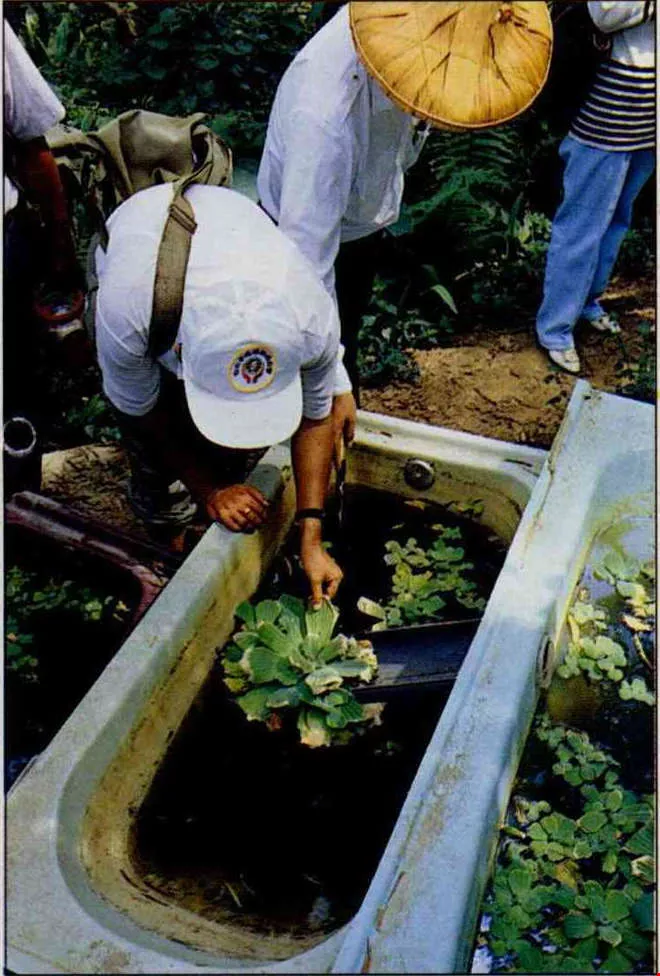
Though putting water plants in one's water receptacles won't help with household mosquitoes, it can greatly reduce the number of potentially disease-carrying Aedas albopictus. It's just that the exact way to implement this strategy and its effectiveness are still points of controversy.
The care and feeding of mosquitoes
It doesn't really matter that much if there are no adults to be had. There are still larvae to collect. As everybody is standing around chatting, two team members set off on their own. They search under trees and in dense vegetation. After a while they come back with five or six old containers-- aluminum cans, plastic bottles--which had obviously been discarded by hikers.
Their "host," Mayor Tung, looks a little shamefaced. "How embarrassing," he keeps saying. "I guess we're still amateurs." It turns out that the Chungho city government had already organized three waves of cleanup work on the mountain, including mobilizing many soldiers, for the express purpose of clearing out all such containers and eliminating the places where the larvae could incubate. Little did they expect that so much would slip through the net.
"Don't worry about it," responds Li Fu-chih, the head of the Section of Communicable Disease Prevention and Control of the Taiwan Provincial Department of Health, trying to cheer Tung up. "These guys are experts, and it is to be expected they would have special skills." Lin has a smile on his honest and straightforward face as he says, "Just let our old hands in there once and you'll really be free from worry!"
The cans and bottles, with a thin layer of dirt and decayed leaves stuck to the bottom, have been picked up, but few of the onlookers realize yet that the real secret lies in the water inside the container. The two veterans at this game open their backpacks, take out a strainer and a small handled pan, and set to work. They dexterously pour the water through the strainer, and then hold the strainer up to the sunlight. As they expected, there are several thin gray larvae, about half a centimeter long, twisting themselves into S-shapes to spring about in movements so rapid that they dazzle the eye.
With practiced hands, they take a suction tube with a rubber bladder at one end and suck the larvae one by one into the aluminum pan, where they do a preliminary check. As hoped, these are Aedes albopictus. They are put into glass jars. Later on in the laboratory the larvae will be showered with drops of a liquid mixed from powdered pig's liver and powdered yeast, giving them a nutritious meal.
This larvae work doesn't appear all that complicated. But it must be done gently. After squeezing the rubber bladder, the suction tube must be placed right up next to the larva without actually pressing down on it. When the hand over the bladder is relaxed, the larva is sucked into the tube. If the operator is clumsy, and touches the larva, it will be injured if not killed, affecting the collection effort and leaving the experts feeling a little sad.

Little Tungta Stream runs between Tunghai University and the Taichung Industrial Park. It is dark and wet by the stream, and old tires filled with water--perfect mosquito egg-laying sites-- are strewn about. It will take a lot of work to eradicate the insects around here.
A world first
Because it has always been more difficult to catch adult mosquitoes, larvae are collected instead, becoming the main means for calculating the concentration of disease carriers. This time the team only wants Aedes albopictus specimens. As for how to get the ones you want while leaving out the rest, that depends on the skills of the sample collectors.
When the subject of differentiating species comes up, in the MES--and indeed among all the mosquito experts in Taiwan--one man, Chung Tsao-lin, known as "Teacher Chung," is commonly regarded as the best. Even associate research fellow Teng Hua-jen, who came back to Taiwan with a doctorate, had to ask Teacher Chung for advice when first gathering samples. When doing field work to survey the insect populations, under the principle that the ecology should be disturbed as little as possible, the larvae are recorded and then immediately released, so it is necessary to bring a powerful microscope into the field to avoid human error.
The purpose of the arduous work of gathering larvae is not only to calculate insect density. It is also aimed at doing virus isolation after they grow to adulthood. Do female mosquitoes pass dengue fever virus on to their offspring? This question is still being hotly debated.
Of course, it is best if adults can be caught directly. The adults are kept for four or five days until they have completely digested the blood they ingested. Then they are put in an icebox for several minutes. When they are lying completely still, and barely breathing, they are quickly taken out of the fridge. (They must be kept alive or the parasitic virus in them will not live long enough to be useful.) After they are classified by sex and type, and the numbers are counted, they are crushed and the virus is cultured. It is only through this method that researchers can be sure that the virus is not a residue of the ingested human blood, and that the virus has actually taken root and propagated in the mosquito. Only this type of mosquito has the capability to spread the disease.
The dengue fever virus was discovered in the bodies of Aedes albopictus taken on this occasion in Chungho City. This provided the first ever "direct" evidence that Aedes albopictus can transmit dengue fever. In the past scientists had only acquired indirect evidence--the presence of Aedes albopictus in dengue fever areas, observing the results of injecting the virus into Aedes albopictus in the laboratory--to infer that these mosquitoes could be vectors. As a result, the US Center for Disease Control wants to send over some people to Taiwan to learn about the situation.

"Aiyah, what is this?" Many people have never had an up-close look at larvae, not to mention attempted to differentiate them according to their special characteristics.
Water, water, everywhere
The old hands have come back with a bountiful harvest from their quick field trip. Or, perhaps we should say that the reproductive ability of mosquitoes is amazing. Look at this glass jar a mere 15 centimeters in diameter. Just a casual count of the tiny bodies by Lu Liang-chen yields, "There they are! More than 100 larvae, and they can't get away!" It looks like the recent insecticide spraying, which wiped out the adults, has hardly affected the larvae who were hidden away in water. Within two weeks, the mosquito eggs mature into larvae. Then the larvae reach the pupal stage, after which the pupa develop wings and become adult mosquitoes, thus rapidly recreating the dance of the mosquitoes in the mountains.
Environmentalists have their own concerns about the recent wave of dengue fever. Every time a case comes up, the surrounding area is coated with insecticides. It is said that the impact is only transient, and that there is no residual toxicity, but still it can't but make people feel concerned. In fact, the place to start to thoroughly eliminate the mosquitoes and their family lines is to clear away water. As Lu says, after finishing up his collecting for the day, shaking off his hands and dumping the water out of the can he is holding into the grass, "once the water is gone, the larvae naturally die off."
If you've got a container that you aren't using, but don't want to throw away, leave it upside down. Or put a cover on the water containers that you are using, so that mosquitoes can't come down to lay their eggs. Environmental and health agencies at all levels have been making themselves hoarse telling people to "do their bit," yet there are still those who turn a deaf ear. Many people see the insecticide sprayers coming and hurry out to tell them to spray into puddles or sewers, which are filled with dirty stagnant water. But when these same people hear that me mosquitoes prefer clean water, and are not likely to lay their eggs in the stagnant water, and that each citizen must pitch in and help, then they start whining and complaining.
Chungho City, which had more than 100 confirmed cases by October of this year, is the most seriously affected locale in all of Taiwan. As in 1981 in Little Liuchiu, where the first outbreak occurred, and in Kanting, near Kaohsiung, during the epidemic there in 1988, geographic factors are paramount. Because the affected areas are either on hillsides or offshore (in the case of Little Liuchiu), it is difficult to get water. Therefore households often keep containers large and small filled with water, which become ideal locations for mosquito breeding. But the mountainside areas in Chungho are mostly occupied by farmers who grow vegetables for a living; asking them to dump out their water is asking them to put their livelihoods at stake. On the one hand, no one wants to keep those people from making a living, but on the other no one wants to put public health at risk. What's the solution?

Whenever cases pop up, the health authorities always spray the immediate area with insecticide and disinfectant. While helpful in the short run, it's not a fundamental solution. (photo by Huang Tzu-ming)
"Heavenly dog fever"
In order to resolve this dilemma, Dr. Lien Jih-ching--the foremost authority on mosquitoes in Taiwan and the forerunner of today's mosquito hunters--came out of retirement to pay a special visit to Chungho. In his view, it is practically impossible to manage the large number of small containers scattered all about. Therefore, the city government, following Lien's advice, is issuing large orange standardized water containers to replace the many small ones.
Because mosquitoes prefer to lay their eggs in containers with water and actually don't like ponds or puddles, Lien has suggested that farmers place some water plants--such as water hyacinth--in the barrels to create the "illusion" of a pond ecology. In addition, farmers could put guppies or other larvae-eating fish into the barrels, and there would even be no harm in adding a small amount of insecticide to the water.
These strategies in the war against the mosquito are actually carried over from the Japanese occupation era. In 1942, as the War in the Pacific raged and people in Taiwan had to take precautions against bombing raids, what they called "heavenly dog fever" followed Japanese troops from Southeast Asia to the port of Kaohsiung, and soon swept through all of Taiwan. Of the six million people then on the island, five million were infected. Where did the carriers breed? In the water barrels set out on every street in case of fires caused by the bombing! Eventually a Japanese specialist came up with the idea to "alter the ecology of the barrels," and thought it worth a try. It seems to have been effective, so has been adopted again in the present day.
Lien's own story is itself worth a look. At that time he was a 14- or 15-year-old student intern at the institute for tropical medicine at Taipei Imperial University (today's National Taiwan University). As part of the Japanese policy to give first priority to protecting Japanese expatriates living in Taiwan, Lien was sent into a Japanese expat residential area to do a mosquito survey. Naturally he couldn't avoid the bite of a carrier mosquito.
Lien recalls that he was in bed for a whole month with a high fever and headache, aching all over his body. "I felt like I had just run a marathon," is how he describes the impact of the disease, which is also known as "breakbone fever." It was only many years later that Lien found out that the dengue fever which spread through Taiwan at that time was "type 2," the most severe variety. Yet, precisely because of his harsh experience, he dedicated himself to research and became Taiwan's ace-in-the-hole against dengue fever. He retired two years ago, passing the mosquito-hunting baton to Dr. Lin.
Back in the Japanese occupation era, except for "changing the ecology" of water containers, keeping the environment clean, and spraying insecticide, there were no special methods to combat dengue fever. So how did the 1942 epidemic end? Dr. Lien surmises that probably everybody who was going to get the disease got it, and people developed an immunity. Fortunately, no other variations of dengue fever entered Taiwan at that time, and the epidemic ran itself out. Anyway, people did not get particularly worried, because the first time one gets dengue fever it is rarely fatal. Indeed, some people even scoffed at those combating the epidemic: "I got heavenly dog fever ages ago. It was just a bit worse than the flu, so why are you making such a big deal out of it!"

Many people don't want to "disturb" their ancestors, so they hardly ever change the water in the Chinese evergreens kept next to the ancestral memorial, making more nests for mosquitoes to lay their eggs and giving public health agencies one more thing to worry about.
Who's next?
True, the first attack of dengue fever is not likely to be fatal. But there are frightening possibilities: If the virus is not quickly exterminated, and the affected area grows larger, the varieties of dengue fever (there are four types in all) can grow more complex. Given the mobility of people in this era, different types of dengue fever can spread easily from one part of the island to another. This can lead to so-called "intersecting infections," which can lead to hemorrhagic dengue fever. If the latter illness is not promptly diagnosed and appropriately treated, the death rate can reach 50%.
That's not all--hemorrhagic fever could develop even without intersecting infections. The Aedes aegyptii has a unique characteristic which enables it to "screen" a virus so that it becomes more virulent with each generation. After months or years, the virus may become so serious that it can cause hemorrhagic dengue fever the first time a person gets infected. It is possibilities like these that give public health professionals nightmares.
Unfortunately, the nightmares may soon be a reality.
The spread of the disease in Chungho City set off alarm bells. In the past, cases of dengue fever had been scattered through central and southern Taiwna, and people in the north merely watched from the sidelines. But the fact that the Chungho cases were all concentrated in a specific area (around the small mountain behind Le Tien Temple and a few areas of similar topography) means that the vectors have set down very firm roots in this city in northern Taiwan, creating what is defined as a "local epidemic." This development has taken health authorities completely by surprise.

Mosquitoes are divided by species and place of origin into these boxes. They live on sugared water and lay their eggs here; some have been in the laboratory for generations.
Putting out fires
Even though the mosquito team is in Chungho on this day, they can't help worrying about the situation in other localities. Recently a number of type 2 cases appeared around Tunghai University in Taichung, indicating that type 2 dengue fever has already formally entered the epidemic stage. Following on 11 cases of hemorrhagic dengue fever last year, more cases have recently occurred in Pingtung and Yungho City....
Disconcerting news has come out continually since autumn of this year. The situation has been changing so quickly that even the authorities can't get a grip on it. Given the sensitivity of the public health agencies, it appears that there is real concern that the current "sparks" of hemorrhagic dengue fever might, as an old saying has it, "start a prairie fire." When will the next case arise, and where? What will be the source of the hemorrhagic dengue fever? Where did the vector infect the victim? How many mosquitoes are in that place? What kinds of preventive strategies will be effective?
With cases popping up all over, the "mosquito raiders" on the front lines have been running all over the island putting out fires. Although they are not allowing their exhaustion to show, observers find it hard to repress a sigh and wonder: "Catching mosquitoes is not, after all, high-tech work. True as it may be that there is a shortage of public health personnel at the local level, and local staff might be less experienced or not so adept, still, why aren't local personnel learning how to do this work themselves?" Yet if the MES staff don't come down, local government officials and elected representatives complain that the central government isn't taking their local epidemic seriously enough. But who has given thought to the fact that this tiny unit of seven people has to race from one dengue fever area to the next, all the while setting aside any long-term, basic research into other disease carriers?
Faced with a series of insoluble practical difficulties, the team members cannot but sometimes fall back on prayer--they are hoping for a drop in temperature. Below 18°C, the virus in the mosquitoes becomes relatively inactive, and even if you are bitten the effects will probably not be very serious. If the fates are especially kind, and send a cold spell of three or four days in a row at 7-10°C, then both the Aedes aegyptii and Aedes albopictus will freeze to death.
But there's no point in wishful thinking, and heaven helps those who help themselves. The hunters might as well act while the day is young and they are feeling energetic, and head out to a few more sites to collect mosquitoes.

As soon as a person enters the room, mosquitoes pick up the "human scent," and crowd around the gauze screen. And when specialist Chung puts his hand up against the screen, at once nearly 100 mosquitoes begin sucking away through the gauze. It sends chills up and down your spine!
Can we win the war?
As we wind our way up the stone stairs set into the mountain, on both sides of the path are graves, and, as is customary, each headstone includes a pair of marble vases. These are set right into the stone, so cannot be turned over. It was raining the past few days, so the vases are now filled with water, turning them into huge base camps for mosquito larvae.
Dr. Lin is first out of the trenches, advancing toward the graves. He uses a suction tube and jar to collect some water. Suddenly a mosquito flies over--walking right into a trap. Dr. Lin holds his breath and waits for the mosquito to deeply penetrate the skin on his arm. Then he gently takes the suction tube, aims, and sucks the mosquito in. Covering the end of the tube with his hand to keep the mosquito from escaping, he takes out a styrofoam cup with the date and location already written on it, and blows the mosquito through a specially designed opening into the cup. The first and only adult mosquito prisoner of the day is captured amidst the hurrahs of the bystanders. The cameraman turns his lens on to the insect, thinking that a blown-up closeup of the mosquito will cause quite a sensation on the evening news.
Bringing things to a close, Dr. Lin puts an insecticide tablet into the vase, so that the next time it rains the poison will drip down and make it impossible for larvae to survive. But looking around, there are not only marble vases, but also holes in trees, bamboo segments, the midribs of leaves.... each is a natural breeding site for the Aedes albopictus. There's a long way to go before the "light at the end of the tunnel" is visible in this war against the mosquito.
[Picture Caption]
p.108
Rolling up their pant legs and committing themselves to the limit, they are determined not to let a single mosquito get away. Working in two-person teams, they can provide mutual support in case they run into snakes,bees' nests, or other emergencies. At left is Director Lin Ting-hsiang.
p.108
(right) Got one! This tiny Aedes albopictus is the villain in the spread of dengue fever in northern and central Taiwan.
p.110
These tombstone vases are ideal breeding places for mosquitoes. Most people avoid cemeteries, but the "mosquito raiders" plunge right in.
p.111
Though putting water plants in one's water receptacles won't help with household mosquitoes, it can greatly reduce the number of potentially disease-carrying Aedas albopictus. It's just that the exact way to implement this strategy and its effectiveness are still points of controversy.
p.111
Little Tungta Stream runs between Tunghai University and the Taichung Industrial Park. It is dark and wet by the stream, and old tires filled with water--perfect mosquito egg-laying sites-- are strewn about. It will take a lot of work to eradicate the insects around here.
p.112
"Aiyah, what is this?" Many people have never had an up-close look at larvae, not to mention attempted to differentiate them according to their special characteristics.
p.113
Whenever cases pop up, the health authorities always spray the immediate area with insecticide and disinfectant. While helpful in the short run, it's not a fundamental solution. (photo by Huang Tzu-ming)
p.113
Many people don't want to "disturb" their ancestors, so they hardly ever change the water in the Chinese evergreens kept next to the ancestral memorial, making more nests for mosquitoes to lay their eggs and giving public health agencies one more thing to worry about.
p.114
Mosquitoes are divided by species and place of origin into these boxes. They live on sugared water and lay their eggs here; some have been in the laboratory for generations.
p.115
As soon as a person enters the room, mosquitoes pick up the "human scent," and crowd around the gauze screen. And when specialist Chung puts his hand up against the screen, at once nearly 100 mosquitoes begin sucking away through the gauze. It sends chills up and down your spine!
p.116
The larvae are allowed to grow to adulthood, then classified and counted for future research. There is always something that needs to be done: culturing of the virus, dissecting insects, injecting the virus into the mosquitoes to see the reaction.
p.117
Of the 130 types of mosquito in Taiwan, only Aedes albopictus and Aedes aegyptii are "vectors" (carriers) for dengue fever. The photo shows the former species. (photo courtesy of the National Institute of Preventive Medicine)
p.117
This is what the dengue fever virus looks like. (photo by Chen Hao-yung)
p.118
Because the "mosquito raiders" are being sent on missions all over the island, it is rare that the seven members of the Medical Entomology Section are all together in one place. This group photo is an unusual event.
p.119
To all citizens: Please carefully check your vases, gutters, flower pots, the bottoms of your refrigerators.... Be sure you are not raising mosquito larvae!

The larvae are allowed to grow to adulthood, then classified and counted for future research. There is always something that needs to be done: culturing of the virus, dissecting insects, injecting the virus into the mosquitoes to se e the reaction.

Of the 130 types of mosquito in Taiwan, only Aedes albopictus and Aedes aegyptii are "vectors" (carriers) for dengue fever. The photo shows the former species. (photo courtesy of the National Institute of Preventive Medicine)

This is what the dengue fever virus looks like. (photo by Chen Hao-yung)

Because the "mosquito raiders" are being sent on missions all over the island, it is rare that the seven members of the Medical Entomology Section are all together in one place. This group photo is an unusual event.

To all citizens: Please carefully check your vases, gutters, flower pots, the bottoms of your refrigerators.... Be sure you are not raising mosquito larvae!


@List.jpg?w=522&h=410&mode=crop&format=webp&quality=80)


