

Local governments are facing grow- ing budget problems, and newly elected mayors and county commissioners emerging from brutal election campaigns, whatever their ultimate political aspirations may be, have become like thrifty housewives, searching every nook and cranny for sources of money so that they can meet their expenses and implement their visions. And besides systematically expanding tax bases and carrying out their own projects, myriad revenue raising methods have come to the fore, boggling the mind.
Out of all the revenue raising efforts, the most interesting may be the "adopt-a-street-light" programs that allow people to treat street lights as votive lamps.
In 2003, Tantzu Township in Taichung County launched the Great Love Votive Lamp program. Subsequently, to raise funds for road maintenance, many local governments launched similar sponsorship programs tying into the folk custom of lighting votive lamps, whereby people would donate money, treating street lights as votive lamps that shed blessings on the populace while they help prevent crimes and accidents. In this way, local governments can gain tens to hundreds of thousands of NT dollars in revenues.
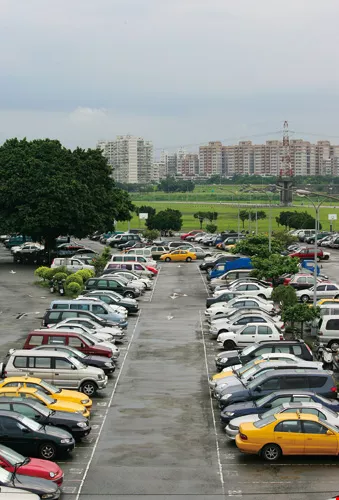
In urbanized locales, public parking has become an important source of revenue for local governments. The photo shows a pubic lot beside Chungcheng Bridge in Taipei.
Hog slops are worth money too
Besides relying on kindheartedness to gain revenue, local governments have found a goldmine in their longstanding and highly effective recycling programs, thanks to sharp rises in raw materials prices.
With the soaring prices of raw materials needed for manufacturing animal feeds, such as petrochemical products and corn, the cost of feed has become a serious burden to hog farmers, who have long relied upon imported feed. As a result, kitchen scraps, which can be used to replace pig feed, have suddenly turned from garbage into gold.
In Chungli City, Taoyuan County, garbage collectors tell us that as of 2006, few farmers were requesting kitchen scraps for use as hog slops. Even when the scraps were given away for free, there were not necessarily any takers. But in 2007, kitchen scraps suddenly became a hot item, with the selling price jumping to NT$510 a ton, when it had been free the year before. In April 2008, businesses from other cities and counties were coming to bid at auction, resulting in a three-fold increase in the price, which reached a record national high of NT$1,810 a ton. It is estimated that the city government could take in over NT$1.5 million a year in revenues.
However, even though selling kitchen scraps is both profitable and good for the environment, seasoned garbage collectors say it's important for the kitchen scraps to be handled

Taoyuan County has already earned more than NT$10 million from the contracts it awarded in March to businesses setting up shop at the Chiang Family Cultural Center. To earn revenue, the Taoyuan County Government sells dolls of former ROC presidents Chiang Kai-shek and his son Chiang Ching-kuo in the Chiang Family Cultural Park tourist information center (near the Chiang Kai-shek Mausoleum).
Green makes business sense
The revenue sources from recycling are not limited to kitchen scraps. Chungho City in Taipei County collects used plastic bags and auctions them off, fetching a high price of NT$3,500 a ton thanks to high oil prices. Companies can manufacture plastic pellets from them, which can then be made into household products like plastic containers, mats and so forth.
Another environmentally friendly source of revenue is furniture recycling. Local garbage crews now collect tables, chairs, cabinets, sofas and other large pieces of furniture, which can be fixed and refurbished, and then auctioned off with the revenues going fully to the local government.
According to the Environmental Protection Adminstration, some 16,000 pieces of furniture were sold in this way in 2007, bringing in revenues of around NT$12.5 million. There are also some cities and counties that leave recyclable materials unsorted (kitchen scraps excepted), auctioning off entire batches to reduce manpower costs. The Taipei City Government began doing this in 2002, adding revenues of NT$60-70 million a year to the city treasury.
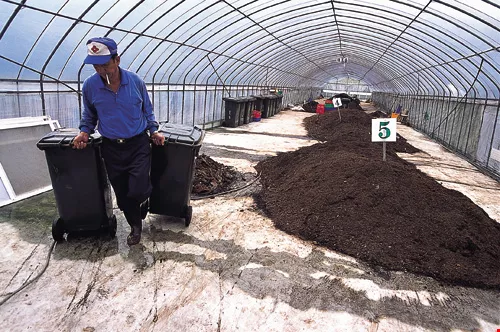
With the price of feed and fertilizer rocketing, kitchen scraps that can be used to feed pigs or to create compost have turned from slop into gold. It's an endeavor that's both environmentally correct and financially rewarding. The photo shows the compost site at the Hsichih Environmental Progress Association in Taipei County.
On May 31, the Chiang Kai-shek Mausoleum in Tahsi, Taoyuan County was reopened after six months of closure. As the new administration takes steps to open Taiwan to mainland Chinese tourism, people are anticipating the potential of Chiang Kai-shek's tomb to attract mainland visitors. But by what means can some of this tourist money be brought into the pockets of local governments?
The quick-thinking Taoyuan County Government, certain that private businesses will be drawn by the mausoleum's tourism potential, began outsourcing the operation of the visitor center by leasing it to a private firm, earning licensing fees and community compensation payments. The government also produces souvenirs like Chiang figurines, mugs and T-shirts that are sold at the mausoleum, which have already brought NT$10 million into the county treasury. When mainland tourists come, revenues are sure to climb.
With the government as a landlord leasing out historic sites and scenic spots, private operators can make use of their business savvy. With government and business complementing each other, such tourist sites can be used more flexibly, raising local visibility and bringing business to nearby streets. In this way, it has become a favorite revenue-generating method for local governments. Many city and county governments have independently adopted outsourcing or Build-Operate-Transfer (BOT) models to reap tourism revenue.
Reinventing famous scenic spots
For instance, the operation of many parks and scenic spots in Kaohsiung, including famous tourist sites like Urban Spotlight and the promenade along the Love River, were outsourced starting in 2002, shaped by the creativity and investments of the operators. This was not just a political boon for the city government, but also saved the city around NT$14 million in maintenance costs and generated around NT$13 million of income in licensing fees and leases.
The Changhua County Government has made plans to build a vacation center near the great Buddha of Mt. Pakua, granting the entirety of planning and development to a private business via the BOT model. The government, in return, is to receive licensing fees for development and operation, land leases, the house tax and land value taxes, which are forecasted to generate NT$7.55 million a year in revenues for the county coffers.
Moving targets: motor vehicles
Another way to for a local government to create revenue is to get it from cars and motorcycles. However, though effective, such measures usually draw public ire.
One way of getting money from motor vehicles is to increase the number of paid parking spaces. To boost revenues and at the same time solve parking problems, the Taoyuan County Government started implementing streetside parking fees in 1998, and in 2003 began outsourcing the operations of streetside parking spaces. Besides saving large sums in payroll expenses, the government earned around NT$400 million from biennial licensing fees. In late 2004, the Taipei City Government initiated a precedent by instituting NT$20 streetside parking fees for motorcycles in the Hsinyi business district, the Nanyang Street area and Neihu Technology Park, and also increased fees for existing motorcycle parking spots. In one year, the city government can bring in NT$330 million in revenues.
How much enforcement?The second way local governments can make money from cars and motorcycles is by boosting detection of traffic violations. Even though local governments vehemently deny that their motive for beefing up enforcement is to increase revenues, they have a hard time convincing doubters. For example, in April, Taipei County traffic police installed two dynamic digital cameras along Hsinwu Road Section 1 in Hsintien, and within two months more than 16,000 tickets were issued for such offenses as weaving through traffic and failure to turn on headlights, to the tune of around NT$20 million.
Naturally, this proved unpopular, with lawmakers accusing the county government of "treating drivers like ATMs." But Cheng Yung-yu, deputy chief of Taipei County's Traffic Police Corps, insists that they're only issuing tickets to lawbreakers to promote safety and protect lives, not to boost revenues. And the fines are transferred to the motor vehicle departments where the vehicles are registered, so the money isn't necessarily gained by Taipei County.
Clearly, in this time of skyrocketing fuel prices and stricter law enforcement, drivers and motorcyclists need to be more cautious if they don't want to pay the price.
The politics behind revenues
But besides pursuing high revenues, we need to stop and think good and hard about the political problems that may be caused by these means of raising money.
When local governments seek additional revenues, methods other than voluntary contributions or collection of kitchen scraps, such as raising fines, local taxes and parking fees, directly impact those segments of the public that are targeted. Concerning this issue, Hsiao Chuan-cheng, a professor of political science at National Taiwan University, notes that in Taiwan's electoral climate, local governments usually aim their revenue-raising measures at "outsiders" or the general public (such as drivers and motorcyclists), while striving to avoid levying taxes or fees on local businesses and organizations, because the former are less able to put political pressure on them.
"In this way, a vicious cycle of 'always going for the soft targets' may appear, leading to the weak becoming weaker while the strong grow stronger. We have to be careful in implementing such measures," Hsiao reminds us.
Even outsourcing, which seems a "win-win-win" situation for government, businesses and the public, in actuality implies a serious issue involving appropriate control of the limits of government-business relations. Hsiao figures that "government cost-cutting and revenue increases via outsourcing and BOT are not bad things per se, but the rules of the game need to be stated clearly and transparency is required in order to allow public supervision, so as to avoid misgivings about collusion between officials and businesses or enrichment of specific individuals."
Therefore, as local governments exercise creativity in finding new revenue sources, the people may be compelled to change their complacent "it won't affect me" attitudes and band together in vigilance for their rights.


