

So, what's a green hotel? Let us take you across the Pacific to California where we find: oak tree branches swaying above the banks of the Sacramento River... birds soaring overhead in their early autumn migration... swans slipping over the surface of a pond... a bark-colored two-story building blending in so well with the surrounding forest that it's hard to tell where one stops and the other starts....
(Sam Ju Li-chyun/photos courtesy of Wen Chang/tr. by Christopher J. Findler)
The scene ends with a shot of the sign over the door that reads "Gaia Anderson Hotel." This is part of the "green hotel kingdom" of Wen Chang, an ethnic Chinese residing in the US. We watch as he greets some swans with a wave of his hand while he walks toward us.
Wen Chang, 64, is from Taiwan. After founding the first green hotel in America in California's Napa Valley, more recently he has been attracting attention once again as he extends his chain of hotels, stressing environmentalism and energy conservation, into other parts of California. This past August, he returned to Taiwan to share his "green miracle" with local hoteliers.
Chang's environmental hotels are all christened "Gaia," the Greek name of the goddess of the earth and the source of all life. Chang's goal: "Man and nature in a sustainable relationship, living together in harmony." To realize his ideas, to incorporate green architecture into his hotels, and to minimize the impact of their construction on the environment, he personally involves himself in their planning and design, the choice of building materials, architectural styling decisions, and the construction process, as well as in their operational management.
He believes that in this era of climate change and global warming, the Gaia hotels' success reflects the awakening of environmental consciousness among the public. It represents the attainment of a common consciousness among humankind.
Wen Chang went to the United States in 1970 to study, live, and work. In his more than 30 years there, he has seen what he calls "the ugly, self-serving side of American business and society." The Gaia hotels embody not only his own personal mission to "be green," they are also his way of "extending an olive branch to commercial society in America." To him, profit and environmentalism were once mutually exclusive pursuits-you couldn't have one with the other. Today, however, the one causes the other to thrive.

(above) Chang's original Gaia Hotel is situated in California's Napa Valley. In 2007, it was awarded the LEED Gold Certificate by the US Green Building Council.
Family's green education
Wen Chang was born in Taichung County's Lungching Township in 1944-one year before the end of WWII-at a time when Taiwan was experiencing severe shortages of everything. Chang's family had nine mouths to feed, including Chang, his parents, three older sisters, two younger brothers, and a younger sister. He remembers his mother exhorting everyone in Taiwanese to "Eat everything on your plates or you'll marry a girl with a pock-marked face." Despite being an accountant, his father still found it difficult to feed so many mouths. As eldest son, Chang was well aware of the hardships his parents faced and would even pick up and eat grains of rice that had fallen to the floor, so that they would not be wasted.
Back then, Taiwan was destitute and received aid from America, but having nothing to eat was still very common. Chang's best friend at school was so poor, in fact, that all his family could give him to bring for lunch every day was a single dried plum. During lunch, he used to curl up in a corner of the schoolyard in an attempt to alleviate the hunger pangs. Witnessing this made Chang appreciate even more the food he had to eat.
It was also during those impoverished times that Chang learned of the "evil wastefulness" of capitalism. One weekend when he was a fifth grader, Chang was startled awake from a nap by his father who was fit to be tied. He was yelling, "People are starving and the Americans are dumping wheat into the Pacific Ocean?!" The US government, willfully ignorant of the sufferings of people in many developing countries, destroyed the grain in an attempt to keep wheat prices up.
"It struck me that American capitalists couldn't care less about other people in the world," Chang points out indignantly. It reminded him of a famous line from the movie Little Women-"a seagull... strong and wild, and fond of the wind and storm, dreaming of flying far out to sea." He believes that like chisels, this line and his parents' influence chipped away to form his character.

(left) Low-flying egrets painted on the hotel's exterior wall come from Chang's childhood memories of nature in his homeland Taiwan. Another wall depicts an abundant autumn harvest, symbolizing beseeching the Mother of the Earth for never-ending life and growth in nature.
Strong, wild, dreaming
Chang finds himself drawn to places offering challenges-the tougher the challenge, the stronger the attraction. He studied at the Department of Shipping and Transportation Management at the National Maritime College (now National Taiwan Ocean University). After graduating, Chang, who learned to loathe the capitalist idea that money is everything, decided to pursue advanced studies in the United States. Changing his field of study to marketing, he focused in particular on niche marketing in an attempt to understand the logic of Westerners' approach to making money, because to understand something, you must study it. During his time in the US, he has worked in the fields of architecture, construction, and hotel management.
First, he bought a franchise with the well-known hotel chain Holiday Inn, giving him an insider's view of how capitalists will "chew you up and spit you out for money."
"The franchise business is full of hypocrites. They might claim to work as close partners with franchisees, but they like to leave traps in their contracts with you. But I'm not one to scare easily," Chang recalls bitterly.
Holiday Inn headquarters once threatened to rescind franchise authorization if franchises didn't fork out an additional fee of US$120,000 for their management computer systems. This stirred deep resentment in Chang who felt that this time, they had gone too far. He and his wife opted to drop the franchise, and they never looked back.
They decided to go into business on their own, renaming their hotel the Brawley Inn after the area they lived in. They saved a great deal of money by not paying the exorbitant annual franchise fees. They also organized essay contests for kids in the neighborhood. Encouraging education among local children as they did business made their commercial hotel much more popular with the neighborhood.
One thrilled first prize winner, a young Mexican-American, once told Chang that it was the best thing he'd ever received. Chang feels that businesses can't just concern themselves with the bottom line. They need to be part of and give back to society.

All curtains, wallpaper, and carpeting in the Gaia hotels are made from recycled fibers. To prevent noxious gases from impacting human health, low-VOC paint is used inside the hotels.
A truth from a glass of water
1999 was an important turning point in Chang's "green awakening." He was celebrating his 55th birthday at a seafood restaurant in Santa Cruz, a town on the California coast, when he asked the waiter why they didn't provide water to customers. The waiter replied, "We only provide a glass of water to those who order one, because of the water shortage." That unexpected reply set into motion the gears in Chang's mind. As he drove along Highway 17 after dinner, he began thinking about resource shortages.
"Not providing water to customers in restaurants unless they ask for some is one step, but what else can be done?" Asking himself this question brought to mind memories of shortages in his youth. He determined at that point to do whatever he could, starting with his own life. That night when he got home, he took a two-minute shower instead of his usual eight-minute one-a practice he has continued to this day.
He explains, "The earth is an integral whole. If you waste here, it affects somebody somewhere else. A little bit less waste means a little more resources." A sentence in Paul Hawken's Ecology of Commerce served as a wake-up call for Chang. Hawken wrote that when the ecology is being trampled underfoot, businesses are the only ones with the wherewithal to reverse the march towards destruction of the global environment and society.
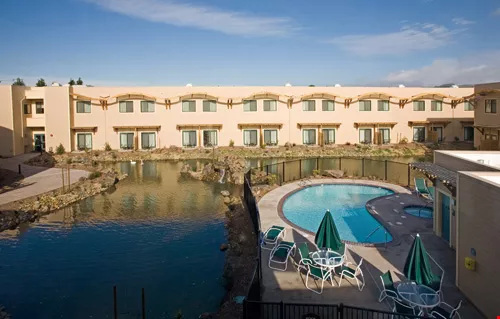
(below) The hotel's swimming pool uses saline solution, which doesn't affect health adversely like chlorine.
Green beauty and ethics
This revelation convinced Wen Chang that businesses can form an alliance with the environment, creating a win-win situation for enterprises and the planet. He immediately determined to start with a hotel of his own. He asked Mickey Muennig, a student of renowned green architect Frank Lloyd Wright, to work with him. They really hit it off, too. They designed a hotel to be located on Half Moon Bay in the Silicon Valley. It was to have a wave-shaped glass roof to allow sunlight in, so that no electric lights would be required during the day and to help the building blend in with its surroundings.
Chang was very happy with the design as it reminded him of the symphonic poem "La Mer" by the French composer Debussy. It also helped him to truly appreciate what German literary giant Johann W. Goethe meant when he said, "I call architecture frozen music." Chang sighs as he explains, "This is what we mean in Chinese when we say 'man and nature as one.'"
But the other investors felt the energy-saving architecture would increase construction and hotel management costs substantially. Their opposition to the Half Moon Bay project effectively aborted it.
This experience, however, further steeled Chang's desire to "interweave environmentalism, ethics, and aesthetics" into the building of a green hotel. He and Muennig continued to work together to build the Gaia Napa Valley. It was from this point that he completely abandoned hackneyed ideas as to what a hotel is and how it should be run used by major hotel chains such as Holiday Inn and the Hilton.
He explains that profit is the primary goal of traditional hotels, but he is more concerned with people and the planet. This is the true manifestation of social responsibility preached by businesses.
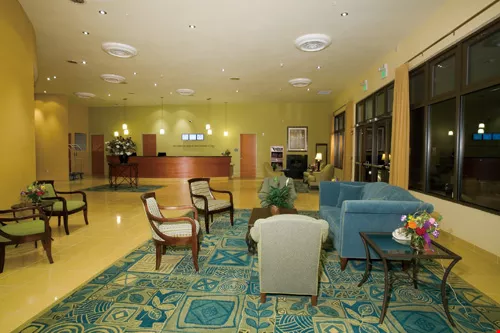
All curtains, wallpaper, and carpeting in the Gaia hotels are made from recycled fibers. To prevent noxious gases from impacting human health, low-VOC paint is used inside the hotels.
The green solution
Where there's a will, there's a way. Chang moved his "green base" from Half Moon Bay to Napa Valley where his green dream finally began. He opened the doors to the Gaia Napa Valley Hotel-America's first environmental hotel-in 2006. It was the first green hotel in the United States to be awarded the LEED Gold Certificate by the US Green Building Council ("LEED" stands for Leadership in Energy and Environmental Design). Seven months after it opened, the hotel started turning a profit, thereby striking the perfect balance between idealism and reality.
Built at a cost of US$18.5 million, the Gaia 2 was inaugurated in Anderson County this past May. With average occupancy rates hovering at about 70%, it began seeing a profit after three months, bowling over other hotel owners in the area. At a time when most people equate environmental architecture with high cost, unpopularity, and losing money, Chang has proved with the Gaia chain that saving the environment is not only not a money-losing proposition, it can be a real moneymaker.
The Gaia hotels boast a number of environmental measures. For example, to protect natural forests and cut down on energy waste stemming from long-distance transport, building materials were required to be from commercial forests within a 500-mile radius of the hotels. The buildings take advantage of California's abundant sunshine by using light guiding systems to gather and distribute natural light into the lobbies and guest rooms. No electric lights are required at all during the day. The buildings' roofs are equipped with heat insulation and room temperature regulation systems to minimize the use of air-conditioning and to reduce temperature differences between guest rooms. Room temperature is kept at about 72°F or 22°C.
To conserve water, the Gaias utilize low-flow water equipment. Most toilets use about two gallons of water with each flush. Those of the Gaias only use 0.9 gallons, less than half that of other toilets on the market. Resource development, conservation, and recycling are a package deal and have to be carried out in concert. So after cleaning their wastewater, the Gaia hotels use it to water plants or return it into their neighboring ponds, reducing total water usage by 40%.
Various conservation measures cut Chang's water bill in half and reduce electricity bills by 25% each month, saving him US$50-70,000 each year per hotel. This proves that not only does environmentally friendly architecture save energy, it saves money.
Chang feels that the Gaia chain has a mission to educate hotels in regard to environmentalism. He offers a series of ingenious designs in his hotels that are very popular with guests.

All curtains, wallpaper, and carpeting in the Gaia hotels are made from recycled fibers. To prevent noxious gases from impacting human health, low-VOC paint is used inside the hotels.
Selling green
"Ecopreneurist" columnist M.C. Milker, for example, wrote an article that discussed the fact that the Gaia hotels don't use chlorine, which can be harmful to the health, in their swimming pools. They use saline solution instead. He also pointed out that the hotels use only refillable economy-sized pump-action bottles for the body wash in guest-room bathrooms. Simply topping off what has been used out of these bottles helps prevent wasting all those little bottles that other hotels use. Freelance writer Rebecca Jane Lacko also wrote an article in July of this year praising the Gaia chain for its spirit of "permaculture" (permanent + culture), that is, blending landscape design with hotel surroundings and adding a touch of culture. She applauded the Gaia hotels for their "inner peace and quiet."
Well read in the classics of both China and the West, Chang prints excerpts from such nature writings as Su Dongpo's poem "The Red Cliffs" and Henry David Thoreau's Walden onto cards and places them in guest rooms as free souvenirs.
Rooms at the Gaia hotels are named after animals, flora, and seashells, pictures and written introductions of which are hung on room walls to help rouse environmental consciousness among guests.
Chang relates optimistically, "Green consciousness is buried deep within the unconscious of human civilization. Now, as we face the threat of global warming, aware individuals will take it upon themselves to help save the environment without anybody prompting them."
As a youngster, Wen Chang hated American capitalism. Now that he is in his sixties, Americans are using his environmental ideas which are turning capitalism's approach to making money on its head. He sees this as a reconciliation between himself and American society, and the triumph of his ideals.
"My green hotels are what I will stick to the rest of my life, so there is no room for compromise," Chang says. Following in the wake of his Napa Valley and Anderson County hotels, Wen Chang is building a third Gaia in Merced County in northern California. There is nothing he would like more than to see the goddess of the earth continue to flourish in his green kingdom.
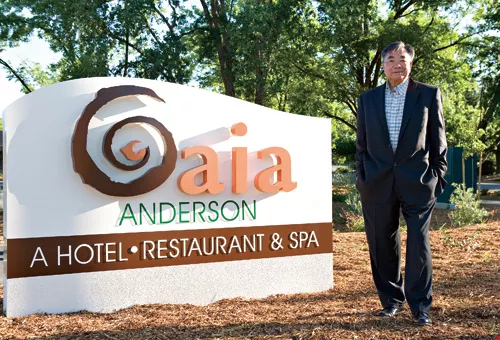
"Green hotels are what I will stick to the rest of my life." Taiwanese-American Wen Chang, 64, has built up a chain of hotels in California that he has christened "Gaia" (after the Greek Mother of the Earth), but which also sounds like the Taiwanese term for "family business."

Green building is taking off in Taiwan too. Surrounded by trees in Peitou Park, the Peitou branch of the Taipei Municipal Library, Taiwan's first green library, is equipped with ecology-friendly equipment like solar power and a rainwater collection system.




@List.jpg?w=522&h=410&mode=crop&format=webp&quality=80)


