If I Had a HammerThe Gong Makers of Ilan
Tsai Wen-ting / photos Pu Hua-chih / tr. by David Mayer
April 2000


Of all the musical instruments used in Chinese performing arts, the gong would seem to be the simplest of all, yet it is actually very expressive. The percussion section in a Peking opera troupe, for example, makes use of both large and small gongs, and you can always count on a rousing roll on the gongs and drums to attract the audience's attention at the beginning of an opera. During the performance, people who really know their opera can often be seen with their eyes closed, listening intently to the sounds of symbolism. The reverberating boom of the large gong announces the entrance of a high-ranking character. When the crisp "thwong" of the small gong rings out, the connoisseur knows to expect the entry of a boy or girl.
In "The Five Mountain Passes" (a Chaozhou-style drum-and-gong performance), thunderous pounding on the gongs symbolizes the martial fury of the great general Guan Yu as he fights his way through five heavily guarded passes to escort the wife of his sworn blood brother to safety. In "Da Yuan Men" (a piece of traditional Chinese music), gongs are used to re-create the excitement of the crowds lining the road as victorious troops return home in triumph. In "Summer Rain," they are used very effectively to create the feel of a tremendous thunderstorm.
Today, as well, gongs remain an important part of the art world, not to mention the indispensable role they play at Taiwan's energetic temple parades. But have you ever wondered where they're made? It turns out that 85% of them have been made in Ilan County by either Lin Wu or his son, Lin Lie-chi.
"Gonngggg.... Gonngggg.... Gonngggg...." The deep, resonant note of the large gong combines with the ear-splitting roar of firecrackers to fill the air with that unique blend of solemnity and excitement that always marks a Taiwanese temple parade.
The night before the Lantern Festival is the birthday of the patron god of Hsi Kuan Temple in Ilan County. A long parade snakes its way though the town. No one has even gotten a glimpse of the parade teams yet, but everyone can hear the drums and gongs already. Then a dozen or more parade teams come into view. If you look closely, you will discover a name painted in crimson characters on the edge their large gongs: "Lin Wu Ironworks." In Taiwan, this name is a virtual synonym for gongs.
King of the temple parade
Every time a god has a birthday, its statue leaves its customary niche and takes to the streets in a palanquin to bestow blessings upon the local residents. On these auspicious occasions, other temples around town always send out parade teams to deliver birthday greetings, heighten the general festivity, and renew old acquaintances. Some of the parade teams are on a mission to clear the streets of evil in preparation for the god's passing, while others are simply out to celebrate.
The parade is a colorful, pulsating spectacle of dancing lions, rites of spring, prancing drummers, gods from the netherworld, and martial arts displays. It makes for an especially pleasing sight as it moves through the green countryside. Stretching out for several kilometers, the parade participants stop for a short while to perform in front of each temple they come across. Several parade teams always perform together-the lion dancers with their small gongs, the bei guan ensemble with their wailing horns, and the big drum troupe with their drums and gongs. These performances always start with a gong and finish in the same way. A star performer in a local bei guan troupe explains the importance of the gong: "If your gong is loud enough, you can overpower the other troupes and force them to play to your beat."
Town criers were still a common sight in Taiwan not so very many years ago, and it was their custom to use a small gong to announce themselves as they worked their way among the streets and alleyways spreading the news of the day: "The temple thanks the gods for peace and prosperity!" "The dragon boat races are about to begin!" "The town hall reminds you to report your taxes." "The health office is now administering chicken pox vaccinations." "A child is missing!"
Back in the days before clocks became a household item, many an exciting tale unfolded to the beat of the night watchman's gong. On the battlefield, the sound of drums was the foot soldier's signal to charge, while a ringing gong was his cue to beat a quick retreat. And in a traditional Chinese wedding it is customary for the bridegroom to go forth to the sound of gongs to collect his bride and carry her home in a palanquin. Similarly, gongs play an important role in funerals, where the black-capped Daoist priest always has a tiny "biscuit gong" in hand. Farmers in northern China have been known to use gongs to keep sparrows away from their grain, while for fishermen in the south the clapping of a gong is the signal that the ship is about to leave port. The phrase "let the performance begin" translates into Chinese as "let the gong be rung." A person with a gravelly voice is described as having a "broken gong for vocal chords." For thousands of years, gongs large and small have been an intimate part of daily life for Chinese people.
Musical blacksmith
Gongs play a key role in bei guan, one of the most important forms of traditional Chinese music in Taiwan, and any attempt to tell how these gongs are made must necessarily focus on Ilan. Most gongs in Taiwan used to be made of steel and were imported from mainland China or southeast Asia because there was no one in Taiwan who knew how to make them.
Lin Wu, Taiwan's first master gong maker, was born in 1916 in the town of Luotung (Ilan County). In his youth he worked at a noodle shop before becoming an apprentice at an ironworks that repaired farm implements and rice milling equipment. Lin eventually became an expert blacksmith, sheet metal worker, and welder, and all of these skills would eventually stand him in good stead when he decided to train himself in the manufacture of gongs.
He had already gotten married, fathered his first child, and started his own business while Taiwan was still under the colonial rule of the Japanese. After the colonial government outlawed the performance of traditional Chinese music and theater, many theater troupes and bei guan ensembles disbanded or stopped performing. It was at about that time that a bei guan musician took a broken gong to Lin and asked him to weld it back together. The job piqued Lin's curiosity, so he went to a theater troupe that was disbanding and bought a couple of small gongs made in China. After studying the gongs, he started to experiment with making his own.
After Taiwan reverted to Chinese rule in 1945, temple parades roared back to life, and 29-year-old Lin Wu continued with his after-hours attempts to reproduce the two little gongs he had bought. Turning out one test sample after another, his skill gradually improved. The first steel gong that he put up for sale sounded even better than the old gong from mainland China, and Lin Wu Ironworks thus began its long love affair with the gong.
Brass gongs and bicycles
Although Lin had become quite proficient in the manufacture of steel gongs, the steel contained a lot of impurities, and the sound of gongs made from it was shorter and sharper than he cared for, so he began making his gongs from very expensive brass.
It was not easy in those days to procure brass stock, but Lin eventually found a shipbreaker who was willing to sell him the brass from old ships. That did not solve all of his problems, however. There are many kinds of brass alloys, and no matter good he got at achieving the desired dimensions, it was fiendishly difficult to get just the sound he was looking for. After experimenting with many different compositions of brass, he discovered that adding a certain percentage of phosphorus imparted just the degree of malleability needed to pound out a beautifully resonant gong. "When my father was alive," says second-generation gong maker Lin Lie-chi, "he used gongs as a metaphor for life. He would always tell us that the most important things are the fundamentals. 'If you don't have the right raw materials, you can't make a good gong.' That's what he'd say."
When Lin Wu's brass gongs went on the market, they made a big impact in the theatrical community of northern Taiwan. Two performance troupes in Keelung were among the first to hear of his gongs and come looking for them. Each bought a gong for the then-astronomical sum of 1,200 yuan, which was enough to buy three expensive Japanese bicycles. In a society where bicycles, not cars, were the main mode of transportation, this kind of price for a gong was truly astounding.
A hammerin' man
Lin Wu's first gongs measured about 60 to 70 centimeters across, but that was only the beginning. He then set about the task of developing a bigger gong with a sound that would be more sustained, deeper, could carry farther, and would resonate more steadily. The sound of gongs reverberated through the Lin household, and all of his six children were immersed in the sound and feel of the instrument all their lives. The youngest child, Lin Lie-chi, is the one who has most shared his father's love of the instrument and its manufacture.
The large gong, with its ponderous, deep resonance, is one of the most important instruments in any bei guan ensemble. It looks so simple-just a big flat disk with a raised "navel" in the center and a projecting rim, but the simplicity is deceptive. When a good gong is struck repeatedly during a performance it will produce a sustained cascade of sound.
Every detail makes a big difference-the size of the navel, its thickness, the angle of the rim.... Lin Wu was fond of saying, "Manufacturing a gong is like dealing with people. Right from the first, you can't afford to get careless about anything." The first step in the process is the selection of raw materials. You must start by choosing pure brass. Then you must stamp out a platter and rim of the proper dimensions. The rim must be stamped in just the right curving shape so it will curl slightly inward once it has been welded to the gong. This shape gives the gong extra resonance and enables it to sustain a note for a longer time. In addition, the outer part of the gong has to be slightly thicker than the middle portion to make the rim stronger and lengthen its useful life.
After the brass has been stamped out in the basic shape of a gong, it is placed on a block of wood with a hole in the center and pounded with a round-headed hammer to form a navel of the proper size and thickness. Next, the platter and rim are beaten continuously to increase the density and hardness of the metal. The manufacture of extra-large gongs is especially challenging. Because they are bigger than any brass stock that is generally available, the platter can only be made by welding two pieces of brass together. These gongs must be pounded tens of thousands of times to ensure that the weld seam is totally reliable, and the process takes several days.
Once the hammering is finished, the rim is welded to the platter and the metal is carefully polished to a brilliant shine. The gong at this point is half finished. The most important work-tuning-remains to be done. Tuning is where the true craftsman distinguishes himself. Once a gong is finished, the pitch and consistency of the sound will differ dramatically depending on where it is struck. This is the one aspect of Lin Lie-chi's work that he declines to discuss in detail. "If I went and told you how I tuned these things," laughs Lie-chi, "I'd be giving my job away."
Lie-chi likes to recall the time a music troupe came all the way from southern Taiwan with a large gong that needed tuning. Lin Wu tapped it a few times, sized up the problem, and with one sharp whack of his wooden mallet announced that the gong was fixed. The visitors were deeply disappointed at Lin s seemingly cavalier attitude, but when they struck the gong and heard the results, the elated musicians couldn't stop marveling at Lin's uncanny skill.
King gong
In 1985 Lin Wu and his son received an order from a major temple in Peikang to make the biggest brass gong in the world. The team's handiwork, which can be found in Chao Tien Temple today, measures nearly two meters across and weighs 160 kilos. When laid flat, you could practically fill it with water and let two or three kids use it as a wading pool, and its sonorous ring can be heard as far as a kilometer away. In 1987, just one year before he passed away, Lin Wu was awarded the Hsinchuan Prize for education in culture and the arts. In 1995, Lie-chi (by now a father himself) became the second gong maker to win the Hsinchuan Prize, and in 1996 he made a gong even larger than the one delivered to Chao Tien Temple. Working this time for Peikang's Hou Tien Temple, Lie-chi turned out a gong measuring nearly 2.4 meters across and weighing 230 kilos. Once again, the Wu family had produced the largest brass gong in the world. It now appears that the clan's gong business will continue into a third generation because Lie-chi's eldest son Lin Hao-hsien, a first-year junior high school student, has already matured into one of his father's most able assistants.
Old instrument, new sounds
There was a time when the gong was shunned by most professional musicians, who didn't want its loud, brash sound in their modern, air-conditioned concert halls. Even when it did make an appearance, the star of the show in boisterous outdoor temple parades was only allowed to make muffled hints at its real capabilities. More recently, however, musicians the world over have begun searching in ancient musical traditions for new sources of inspiration, and the change has given the lowly gong a new lease on life. The change has also brought new clients to Lin Wu Ironworks, where orders used to come exclusively from bei guan ensembles and traditional theater troupes.
The Ju Percussion Group, which runs schools all over Taiwan for people interested in percussion instruments, hired Lin Lie-chi ten years ago to make a set of gongs tuned to 13 different notes. Always one to accept a challenge, Lie-chi made over 30 gongs of all different sizes, chose the 13 best suited for the set, then set about the long slow process of tuning. Whereas gongs had only been used in the past to beat out rhythm, this new set made it possible for the first time to play melodies. After thousands of years, an ancient musical instrument had taken off in a new direction.
Lin Lie-chi's next major client was U Theatre, a group that uses music as a means of self-cultivation. The group had started off using only drums, but when they decided to branch out a bit, it was to Lie-chi that they turned, ordering ten large gongs and over 30 small ones. Combining the assertive sound of drums with the more retiring gongs, U Theatre in 1996 created "The Sound of Silence," and entered it in arts festivals in Avignon, France and Sao Paulo, Brazil.
The percussion section in "The Sound of Silence," was directed by Huang Chih-wen, who states, "Although gongs and cymbals may seem like nothing more than noise makers to a lot of people, the fact is, they can awaken something inside you." The performance starts off with a thunderous stampede of bass drums symbolizing the creation of the earth, followed by the pitty-pat of small drums that re-create the very first rain drops. The rainfall starts with a desultory plop-plop, then gradually grows into a deluge that creates the vast and boundless seas. The forceful drumming of the male drummers calls to mind ocean waves crashing into a rocky seacoast. The performance then moves on to its spiritual theme-"listening to the sea's heart." A single male drummer appears. Close-cropped, bare-chested, and wearing a long cloth skirt, he slowly raises a large mallet with all the solemnity of a high priest and proceeds to slowly strike several large gongs. The sound washes over the audience like wave after wave upon the sands. All the while, something akin to a Buddhist chant goes on in the background. The gentle sounds transport the rapt listener to a different world. In the meantime, female drummers sitting on the stage floor strike various small gongs. The tipply tinkling skitters across the concert hall like ripples on the water's surface. And finally, larger gongs and drums roar back into action, symbolizing the forces of yin and yang at work in nature and signifying the birth of yet another round of life.
Lin Lie-chi's involvement in the performing arts has spurred him to continually explore the possibilities of his craft, and he has now successfully produced a 26-note set of gongs. In fact, his involvement has now gone beyond craft and into the realm of art. When Matthew Lien, a Canadian musician whose environment-conscious work is highly acclaimed in Taiwan, came here last year, he invited Lie-chi to perform together with him on the gongs.
Passing on the torch
Having made gongs for so many different types of clients, Lin Lie-chi has acquired a certain degree of proficiency as a performer himself. Different people require different sounds from their gongs. A bei guan ensemble, for example, needs large gongs with a deep tone that will last long and carry far. The large gong used for a lion dance, on the other hand, must have a hard, high-pitched sound. The "horse gong" used by the frenetically dancing drummers in a hua gu team has to have a crisp, short sound. There are convex gongs with no navel, hat-shaped gongs for chanting Buddhist scriptures, and gongs with a completely flat platter that are used by town criers to get attention. Not only do the shapes differ, but the tones must also be adjusted according to the purpose of the gong. It takes more than just a few short months or years of apprenticeship to acquire the skill to handle all these different needs, and the gongs themselves cannot be made by machine with the same level of quality.
After a lifetime spent making and playing gongs, the Lins naturally hate to see these instruments mistreated. Lin Lie-chi points out that there is no need to strike a brass gong very hard. With a good one, all you have to do is lift the mallet and strike the gong squarely in the navel with an easy, level stroke to get a full, resonant sound. He is especially appreciative of the way older folks take care of their gongs. In a temple parade, direct exposure to the hot sun can get a gong too hot and foul up its sound. When this happens, the old folks will wipe a gong with a wet cloth and wait for it to cool before striking it. When the gong returns to the proper temperature, it will sound right. "Back in the old days," says Lie-chi, "I often got kids coming in here asking me to tune gongs that used to belong to their grandfathers, but kids nowadays just want to beat on the gongs with all their might. After a few months the gong often ends up all misshapen and out of tune." The gong maker can't help but heave a sigh of regret. Although it means more business for him when this happens, he would just as soon see people take proper care of their gongs and use them for a long time.
After banging on gongs for so many years, Lin Lie-chi has grown a bit hard of hearing, but he jokes, "That's actually a good thing, because it makes it harder for me and my wife to quarrel. I can't hear what she's saying." Why has the family kept at such a demanding and "unsexy" pursuit for so long? "This isn't something that you can learn to do in just two or three years. I've been at it for over half a century, and our family is now into its third generation of gong makers. It would be a real shame to just go and chuck it out the window." Lie-chi and his brothers all agree that they should keep the family in the gong making business, so they're doing all they can to train any of their kids who show an interest in the craft.
Toward sunset a black-capped Daoist priest who performs funeral rites comes into the shop and asks Lie-chi to shine up his gong, which has grown tarnished from long use. "Our family has been doing Daoist rites for three generations now, and all of our gongs have been made by the Lin family. They just sound better, and that's what you need to do the rites properly." Lin Lie-chi takes out a brass gong that has been in the shop for 50 or 60 years and uses it to tune the customer's gong. Says Lin, "The biggest satisfaction of this job is dealing with people who have done business with my family for generations."
p.107
As the gong is struck repeatedly, its long, slow moan washes over the listener like wave after wave upon the sands. Gongs are the centerpiece of a new performance by U Theatre. The show makes innovative use of a very ancient instrument that is better known for its role in temple parades. (courtesy of Teng Huei-en)
p.108
This huge gong measures nearly two meters in diameter and stands higher than its maker. Lin Wu and his son crafted the gong, which can be heard from a kilometer away, in 1985 for Chao Tien Temple in Peikang. (courtesy of Lin Lie-chi)
p.109
A gong's "navel" is made using a rounded hammer and a wood block with a round hole in it. The square-headed hammer is used to pound the platter and rim into shape. Lin Wu and his son made these special tools themselves.
p.110
Second-generation gong maker Lin Lie-chi has gone on to top the achievements of his father. The winner of Taiwan's Hsinchuan Prize, Lie-chi's development of a 13-note set of gongs opened up a whole new range of possibilities for the use of gongs in music.
p.111
A bronze platter is first stamped out to match the customer's size specifications. Lin Lie-chi then places it on a wood block and pounds out a navel of just the right size. The platter is then hammered some 10,000 times to improve density and strength. The rim is prepared in the same manner and welded to the platter. A lot of tuning work remains to be done at this point.
p.112
"Thwongggg... Dwongggg..." Gongs are the center of attention at traditional temple parades. Members of this tiaogu troupe sling drums or small gongs from their hips and dance frenetically in the streets. (photo by Cheng Yuan-ching)
p.113
In the Chinese world, the simple sounds produced by drums and gongs have a mysterious power. Daoist priests and spirit mediums use them to open the doors to the netherworld.
p.115
When a Chinese person wants to announce that an event is about to begin, he will shout, "Bang the gong!" And there needn't neces-sarily be a gong on hand for the banging! Lung Ying-tai, director of Taipei City's Cultural Affairs Bureau, is shown here striking a gong and announcing the establishment of the bureau. (photo by Diago Chiu)
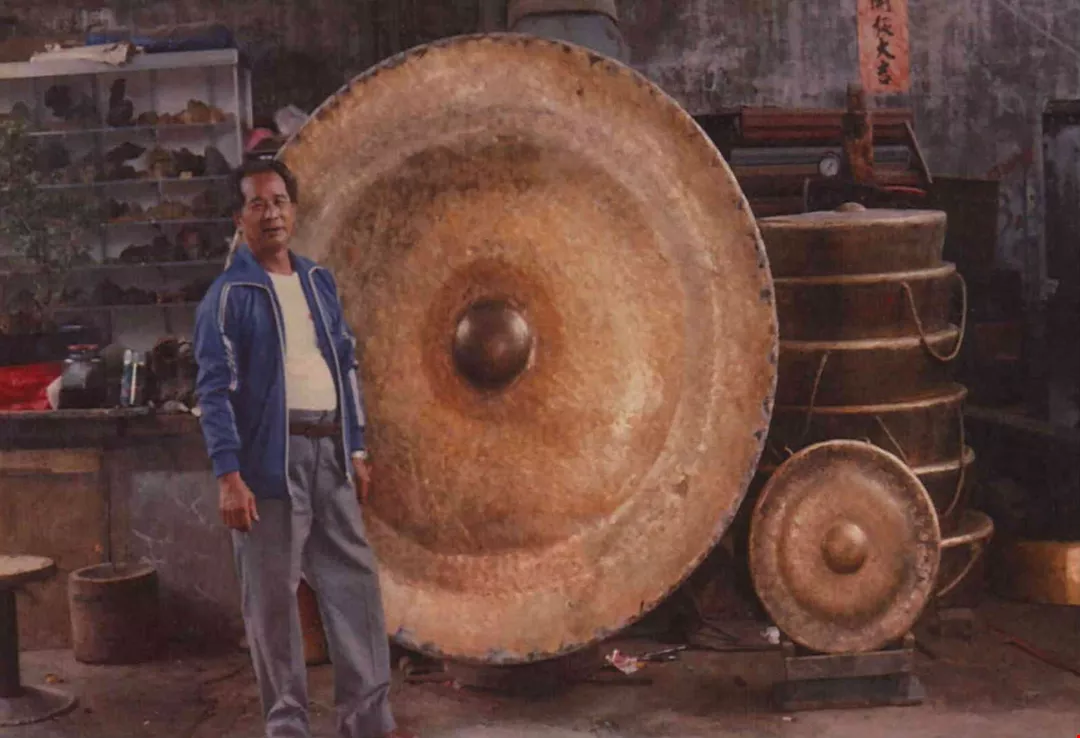
This huge gong measures nearly two meters in diameter and stands higher than its maker. Lin Wu and his son crafted the gong, which can be heard from a kilometer away, in 1985 for Chao Tien Temple in Peikang. (courtesy of Lin Lie-chi)
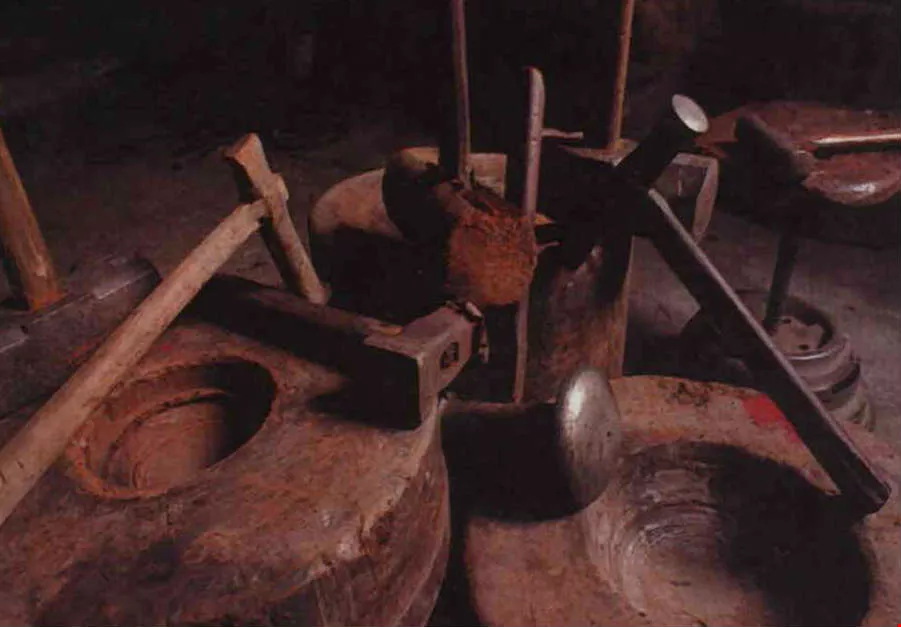
A gong's "navel" is made using a rounded hammer and a wood block with a round hole in it. The square-headed hammer is used to pound the platter and rim into shape. Lin Wu and his son made these special tools themselves.
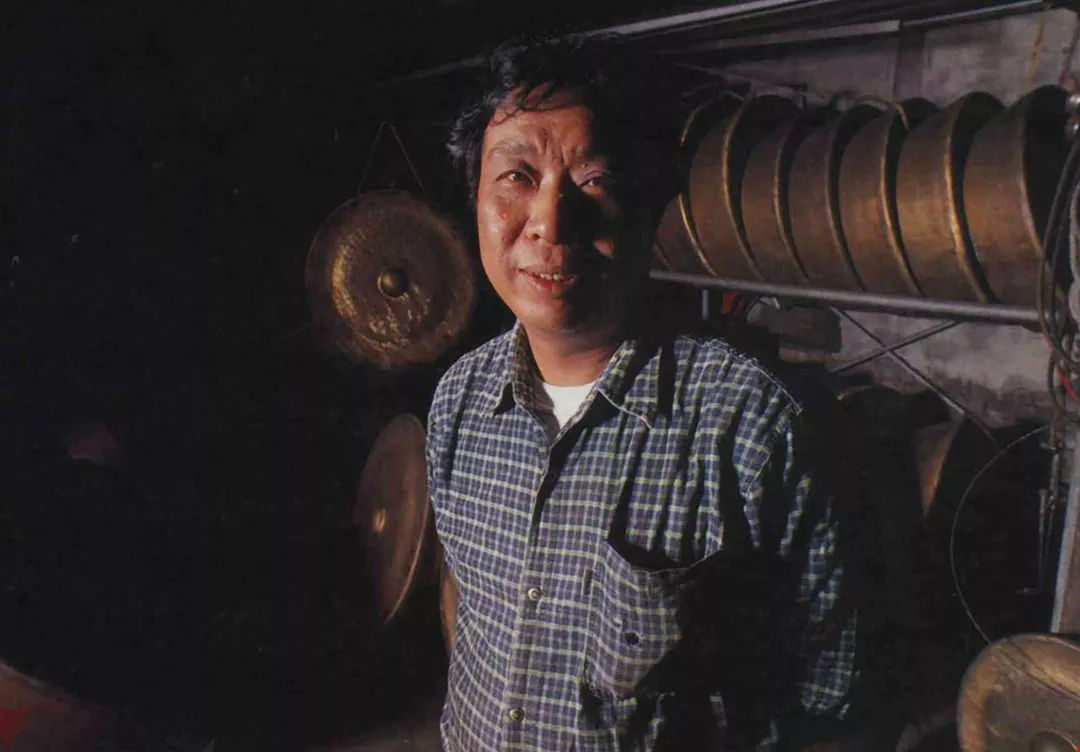
Second-generation gong maker Lin Lie-chi has gone on to top the achievements of his father. The winner of Taiwan's Hsinchuan Prize, Lie-chi's development of a 13-note set of gongs opened up a whole new range of possibilities for the use of gongs in music.
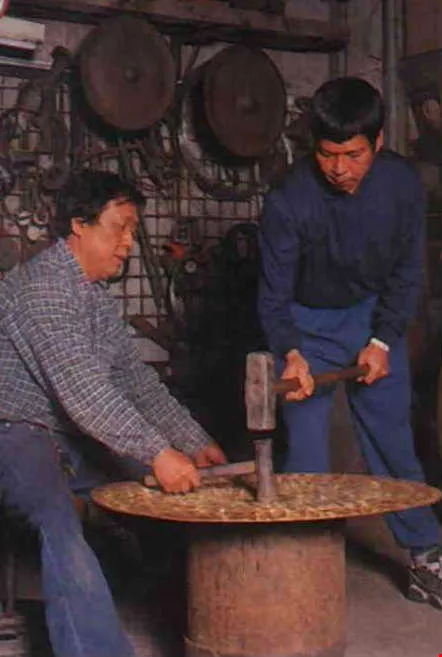
A bronze platter is first stamped out to match the customer's size specifications. Lin Lie-chi then places it on a wood block and pounds out a navel of just the right size. The platter is then hammered some 10,000 times to improve density and strength. The rim is prepared in the same manner and welded to the platter. A lot of tuning work remains to be done at this point.
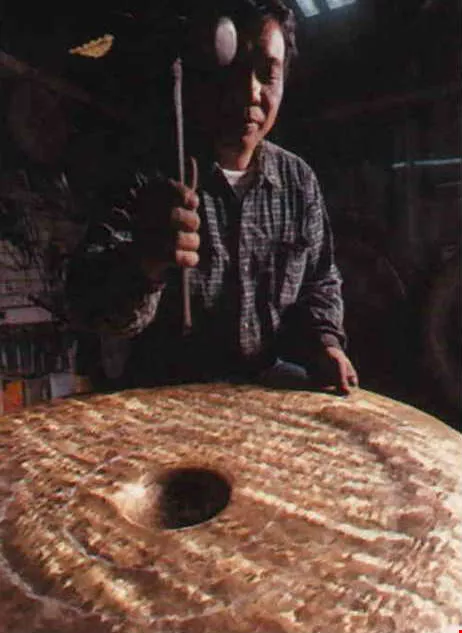
A bronze platter is first stamped out to match the customer's size specifications. Lin Lie-chi then places it on a wood block and pounds out a navel of just the right size. The platter is then hammered some 10,000 times to improve density and strength. The rim is prepared in the same manner and welded to the platter. A lot of tuning work remains to be done at this point.
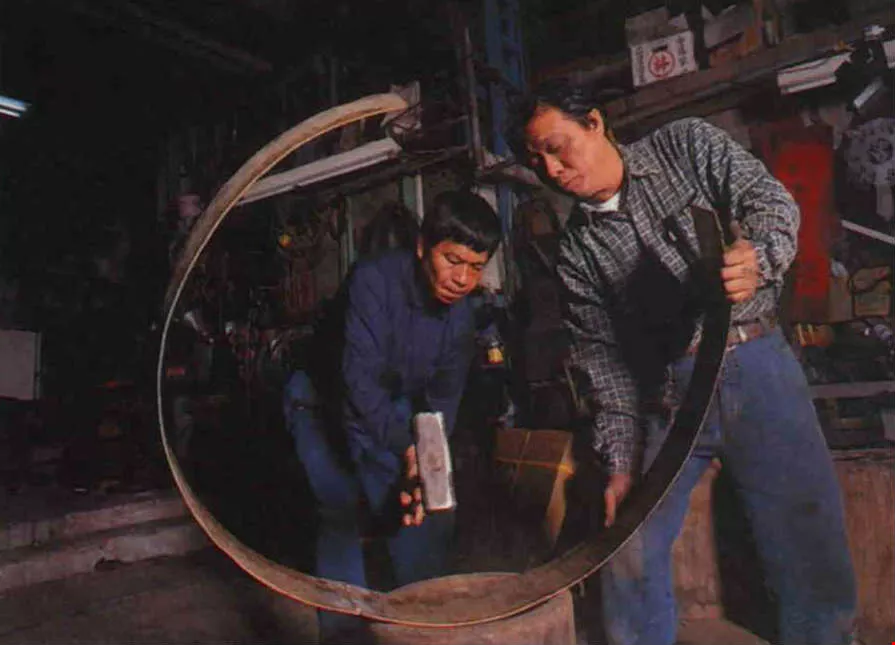
A bronze platter is first stamped out to match the customer's size specifications. Lin Lie-chi then places it on a wood block and pounds out a navel of just the right size. The platter is then hammered some 10,000 times to improve density and strength. The rim is prepared in the same manner and welded to the platter. A lot of tuning work remains to be done at this point.
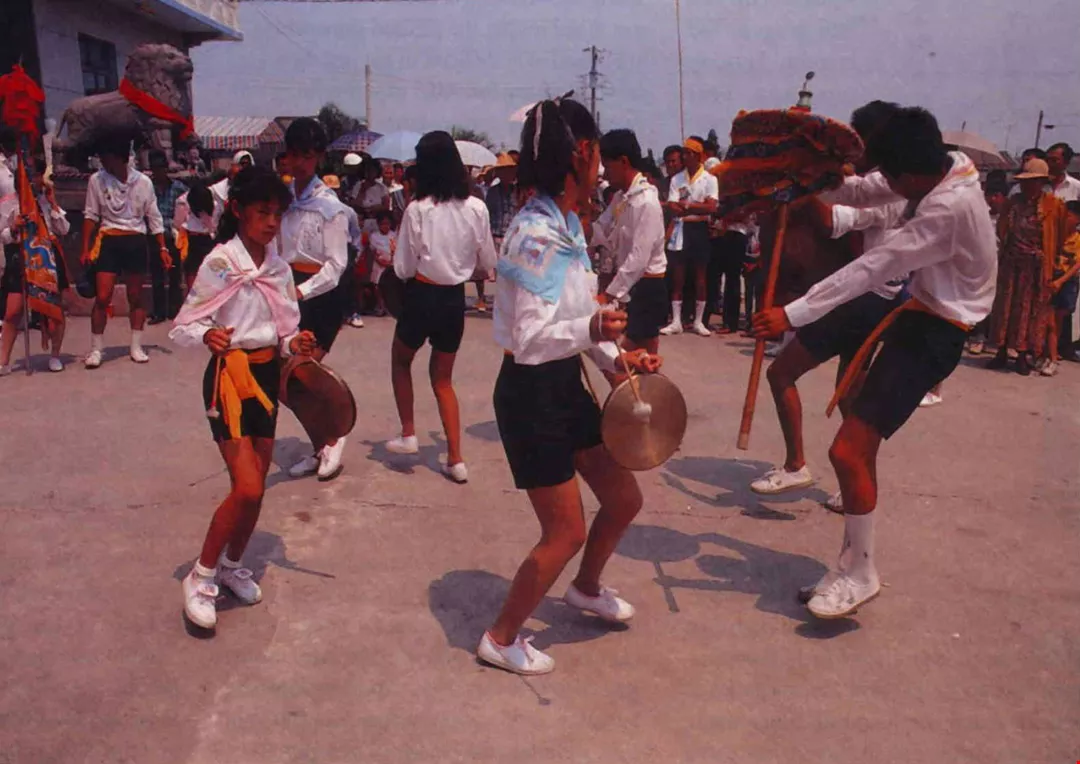
"Thwongggg... Dwongggg..." Gongs are the center of attention at traditional temple parades. Members of this tiaogu troupe sling drums or small gongs from their hips and dance frenetically in the streets. (photo by Cheng Yuan-ching)
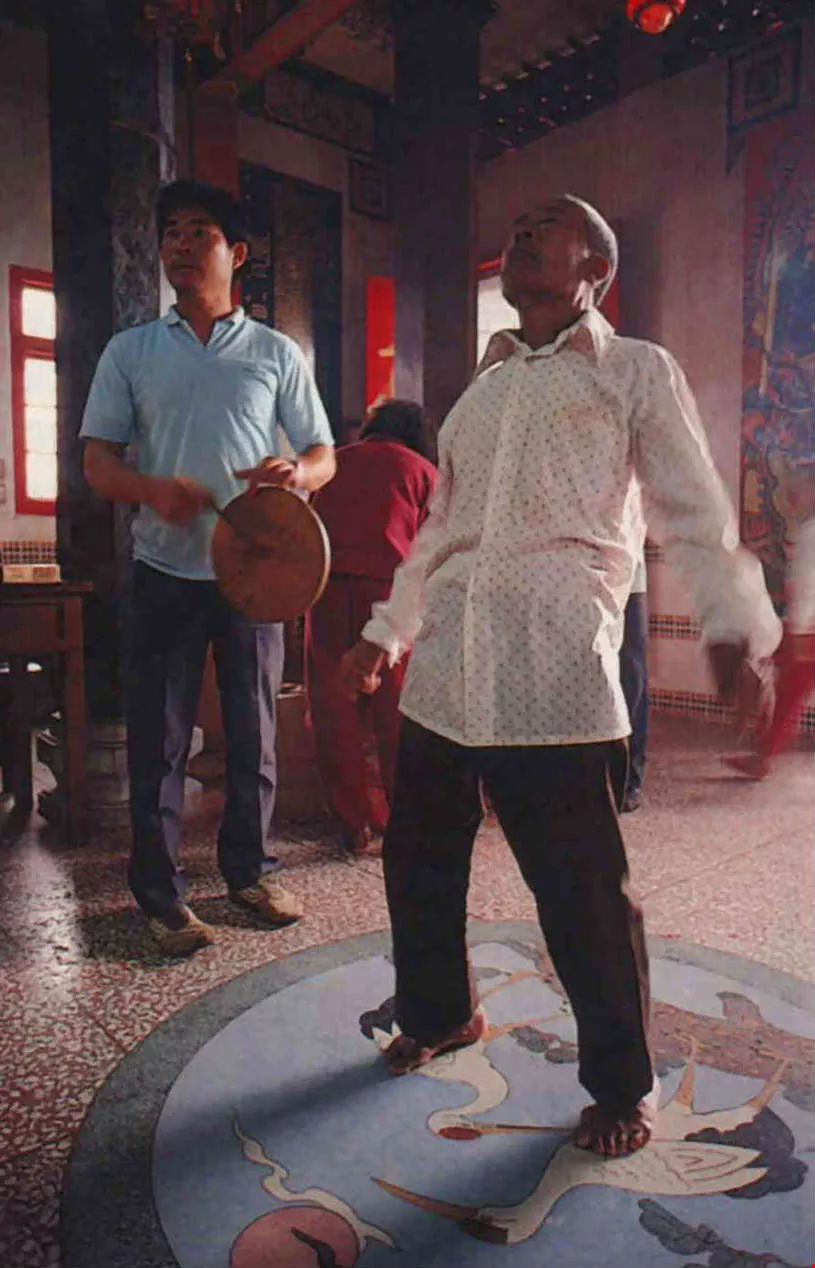
In the Chinese world, the simple sounds produced by drums and gongs have a mysterious power. Daoist priests and spirit mediums use them to open the doors to the netherworld.
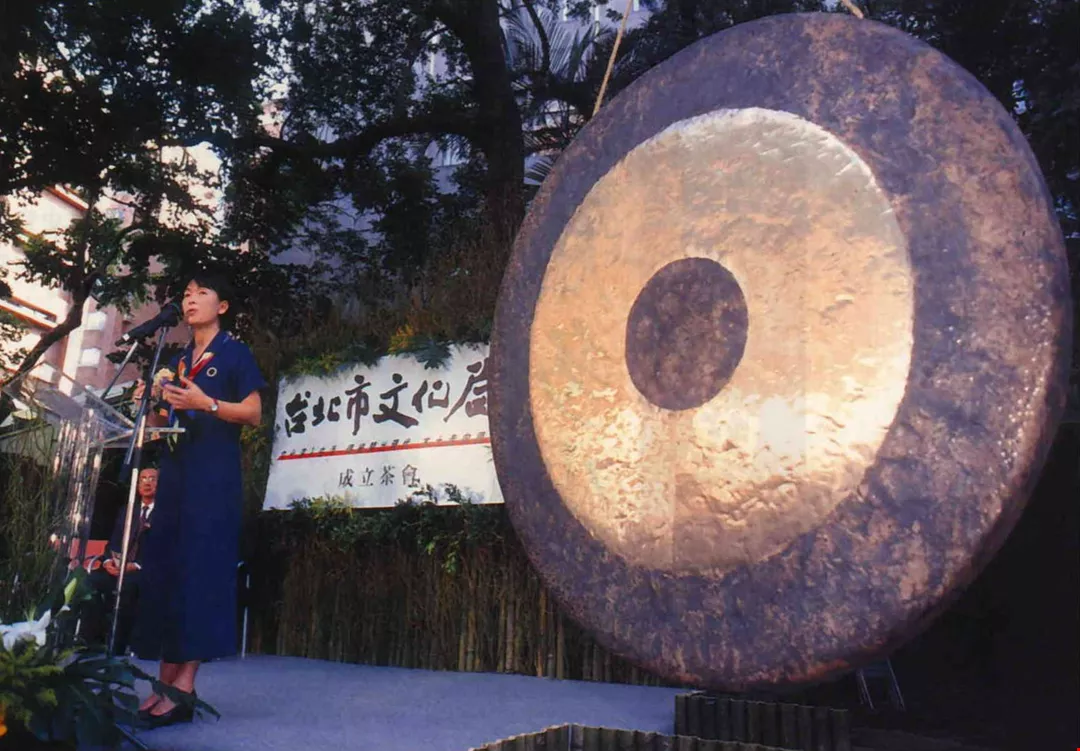
When a Chinese person wants to announce that an event is about to begin, he will shout, "Bang the gong!" And there needn't necessarily be a gong on hand for the banging! Lung Ying-tai, director of Taipei City's Cultural Affairs Bureau, is shown here striking a gong and announcing the establishment of the bureau. (photo by Diago Chiu)


@List.jpg?w=522&h=410&mode=crop&format=webp&quality=80)


