"Return" on Their Investment--Taiwanese Businesses Head for Home
Coral Lee / photos Chuang Kung-ju / tr. by Scott Williams
January 2009


In 2008, the hundreds of thousands of Taiwanese businesses with operations in mainland China faced a grim situation, the like of which they'd never seen before.
Beginning in June 2007, measures adopted by the mainland authorities, including a reduction in export tariff rebates and the passage of the new Labor Law, were knives to the heart of Taiwanese-owned export-oriented businesses. One thing followed another in a seemingly endless succession. European and American orders shrank following the explosion of the US subprime mortgage crisis in late 2007, and Taiwanese firms along the Chinese coast began going under or relocating to the south and the west in 2008. As the financial crisis went global, many Taiwanese businesses found themselves in dire straits.
In this time of domestic and foreign crisis, the one bright spot has been the Ma administration's resumption of talks with mainland China. The direct cross-strait flights long sought by Taiwanese businesspeople became a reality in mid-December 2008 with the opening up of the so-called "three links." The shorter air routes made possible by direct flights will greatly reduce travel times and transportation costs, and should thus boost the competitiveness of mainland-based Taiwanese businesses. However, given the increasing difficulty of life abroad, the proximity of home, and the chronic push and pull of the cross-strait situation, the return of Taiwanese firms from China to Taiwan looks set to become a trend. But Taiwan itself has limited resources and is being ravaged by the global crisis. Should we be urging successful businesses to come back and invest some of the wealth they've acquired into their hometowns? Or should we be opening our arms wider, to give struggling firms an escape route back to a Taiwanese safe haven?
In fact, the ROC government has been rolling out incentives like loans and preferential leases to Taiwanese businesses since the investment climate in China began to change in 2006. In 2008 it went even further in its efforts to bring back Taiwanese businesses and encourage them to upgrade their technology, by introducing measures that offer, among other things, R&D assistance.
According to the Ministry of Economic Affairs, between September 2006 and October 2008 Taiwanese businesses in China invested a total of NT$33 billion in over 150 projects in Taiwan. Though this number pales in comparison to the more than 3,000 Taiwanese investments in Vietnam in 2008, their stories offer food for thought for policymakers and Taiwanese businesses unsure which way to turn.
Turning down a nondescript street off of the highway between Danshui and Jinshan on Taiwan's northern coast, we enter a factory belonging to Jhih Cheng Non-Woven Co., Ltd. A dozen or so machines are working busily. Strands of yarn are run through warping machines and wound onto reels. In the middle of the factory, blending and combing machines turn short fibers into comber web, several sheets of which are bound together in bundles. At the back, the cotton-wool shaped bundles are run through another machine and sewn up with yarn to make bundles of greige fabric. Once shaped, the greige becomes stitchbond fabric, a material used to strengthen the lining and insole of shoes.
The facility is very much that of a "traditional manufacturer," but you can sense the drive to draw on the strengths of both sides of the Taiwan Strait to grow itself, a characteristic common among the Taiwanese small-and-medium enterprises that operate in China and Taiwan.
Established in 1993 in Taoyuan County, Jhih Cheng now has production lines in Danshui, Taipei County and in Guangzhou, mainland China. When its growth over the last couple of years left with insufficient capacity to meet demand, it began making plans to expand into Indonesia. But Jhih Cheng changed its mind when a Taiwanese competitor closed a factory in early 2008. Unwilling to see equipment from that facility end up in the hands of a rival, Jhih Cheng bought it for nearly NT$50 million. In so doing, it moved the focus of its development back to Taiwan.
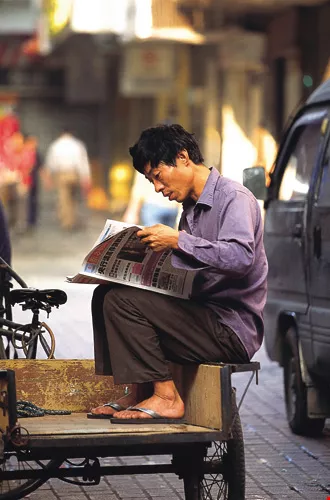
Over the last year, China has rolled out a series of measures aimed at making adjustments to its export framework, a new labor law among them. These measures have made it more difficult for small foreign-owned factories, including Hong Kong and Taiwan-invested facilities, to operate. Bitter "runaway" disputes have become more common, harming firms and their mainland employees and worsening the cross-strait economic situation.
Tremendous flexibility
"We increased the number of Taiwanese production lines from six to 20, added 40 people, and broadened our production " says David Lai, the second-generation head of the company, who heads up its Taiwan operations. "We can now handle orders for both high- and low-end products." Lai explains that his clients are moving toward a zero-inventory "just-in-time" production model, which requires that Jhih Cheng be able to rapidly deliver small volumes of a variety of products.
"If your clients want 100 different kinds of fabric, you can't produce just 99," argues Lai. He says that Jhih Cheng's Guangzhou factory is limited by its equipment to the manufacture of 14-stitch-per-inch stitchbond fabric (the greater the number of stitches per inch, the higher the quality of the stitchbond). The company's well managed and adaptable Taiwanese factory specializes in handling orders for high-end and highly diverse low-volume products. Its margins are higher than those of the Guangzhou facility, but small volumes don't yield much profit even at high margins. With the economy slowing, companies must be able to handle orders both large and small to keep earnings growing. Jhih Cheng's expansion in Taiwan has given it means to produce 14-, 18-, and 22-stitch-per-inch stitchbond, double-needle stichbond and high-end fabrics that require complex processing.
The return to Taiwan not only expanded Jhih Cheng's production space, it also made it eligible for support from the Taiwan Textile Research Institute (TTRI). The Ministry of Economic Affairs (MOEA) has for some time been using loans and the 006688 Program, which offers leases at preferential rates, to encourage Taiwanese businesses interested in upgrading their technology to come back to Taiwan. In May 2008, it also rolled out a program that recruited 16 industry groups (including TTRI) to help companies evaluate their technologies and guide their R&D.
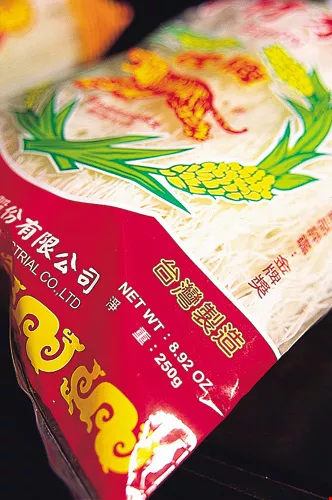
Burned by an investment in Xiamen, Tiger Food chairman Lin Ming-tung invested back in Taiwan in 2006. His company has also been developing the world's first automated rice-noodle production line in an effort to cut labor costs.
Technical support
TTRI first visited Jhih Cheng to better understand its needs. It discovered that David Lai was very interested in bringing in new technology and innovating. TTRI provided technical assistance, enabling the company to improve the wear resistance and elasticity of its fabrics and institute environmentally friendly manufacturing processes. It also helped Jhih Cheng get support to further upgrade its technology from the MOEA's Small Business Innovation Research (SBIR) program.
"SBIR approved our application," says Lai. Becoming animated, he explains that SBIR enabled them get more out of their machines by helping them develop woof structures that allow them to weave in silver fibers with antiseptic properties, elastic yarns that support the knees, or luminous threads that aid nighttime visibility. The government funded 40% of the research (about NT$1.4 million), which is now yielding patents for Jhih Cheng.
"If an overseas Taiwanese textile maker is already moribund, facing bankruptcy and the closure of its plant, coming back to Taiwan won't save it," says Chiu Sheng-fu, head of TTRI's Department of Industrial Information and Service. "Those that return usually have skills and an interest in upgrading, or produce functional and industrial textiles." TTRI has been visiting returning Taiwanese businesses since it accepted the MOEA's commission, and Chiu says that it has achieved good results with the roughly ten firms with which it has worked over the last six months.
According to the MOEA's Department of Investment Services, more than 90% of the 150-plus returning companies that have invested NT$33 billion back in Taiwan have, like Jhih Cheng, never abandoned their Taiwanese operations. Their typical cross-strait division of labor has been to produce high-end, distinctive, or low-volume/highly variable products in Taiwan while making low-end products or high-volume new products utilizing mature technologies in China. Many Taiwanese firms have chosen to invest in upgrades in Taiwan once their "volume" operations in the mainland began making money. One reason many Taiwanese firms have been reluctant to cut their ties to the island is that whereas Taiwanese firms doing R&D in China have real concerns about their intellectual property being leaked to others, those operating in Taiwan have long received R&D guidance and technological support from the Taiwanese government.
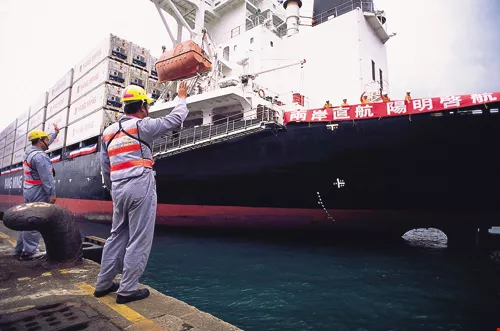
The opening up of the three links will facilitate flows of goods, materials, and personnel across the Taiwan Strait. These freer exchanges are widely expected to bring another wave of Taiwanese business back home from the mainland.
A little compressor giant
Hanbell Precise Machinery, the world's fourth-largest maker of compressors, is another firm that was quick to recognize the value of the Taiwanese government's technological support and therefore retain its Taiwanese business while growing its mainland business. Hanbell had its cross-strait business model worked out by the time it opened a plant in China in 1998: It was establishing its Shanghai base to get into the China market, and would continue to use its Taiwan facility to sell to the global market and develop high-end products.
Few people know that Hanbell made the compressors at the heart of the air-conditioning systems of the Taipei Arena, the Beijing Airport, and the Seoul Airport. Powered by its screw-rotor technology, the company ranks number one in market share in Taiwan, China, and South Korea. Liao Zhenan, the company's chairman, developed the technology himself after realizing 20 years ago that Taiwan's appliance manufacturers, including Teco and Sampo, were totally dependent upon Japan for their compressors. Liao believed that Taiwan needed to develop its own technology if it was to avoid forever being "colonized" by foreign firms. When he left Teco, he recruited some like-minded individuals and established his own business with a strong emphasis on R&D. He then worked with the Mechanical and Systems Research Laboratories (MSRL) at the Industrial Technology Research Institute (ITRI), gradually creating the core technologies he needed.
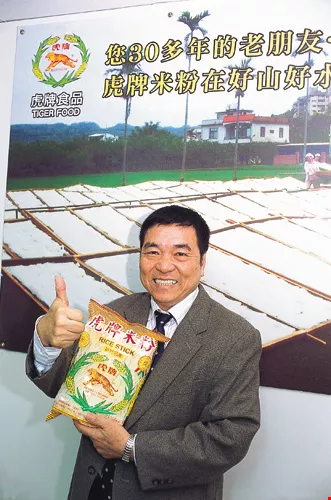
Burned by an investment in Xiamen, Tiger Food chairman Lin Ming-tung invested back in Taiwan in 2006. His company has also been developing the world's first automated rice-noodle production line in an effort to cut labor costs.
Growing in step
By spending 7% of its annual revenues on R&D and maintaining its long-term partnership with ITRI, Hanbell has developed the technology to build refrigerant compressors (for air conditioners), air compressors (for industrial use), and refrigeration compressors (for refrigeration equipment). In more recent years, it has entered the high-tech arena via its development of a dry vacuum pump used in the manufacture of semiconductors and printed circuit boards.
According to Fang Hongsheng, Hanbell Taiwan's R&D manager, the company's Taiwanese production is oriented toward low-volume, big-ticket products that require little labor to manufacture. Because direct labor inputs account for only about 7.5% of the cost of these items, there is little economic benefit to relocating their production to the mainland or Southeast Asia. It sells these products in European, American, and Japanese markets, where local manufacturers have a hard time competing with Taiwanese firms' lower costs.
In China, Hanbell produces standardized products in large volumes. There, the company has been able to overcome strong rivals from Germany, the US, and Japan by focusing for a decade on branding and service. Take the way it dealt with the unstable power supplies common in the early years after China's economic liberalization. Compressors from other countries would trip their breakers when the voltage fluctuated. While German manufacturers simply stated that the problem had nothing to do with their products, Hanbell developed products that could tolerate voltage fluctuations of up to 100 volts. By designing a product capable of operating normally in spite of unstable voltages, Hanbell was able to win 35% of the Chinese central-air-conditioning compressor market.
With sales soaring, Shanghai Hanbell listed on the Shenzhen stock exchange in 2007, becoming one of the few Taiwanese companies to trade as an A-share in the Chinese market. In 2006, Taiwan Hanbell also invested NT$630 million in an expansion in the Taichung Precision Machinery Park that it expects to bring online in 2009. This two-pronged strategy of building its brand within the Chinese market while pursuing R&D innovations in Taiwan has earned Hanbell the nickname of the "little giant" of the compressor industry.
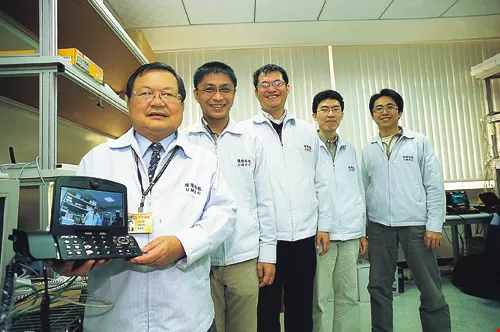
UMEC chairman Jimmy Ou (far left) has long used the money his firm makes in mainland China to pay engineers in Taiwan to develop new product lines. Fortunately for the company, the videophones it developed a decade ago are generating good returns in these tough economic times.
Upgrading
Communications powerhouse Universal Microelectronics (UMEC), which has long striven to make investments and grow at the same pace on both sides of the Taiwan Strait, provides another model for coming home.
When the Internet bubble burst and pushed the global economy into recession seven years ago, Taiwan's consumer electronics companies began moving more of their operations overseas and increasing their investments in mainland facilities. But UMEC chairman Jimmy Ou decided to take his company in a different direction-he spent NT$700 million on a new facility in the Taichung Industrial Park to enter the fiber-optic field that was then just taking off.
"We are a Taiwanese business and have to give some thought to Taiwan," says Ou. "What would our employees do if we took the entire company overseas?" Ou, a modest and amiable figure described by the media as a "quintessentially Taiwanese businessman," says that the company had no choice but to move what was then its core business-manufacturing network transformers, power supplies, and peripherals for other companies-to China because its customers had moved there and competition was fierce. But Taiwan remains its base for the manufacture of high-end and high-value-added OEM products like radar, and for the development of new products, such as fiber-optics, videophones, and GPS systems. UMEC transfers production of products to China when their manufacturing technology matures or when their prices face pressure. This allows its Taiwanese headquarters to focus on technological advances.
Most export-oriented tech companies have prioritized expanding their China operations and fighting tooth and nail to grow sales. "Not many have balanced mass production and R&D the way we have," says Ou, explaining that his company strives to leverage the strengths of both sides of the strait for maximum effect.
To ensure that it continues to incubate future product lines, UMEC has more than 100 of its 600 Taiwan-based employees working on R&D. "R&D and innovation are difficult processes," says Ou. He explains that the company uses the money it earns from its China operations to pay engineers in Taiwan to develop completely new product lines. The failure of even one of these could wipe out the company, but keeping the company viable in the future requires that they take the risk.
He cites as an example the company's videophones, for which they finally received their first large order in 2008. UMEC plunked down the money to develop the phones ten years ago, but in those days there was too little bandwidth to rapidly transmit images. As a result, their phones sold poorly in spite of good reviews. Now that bandwidth has increased and a business model has taken shape, the company scored a large order from an American telecom. UMEC's video phones are at last bearing fruit, ten years after their initial development. In fact, they've helped offset some of the first- and second-quarter losses that the tech-industry slowdown has visited on the company's mainland facility. They've even realigned the company's cross-strait revenue distribution, raising the Taiwan share from 30% to more than 50%.
UMEC has forged ahead with its R&D and integration efforts for more than 20 years, devoting 4% of revenues to R&D every year. Focusing on network communications, the company has integrated vertically by expanding from parts and modules to systems, while also branching out horizontally into broadband, fiber-optic, and wireless products. UMEC has even ventured into the newest segment of communications field-passive optical networks (a large-bandwidth, point-to-multipoint optical network architecture)-moving beyond the manufacture of parts to the integration of modules. Here too its long-term objective is to produce complete systems.
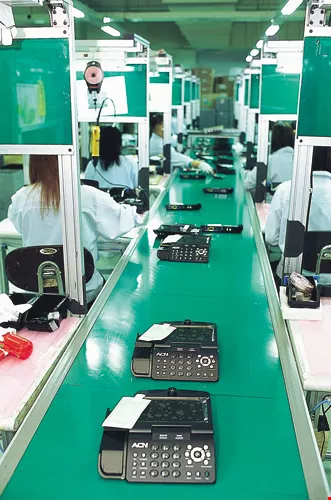
Universal Microelectronics kept its high-value-added and customized production in Taiwan when it relocated its low-margin production to mainland China. It's a model often followed by Taiwanese firms with a cross-strait division of labor. The photo shows UMEC's Taiwan-based videophone production line, the world's largest.
Growing while others decline
Some companies have been simultaneously repelled by the mainland's deteriorating investment environment and drawn to Taiwan's aggressive solicitation of investment.
"There are way too many uncertainties in the mainland," say a number of returning businesspeople who prefer to remain anonymous. These individuals blame their pullout on everything from the legal and tax systems to the attitude of administrative officials, and cite the mainland's new Labor Law as a case in point. Though the policy was announced a year in advance, the law was implemented before the accompanying regulations were ready. Companies wanted to obey the law, but didn't know how to. Their lawyers told them one thing, while Communist Party functionaries said something else. The management costs were huge.
In addition, the mainland began implementing numerous currency controls in July 2008 in an effort to reduce currency speculation and stabilize its financial markets. "You have to report every advance receipt, prepayment, and late payment," says an industry insider. Companies have to provide an explanation if they haven't received payment 90 days after the shipment of goods, and those making deposits on orders of raw materials have to provide written guarantees or be suspected of placing false orders. "This kind of interference reflects a complete lack of understanding of how business works," say industry insiders. The process is overly complex, affects how firms deploy their capital, and impacts their relationships with their customers.
With Taiwanese firms getting fed up with the constant barrage of bizarre rules, Taiwan's policies are making the island more attractive at just the right time. Yilan County magistrate Lu Guo-hwa's aggressive pursuit of business investment is a case in point.
Lu's first catch was Sheico, a global leader in watersports apparel manufacturing that has been investing overseas for ten years and currently employs 8,000 people worldwide. Headquartered in Yilan, the company recently elected to expand its spandex production in Taiwan rather than Haining, Zhejiang Province.
"First, we had regular visits from the county's Industrial Development and Investment Promotion Committee [IPIPC]," says Huang Guizhen, head of Sheico's legal department. "Once they discovered we were interested in coming back, the county magistrate arranged a meeting with the public works bureau, environmental protection bureau, and all the other relevant bureaus and departments. We were able to resolve all the questions pertaining to the construction of the factory in just two hours. Our president decided right then and there to come back."
IDIPC head Andy Lo, tasked with bringing businesses to Yilan, says Sheico estimates that the cost differential between Chinese and Taiwanese production has fallen to 8% and will narrow further. That has left the company with little incentive to deal with the headaches of overseas production. The company will get to work in its homeland, and will make up the cost differential on higher yields and better management.
For companies under the gun to deliver orders, time is money. The liaison office at Yilan's Lize Industrial Zone calls firms in the park daily to check on the progress of their construction. Sheico is finding the pro-business attitude of Yilan's government since the new county administration took office a very pleasant contrast to the blatant disinterest shown by mainland officials since its economy took off.
Now that Sheico's automated spandex facility is complete and its equipment installed, it has moved into the testing phase. Once it begins mass production, the company plans to rapidly ramp its annual capacity up from its current level of 12,000 tons per year to 30,000 tons, a level that would make it one of the world's top ten producers. Sheico projects that its new Yilan facility will create nearly 300 jobs. Meanwhile, the other half of the site sits ready to be put to use propelling the company to its second "world number one." (Sheico already ranks first in the world in terms of its watersports-apparel and watersports-fabrics production capacity.)
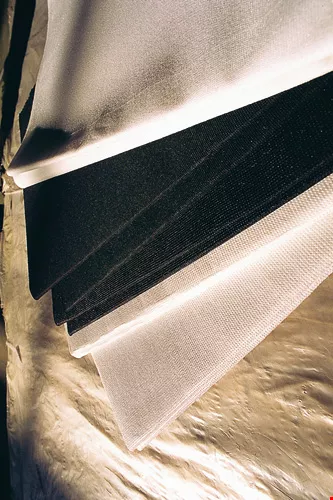
More than 90% of the Taiwanese firms operating in China who've chosen to invest back in Taiwan in recent years utilized a cross-strait division of labor that kept their roots in Taiwan. For a variety of reasons, these firms are now choosing to go long on Taiwan. The photo shows a small-run stitchbond fabric produced by Jhih Cheng Non-Woven Fabrics at the Taiwan facility it opened in 2008.
Firing up another oven
Faced with a deteriorating business in China and aggressively courted by Yilan, Tiger Food spent tens of millions of NT dollars to set up a facility in the Lize Industrial Zone in 2006. It has also sweated blood on its in-house effort to develop automated production equipment.
"We rushed back to take part in the 006688 Program," says Lin Ming-tung, Tiger's chairman. He explains that food processing is a labor-intensive industry, and that land and labor together account for about two-thirds of costs. The MOEA's 006688 Program and county government incentives for low-pollution factories essentially provide the company four rent-free years. In addition, the opening of the Xueshan Tunnel puts Yilan within an hour's drive of the company's headquarters in Taipei's Muzha area. Lin says he decided to shut down the company's Xiamen facility and bring its production back to Taiwan just ten days after Magistrate Lu personally visited the company.
Established in 1970, Tiger generates 70% of its revenues from exports to markets including Japan, the US, and Southeast Asia. Lin built a factory in Xiamen seven years ago to escape Taiwan's relatively high labor costs, but running it turned out to be tough. In addition to dealing with unproductive, difficult-to-manage workers, he had to contend with the mainland's inadequate infrastructure and measures that limited traditional manufacturers' use of oil and electricity, which compelled them to start their workday in the middle of the night. Plus, low-price competition from small rural factories effectively boxed them out of the mainland market.
Still bleeding from his China venture, Lin resolved to try a new strategy when he returned to Taiwan-automating to reduce labor costs. "We've built the world's first automated rice-noodle production line," he says. "It's like the Mercedes-Benz of the rice-noodle world!" Lin explains that the labor-intensive nature of rice-noodle production means that the quality of the noodles can vary greatly with the skill of the noodle-maker and the tiredness of the workers, and argues that his introduction of automated equipment will result in more hygienic, higher-quality noodles.
Unfortunately, Taiwanese rice-noodle companies are relatively small, and none had tried to automate production before. Therefore, none of the necessary equipment existed and the government had no technical support to offer. Tiger had to bear on its own the cost of hiring academics to help with equipment development and digital design work. "The first production line stumbled along for a year, but is now running at 80%," he says. Lin has spent a lot, but remains optimistic about the outlook for his company's transformation and upgrading. Since returning, he's also worked with the Jiaoxi Farmers' Association to develop a couple varieties of rice noodles made from rice irrigated with water from a hot springs. Lin claims these are more tender and chewy, as well as more easily digestible than ordinary rice noodles. Tiger will begin selling them once the new factory officially opens in March.

New cross-strait situation
CB Carbide, which is investing in Taiwan in anticipation of improvements in the cross-strait political and economic situation and the implementation of the "three links," is typical of the Taiwanese companies that grew large abroad and are now investing back in their homeland.
CB Carbide makes tungsten carbide, a compound of carbon and tungsten that is nearly as hard as diamond, is resistant to both impact and wear, and has a melting point above 2800oC. Widely used in molds and tools, it has broad industrial applications.
CB Carbide began life as a trader dealing in screw-making machinery. It then began producing carbide molds and by 1987 controlled 75% of the Taiwanese market. In 1987, it invested in China, opening a facility in Xiamen intended to help it ensure stable supplies from the Chinese mines that are the source of more than 70% of global production of tungsten ore. Over the course of 13 years, it moved into molds, refining, and smelting, becoming the world's only fully integrated carbide producer. In the years since, its annual revenues have grown from NT$1.5 billion to NT$12 billion, earning it the nickname "King of Carbide."
Over the same period, the company transitioned from making traditional carbide blanks to producing small blanks for the tech industry. The Hon Hai Group, for example, gets more than half of the carbide it uses for the more than 10,000 precision dies it develops every year from CB Carbide.
In 2006, CB Carbide chairman Liao Wan-lung spent NT$1.5 billion to buy a factory in Taipei County's Wugu Industrial Park and imported a dozen or so precision smelters from Germany to produce high-end carbide and guarantee the company's delivery dates.
"Taiwan is my home," says Liao, who still remembers receiving the first "young entrepreneurs loan" of NT$400,000 from the late President Chiang Ching-kuo's own hand. Liao built his business on that money, and believes that no matter what kind of success Taiwanese businesspeople achieve abroad, it counts for nothing unless they bring it back home. He himself began thinking of reinvesting in Taiwan a number of years ago, but the time wasn't right-there was too much cross-strait tension and the government was hostile to Taiwanese businesses that had invested in the mainland.
Generally speaking, most of the Taiwanese firms that have invested back in Taiwan are those that have kept their roots here while allocating resources on both sides of the strait, those who have grown large overseas and have come back with capital seeking technological support, and those that have upgraded on their own and decided to return to their homeland. With Taiwan opening up direct cross-strait flights and the three links, and the Chinese, Taiwanese, and Southeast Asian economies becoming ever more tightly integrated, we can only wonder what the future has in store for these companies.


@List.jpg?w=522&h=410&mode=crop&format=webp&quality=80)


