The Trustworthy AI Dialog Engine (TAIDE), a chatbot under development by the National Science and Technology Council (NSTC), is being trained on uniquely Taiwanese corpora, so that its information pertaining to Taiwan is correct and comprehensive. Industry, government, and academia have used the TAIDE model to develop applications in such fields as agriculture, healthcare, and smart manufacturing. In the process, they have made great strides toward the development of sovereign AI.
TAIDE is the result of a project launched in April 2023 by NSTC to develop a generative AI chatbot (“AI model”) and large language model (LLM).
To better understand the subject, we visited the National Center for High-performance Computing (NCHC), which is building a new generation of supercomputers and developing a training platform for TAIDE’s large language model.

A language model suited to Taiwan
NCHC director general Chang Chau-lyan clarifies what TAIDE is not: “Many people mistakenly believe that TAIDE is supposed to replace ChatGPT with a Taiwanese version of ChatGPT.”
“But that was never the idea.” Instead, the TAIDE model concentrates on five main functions: Chinese-to-English translation; English-to-Chinese translation; email writing; automatic summarization; and article writing.
In these five main functions, TAIDE is far better adapted to Taiwanese culture than any model developed elsewhere.
Chang points out that 90% of the Chinese-language corpora utilized by mainstream international AI models come from China, which means Taiwan consciousness and Taiwan’s mainstream culture get marginalized and diluted because almost all the AI data is from China. When users of a mainstream international chatbot ask about Taiwan, the AI model inevitably answers from a Chinese perspective.
Industry, government, and academia in Taiwan therefore began calling for the development of an AI model that would emphasize Taiwanese culture and a Taiwan-centric perspective. These calls gained the support of Wu Cheng-chung, former minister of the National Science and Technology Council.
Within a year after the launch of the TAIDE project, the TAIDE model was able to give accurate, complete answers to questions related to Taiwan.

Chang Chau-lyan says that around the world the copyright-law concept of fair use is being applied to the development of generative AI. AI is like a really smart person who has read lots of books and remembers tons of information. The only difference is that AI is more powerful than people. It can read more books, and remember a lot more information. (photo by Jimmy Lin)

Both a feature and a bug
This is the biggest difference between TAIDE and international models. Beside the fact that TAIDE is Taiwan-centric, the model is further strengthened by licensed access to databases of the Central News Agency, Taiwan Panorama magazine, Public Television Service, various central government agencies, various legislative databases, Taiwan Cultural Memory Bank, and various online dictionaries.
Data collection difficulties are the biggest roadblock for TAIDE at this point.

Computing power is national power
Liu Ching-yi, vice chair of the Taiwan AI Center of Excellence (Taiwan AICoE) and a consultant to the Internet Governance Forum (IGF), emphasizes the importance of Taiwan having sovereign AI. “Sovereign AI doesn’t just serve to maintain linguistic and cultural diversity, nor does it simply play a role in hard power struggles. Beyond those things, it is part of a struggle over democratic values.”
Chang Chau-lyan notes that the term “sovereign AI” includes at least three elements. The first is data sovereignty. The second is computing power sovereignty. And the third is AI model sovereignty.
As for computing power, in addition to the Nano 5 supercomputer, which NCHC brought online in 2025, NCHC is also scheduled to bring online a new-generation Nano 4 GPU supercomputer at a new computing center that it completed in September 2025 in Tainan. The Nano 4 will employ the most advanced equipment, including 4 nm chips from TSMC as well as GB200 and H200 GPU clusters from NVIDIA. The Nano 4 supercomputer is expected to go online in the first half of 2026.
Stating that “computing power is national power,” Chang Chau-lyan declares that Taiwan can be proud that the world’s most advanced chips are all manufactured in Taiwan, and notes that most people overlook the fact that 90% of the world’s high-end servers are produced in Taiwan, almost exclusively for export.
On May 7 2025, the industrial community established the Super Computing Alliance Taiwan to build a Taiwanese computing ecosystem that is both sovereign and reliable. Through public–private cooperation, the alliance hopes to further enhance Taiwan’s impact on global AI technology and high-performance computing.
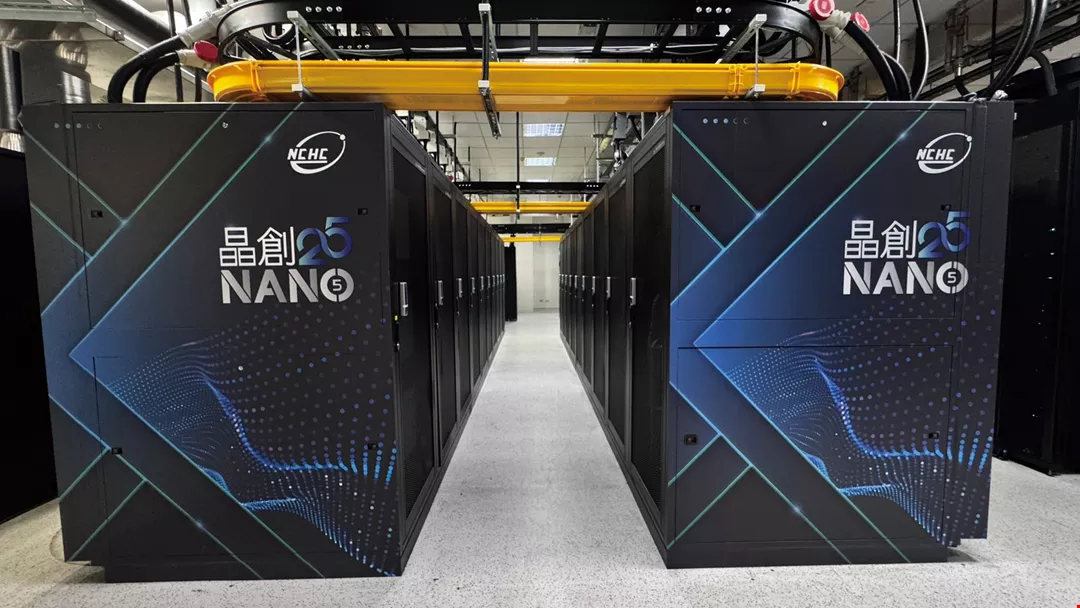
The Nano 5 supercomputer was brought online in 2025. (courtesy of NCHC)

Future trends in AI models
Moving forward, says Chang Chau-lyan, AI models will use the advantage of large models to train smaller models to complete small, basic tasks; or they will gather multiple AI agents together to complete complex multifunctional tasks. This is the future direction of AI model development.
NCHC is moving in this direction with the cloud-based AI RAP platform it is currently developing. When small and medium-sized businesses, startups, or academic institutions seeking to develop apps need a Chinese-language corpus, they can act via the AI RAP platform to reach the greatest possible number of people in Taiwan.
AI agents will come into increasing use in the near future.
