"Proxy sales" offer an opportunity
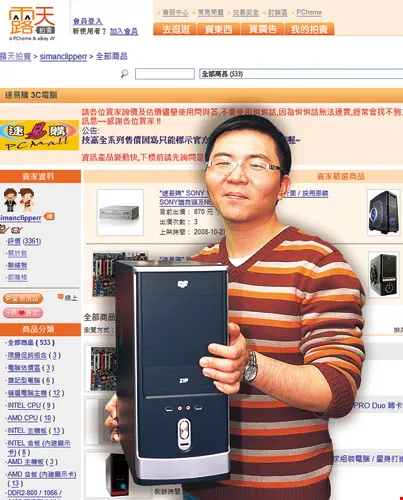
The online seller offering this insightful analysis of the situation at Guanghua Market is himself a veteran of the market with 10 years' experience there. The 36-year-old Cai explains that not long after completing his national service, he took up a job at Guanghua Market driven by his interest in assembling computers. From front-line sales, to assembly and maintenance, to handling orders and purchasing, he's done it all. "I just hadn't been the boss yet," he laughs.
In early 2007, he left the computer market after he and his new boss didn't see eye to eye, moving into a new line of work in finance selling stocks.
"I pretty soon realized that I'd hardly even be able to support myself though, so after a year and a bit I hit the road."
Whiling away his unemployment at home, Xiao Cai became the go-to guy for his friends when they needed someone to build a computer for them. Everyone knew he knew where to get the cheapest parts, and some "friends of friends" began asking him to buy for them.
Eventually making two runs to Guanghua Market every three days to help more and more friends of friends, Xiao Cai began to wonder why he shouldn't just start his own business and make his orders that way. He started with a small inventory made up of the leftovers his friends didn't want, putting them up online for auction.
"Since I don't need to pay the massive rents of Guanghua Market and don't have the pressure of having to hire and pay staff, I can cut a little more off my prices, and quickly my sales got noticed by more and more people online, so I started increasing my stock," says Xiao Cai.
Garnering good reviews
Cai first set up shop on Yahoo! Auctions, the most popular such site at the time, but soon afterward Yahoo! began levying a 3% transaction fee. Despite having only just started his auction business, Cai was giving as much as NT$20,000 a month to Yahoo! in these fees; "I was practically giving them all my profits!" says Cai. Soon he decided he'd had enough and moved his business over to Ruten, which is entirely free to use.
Formed through a partnership between PChome and eBay, Ruten was a latecomer to the field, and when it first started it lagged behind Yahoo! substantially in popularity with buyers and sellers alike. To expand his client base, Xiao Cai decided to focus on volume of sales rather than large profit margins, offering low prices on CPUs, hard disks, motherboards, and graphics cards, making at most NT$50 per unit.
"The parts we sell are the same quality, but anything from NT$500 to NT$1000 cheaper than what you'll find at Guanghua Market," says Cai confidently.
As well as offering low prices, Cai focuses on interacting personally with each client, making him a standout popular seller.
As an example, if a potential buyer asks a question on an auction, Cai will answer in as much detail as he can as soon as he can. He also goes onto popular electronics community sites Mobile01 and Yahoo! Knowledge (a Taiwanese site similar to Yahoo! Answers) to answer any and all kinds of computer questions, adding a link to his store to his posts.
"I figure it's a great way to increase visibility for my store," says Cai, "and next time the people that frequent these sites need to buy or install a new computer part, there's a better chance they'll think of me."
From basement to storefront
Soon Cai's store on Ruten, with its low prices and excellent service, earned over 1000 points in positive reviews on the site. Having started off secreted away in the basement doing business, Cai began considering setting up his own bricks-and-mortar store.
A majority of his business, says Cai, was small workshops installing parts or repairing computers for others. They often needed parts urgently, so he was always getting phone calls asking him to hop on his scooter and deliver as soon as possible.
"I don't live too far from Taipei Main Station, so most of my buyers would pick up their purchase at the station, but the times were always different. Some computer parts are not light, and at one point I made 10 delivery runs in one day. When I got home, I was knackered," he remembers.
Early last year, to offer better times and a better place for himself and his most frequent customers, Cai rented a relatively cheap store on Bangka Boulevard in Taipei's Wanhua District, inviting some of his old colleagues from Guanghua Market to help out. He had become a real boss.
Now the store is doing business of over NT$10 million a year, and when rent, payroll, and the cost of bringing in products are taken off, Xiao Cai is making NT$40,000 a month.
"It's pretty good pay considering the economy, and the store is all mine. Watching my business grow over time is just beyond description, and it's miles better than working for someone else," he laughs.





@List.jpg?w=522&h=410&mode=crop&format=webp&quality=80)


