Elan Microelectronics: Patent Warrior
Lin Hsin-ching / photos Chuang Kung-ju / tr. by David Smith and Phil Newell
April 2014


Patent wars are raging across the world, the intangible battlefields of the modern marketplace. In the electronics industry, with its short product cycles, the fighting is especially vicious. Big makers such as Apple and Samsung are frequent and formidable litigators who file patent infringement suits not just to protect their own intellectual property rights, but also to disrupt the plans of competitors. An infringement suit can force another firm to delay a product launch, for example, or stay out of certain markets.
But international litigation requires careful preparation. Even more, it requires very deep pockets, which means that Taiwan’s relatively small firms generally find themselves on the defensive, required to pay for expensive patent licenses just to survive.
Against all odds, Elan Microelectronics, a maker of touch screen controller integrated circuits (touch ICs) which was recently one of the winners at the 2nd Mittelstand Awards, staged by the Industrial Development Bureau of the Ministry of Economic Affairs, is one of the few Taiwanese firms to have successfully taken on the Goliaths of this economic sector. Elan has successfully filed and won separate international lawsuits against two of the “biggest fish in the sea”—Synaptics and Apple. These victories not only have resulted in Elan receiving US$20 million in royalties, they also firmly established the company’s leadership status in the global touch IC market.
Using your fingers to slide images around or control window size; turn, scroll through, or rotate pages; and even draw pictures, write Chinese characters, and give commands… touch control technology has already become tightly interwoven with our daily routines. These days it is a de rigueur mainstream spec in electronic products. Everything from cell phones, laptops, PCs, and tablet computers to intelligent TVs that incorporate Internet functions, and the latest super-hip wearable devices (like “smart” eyeglasses and wristwatches) all have to come with powerful touch control capabilities. This is a market with enormous potential profits and virtually unlimited scope for the imagination.
And right here in Taiwan we have a firm that is the world leader in touch-screen technology. This company currently has a global market share of 25% for touch control pads and 42% for touch IC chips for laptops. Last year the conglomerate had total revenues of NT$7.795 billion with a 29% increase in net profits for the year, and their stock enjoyed after-tax earnings of NT$3.8 per share. This firm is Elan Microelectronics.
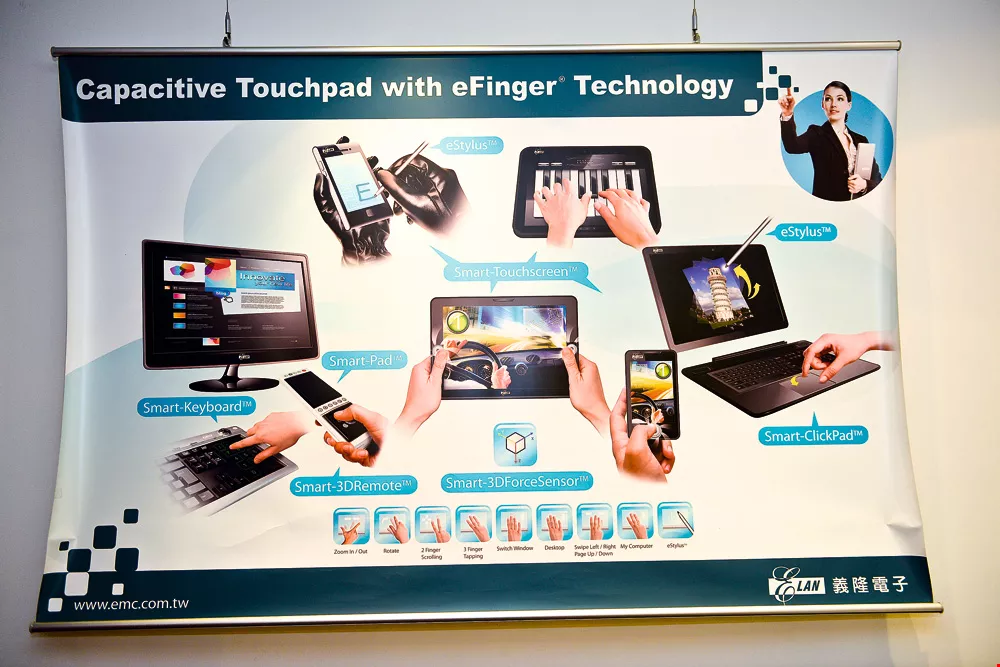
Elan possesses powerful multi-finger touch control technology. It works even if the user’s fingers are wet or gloved.
Elan chairman and president I.H. Yeh is a manager with an engineering background. With degrees from Taipei College of Technology (now National Taipei University of Technology) and the Graduate Institute of Electronics Engineering at National Chiao Tung University, he first went to work in the Electronics and Optoelectronics Research Laboratories at the Industrial Technology Research Institute. In 1987, he along with 20 of ITRI’s best and brightest, including his wife Olivia Yu, were hired away by Hualon Microelectronics, a subsidiary of the Hualon Group, to focus on designing IC chips for use in telecommunications.
In 1994, the R&D department at Hualon Microelectronics was spun off as Elan Microelectonics. Yeh, who had worked primarily on digital technology and digital signal processors, was designated chairman and general manager.
At first Elan’s main profit center was in designing ICs for telecommunications and consumer electronics. But as a result of its formidable R&D capabilities, the company kept coming up with novel products that rocked the marketplace. For example, in 1996 they came out with the world’s first ever caller ID with call-waiting capability, followed in 1998 by the Internet mouse and in 2000 by a scientific calculator.
In a more playful vein, following on the success of Japan’s Bandai Corporation with their Tamagotchi digital pet, in 1997 Elan hatched their own “electronic chicken.” It took the local market by storm, selling nearly 1 million units. Nearly every schoolchild had one, which they could use anytime and anywhere to feed their “chicken” and check on its health…. It remains one of the most deeply ingrained collective memories of that generation of Taiwanese schoolkids.
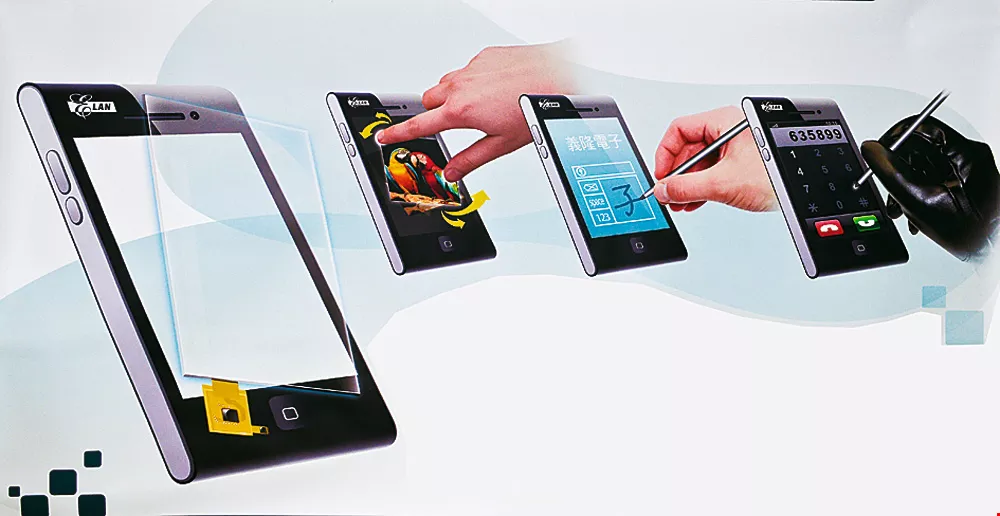
Elan possesses powerful multi-finger touch control technology. It works even if the user’s fingers are wet or gloved.
You might think that when the subject of the company’s past successes comes up, I.H. Yeh would do a bit of well-earned preening. But he knows that in the business world, you can’t live in the past. He points out that the consumer electronics market means lots of competitors, thin profit margins, and vulnerability to copying. Once the market for a given product is saturated, it no longer serves to drive growth for the company, and you have to come up with new lines of business or new markets if you want to have any future.
Elan’s transformation began in 2001. At that time they worked with their client K-Tech (a subsidiary of the Japanese parts supplier KOA) to develop a touch pad IC, thereby formally entering the laptop computer market. Two years later Elan bought K-Tech.
K-Tech was deeply involved in touch screen technology, and had a killer patent for “multi-finger touch control.” By getting K-Tech to “marry into the family,” Elan solidified its foundation for continued development of applied technology and products utilizing multi-finger touch control.
What is multi-finger touch control? The basic meaning is pretty self-explanatory. Anytime a person can use two or more fingers at the same time to operate their touch screen, that’s “multi-finger” control. Examples include using two fingers at once to enlarge or shrink the size of an image or page on a screen, using three fingers at the same time to draw lines, or using all ten fingers to play a virtual piano.
But the fact that the name is easy to understand should not obscure the fact that the technology bar is far higher for multi-finger than for single-finger touch control. Yeh explains that this is because when one finger touches a screen, the IC chip will sense only a single wave crest (or wave peak), which it can easily interpret. But if two or more fingers touch the screen at the same time, the waves will overlap and interfere with each other, greatly multiplying the difficulty of deconstructing each one. K-Tech just happened to have put their finger on the secret of decoding your fingers, and was in fact at the vanguard of the industry at that time.
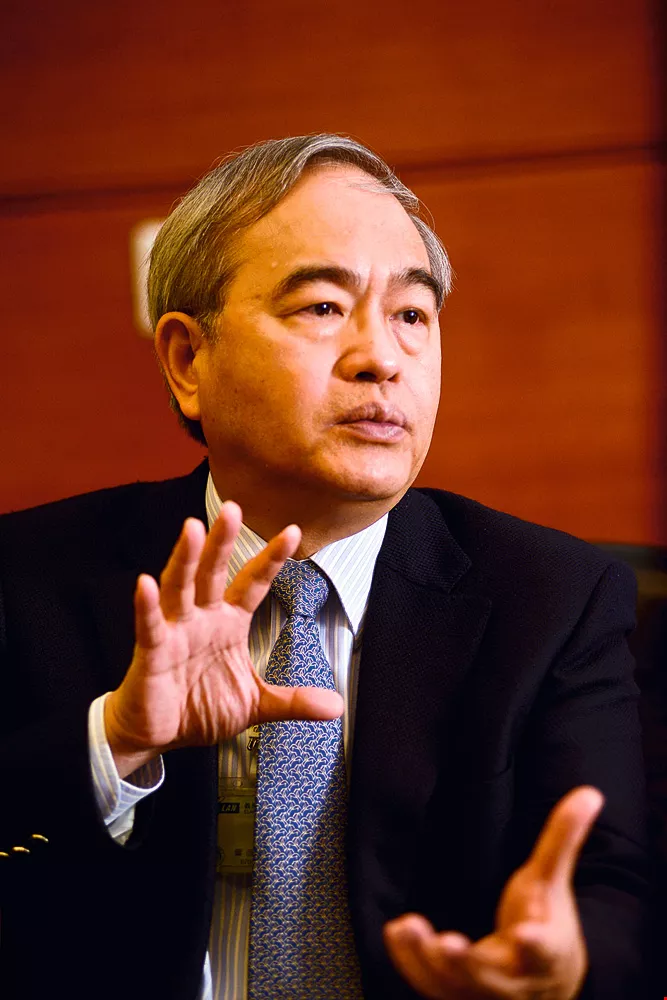
Elan chairman I.H. Yeh has been the strategist behind the company’s successful international patent lawsuits.
After acquiring K-Tech, Elan decided to aggressively enter the market to supply IC chips for multi-finger touch-control laptops. But they soon ran into a major obstacle. At that time the US firm Synaptics held the largest share of the world market in touch IC chips, and many laptop makers feared that Elan might be infringing on Synaptics’ patent rights, so they were extremely reluctant to use Elan products.
In order to overcome these marketing problems, Elan had little choice but to take the battle to the enemy. In 2006 they sued in US court, accusing Synaptics of infringing on Elan’s multi-finger patent rights. Synaptics counterattacked, accusing Elan of violating five of its IC patents.
This David and Goliath patent fight was decided in favor of Elan, because Elan did unquestionably control the key patents. In 2008 the two sides reached a formal cross-licensing settlement, exchanging permission to use each other’s patents and bringing Elan hundred of millions of NT dollars in royalties.
The victory in the patent suit brought Elan overnight global attention, and the company was suddenly seen as a rising star in the global laptop touch control market. Today, Elan has the lead over Synaptics and holds the largest single share in the global market for laptop touch IC chips.
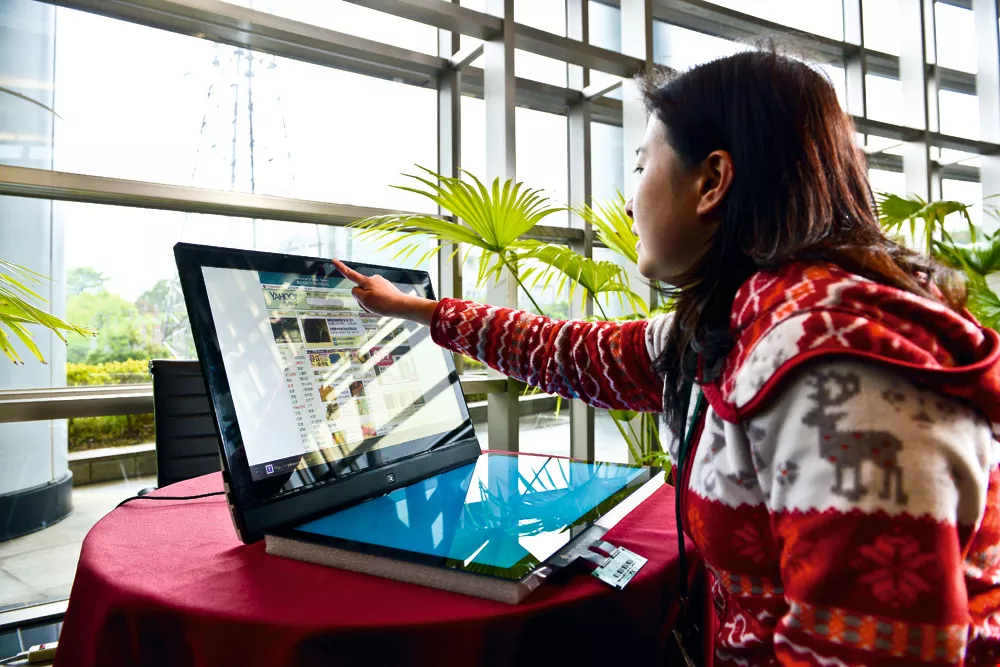
Elan was the first company in the world to be certified for Windows 8 touch ICs, and is now the global leader in market share for this product.
Another highly profitable market for touch ICs is smart phones.
Apple’s introduction of the first-generation iPhone back in June of 2007 radically transformed the cell phone market. Overnight, smart phones equipped with multi-finger touch control soared in popularity, leaving traditional keypad phones on the scrap heap of history.
It goes without saying that Elan, already with its eggs heavily in the multi-finger basket, would want a slice of this burgeoning pie. But again they faced a struggle over patent rights. Only this time their opponent was the company commonly recognized in the industry as the toughest of all to wrestle to the ground: Apple.
I.H. Yeh recalls that the first time he brought Elan’s multi-finger touch IC technology to Korea’s Samsung to talk about working together, the first thing the Samsung people did was ask conspiratorially, “You guys sure you haven’t infringed on any of Apple’s multi-finger patents?”
In order to reassure their customers and punch their ticket to the smartphone big leagues, in April of 2009 once again Elan took to the courts, this time to challenge market leader Apple. But the difficulty and stress of suing Apple was many times greater than that of suing Synaptics. Fortunately—though it can hardly be considered luck!—Elan did indeed control the core patent rights. Apple, which had always seen itself as a cut above the rest of the crowd, was forced into submission. After three years of wrangling, the two parties finally reached a settlement in February of 2012. As in the Synaptics settlement, the two parties again agreed a cross-licensing deal.
Partner to the powerhousesToppling two global giants out of their patent beanstalks has undoubtedly been the key to Elan’s current position of strength. Besides picking up US$20 million in royalties, Elan has greatly strengthened the competitive advantage of their products in the touch IC market. No matter what direction they and their clients head in—laptops, PCs, smartphones, tablet computers, smart televisions—this advantage will serve them well.
However, I.H. Yeh has no illusions: “Having had good luck in the past is no guarantee you will have good luck in the future.” To keep business coming in and pre-empt (and when necessary, win) future patent disputes, Elan will not only have to continue upgrading its R&D capabilities and strengthening its global IPR assets, it will have to try to transform itself into the “spec setter” for the market—the company whose products are so advanced it is up to everyone else to adjust theirs to conform to the standards set by the industry leader.
In the past few years Elan has worked to create strategic partnerships with industry behemoths like Microsoft, Intel, and Google. Elan was the first company in the world to be certified for Windows 8 touch control (and is currently number one in world market share for the Win 8 touch IC chip). Moreover, they have worked jointly with Intel to develop the new platform Haswell LPML1 and with Google to create the first and second generations of Android system tablet computers.
As the first company in Taiwan to successfully use the legal system to defend their patents against (and get king-sized royalties out of!) firms like Synaptics and Apple, Elan has become the top dog in the world’s touch IC market. It has been able to occupy the strategic high ground by controlling core technologies and by having a comprehensive IPR strategy. It would behoove other companies in Taiwan that face international patent competition to learn from Elan’s experience.


