Here Comes the Sun Chou Dean-yi's Helioseismology Research
Chang Chin-ju / tr. by Robert Taylor
September 2001


Chinese mythology tells the story of Kua Fu chasing the sun. Today there is someone who follows the sun with the same determination, observing it from sunrise to beyond sunset. Chou Dean-yi's research into "solar oscillations" has surpassed both ancient and modern knowledge, enabling humans to transcend their sense of vision, and for the first time in history to look inside the sun.
The ancients observed the heavens in order to understand the passage of time, and to this end they measured the movements of the sun. But why do astronomers today follow the ball of fire in the sky? How do they study the sun, which is too bright to gaze at with the naked eye? Why is the research into solar oscillations at National Tsing Hua University seen as the first ray of dawn for astronomical research in Taiwan? And where does its importance lie?
When those in the know talk about Taiwan's achievements in astronomical research in the last decade, the first thing they mention is the work on "solar oscillations" by physics professor Chou Dean-yi of National Tsing Hua University (NTHU). In 1997, an article in the respected science journal Nature described how the "acoustic imaging" method devised by Professor Chou is used to analyze oscillation data collected from the sun and create images similar to ultrasound scans, which reveal how sunspots slowly disappear into the interior of the sun. This imaging method opened up a new field of solar research.
The sun is made mainly of hydrogen, and its energy comes from the nuclear fusion reaction by which hydrogen is converted into helium. The sun's "photosphere"-its visible, glowing surface-has a temperature approaching 6000oC, and is too bright to stare at directly with the naked eye. But the sun's core is far hotter still, at 15 million degrees. "Helioseismology" researchers studying solar oscillations at NTHU were the first humans to look through the photosphere into the sun's interior, thus earning themselves a place in astronomical history. A recently published British encyclopedia of astronomy makes two mentions of NTHU's solar oscillation research. More importantly, the entire research program, from concept to implementation, has been led by laboratories within Taiwan, so it can truly be called "home-grown" astronomical research.
Shivering Sol
Perhaps because of the long struggle for dominance in space between the USA and the Soviet Union, we tend to think of astronomy laboratories as somewhat surreal places bristling with state-of-the-art equipment. But Chou Dean-yi's several laboratory rooms at NTHU are plain and rather poky. The dehumidified room where the magnetic tapes full of solar images are stored contains a few simple glass-fronted cabinets; between the stacks of computers in the computer room, there is barely space for one person; and the work space behind it, separated off by cupboards, contains a long, makeshift table made by students, stacked with boxes full of various components, along with two dismantled astronomical telescopes. It is in these cramped quarters that Chou's efforts to reveal the true face of the sun take place, from designing and building instruments to calculations using all kinds of formulae.
What is helioseismology? As the name suggests, it is derived from seismology, the study of earthquakes. Seismologists use oscillations (waves) from earthquakes or other sources to probe the internal structure of the earth. Helioseismologists use information about oscillations within the sun, derived from observations of the sun's surface, to explore aspects of the sun's structure, such as temperature, density, flows and magnetic fields.
It is no exaggeration to say that human civilization began from the moment when people started systematic observation of the sun. "Besides venerating the sun and giving it a prominent place in their mythologies, ancient peoples also devised various ingenious methods of observing the sun, in order to predict the changing seasons and increase agricultural harvests. China's guibiao sundials, the pyramids of Egypt and Britain's Stonehenge are all related to solar observation.
Humankind has been watching the sun throughout history, but the advance of scientific instruments allowed humans to recognize that the fiery orb at the hub of the solar system is neither everlasting nor immutable. Galileo observed that sunspots move across the face of the sun, disappear and reappear in a period of about 30 days, and from this he deduced that the sun rotates about its own axis; and modern astronomers have discovered that the sun's surface activity increases and decreases in an 11-year cycle. When the sun is in a more active phase, the number of sunspots on its surface increases, and it spits out huge quantities of hydrogen in solar prominences as majestic as lava flows, that may be many times the width of the earth.
Solar wind
The sun, a gigantic concentration of mass and energy with 330,000 times the mass of the earth, influences the heavenly bodies around it. Countless high-energy protons streaming away from the sun form a super "solar wind" blowing out into space. When the solar wind reaches the earth it still has tremendous power, and it interacts with the earth's magnetic field and ionosphere, creating geomagnetic storms that disrupt telecommunications.
In 1989, at the peak of the last cycle of solar activity, a geomagnetic storm knocked out North America's electric power distribution system, leaving millions of users without electricity and causing losses worth US$10 billion dollars.
Solar wind also threatens the transducers and control systems of spacecraft such as satellites, and exposes the passengers of aircraft flying at high latitudes to radiation. Some people have found a statistical link between periods of intense solar wind and earthquakes or volcanic eruptions, and many scientists are trying to make connections between solar wind and abnormal droughts and floods or the greenhouse effect. Even the incidence of heart disease and neurological complaints, and the frequency of traffic accidents, have been ascribed to the powerful wind blowing from space.
In 1979 the first international Solar Terrestrial Prediction Workshop was held by the International Space Environment Service (ISES), and further workshops have taken place every four years. Just as meteorological offices predict the path of typhoons, today there are over ten regional warning centers worldwide responsible for predicting the strength of the solar wind.
Growing awareness of the potential for the sun to affect conditions on earth caused "solar-terrestrial interaction" to emerge as a new field of learning, and boosted the importance attached to investigating the sun itself. Temperature and flows inside the sun alter the frequencies of solar oscillations, and since the mid-1980s helioseismology, which makes use of oscillations to study the sun's structure, has developed rapidly. Astronomers can use helioseismology to gain accurate knowledge about internal structures and properties of the sun such as the solar speed of sound, magnetic fields, chemical composition, and convection.
Helioseismology also has wider implications for astronomy. Other celestial bodies experience oscillations similar to those observed in the sun, so astronomers make the sun-our nearest star-the starting point for research which they hope can be applied to other stars in the future. In 1990, helioseismology was identified as one of the ten most important research fields in astronomy internationally.
A global observation network
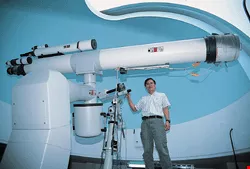
Plans for helioseismology research in Taiwan began in 1989, and after the Taiwan Oscillation Network (TON) program got under way in October 1991, it made rapid progress. Chou Dean-yi explains that to obtain long-term continuous records of solar oscillations, and thereby improve the frequency resolution of the data, it is necessary to set up multiple telescopes at suitable longitudes around the world, so as to continuously observe the "unsetting sun." Therefore the first step in the program was to set up telescopes at points around the globe.
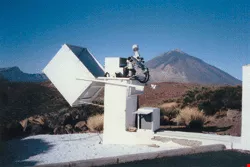
In 1992 trial observations began with a prototype telescope designed at NTHU, and after modifications it was shipped to Tenerife in Spain's Canary Islands in June 1993, to be installed and begin operation. Six months later, a second telescope arrived at the Huairou Solar Observing Station in Beijing, and six months after that a third was successfully set up at the Big Bear Solar Observatory in California. After three solar telescopes were set up in the space of a year, other research groups internationally could not help taking notice of the new kid on the astronomical block. In the summer of 1996 a fourth telescope went into operation at Tashkent in Uzbekistan, Central Asia, but before that NTHU's astrophysics laboratory had already begun publishing papers on the project in astronomy periodicals.
In addition to Chou Dean-yi, NTHU physics professor Chang Hsiang-kuang, and Professor Sun Ming-tsung of the mechanical engineering department at Chang Gung University also joined the TON project team. Thus the design, manufacture, assembly and testing of the telescopes could all be completed independently in Taiwan, prior to the instruments being shipped to their host observatories around the world. Overseas, the telescopes are operated and maintained by local staff trained by NTHU, and the tapes of the oscillations in solar intensity, recorded once every minute, are regularly sent back to Taiwan. In the laboratory in Taiwan the recorded oscillation images are analyzed using computer software and mathematical models.
Another way to detect solar oscillations is to record them from space, where observations are unaffected by the earth's atmosphere. Late 1996 saw the launching of the Solar and Heliospheric Observatory (SOHO) satellite, which was built in a collaborative project between the European Space Agency and NASA. SOHO's missions include studying the sun's internal structure and outer atmosphere, and the solar wind. But satellite observations are immensely costly, and satellites have a limited service life and a high risk of failure. SOHO itself has suffered several malfunctions. Last year, during a period of high solar activity and at a key time in US observations of sunspots, contact with the satellite was suddenly lost, causing research work to be interrupted for two months.
Ground-based observation networks are much more reliable, with fewer "worries," and therefore helioseismological research mainly relies on ground-based observations. Today the UK, France and the US all have ground-based networks, but this does not make the TON project any less valuable. In particular, in spring 1997 Chou Dean-yi's team developed an "ambient acoustic imaging" method which produced the first ever images of the internal structure of the sun, and thus pushed NTHU's helioseismological research to new heights.
Pictures from sound
Chou Dean-yi says that with each of the helioseismology networks constantly collecting solar oscillation data, it is only by finding better methods of analyzing and interpreting such data that one can produce more and better information than other people, and so surpass one's competitors.
The idea behind acoustic solar imaging came from a new imaging technique in oceanography, called "ambient noise imaging." In 1996 Chou read an article about oceanographic research in which the writer, inspired by everyday experience, described how even in a closed room with no direct light source, scattered sunlight ("ambient light") entering the room and striking objects is reflected into people's eyes to form images, so that people in the room can still see each other. When applied to oceanography, the natural sound waves produced by the wind and currents create ambient noise, which is comparable to ambient light. An underwater target will perturb this ambient noise to produce "noisy" signals, just as ambient light reflects off objects in a room. Even though the ambient noise does not come from a specific source as in conventional sonar imaging, it can still "illuminate" objects. By placing a dish-shaped sound reflection lens below the surface of the sea, and collecting sound signals through an array of microphones, researchers were able to create images of underwater targets.
Reading this article gave Chou Dean-yi an inspiration: "We can treat the seismic waves within the sun as ambient noise-equivalent to the scattered light in a room-which we can use to illuminate targets inside the sun (irregularities in the wave propagation medium, such as areas of magnetic field)." Chou explains that there are nonetheless big differences between the application of these techniques to the sun and to the ocean. The path of acoustic waves within the sun is not straight, and different wave modes travel at different speeds and to different distances from their source before reaching the surface of the sun; nor is it possible to place a reflecting or refracting lens into the sun to collect acoustic waves. To enable suitable waves to be used to accurately reflect structures within the sun, Chou applied his flair for mathematics and designed a "computational acoustic lens" to collect solar oscillations and form them into images.
Building on the focusing principles of optical lenses, he used many complex mathematical formulae to enable the time-distance relationship to be calculated between a target point within the sun and the sun's surface, so as to finally reconstruct the acoustic signal from the target point and integrate the recorded wave amplitudes into images of the sun's interior. "I started thinking along these lines in October 1996. In December I overcame the main difficulties, and in 1997 I announced the results at a conference in Britain." Chou, who is talented in both mathematics and physics, did not waste a moment.
The sun's 11-year itch
Before the advent of acoustic imaging, the degree of understanding of the sun's internal structure that could be gained from its surface oscillations was very limited. For instance, scientists were already aware that the cycle of sunspot activity is related to the way the north and south magnetic poles of the sun are reversed every 11 years. But where was the sun's magnetic field located? What were its physical properties? Twenty years ago theorists proposed that the magnetic field extended down below the sun's surface to a depth of 0.7 solar radii from the center of the sun surface, but signals from the magnetic field are very weak, and could not be detected by the methods and instruments then available. But today acoustic imaging has enabled Chou Dean-yi to find much stronger evidence in support of the 20-year-old theory, and this is highly significant for solar astronomy.
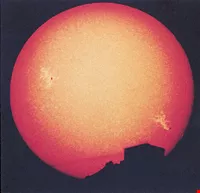
Every 11 years, when the solar magnetic field goes into overdrive, in some areas of the sun's surface the temperature sinks to 4000oC, so that these areas look darker in color than the surrounding photosphere. Seen from the earth they appear as small dark spots on the face of the sun, but in fact a single sunspot may be many times larger than the total surface area of the earth. Using acoustic imaging, helioseismologists can construct images of the intensity, at different depths within the sun, of the acoustic waves associated with sunspots, from which one can clearly see how sunspots weaken with depth. This is very helpful for further understanding the effects of sunspots within the sun, and for studying the effects of the solar magnetic field.
Although acoustic imaging has greatly raised the profile of the TON project, it is not the program's only scientific achievement. Over the past decade, TON team members have published 20 articles in periodicals, and presented over 30 conference papers. In Chou Dean-yi's view, the program's greatest significance lies in the training it has given to students. Mathematicians and physicists who were accustomed to working mainly with their brains have gained hands-on experience in manufacturing and operating precision telescopes and learning how to select components. The whole project has provided training in the areas of electronics, mechanical engineering, optics, software and hardware, and many of the fields involved-such as image analysis, software design and instrument manufacture-have industrial applications.
Over the past decade the National Science Council has provided the TON project with something over US$2 million in funding, and the program has yielded rich results in the forefront of astronomical research. Compared with the near US$1 billion cost of the SOHO satellite, this is great value for money. But Chou Dean-yi says there is nothing remarkable in this, instead ascribing his achievements to the larger environment: "After helioseismological research began in the 1970s, 1985 to 1995 was the period when instruments were developed, and several global observation networks went into service and began to accumulate large quantities of data. What has come next is the peak time for data analysis. Researchers can sit back and interpret solar cycles, so naturally this is when the results begin to appear."
Sunshine man
However, Chou stresses that acoustic imaging is "still in the early stages of development," and that further research is needed, for instance with regard to such issues as vertical and horizontal resolution, and the relationship between resolution and the size of the area sampled. He says modestly that although acoustic imaging can produce "acoustic intensity maps" and "phase maps" for different depths within the sun, interpreting these three-dimensional images in order to understand the sun's internal structure is still a big challenge for researchers. "We hope we can also use acoustic imaging to study other questions, such as the location of wave sources, sunspots on the far side of the sun, and other physical conditions," he adds.
What is the secret of Chou Dean-yi's success in astronomical research? "Finding suitable research topics." Chou, who is not given to self-promotion, says simply: "The important thing in scientific research is not to set your sights too high."
Though Chou Dean-yi spends his days following the sun, he has both feet firmly on the ground.
p.026
The sun controls the fate of the solar system's nine major planets. The activity of the sun's surface has become an important subject of study for earthlings. (courtesy of Taipei Astronomical Museum)
p.028
The Taiwan Oscillation Network program, led by NTHU physics professor Chou Dean-yi, attracted attention in the worldwide solar research community for its development of "acoustic imaging" methods. (photo by Jimmy Lin)
p.030
From 1993 on, solar telescopes built at NTHU were set up in the Canary Islands, Beijing and California, to observe the sun 24 hours a day. (courtesy of Chou Dean-yi)
p.031
Local people on Tenerife proudly use posters displaying images captured by the NTHU telescopes to attract visitors. (courtesy of Chou Dean-yi)

@List.jpg?w=522&h=410&mode=crop&format=webp&quality=80)


