

When you mention TaiSugar, people typically focus on its vast land holdings. But the truth is that the agricultural skills and technology the company has developed over the course of a century in business are really its biggest asset in its current quest to grow and transform. In recent years TaiSugar's share price has shone and biotech products that are direct outgrowths of its early technology have earned renown. From Cordyceps sinensis, glossy ganoderma, evening primrose, red yeast rice, lactobacillus, and royal jelly, to garlic extract, Agaricus blazei mushrooms, collagen protein, and ostrich eggs, from animal products to herbal extracts, TaiSugar has made a new mark in the health food and cosmetics markets, bucking the apparently remorseless trend of its corporate decline.
With the arrival of biotech, century-old TaiSugar no longer wants to sell sugar. For that matter, TaiSalt (Taiwan Salt Corporation) doesn't want to sell salt either. These former national corporations have both entered biotech production and are now confronting each other as direct competitors in the collagen protein market.
Collagen protein, found in the extracellular matrix of multicellular organisms, is the principal constructive protein of animals' connective tissue. With more than 600,000 pigs, TaiSugar is using high-grade fresh pigskin as its raw material, while TaiSalt, which is not in the animal husbandry business, instead uses imported cowhide.
TaiSugar began producing collagen protein in early 2001. At first it didn't receive much attention, whereas TaiSalt, which entered later, quickly produced its own brand, Lu Miel. So it can be said that in this battle of brothers, the younger brother, TaiSalt, won the first round.
Nevertheless, the domestic market for collagen cosmetic products is thought to have much potential and is expected to grow to NT$400 million in 2010. In 2001, when TaiSugar was strengthening its brands and marketing, it sold only NT$1 million of placenta extract and collagen products, but since then they have become two of its star products. Developed by its animal husbandry division, TaiSugar's collagen protein technology can be described as a product entirely connected to the raising of pigs. After this product began to reap profits, TaiSugar learned to treasure its technological assets and find new uses for old techniques.
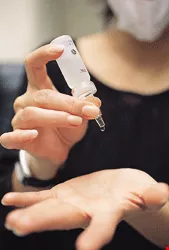
A tiny drop of lotion, a dream of eternal youth. Placenta extract commands a high price, and is one of the brightest stars among TaiSugar's new generation of products.
Rising from the trash heap
Long before the rise of biotech, TaiSugar had the ability to develop biotech products. Early on its main products included alcohol, yeast, and the feed additive lysine, as well as organic fertilizer.
Molasses and bagasse (cane pulp) are the two main byproducts of sugar production. Molasses represents about 3.3% of sugarcane by weight, but in reality it is a waste product that can cause environmental pollution. Yet the sugar in molasses can be used for fermentation and can then be applied to waste products to reduce pollution. Finding a use for its molasses is why TaiSugar got into alcohol production in the first place.
Having developed alcohol production technology, when there was a run on rice wine in late 2002 due to looming tax hikes, TaiSugar was able to release its "Three-in-One" rice wine and alleviate the crisis.
Biotech, animal husbandry, and specialty agriculture, all outgrowths of TaiSugar's original agricultural technology, are regarded as its stars of tomorrow. The technical specialists at TaiSugar's research institute, which had early on been responsible for brand research, were assigned to various administrative departments. Yang Po-wen, who was just this year made executive director of biotech, previously led TaiSugar's research institute. The popular Cordyceps sinensis product was the result of nearly six years of hard work on his part.
TaiSugar's future biotech operations will be centered in Talin, Chiayi County. Occupying four hectares, the Talin center will end up costing NT$400 million to build. A biotech plant meeting cGMP standards was completed in late 2003. Test runs will take place from January to June 2004, and mass production will start in July.
The Talin plant's core technology is in fermentation and extraction. In the future, apart from producing TaiSugar's own products-including fermented fungi (such as Cordyceps sinensis), physiologically active extracts of natural herbs (such as Chinese herbal medicines), products made from new materials (such as Chinese medicines, and lactobacillus), cosmetics, and alcohol and alcohol-based products-it is also seeking cooperation with industry, government and academia, and accepting contracts to mass-produce biotech products developed by others.
Yang Po-wen explains that due to the limits of the company's size and economic power, it still can't compete with major foreign pharmaceutical companies. But because there's a lower entry bar for producing Chinese medicines such as Agaricus blazei, TaiSugar's biotech division may become its most profitable.
What's more, biotech is a broad field where it is important to focus on customers' needs and go where the market leads. TaiSugar has even marketed an "anti-oxidant moisturizer and whitener," working hard to close the gap between itself and foreign brands in the sophistication of its brand marketing.
To sell cosmetics, know makeup
By competing with TaiSalt in the collagen protein market, TaiSugar has learned the importance of brand marketing and has specially researched the issue of packaging in the cosmetics market. Li Ming-hsun, brand manager for the biotech division, cites the example of TaiSugar's long-marketed yeast brand: "Many TaiSugar products are competitively priced and of outstanding quality but have suffered from a poor image. Packaging and image molding will be major items of concern in the future."
Take, for instance, Agaricus blazei. This mushroom contains abundant lipopolysaccharides, which can raise the ability of lymph T cells to resist cancer. It's a highly regarded health food, but because it hasn't been marketed aggressively, sales have lagged far below TaiSugar's expectations.
Apart from packaging, TaiSugar, which has been used to marketing products for which it enjoys a monopoly, obviously needs to improve its control of distribution channels.
TaiSugar's products have had to overcome the image associated with its "Star Rosewater" brand of perfume, which ended up being used to deodorize bathrooms, Li Ming-hsun points out. Instead it should march in the direction of becoming another Chanel. He believes TaiSugar doesn't know how to "make itself up"-that it has good products but frustratingly lacks any understanding of packaging, which makes it hard to attract consumers.
The elephant and the mouse
As opposed to the operating losses suffered by TaiSugar, TaiSalt in 2002 had outstanding profit margins of nearly 18%, and in a economic climate in which downsizing was the mot du jour, it broke the record for employment growth among public enterprises. Going from having the security of being a government monopoly to working hard to improve competitiveness, TaiSalt, which has left the sunset industry of salt production, has often been compared to TaiSugar. From leisure and tourism to biotech products such as cosmetics, the multi-pronged operations of TaiSugar and TaiSalt are indeed quite similar.
Yet TaiSugar staff members see things differently. "How many people work for TaiSalt, anyway?" asks one. "Its staff isn't but a tenth of TaiSugar's!" He says that TaiSugar is an elephant, whereas TaiSalt is a nimble mouse. In a market where the lifespan of products has been dramatically shortened, TaiSalt has an advantage with its agile organizational structure that TaiSugar can't match.
A large bureaucracy kills speed. In 2003, in an effort to make itself more competitive, TaiSugar broke itself into separate divisions and made each responsible for its own profitability. But can the company truly regain its initiative and coordinate its attack, thereby finding a way into the fickle consumer's heart? Everyone awaits the answer.


@List.jpg?w=522&h=410&mode=crop&format=webp&quality=80)


