Wesley Huang and MTI: Riding the (Micro) Wave to High-Tech Success
Laura Li / photos Jimmy Lin / tr. by Phil Newell
November 2001


In the wake of the September 11 terrorist attacks, the United States began bombing Afghanistan. On the day bombing began, the stock price of Microelectronics Technology Incorporated (MTI), a Taiwanese company which became globally known during the Persian Gulf War ten years ago, shot upwards. Once again, microwave communications technology has become a focus of attention.
MTI, which achieved overnight fame during Desert Storm, faced a serious crisis in 1996 and 1997. Two years ago or so, Wesley Huang, one of the old veterans dating back to the founding of the company, took over the heavy responsibility of being general manager in this time of crisis. Since then he has turned in a stellar performance. How has this man, often called "Father Huang" or "Elder Huang," who in the eyes of his employees always wears a smile, been able to draw MTI back from the brink? How is it that MTI's future looks brighter and brighter?
In the showroom at the headquarters of Microelectronics Technology Incorporated in the Hsinchu Science-Based Industrial Park, there is a single book placed underneath a large satellite. When you look closely at the cover, it turns out to be the Gulf War memoirs of CNN reporter Peter Arnett. MTI comes in for high praise in this book. It was only by using INMARSAT equipment specially made by MTI, so durable that it would still be functional after a fall of more than 1000 feet, that Arnett was able to report despite the smoke, dust, and cutoff of standard communications.
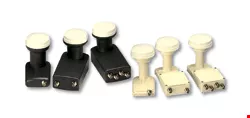
The era of global-access home entertainment systems is upon us. The picture shows a "low noise block downloader," (LNB) a vital piece of technology developed by MTI for improving satellite TV reception.
In the eye of a Desert Storm
As company president Wesley Huang says with a smile, "At that time, CNN had an audience of more than 100 million people, and every time they tuned in, they could see the MTI logo." In this way MTI achieved global name recognition.
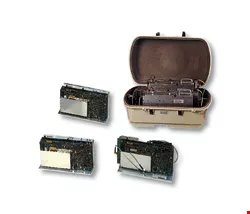
Today there is another war in the Middle East, but MTI sold its land-based INMARSAT business three years ago because the market is too small. But before selling that side of the business, MTI developed an even lighter and smaller communications device. Undoubtedly you have seen 007-type films in which the secret agent checks into a hotel, pops the catches on his mysterious briefcase, opens the window, and then opens the briefcase to send and receive top-secret wireless communications. At the heart of the briefcase is the "transponder," which is MTI's main product at present.
Recently, Typhoon Nari caused severe flooding in Taipei City and Taipei County, and knocked out many mobile phone ground stations. But thanks to MTI, which mobilized its "point-to-point communications" equipment teams to set up microwave transceiving stations on top of tall buildings, the problems of many mobile phone users were resolved.

Cheap and convenient point-to-point and local multipoint distribution system (LMDS) equipment is useful for commercial and personal networking, and even more useful in disaster response.
The mysterious world of microwave
MTI, founded in 1983, was the first company in Taiwan to specialize in microwave and satellite communications. Prior to that, microwave communications had been exclusively for use by the military. Few civilians were permitted into this mysterious realm, and even graduate students studying communications could only get a vague idea about it from their textbooks.
"Microwave refers to an electromagnetic wave with frequency higher than one gigahertz," explains Huang (one GHz is one billion cycles per second). Electromagnetic waves are all around us. A typical household telephone line operates at a few kilohertz (kHz, one thousand hertz). These are considered low frequency. Broadcast radio stations like BCC operate at a frequency of about one megahertz (MHz, one million hertz). This is considered a mid-range frequency.
The main products produced by MTI have frequencies from 900 MHz to 42 GHz. MTI's core competitiveness lies in this area of "wireless high-frequency microwave." The higher the frequency, the broader the bandwidth, the more information it can carry, and the faster it can go. To make an analogy, low frequency is like a dirt road, mid frequency like a paved street, and high frequency like a broad and straight superhighway. Given today's explosive growth in information, wireless communication and high frequency microwaves are increasingly important, with more and more applications emerging all the time.
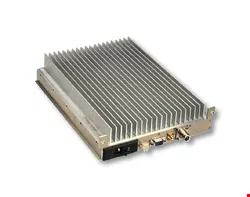
Mobile phones are able to handle more and more functions all the time. For this reason base station transceiver technology must be constantly upgraded.
Top-secret handicraft
The higher the frequency of the microwave, the higher the degree of sophistication required for manufacturing the transceiving equipment. Each microwave substrate, no larger than the nail on your little finger, has a wide variety of chips densely packed onto the surface. An old American saying has it that "an inch is as good as a mile," but with these little guys, an error of a mil (one thousandth of an inch) could cause a deviation of 1000 miles. Even if the information somehow gets to where it is going, the transmission quality will be greatly inferior.
Because there is so much variability in the microwave manufacturing process, MTI does not use standardized and expensive machinery like you would see in a typical wafer factory. Instead, each chipset is put together painstakingly, chip by chip, by MTI's dozens of female employees, relying on their sharp vision, patience, and steadiness. The finished products must take into account that along the way microwave equipment may run across storms, desert sands, intense heat, or freezing cold, so each product must be precisely adjusted for specific weather conditions. Monthly production at an ordinary wafer factory might be 100,000 or so, but at MTI monthly production is numbered in the thousands, which should give you an idea of how refined these products have to be.
Eighteen years ago, when Wesley Huang first entered MTI, he did so as a "seed student." He had been sent to the Whirlpool company in the US to study thin film technology. Huang recalls that Whirlpool turned over 12 sets of materials to him, and asked him to produce at least ten finished chipsets. With guidance from Whirlpool staff, Huang pored over the electrical circuits using a magnifying glass and set the chips in place. He also had to keep a complete, detailed record of the manufacturing process, so that he could teach his colleagues when he got back Taiwan.
"At that time, it was all up to me to get our first order. The pressure was incredible," says Huang, who can smile about it now. The manufacturing process for high frequency thin film components depends largely on experience, so senior workers are highly treasured in the company. This is why MTI set up its new factory in Wuxi (in mainland China's Jiangsu Province), which began turning out products in September. Seeing that Wuxi is less developed than nearby Suzhou, the company reasoned that most of its employees would be local people, not workers coming in from other cities just for the fast buck, and therefore there would be lower turnover. Jiangsu girls are also famous for their attention to detail and their manual dexterity, and they can handle this kind of painstaking work.
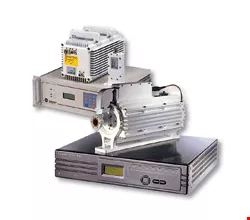
MTI was one of the earliest companies in the world to get into production of V-SAT, in which the transceiver is critical. As global firms continually expand,
Analog: alive and kicking
Huang points out that while everyone describes the present as the digital era, in the high frequency world, analog circuits are still the only technological option. Information sent on wireless communication systems, including mobile phone platforms, satellite TV, and broadband Internet access, may very well be in a digital format, but in the actual process of transmission, the data must first be converted using an analog transponder from digital to mid frequency signals, and thereafter be switched to high frequency. Only in this way can it get on to the high frequency information superhighway. When it arrives at the receiving end, it must go through the same steps in reverse.
"We can use a water faucet as a metaphor. Digital technology, based on an either/or choice between zero and one, can only represent two positions for the faucet: completely open or completely closed. It is relatively limited in terms of control options. Analog circuitry, on the other hand, offers a continuous range of options from 0 to 1, which is to say an unlimited range of possibilities between completely open and completely closed, with much greater complexity," explains engineering director Rod Chang.
According to a secret report prepared by one of MTI's competitors, although MTI's sales volume is not large, in terms of its capability to manufacture, design, and assemble transponders, the company ranks fifth in the world. Because its technology is so reliable, MTI has long been the favorite contract manufacturer for major international companies.
Take for example the V-SAT (a small satellite communications systems for commercial use), the product with the largest sales volume among MTI's five main product lines. The V-SAT, which MTI makes in cooperation with the American company Hughes Network Systems, has many applications for large multinational corporations. For example, information on stocks, seat reservations, cash flow, or other aspects of a big organization's worldwide operations can be accessed instantaneously. Hughes dominates the world V-SAT market, but in fact it only manufactures for the American market; manufacturing for the rest of the world is left to MTI.
Besides commercial uses, in recent years V-SAT has been made available to the individual consumer. Direct Way wireless communication equipment has recently come on the market in the US. The price for a single unit is about US$700. Consumers can sit at home and quickly get online or receive satellite television programs from around the world. As the unit price becomes more affordable in the future, the prospects for profits look bright.
Wesley Huang is dedicated to his job, his family, and his church, but also loves music. He is a violinist with the Hsinchu Symphony Orchestra, and often plays at home for himself and friends.
No more follow the leader?
The only product that MTI sells under its own brand name is the "low noise block downconverter," which lowers interference in reception of satellite TV. MTI's LNB currently has about a 12% global market share, second only to Japan's Sharp Corporation.
MTI also makes mobile phone ground stations for Lucent. MTI currently works mainly with G2.5 WAP and GPRS systems, while actively preparing for the coming of the G3 video mobile phone market. (G stands for generation.) However, while "G3 is certainly going to be the mainstream," relates Wesley Huang, "licenses for G3 are unbelievably costly, and the investment required is enormous. Given the current economic downturn, most companies are taking a wait-and-see attitude."
In economic hard times, price and production costs are always primary considerations. This year many large international manufacturers have asked MTI to design transponders for them to meet specific needs, frequencies, and specifications. They hope to draw on MTI's know-how to make better and cheaper products. MTI has earned a lot from design fees, but is still not getting the big orders.
Last year MTI had the highest sales in its 18 years in business: nearly NT$5 billion. Moreover, the company was growing at a rate of 10% through August of this year. But in September the company suddenly felt the pinch of the economic downturn. Huang says, "The big manufacturers don't have any orders themselves, so how can they subcontract to us?"
MTI has always been a very loyal subcontracting company, producing each product only for single buyer. But recently the company has begun to seriously consider the limits to growth imposed by this role, especially now in economic hard times when the big companies are looking after themselves. Should MTI accept orders from different companies in the future?
"Once I brought a foreign visitor to Window on China, where we saw some people performing traditional Chinese tricks. There was one guy keeping six or seven plates spinning all at the same time. My friend said to me, 'Isn't that exactly what you do!?'" That comment hit like a bolt from the blue. Huang has to consider that his company faces a two-front war against factories established by major companies themselves on one side and specialized subcontractors on the other. Profit margins for MTI's current products are likely to get thinner, while the market for new products has been repeatedly delayed. Can the company find its way out of the current situation? If history is any guide. . . .
An old veteran new at the helm
Let's go back to five years ago. At that time, MTI was in crisis due to over-expansion, trying to do too many things of too complicated a nature at the same time. This was the result of a decision to bring in 21 new products at the same time to increase sales. But the new products scattered company manpower and capital, and each department thought only of protecting its own position, while many mid-level managers simply gave up and left. MTI, which had always run smoothly, suffered a loss of NT$300 million in 1996, a figure which grew to NT$700 million in 1997.
"MTI stock fell by more than three NT dollars to 19, and everyone thought we were finished," recalls Wesley Huang. Fortunately, chairman Patrick Wang made the decision to bring in "fresh troops" from outside. Dick Anderson, the representative on MTI's board of directors from Whirlpool (one of the main stockholders), had just decided to retire from that role, and Wang hired him to restructure the company. The bloated production section was rapidly slashed to only four or five core areas.
After Anderson came in, he spoke individually with the more than 40 managers in the company to ask them who their boss would be. Virtually everyone mentioned Wesley Huang. A year or so later, Huang left his job as vice president for manufacturing to president.
Huang was no "paratrooper" dropped in from the outside. His relationship with MTI extended all the way back to his days at the Chung Shan Institute of Science and Technology (CSIST) in the 1970s. CSIST, which is under the military, was at that time the only agency in Taiwan doing research in microwave communications. Many patriotic overseas experts came back to work there, bringing with them the latest ideas in microwave technology. At that time Huang was in charge of the microwave communications program at CSIST, were he got to know people like Wang Yen-hua and Chu Shih-chao, who had worked at Whirlpool in the US and were then advisers to CSIST.
In 1983, Wang, Chu, and others formed an eight-man team to come back to Taiwan and go into business, and they persuaded Huang, who was then preparing to go abroad to study for his doctorate, to join them. Huang agreed to "lend a hand for while," and set to work putting in endless days and nights setting up the factory. He has now been there for 18 years.
The vision of Elder Huang
As one of the veterans at MTI, Huang could not but hesitate before taking up the heavy responsibilities of being company president. "I asked myself whether someone like me, who is by no means the most outstanding person in the company in terms of technical knowledge, sales, or management ability, could really rule over all these other people?"
But Dick Anderson told him that precisely because he had no special area of expertise, he would be balanced and fair, and could integrate the various departments, which is exactly what MTI needed. Events have proven that the judgment of this "foreign legionnaire" was right on target.
After taking up his new position, Huang moved to rebuild employee dedication to the company. He arranged to have a lunch meeting with managers every Monday, where he repeatedly shared his vision for the future: "We must become the number one company in the world for RF/microwave transceivers."
The long-standing problem of production being delayed by overly complex production lines was solved as Huang directly examined every link in the production chain to restore a "sense of urgency." One example highlighting the company's turnaround was its line of local multipoint distribution system (LMDS) equipment. At the end of 1998, MTI signed a contract with Lucent, and began mass production the following year. That year MTI received more than US$5 million in LMDS orders, giving a huge boost to morale in the company.
Huang, a devout Christian, is mild mannered in speech, friendly and approachable in demeanor, and is fondly known as "Elder Huang," a Chinese pun on Presbyterian terminology. But when the situation calls for it, he can get angry and be very uncompromising. No wonder his employees say "everything is usually 'green' with him, but be careful if you see the signal changing to red," to describe their soft-on-the-outside, tough-on-the-inside general manager.
You can see something of Huang's character from an incident in his past. Despite leaving the doctoral program in electrical engineering at Chengkung University to enter CSIST, he never forgot his goal of going abroad to complete his degree. CSIST even several times offered to send him abroad to study. But according to the rules, personnel working in military institutions could not take their wives with them overseas.
Huang thought the restriction "inhumane" and refused to accept it. He believes: "A family, in times of growth, should grow together, and in times of trouble, should stick together." For this reason he rejected the opportunity to go abroad to study at government expense. His plans to go abroad on his own were, as we have seen, scotched by his decision to enter MTI, so he has still never picked up his PhD. He says this is his only regret, but that he would make the same choices if he had to do it all over again.
There's no accounting for fate. Today MTI has recovered its previous vitality. When you look at how this old MTI veteran advances, one sure step at a time, neither hesitating nor blindly rushing forward, can't you see in him the secret to Taiwan's economic success?


@List.jpg?w=522&h=410&mode=crop&format=webp&quality=80)


