Taiwanese Design Takes Flight
Teng Sue-feng / photos courtesyof Taiwan Design Center / tr. by Scott Williams
May 2007


In five short years, Taiwanese indus-trial designers have taken home more than 100 medals from design competitions around the world, including the likes of Germany's iF and red dot, the US's IDEA, and Japan's G-Mark. Eight of these awards have been gold medals. What sorts of innovations have Taiwanese designers produced to claim a place on the global stage? How are design capabilities adding greater value to Taiwanese businesses?
The Greater China region's first iF product-design gold medal--sometimes called the design community's Oscar--glitters in a glass cabinet in a hall in the offices of Asustek Computer, Inc.'s Asus Design, which works out of Asustek's old office building in Kuantu, in Taipei City's Peitou District.
Asus Design's creative headquarters, which sits in the area behind the cabinet, employs nearly 50 designers averaging about 35 years of age. This is the team that dreamt up a six-layer carbon-fiber notebook PC case and the world's first notebook PC bound in real leather. It seems that providing designers with a comfortable "home" in which to work really does help keep their creative juices flowing.
"Designers are never satisfied with either the size or layout of their workspaces," says Li Cheng-yi, deputy director of Asus Design. He says that when Asustek completed plans for its new building a few years ago, they called for offices separated by solid dividers. But such a layout doesn't lend itself to discussion and communication among the members of a team. Upon consideration, Asus Design decided to forego the privacy that the new offices would have afforded and instead moved into the old building. There, they redesigned their workspace by knocking out a wall, installing large light sources, and opening up sightlines to the outdoors. The new layout allowed the designers, who spend most of their time in front of computer monitors, to walk out onto an exterior balcony for a breath of fresh air or a smoke, or for a glimpse of sunset on the Kuantu Plain. The department now sometimes even holds meetings in Kuantu's waterfowl refuge, alternating between discussing issues and watching the birds.
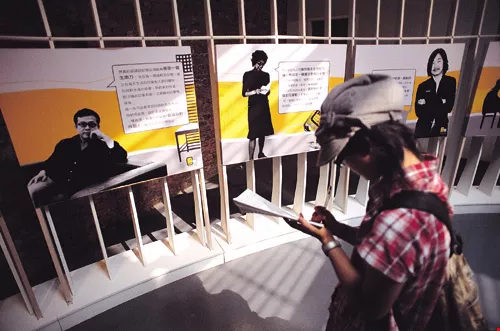
In an economy of aesthetics, everyone will have their own inventory of "aesthetics on account." The photo is from the fourth Taiwan Design Expo.
In July 2004, an LCD display designed by the BenQ Lifestyle Design Center made the cover of the US's BusinessWeek magazine, serving notice to Europe and the Americas that Asian designers were now a force to be reckoned with. The display, which turned the traditional rectangular design on its head, featured a porcelain-like blue border and "butterfly-wing" base. It also proved a tremendous feather in the cap of the design center, then just two years old, when it won a 2004 IDEA award for its fashionable and innovative look.
That same year, BenQ launched another display at Milan's Fashion Week. Carried onto the runway by one beautiful model after another, many attendees assumed it had been designed in Italy. In fact, the display made such a splash in Milan that organizers of fashion shows in Spain, Russia, and Tokyo subsequently approached BenQ about using it in their own shows.
Taiwan's industrial designers received still more kudos in 2005, performing very well overall at that year's iF competition, which included 2,332 entries from 31 nations. In fact, the Asus team came away from the event with the Greater China region's first ever iF gold medal for product design, and other local designers managed to take home 28 of the 542 awards presented. Such results represented a huge improvement on 2003's 14 awards, and for the first time matched those of designers from leading Korean firms such as Samsung and LG.
Taiwan did even better at the 2006 iF awards, winning 66 prizes, one-third of which were taken home by small and medium-sized enterprises (SMEs).
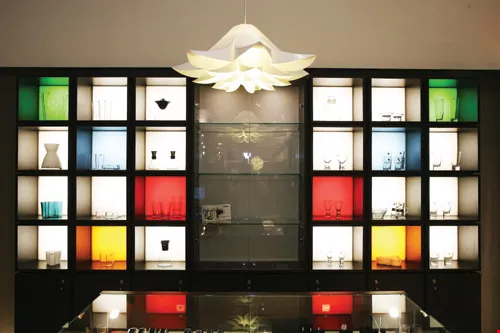
Colored lighting adds a touch of elegance to the display area and goods of the Nordic counter in Eslite Books' Hsinyi Road branch.
Kiddie's Paradise, Inc., which built its business importing educational toys, recognized that with Taiwan losing its competitive advantage in manufacturing the company needed to establish a design and branding center. Six years ago, it began developing the Weplay brand and designing products in house, and has now successfully transitioned to its new business model.
Last year, it drew on the mathematical concept of the Mobius strip to create a second-generation Tai Chi Ball. Mobius strips are formed by taking one end of a length of material, turning it 180 degrees, and joining it to the opposite end, thereby creating a strip with only one face. Combining this concept with the alternating activity and quiet of taijiquan, the company came up with a bilaterally symmetric ball containing another smaller ball that travels on a continuous track. Children hold the toy in both hands and attempt to keep the inner ball moving along the track, improving their hand-eye coordination and balance in the process.
Kiddie's Paradise designed three of the nine Taiwanese products selected for the 2002 iF design competition and won an award for the ball. The Tai Chi Ball was an exceptional achievement and demonstrated that Taiwanese design could go toe-to-toe with that of the rest of the world.
"The problem with the first generation Tai Chi Ball [which lacked an outer shell] was that people picking it up for the first time didn't have a good feel for the technique or for the speed at which the ball moved. As a result, they spent most of their time running after the ball or trying to figure out where it had gone. We designed the second generation as a ball within a ball to reduce the frequency with which the ball got lost," says managing director Michael Chiu. "We never expected the members of the Taiji Association to become so interested in it," he adds, explaining that when you hold it in both hands and turn it slowly, it looks like you are performing taijiquan's "cloud hands" move.
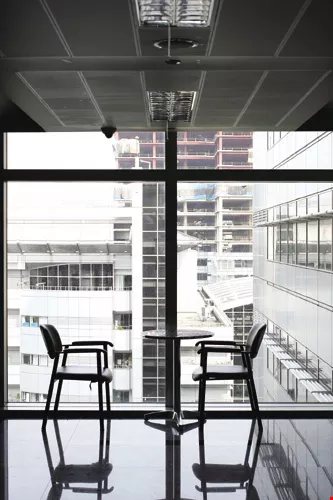
The Taiwan Design Center, located in the Nankang Software Park, is working with Taiwanese businesses to develop a uniquely Taiwanese design sensibility and to put Taiwanese designers in the international spotlight.
In just a few years, industrial design has taken Taiwan by storm. It has become the media's favorite creative-cultural industry, and has come to be regarded as a key means of upgrading local industries by the business community, government and academia.
"You can't just leap from manufacturing and design to creating a brand," says Tony Chang, CEO of the Taiwan Design Center. "You've got to consider the development trajectory of Taiwanese industry." Noting that Taiwan is an exporter, he mentions instances in which poorly packaged home electronics shipped to Middle Eastern ports fell out of their packaging as they were being unloaded. Such incidents were dangerous, as well as damaging to Taiwan's image. In 1979, the Taiwan External Trade Development Council (TAITRA) responded to the problem by establishing a product design department. The intention was to help firms improve their packaging, thereby burnishing the image of Taiwanese products abroad. The department also laid the groundwork for the development of the field in Taiwan by training local designers and exhorting local businesses to pay greater attention to design.
Chang says that when Taiwan's economy was primarily manufacturing-driven, a "designer" was either a graphic designer or an illustrator. But with the rise of the tech economy, the products of industry became essentially commodities. In their efforts to differentiate their companies' products from the hosts of virtually identical products on the market, designers began shaping product exteriors, developing and working with new materials, and making greater use of color.
"As we move into the 21st century, we are entering the age of the 'brand' economy," says Chang. "We can't just design for the sake of designing. We have to study consumer behavior and emerging trends; we have to use stylish design to create a story for our products." Chang cites the Y Chair created by Danish designer Hans J. Wegner as an example. The chair has sold well for more than 50 years because of its outstanding design, and has gained iconic status within the furniture industry.
Inspired by Ming-Dynasty furniture, Wegner borrowed the solemnity of the rounded arms of Chinese-style chairs and combined it with Scandinavia's perfectly proportioned linearity. This truly outstanding piece of craftsmanship became known as the Y Chair for the resemblance of its back posts to the letter Y. Imported into Taiwan in recent years, it sells on local websites for nearly NT$30,000.

photo taken at 2006 Taiwan Design Expo
TAITRA's design department became the national Taiwan Design Center in 2004. The mission of the center, which has a staff of more than 70 and an annual budget of NT$200 million, is to nurture and advance the local design industry.
But the government isn't the only organization making strides: the private sector has also been winning a name for itself on the international stage. Asustek, which operates a successful own-brand business in addition to its OEM work, and BenQ, known for its cellphones, have both been cultivating designers in recent years.
We learned in March that BenQ had won a gold medal in this year's iF awards for the design of its portable LCD TV. Designed to echo the pure whiteness and roundness of a Chinese porcelain plate, the TV is also feature rich. Built with a unique swiveling handle, it is water resistant, has an internal card reader, and can function as a digital picture frame. Not to mention that it provides for wireless TV viewing in any corner of your home.
"Many of our award-winning designs aren't really all that highly advanced or technological," says Manfred Wang, head of BenQ's Lifestyle Design Center. "Instead, they solve a problem people have in their lives or provide them with a sense of attention to detail and comfort." Wang cites a vertical scanner as an example. Noting that scanners are a mature technology and that their market is saturated, he explains that they are often bundled with computers in a package deal. Enter the designers, whose job it is to make a product competitive when pricing is this cutthroat. In this case, they first conducted targeted interviews with users, then observed how scanners were actually deployed in office settings. Their research showed that scanners weren't used frequently, that most sat off in a corner somewhere with things piled on top of them. Most users didn't even bother connecting their scanners until they were needed because the devices took up just too much space. And when they did hook them up, they often had to spend time hunting up the necessary cables and drivers.
"We looked at the problems and began bouncing around solutions," says Wang. Possibilities included retractable cords, the ability to stand the scanner up next to the wall when not in use, and the ability to scan while hanging from a wall. They then sat down with the engineers, ultimately creating a product that earned rave reviews.
In an effort to develop the China market, the design center had a group of researchers ride trains from Guangzhou to Shanghai and Beijing to observe how young people used digital devices. They learned that the typical MP3 player's battery lasted three hours at most and that the trains provided no means to charge batteries. BenQ therefore developed an MP3 player specifically for the Chinese market that featured on-the-fly charging and a swappable battery. Thoughtful design pays dividends--the player has sold well.
"Design can lead the way," argues Wang. "You don't have to rely on the manufacturing department or R&D engineers to come up with something." He notes that most flash drives come with a cover to protect their USB connector, but that the covers have a tendency to become worn or go missing. Designers responded to the problem with two ideas--a connector that retracts like the blade of a box cutter and a connector that folds back into the drive's body like the blade of a pocket knife. "Design innovations aren't standard answers," explains Wang. "They come out of a process of recognizing a problem and finding a solution."

A toilet for toddlers designed by Tainan's Axis of Time Design Group.
When Asustek, originally known for its motherboards, decided to create its own brand of notebook computers in 1997, it was ten years behind everyone else in the field. Through innovative design and branding, it quickly caught up, growing its sales from a few thousand units per month to more than 100,000 in just a few short years. These days, the company ships more than 300,000 notebook PCs per month.
Though they present their work as play, Asustek's designers labored over their notebook designs. They met with materials engineers at the company's production facilities to acquire a deeper understanding of materials and a better feel for them. They also had endless discussions on the feasibility of designs with the engineers in charge of the precision machinery and production molds.
Speaking on Asustek's 2004 introduction of the world's first leather-bound notebook PC, Asus Design's Li Cheng-yi says, "At the outset, we didn't know how to cut leather or even where you began to cut it. We were stupid computer people with a high opinion of ourselves. We had no idea how much mental and physical effort or how much time and cost were involved in traditional leatherworking techniques." For example, cattle that are too well fed have thick fat deposits that stretch their skin in places, resulting in a lower-quality leather. Raising cattle naturally in pastures also affects the quality of the leather. The fences around pastures are electrified, and cattle are prone to stampede. When they run into such fences, they scar their skin. In addition, being picky about quality means using only that part of the hide in which the pores are small. As a result, you're going to get fewer than ten notebook covers out of a hide that costs hundreds of thousands of NT dollars.
"Probably 90% of design concepts are stillborn," says Kiddie's Paradise's Chiu, who notes that it took four years to bring the second-generation Tai Chi Ball from concept to production. Considerations about what materials to use, those materials' shrinkage ratios, and whether the track would adhere to the outer wall all impacted one another and slowed the process, making it a genuinely difficult endeavor.
The company needed a material that was transparent and resistant to punctures for the ball's exterior, something soft and flexible for the track's outer rim, and something firm for the inner rim. They also had to be able to join the materials to one another and precisely calculate the amount of warping and shrinkage they would experience when they came out of the hot dies. They ended up testing more than ten possibilities and producing three prototypes before choosing a plastic as hard as bulletproof glass for the exterior and other plastics for the inner and outer rims of the track. "Integration is one of Taiwan's strengths. You've got companies that do plastic injection and vacuum molding, and that have rotary furnaces, all within 300 kilometers. With these resources, designers can let their imaginations soar," says Chiu.

photo taken at 2006 Taiwan Design Expo
There's no doubt that Taiwan's business community now recognizes the importance of design; Asustek and Kiddie's Paradise are models of how design is done at large high-tech firms and SMEs, respectively.
The Taiwan Design Center's September 2005 survey of more than 1,000 companies on their use of design revealed that 66% felt that design was extremely important to their company's operations and that 78% had made use of designers. Major uses included the creation of product brochures, illustrations, websites, instruction manuals, and packaging, as well as the look and structure of products.
The results of this survey may seem positive, but according to Liou Wei-gong, an assistant professor of sociology at Soochow University who studies consumer behavior, viewed from the perspective of the Design Ladder proposed by the Swedish Industrial Design Foundation, Taiwanese businesses have only a rudimentary understanding of design's capabilities.
The Design Ladder describes businesses' use of design in terms of four tiers. The first tier, "non design," describes those for whom design is of no importance. The second, "design as styling," relates design to the physical form of a product. The third, "design as process," is for businesses that include design in the product development process. Asustek and BenQ are companies of this type. The fourth and highest tier, "design as innovation," describes companies that incorporate design into their operating strategy and corporate culture.
Nearly all Taiwanese businesses recognize that design is important, but how should they integrate it into their operations? How do they go about placing design at the heart of their corporate culture, rather than simply treating it as something peripheral or as a means of adding value?
"The first thing is to raise the standing of the directors of design departments," says TDC's Chang, who notes that the head of the Samsung group's design department also sits on the board of directors. With a design expert on the board, policy naturally takes design considerations into account.
In Taiwan, BenQ has located the offices of its Lifestyle Design Center on the 13th floor of its Neihu office building, just below those of company chairman Lee Kun-yao. The center reports directly to the president and chairman. BenQ also promoted Manfred Wang from design supervisor to chief design officer (CDO) in 2006, becoming the first company in the Greater China region to establish such a position.
BenQ has also been raising staffing levels in the department, growing it from just seven employees to 80 in five years. Even so, it remains small in comparison to the design departments of South Korea's electronics giants--Samsung employs over 500 people in its design department, while LG's employs some 400.
Sony, which has the 22nd most valuable brand in the world, is an archetypical design-led corporation. Liou Wei-gong's research has identified three characteristics of Sony's design organization: First, the company's designers have higher status relative to its engineers and play more roles than at other companies. Second, Sony's designers have more opportunities to move into senior management positions. Third, Sony's designers focus on cultural trends and its target customers' cultural habits, with the result that its products show a cultural dimension unrelated to technological limitations.
Design, brand, lifestyleDesign is the mechanism by which Taiwanese businesses are transitioning from a manufacturing-driven business model to a brand-driven model. But local companies are still unclear on how to use design to build their brands' value.
According to Liou, who spent part of last year interviewing designers in Scandinavia, 27% of companies in Sweden make no use of designers; 12% believe that "design" refers to the physical form of products; 39% incorporate design into their development processes; and 22% have designers working side-by-side with management.
"Trends in the cellphone handset market show that it is never the addition of features or technology that spurs consumers to buy; it's their 'feel,'" says Liou. "For example, Motorola emphasizes lightweight phones, whereas LG focuses on flip phone designs and colors. Nokia's CEO has gone even further, claiming that Nokia isn't an electronics company, but an 'experience company,' and that its competitors aren't other cellphone manufacturers, but rather companies that offer joy or sweet confections, i.e. candy makers, the entertainment industry, and the service industries."
In the case of the Swedish Singelringen that swept the world a few years ago, the inspiration was an ordinary, everyday occurrence:
A young Swedish man met a young woman at a dinner party and they really hit it off. During the course of their conversation, both noted it was really difficult in this day and age to figure out who was single and who wasn't, and agreed that asking directly was extremely awkward. A thought then arose: Married persons wear a ring that announces their status to the world. Why couldn't singles have their own ring? Tens of millions of these uniquely numbered, turquoise acrylic-and-silver rings have now sold around the world. The Singelringen has done so fantastically well because it isn't simply a ring--it is also a sharp response to a social need and suggests a mature and confident stance towards life.
Liou argues that design, branding and lifestyle are all linked, but believes that the connection between design and branding is an indirect one. This connection passes through and is transformed by lifestyle, creating a circular relationship between the three. The connection between product design and lifestyle, meanwhile, is quite intimate and built upon aesthetics. Design increases the aesthetic appeal of a brand, creating a unique and powerful aesthetic image that etches itself into consumers' minds.
Nurturing aesthetic senseBut is Taiwanese soil fertile enough to grow a "lifestyle society"? Do we understand the market for aesthetic consumption well enough?
Lee Jen-fang, director of National Chengchi University's Graduate Institute of Technology and Information Management, has written that business, government and academia used to believe that if Taiwan wanted to escape the curse of low margins it had to transform its economy as rapidly as possible from one that was manufacturing driven to one that was knowledge based. When we later learned that many so-called "knowledge industries" also struggled with low margins, a new prescription was developed. This one called for grafting a design-intensive "economy of aesthetics" onto the structure of the knowledge economy.
Lee went on to ask why, given the slew of major international design awards Taiwan has won in recent years, so few Taiwanese products were catching fire around the world. Were they missing some crucial element necessary to spark consumers' interest?
Asustek general manager Eric Chang argues that design enhances a brand's image, but acknowledges that its effects on business aren't immediately quantifiable. He believes that design has played an important part in the rapid growth of his company's profits.
BenQ's Manfred Wang, meanwhile, argues that sales of award-winning products depend on a number of factors, including price, consistency of quality, and marketing. As a result, even well-reviewed products sometimes fail to sell well.
Perhaps we've been too eager to commercialize "designed products."
"Creativity only flowers where the soil of life is rich," says Lee. Taiwanese society is one in which people work and live at a frenetic pace. Life moves so fast that lifestyles suffer. If Taiwanese don't first develop a pervasive interest in style and aesthetics, the much-talked-about economy of aesthetics will become nothing more than so much hot air.
"In Taiwan, businesspeople tend to think all you need to do to create a brand is unveil a bunch of products and market them heavily," says Lee. "But brand and name-recognition aren't the same thing. A product's notoriety doesn't necessarily translate into sales to consumers." He argues that in an age of overproduction, we can't continue to view branding from the perspective of production. We need to change directions, moving towards consumer-driven notions of branding. We need to think about creating lifestyles when we consider the branding models of this new era.
"As with Taiwan's many international innovation awards and patents, the design awards are an affirmation of our design capabilities," says Liou. "But we have yet to bridge the gap between design and the consumer market. Our long-term objective is to find ways to transform strategic design and creative capital into products. We need to acquire a finer, more precise understanding of consumers' tastes and aesthetic trends."
Innovation and design aren't mathematical equations that you can solve with precision; they grow out of our imaginations and aesthetics. Taiwan should use the manufacturing technology it already possesses as a foundation on which to build up its design capabilities. It's going to take all of us to ensure that local design truly takes flight.
| Award name | 2002 | 2003 | 2004 | 2005 | 2006 | 2007 |
|---|---|---|---|---|---|---|
| Germany iF Award | 7 | 5 | 14 | 37 | 72 | 38 |
| Germany Red dot Award | 0 | 0 | 2 | 20 | 35 | 33 |
| Japan G-Mark Good Design Award | 7 | 11 | 36 | 38 | 38 | - |
| USA Industrial Design Excellence Award | - | - | 1 | 5 | 1 | - |
| Total | 14 | 16 | 53 | 100 | 146 | - |
| note: The German awards are divided into categories such as product design and visual design. The figures shown are totals. source: Taiwan Design Center | ||||||


