The Heat Is On! Investigating Urban Heat Island Effect
Chen Hsin-yi / photos Hsueh Chi-kuang / tr. by Geoff Hegarty and Sophia Chen
August 2010


Before the Dragon Boat Festival in June, we were fortunate that the year's weather to date could be described as pleasant. But the unhappy truth struck at the beginning of July with a steep increase in temperatures. Xiaoshu (little heat), the 11th solar term of the Chinese calendar, was yet to begin when Taipei City was hit by a heatwave with maximums climbing above 37oC for five consecutive days.
This year in fact, countries around the world including India, the US, China, France, Italy, Germany and Spain had all suffered their own heatwaves before Taiwan's turn came. According to data from the US National Oceanic and Atmospheric Administration, in June this year the average temperature of the global land mass rose 1.07oC above last century's measurement, a record since measurements commenced in 1880.
Why is it so hot? Most scientists agree that global warming is a major contributor. They are warning that if the world doesn't reduce greenhouse gas emissions, the frequency and strength of future heatwaves will only increase.
However, there is another important reason for the Earth's climate malady: the heat island effect. Research into this phenomenon has been late in coming to Taiwan, but now may be the time to deal with it-and quickly.
Shaw C. Liu, director of the Research Center for Environmental Changes, Academia Sinica, notes that in terms of absolute values, the increase in temperature (1.5oC) of Taiwan's major cities over the past century is around double that of the Northern Hemisphere as a whole (0.7oC). This tends to indicate that "global warming" is only a backdrop to the main urban warming phenomenon: the heat island effect.

The heat island effect (HIE) is a regional climate anomaly, occurring in most big cities around the world. Basically, it means that at any particular time, a metropolitan environment will be significantly warmer than its rural surroundings.
There are a number of factors contributing to HIE. Cities tend to contain a lot of steel, concrete and masonry in buildings, and asphalt on roads. The thermal conductivity and heat storage capacity of these materials are high, and they can absorb a large amount of solar radiation. Second, as asphalt and cement replace the original vegetation, the cooling function of plants and soil through natural evaporation is to a large extent lost. To make matters worse, high-rise, densely packed structures reduce the cooling efficiency of urban air flows, while at the same time automobiles and air-conditioning plants are releasing massive amounts of waste heat into the atmosphere. Air pollutants produced by auto engines tend to develop into clouds and fog the urban skies-which may help to reduce sunlight during the day, but capture the heat when the sun goes down, raising night-time temperatures.
How significant and widespread is HIE in Taiwan? According to research into long-term climate change in Taiwan by Shaw C. Liu, Hsu Chien-chung and Chen Cheng-ping in 2009, data from three different areas can illustrate the problem. Since 1980, temperature increases in the three metropolitan areas of Taipei, Taichung and Tainan have been around two times higher than those in three medium and smaller cities (Hualien, Taitung and Hengchun). This shows that metropolitan areas are being more seriously affected by HIE.
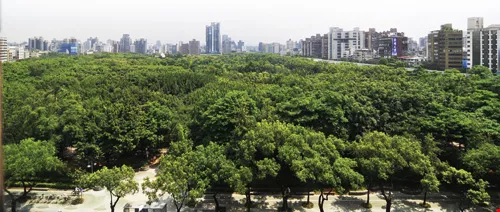
The best way to alleviate the urban heat island effect is to create oases in the city. According to one study, three hectares of green space can reduce the surrounding temperature by 0.5oC, and one hectare of trees can absorb 67 tonnes of dust per year. The picture shows Da'an Forest Park in central Taipei, with an area of 25.9 hectares.
Second, calculating the number of nights with minimum temperatures above 25oC around Taiwan between 1961 and 2005 (see Fig. 1) shows that "night warming" is a specific effect of HIE. This is because the massive amount of heat absorbed during the day tends to be released at night. This particular temperature was chosen, Liu explains, because if the minimum is above 25oC at night, air-conditioning will probably be needed.
As Figure 1 shows, the number of such nights has increased significantly all over Taiwan in the past half century. The biggest rise, however, is in Taipei City, where the number of nights above 25oC has increased from an average of 35 days per year to over 100.
Examining the records for daytime temperatures above 37oC between 1961 and 2005 around Taiwan, as Figure 2 illustrates, only one region shows an obvious increase. Significantly, this was the capital Taipei, which went from less than five days per year at 37oC to over 12, indicating that Taipei is a clear candidate for HIE.
Overall, Liu argues, "With regard to HIE, Taiwan could be one of the world's most seriously affected regions." Throughout most of the year, Taiwan's climate is regulated by the ocean (which absorbs and releases heat), so the extreme heat often suffered by inland regions at a similar latitude should not occur in Taiwan. But unfortunately, because of Taiwan's rapid urbanization and industrialization over the past 40 years, most of the vegetation in the western plains has been replaced by dense rows of buildings, factories and asphalt roads. "Even in the countryside, the paddy fields which previously provided a source of evaporation, effectively cooling the surrounding areas, are disappearing." With most of the island's plains being eventually swallowed up, the impact of HIE can be expected to increase markedly in the future.
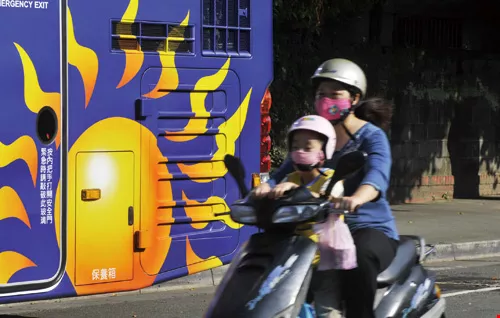
The urban heat island effect makes global warming worse. Scientists predict that if human beings continue for another 15 years with the present rate of greenhouse gas emissions, the next generation will be forced to live in a world which will be hit in turn by heat waves, drought, storms and landslides.
Climate change, coupled with the heat island effect, poses a direct threat to human health.
Physicians note that when the human body is placed in a hot environment or under strong solar radiation, heat-related illness results from confusion of the central nervous system and disruption of the body's temperature regulation mechanism. Because Taiwan's summers are often accompanied by high temperatures and humidity, heat dissipation from the body becomes more difficult, and there is a relatively increased risk of illness.
Common heat-related health issues include heat exhaustion and heatstroke. The former refers to a situation when the body is placed in a hot and humid environment, causing excessive perspiration and loss of electrolytes. Symptoms of slight shock may appear, including dizziness, headaches, general weakness, nausea, and sometimes muscle spasms, mainly the result of body salt distribution disorders. Patients' body temperatures usually remain lower than 39oC, and as long as treatment is appropriate (providing additional water and salt, and reducing ambient temperature), the patient will gradually recover.
Heat stroke, which may follow heat exhaustion, is however much more serious. Under this condition, the body temperature may increase to more than 40.5oC. Because the body can no longer dissipate sufficient heat, the patient will have dry and red skin, and perspiration will almost cease. Other symptoms include a rapid pulse, convulsions and unconsciousness. Once the temperature reaches 42oC or above, fatal pulmonary edema, cardiopulmonary dysfunction or permanent brain damage are likely.
According to one study, the occurrence of heatstroke in the elderly is three times more likely than for ordinary adults. Typical contributing factors include poor physical adaptability, or a lack of air-conditioning. In 2003, when a heatwave swept across Europe, for example, the majority of the more than 30,000 deaths were among the elderly. Alcoholics and patients with cardiovascular disease or obesity are at particular risk.
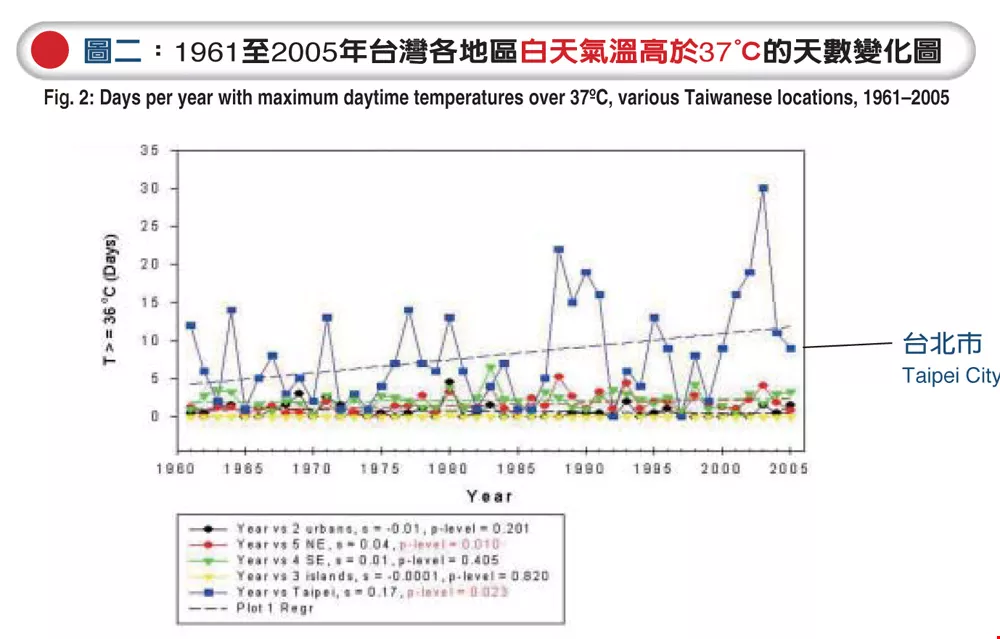
Fig. 2: Days per year with maximum daytime temperatures over 37°C, various Taiwanese locations, 1961-2005 / The number of days with temperatures above 37oC have increased significantly only in Taipei City, from under five to over 12 per year. / source:C.-J. Shiu, S. C. Liu and J.-P. Chen, 2009: Diurnally asymmetric trends of temperature, humidity and precipitation in Taiwan, J. Climate, 22, doi:10.1175/2009JCLI2514.1, No. 21, 5635°V5649
Excessive heat and reliance on air-conditioning, on the one hand, is detrimental to efforts to conserve energy and reduce of carbon emissions, and thus forms a vicious circle with global warming; it may also lead to systems failures in different areas, threatening urban lifestyles, and even life and property.
Taiwan's extreme heatwave on July 3-4 is an example. Fortunately, it occurred over a weekend, when many of the factories which consume enormous quantities of power were closed. Consequently, there was no risk of an overload. However, the Taiwan Power Company has since pointed out that the island's total instantaneous power consumption on those two days reached beyond all records for the years 2008 and 2009. If temperatures continue to rise, the spectre of power shortages could become an unpleasant reality.
Other cities around the world have also been hit by heat waves this summer.
Newark, in New Jersey in the United States, hit a record high of 39.44oC in early July, the heat making the electric wires dangle loosely. Railway tracks became distorted, forcing the subway to slow down, and causing delays and cancellations to commuter trains.
In Germany, air-conditioning systems in three trains failed because of the high temperatures. In one train still far from its destination, the high-tech windows couldn't be opened by hand, resulting in interior temperatures of 50oC. Fifty-two people ended up with symptoms of heat exhaustion and had to be rushed to hospital for treatment.
In fact, while people tend to see air-conditioning as a guarantee of peace of mind for the summer months, many do not know that the average air-conditioner is equipped with a high-pressure safety feature. When the outdoor temperature becomes too high (typically more than 40oC), it will stop its cooling function in order to prevent overheating and a possible fire. The electrical industry suggests that conditioners should run for no more than 12 continuous hours, and should be set one to two degrees above the usual temperature in order to reduce the risk of overloading the compressor.
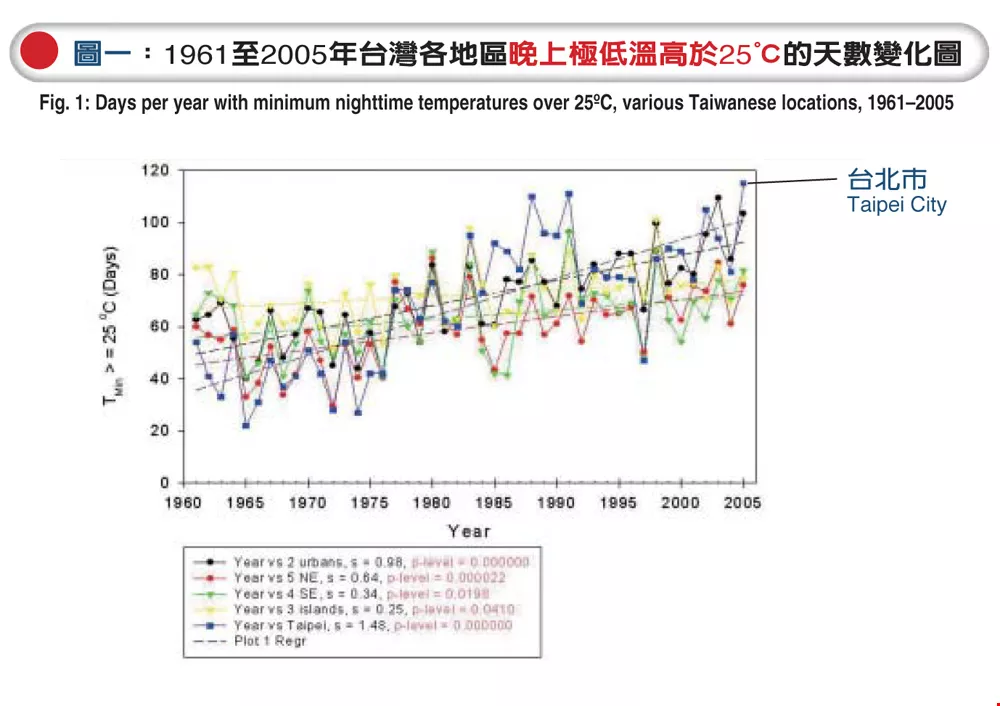
Fig. 1: Days per year with minimum nighttime temperatures over 25°C, various Taiwanese locations, 1961-2005 / The greatest increase is in Taipei City (blue), going from 35 days to over 100. Other locations in order of growth: Taichung and Tainan Cities (black), northeastern Taiwan (red), southwestern Taiwan (green), outlying islands (yellow). / source:C.-J. Shiu, S. C. Liu and J.-P. Chen, 2009: Diurnally asymmetric trends of temperature, humidity and precipitation in Taiwan, J. Climate, 22, doi:10.1175/2009JCLI2514.1, No. 21, 5635°V5649
Because very hot summer weather is becoming the norm, some countries have considered the possibility of extreme heat "subsidies" and "leave" as desirable additions to the welfare system. In the last two years, China has listed "extreme heat" as an occupational hazard in its Occupational Disease Prevention Act. Every year from June to October when temperatures rise above 33oC, local governments require employers to pay "extreme heat allowances" to any middle and lower level workers who work without air-conditioning. (The system proved ineffective in practice, however, as most owners simply extended the lunch break to two hours as an alternative to paying the allowance).
Recently in Taiwan, academics and labor organizations have called on the government to either implement a scheme of "extreme heat leave" or adjust working hours for outdoor workers. Yang Chih-yuan, an associate professor in the Department of Land Resources of Chinese Culture University, suggests further that meteorological agencies should establish a complete set of early warning procedures for extreme weather, and coordinate planning for such events with social welfare and health authorities. Only by implementing these measures can public health be guaranteed.
Urgent: Urban transformationHIE has resulted to a large extent from the failure to take into account comprehensive environmental considerations during urban design and planning phases. Measures for improvements must not only include building redesign and modification, but will also require a review of urban planning laws.
In particular, proposed measures to improve construction techniques include initiatives such as rewarding the planting of vegetation around buildings and on car parks; promoting the use of permeable road paving systems and improving rainwater recycling (such as recycling rainwater from storm drains for irrigation of road planting); encouraging the installation of "green" roofs and rooftop container planting, or the use of insulation tiles or highly reflective coatings, in order to inhibit heat absorption by building roofs.
A broader approach would include: expansion of conservation initiatives for the natural environment, particularly for urban green spaces, rivers and agricultural lands; regulating to ensure that new constructions meet certain levels of energy efficiency; and adaptation of urban construction planning and design to the natural terrain and wind direction, in order to enhance ventilation of the streetscape.
To conclude, only with the continued and strict implementation of these multi-pronged measures will it be possible to transform the urban heat island into an urban oasis.


