From Sideshow to Center Stage:Reflecting on the Little Three Links in Matsu
Vito Lee / photos Jimmy Lin / tr. by Phil Newell
August 2004


In a flash, more than three years have gone by since the launch of the "Little Three Links," a policy founded with the twin aims of promoting prosperity in Kinmen and Matsu and encouraging positive cross-strait interaction.
Over these three years, the routes between Kinmen and Xiamen and between Matsu and Mawei have successfully served to get Kinmen-Matsu residents and Taiwanese businesspeople to the mainland quickly and directly, and the number of tourists taking these routes has slowly risen. In addition, early fears of security problems resulting from a large influx of tourists from mainland China have not been borne out, because the PRC has not yet lifted travel restrictions for ordinary tourists. On the other hand, the anticipated economic benefits-a "cross-border" trade boomlet and spending by travelers-have also yet to materialize.
While they are nominally being implemented only "on a trial basis," there is by now no turning back from the Little Three Links. In this age of globalization and wide-open borders, we should ask ourselves: What have we learned from the Little Three Links? What still needs to be done to move on to the Big Three Links?
"Briefcase in hand, setting out to conquer the world... the soldier-ant spirit of Taiwanese businesspeople is the same, it's just that the scenery gets changed around," says a Mr. Wu, a self-described "Taiwanese cadre" sitting in the waiting room at Fu-ao Harbor on Matsu's Nankan Island.
China's current "magnet effect" is drawing capital and people from around the globe, and naturally Taiwanese businesspeople are no exception. Mr. Wu, who is not yet 40 but has been deeply involved in the mainland for ten years, has evolved from managing investments to being a deal-maker and facilitator-from being a "Taiwanese businessman" to being a "Taiwanese cadre." It is estimated that there are more than 60,000 Taiwanese businessmen like Mr. Wu in Fujian alone.
Having completed his vacation in Taiwan, Mr. Wu left his home in Taoyuan County at ten o'clock this morning, and, here it is not yet two in the afternoon and he has already turned up in the waiting room at Fu-ao Harbor. "From Matsu to Mawei, the boat trip takes one hour 45 minutes; from Mawei to Fuzhou it takes another half hour by car. Ten minutes from now I'll get on that boat, and in less than three hours I'll be back in the factory dormitory," he says.
Among those in the waiting room, there are Taiwanese businesspeople, local Kinmen and Matsu residents, and mainland brides returning home to see their families; you can tell at a glance who's who just from the way they dress. Today, the marine weather forecast is excellent and the 30 or so people in the waiting room all look relaxed and calm. "Just call me Wu," says my interlocutor, preferring not to reveal his full name. Among the group waiting this afternoon for the boat Golden Dragon he is one of only two people carrying briefcases.
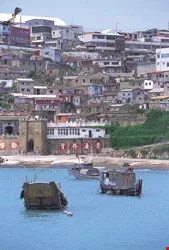
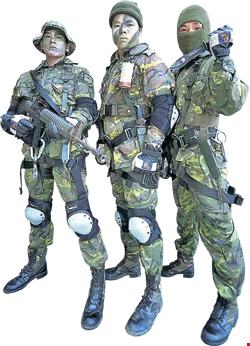
Thanks to current defense policy, the numbers of military personnel stationed in Tungyin, pictured below, have dropped year after year, forcing residents to find new ways to make money.
Stuck in the middle
Passers-through rarely leave their names. Yet for decades now the economy of the sparsely populated Matsu archipelago has been heavily dependent on these "passers-through"-from soldiers in the early days to Taiwanese businessmen and tourists today. From the days when Matsu was the first line of defense to its status today as a transit point for the Little Three Links, its special geographic position has been its boon, but also its bane. It's not always easy to be a little guy stuck between two giants.
Located at the mouth of the Min River, the Matsu archipelago is a full 114 nautical miles from Keelung Harbor on the main island of Taiwan, whereas Kaoteng Island, Matsu's closest island to the Fujian coast, is only 9.3 kilometers from PRC territory.
Before 1949, there was a constant flow of traffic between Matsu and the mainland. People called nearby Huangqi "the inner mountain" and Matsu "the outer mountain," indicating that they were seen as part of a contiguous area, and the two were closely intertwined in terms of both economy and daily life. It was quite common for extended families, in-laws, and even brothers to reside in one place and the other. But after 1949 these two locations ended up under different regimes. Yet even when there were strict rules against making contact with the other side, fishing boats continually crossed paths along the mouth of the Min River.
In 1992 Matsu, after long holding down the heavy responsibility of being the first line of defense for Taiwan, began to shed its combat attire. The number of troops stationed here fell sharply from the one-time peak figure of over 10,000. With the relocation of the forces, who were a pillar of the local economy, boat-to-boat trade became even more important. "People from Matsu wanted the sea catches, people from the mainland wanted wristwatches, mobile phones, stuff like that. This was a very common pattern of boat-to-boat barter."
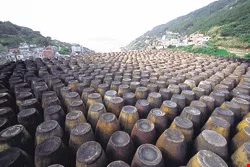
Bringing Taiwan and the mainland together through drink! Thanks to the Little Three Links, Matsu's famous Tunnel 88 Kaoliang (sorghum liquor) has recently broken into the mainland market.
Westward visions
In 2001, responding to popular demand in the offshore islands, the government began to move forward to address the needs of the people of Kinmen and Matsu and to create more positive interactions between Taiwan and the PRC. It formally opened the routes between the "two gates" (Xiamen and Kinmen; the second character in each means "gate") and between the "two horses" (Matsu and Mawei; the first character in each means "horse").
Three years have passed, and from humble beginnings a Little Three Links transportation chain has slowly taken shape. A major advance was the completion of Nankan Airport last year. Now it takes only a total of three hours to go by plane from Taipei's Sungshan Airport to Nankan and then by boat from Fu-ao Harbor to the other side. Timewise, that is even quicker than going via Kinmen.
As part of the construction of faster routes, transport operators who originally took a wait-and-see attitude turned their former irregular passenger sailings into regular ones, and over time have expanded service from two journeys a week (one each on Tuesday and Friday) to two trips per day Monday through Friday at present. When you consider that a one-way boat ticket costs only NT$750, then Matsu should certainly have its attractions for Taiwanese businessmen headed to Fuzhou (where many of them are concentrated) and from Fuzhou onward by plane to other places in China.
However, despite regular schedules, a one-way price that is far less than going via Hong Kong or Macao, and even subsidies from the county government and the Mainland Affairs Council (MAC) to encourage transport operators to maintain regular service, the expected surge of prosperity in the local economy has simply not occurred.
On this day, once the Golden Dragon pulls away from the pier, a deep silence settles over Fu-ao Harbor, and Nankan Island-the main island of the Matsu chain-lapses back into a state of hibernation.
What's gone wrong? For one thing, a unique geographical position means a highly variable climate. From March to May, dense fog often closes Matsu's airports. In winter, the northeast seasonal monsoons hit hard, with Force 9 winds stirring up large waves, bringing ferry transport from Taiwan to Matsu to a halt. On days when ferries stay at the dock and planes are grounded, Matsu becomes a very isolated island. When you take into account this unpredictability, even though Matsu is closer to the mainland than Kinmen, businesspeople often prefer to give it a miss.
As Chen Sai-hsiang, operator of a hotel, says with exasperation, "Folks in Matsu depend for their daily bread on the vagaries of the weather."
If nature seems hard to predict, worldly events also do not necessarily turn out the way people hope. "From front line to transit point, Matsu's niche is to play functional roles," says Tsao Yi-hsiung, a member of the Lienchiang County Assembly. But people are not using Matsu as envisioned under the Little Three Links. Here we are today, three years on, and the mainland is still delaying any opening up of tourism by ordinary citizens while a much smaller number of Taiwanese businesspeople come through than had been anticipated. It's not hard to imagine why Matsu residents feel disappointed.
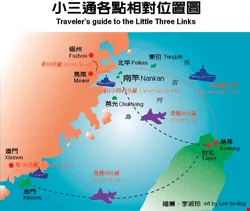
Traveler's guide to the Little Three Links
Air Matsu
According to the MAC, in the more than three years since the opening of the Little Three Links, only 11,700 passengers-less than ten per day-have used the Matsu-Mawei route to travel between the two sides. Moreover, four out of every five of these passengers has been Taiwanese, meaning that money is going out, but not coming in.
How can that be? For one thing, businessmen from Taiwan proper, who in fact make up only a tiny proportion of these travelers, generally just scurry through. A typical businessman will grab a cab straight from the airport to the harbor and set off as soon as possible. Except for what they spend on transportation, business travelers contribute very little to the local economy.
Meanwhile, as Tsao Yi-hsiung explains, "The main impact of the Little Three Links has been in creating more options for daily life for residents of Kinmen and Matsu, especially in terms of recreation. There's been a great increase in the number of people going to the mainland to visit relatives, for travel, or for entertainment."
Thus, economically speaking, not only have the Little Three Links not brought in big-spending business travelers and mainland tourists, they have allowed Matsu residents to take a lot of their own consumer purchasing to the PRC, where everything is much cheaper. And more and more Matsu people are moving their assets to the PRC or investing there rather than at home, further draining the island's economy.
When launching the Little Three Links, the government hoped that this experiment would provide guidance in weighing the wisdom of opening the Big Three Links. The government wanted especially to observe the impact of the new policy on local security and the local economy. Today, since mainlanders don't come here, there are no security or public order problems. However, as an MAC official points out, "The fact that the Little Three Links allow so much money from Kinmen and Matsu to flow to the mainland naturally will affect the government's willingness to proceed with the Big Three Links down the road."
However, following the Ministry of Economic Affairs' expansion of the list of items from Kinmen and Matsu that can be legally exported to the PRC, the first batch of Matsu's Tunnel 88 Kaoliang liquor successfully landed in the mainland last September, breaking the "goods come in but don't go out" gridlock. "If restrictions can be relaxed more, and more effort is put into curbing illegal trade, then smuggling by ordinary citizens will decline," argues Tsao Yi-hsiung.
As a further indication of improvement, with the beginning of regular transport schedules last year, more people have been using the Matsu-Mawei route-from less than 2000 each of the first two years to nearly 3000 in the most recent 12 months. As a bonus, because it is easier to take advantage of the Little Three Links if one has Matsu residence, there has even been a steady increase in local population (based on household registry), from 6800 before the Little Three Links to nearly 9000.
A cold pot, it is said, takes a long time to boil. Behind the gradual warming up of the Little Three Links, an astounding amount of effort has been invested.
"The Little Three Links is not just a matter of boats setting sail, you've got to work out coordinated transportation to and from the piers as well," says Liu Te-chuan, director of the Lienchiang County Bureau of Transportation.
For several years now, the Executive Yuan has budgeted NT$30 billion per year for an offshore-islands development fund. Nearly one-third of this has been spent on Matsu. Thanks to the infusion of central government funds, Matsu's formerly skeletal air transport network has been rapidly upgraded. Both the relocation of the runway on Peikan Island (which was very short and could only be approached visually) and the construction of the new Nankan Airport (a project costing a whopping NT$1.9 billion) have been finished in under three years.
Moreover, although currently there is only the one air route running from Matsu to Taipei, putting a damper on the willingness of businesspeople from central and southern Taiwan to exit Taiwan via Matsu, that could change soon. As a result of efforts by the Lienchiang County government and airline operators, a schedule of ticket prices for Matsu-Taichung and Matsu-Kaohsiung routes has been submitted to the Ministry of Transportation and Communications. Flights could start as early as this fall.
The government is doing what it can to make the Little Three Links road as useful as possible for Taiwanese businesspeople. But what can be done to extend a hand to people in the mainland? Not as much as one would like. "It's not entirely in our hands whether mainland tourists come to Taiwan or not," admits Lienchiang County executive Chen Hsueh-sheng, whose two main goals since assuming office have been "promoting the Little Three Links" and "developing tourism."
Nonetheless, he points out, regardless of whether the economic benefits have been as extensive as expected, there is no turning back from the Little Three Links. Looking to the future, efforts will be devoted to the creation of a "tax-free zone" or a special "frontier cooperative zone."
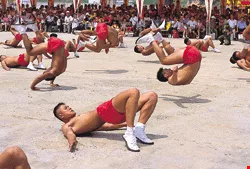
With the Little Three Links, Kinmen and Matsu finally succumbed to tourism; aside from the natural beauty they share with the other outlying islands, their military culture gives them that extra pull. Here we see troops stationed at Tungyin Island demonstrating so-called "frogman" exercises.
Two battlefields, one mindset
Both Kinmen and Matsu, long-time frontier bastions, are going through the same type of economic transition. As a result, for both these major offshore islands, advancing the Little Three Links and developing tourism are key policy goals. Fortunately, both Kinmen and Matsu undeniably possess rich tourism assets. Kinmen offers an aggregation of overseas emigrant culture, historic front-line military sights, and Southern Fujianese culture. Matsu, on the other hand, has intact communities of Eastern Fujianese style architecture and a rare species of tern.
The larger question, though, is where and how do Kinmen and Matsu best fit in? As a result of different natural surroundings, histories, cultural developments, and geographical positions, the people of the offshore islands feel very far removed from Taiwan proper. "Whenever a typhoon comes," says hotelier Chen Sai-hsiang, offering one example, "it is only after the storm passes Taiwan that the winds and rains finally hit Matsu."
Distance, in this case, makes the heart grow remoter. How can this situation be improved? There's no substitute for increased contacts between Taiwan proper and the offshore islands. But basic needs and economic necessity have tended to draw the people of Kinmen and Matsu closer to the mainland. Considering that it is impossible to halt exchanges between Taiwan and the PRC, as the Little Three Links continue to play out, perhaps Taiwan's citizens will be moved to rethink the status of Kinmen and Matsu as intermediary bridges.
This white lighthouse, built by the British, has been witness to the many changes in the three-way relationship between Taiwan, Matsu, and the mainland. Once part of the front-line defense of Taiwan, it has since changed roles to become a welcoming beacon for tourists.
How the story ends
Just 15 minutes by car from Fu-ao Harbor is the Tien Hou Temple. Legend has it that the body of Lin Mo-niang-later deified as the goddess Matsu-washed up here after she cast herself into the sea. When you arrive at the temple, built facing the water, your back, neck, and face are immediately covered by fine grains of sand which retain the salty aroma of the ocean winds.
Ties between Matsu, the mainland, and Taiwan have twisted and turned with the times. The meeting between the goddess Matsu and this anonymous islet 1000 years ago gave this place its name and inspired a set of popular beliefs that spread throughout Fujian and Taiwan. Later on, early in the Qing Dynasty, in an effort to prevent the Ming loyalist general Zheng Chenggong, who had retreated to Taiwan, from fomenting resistance along the mainland coast, the emperor ordered that all residents in the Fujian coastal region be moved 30 li (about 15 kilometers) inland. It was only in 1683, when Zheng's resistance was completely broken, that the command was rescinded and the people of the Matsu archipelago could resume contact with the mainland.
Standing before the Tien Hou Temple, one cannot help but think back to January 2, 2001. On that day more than 500 Matsu faithful from Taiwan boarded a ferry and sailed directly to Mawei, from where they journeyed on to the Matsu Temple on Meizhou Island to pay their respects. This turned the handle on the door of the Little Three Links, the latest twist in our tale.
But this is not the end of the story. While one cannot but feel frustrated by political obstacles, "Let's hope that with the people leading the way, through mutual goodwill and reciprocity between the two sides, the road of the Little Three Links will become ever broader and smoother." These words of Lienchiang county executive Chen Hsueh-sheng represent the feelings of all Matsu's residents.
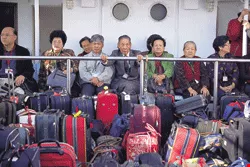
"Wherever you may wander, you'll always find your way home." From allowing people to visit relatives in the mainland through to the Little Three Links, as links between Taiwan and the mainland become more open, complications caused for families by their separation are also eased. This photo shows people waiting for the Kinmen-Xiamen ferry.
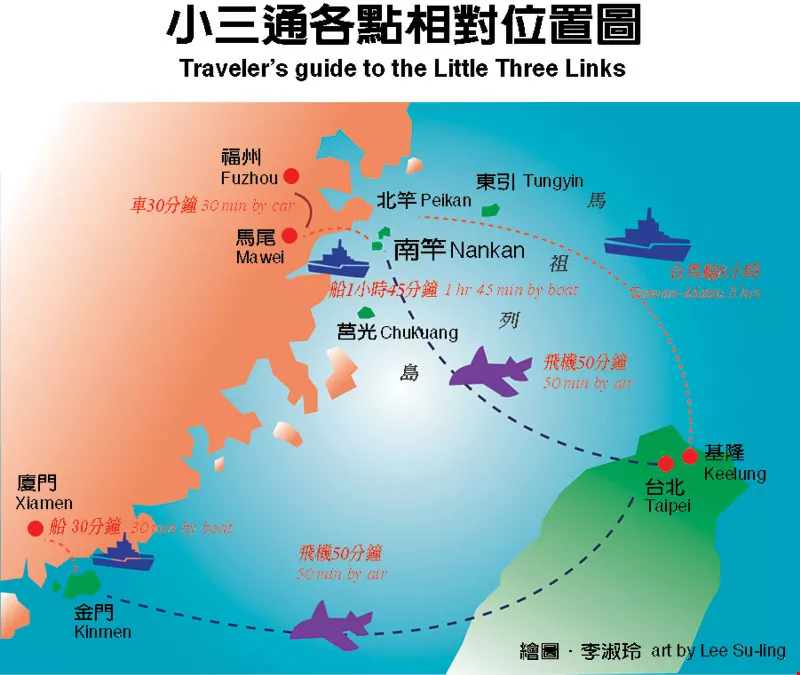
Traveler's guide to the Little Three Links


@List.jpg?w=522&h=410&mode=crop&format=webp&quality=80)


定稿-1@List.jpg?w=522&h=410&mode=crop&format=webp&quality=80)
