Letzer Industrial Park Finds Its Place in the Sun
Coral Lee / photos John / tr. by Phil Newell
March 2009


Does anybody recall when, 22 years ago, "God of Management" Wang Yung-ching had his eye on the Letzer Industrial Park in Yilan but was blocked from getting a foothold there? Time passed, and eventually Wang built his Sixth Naptha Cracker complex in Mailiao, Yunlin County. Now Letzer, after 20 years of hard times, is finally once again attracting the attention of the business world, fighting to stand up against the global economic storm.
At the end of November 2008, Yilan county executive Lu Guo-hwa announced to a press conference the formation of a solar power industry concentration in the Letzer Industrial Park. The following week, Sun Materials Technology Company, Taiwan's first manufacturer of polycrystalline silicon, a critical upstream material for solar power, broke ground there. At the same time, Sunrise Global Solar Energy, the first solar-cell plant created as a result of a joint venture between Taiwan and a team of renowned international technology experts, began trial operation of its production line at Letzer.
Can new green industries bring prosperity to this neglected industrial park and turn it-along with the Southern Taiwan Science Park-into a second pillar of the solar power industry in Taiwan?
An early January 2009 visit to Sunrise Global Solar Energy in the Letzer Industrial Park in Yilan County shows that much of the five-hectare site is still empty. But there is a sparkling, spotless new factory there, looking much like a semiconductor plant. In a clean room, engineers sit in front of computers setting parameters, while amidst the enormous machinery occupying the middle and rear parts of the building German technicians are running instrument tests. The single production line is over 200 meters long and the building occupies a space larger than two soccer fields.
"This is just our first production line, yet the first solar cell we made had a conversion rate of 16%-even the original factory technicians were surprised!" says company CEO Hsu Kuei-chang. After adjustments and improvements, they anticipate reaching a conversion efficiency of 19% by the end of this year.
The "conversion rate" refers to the proportion of solar energy hitting the solar cells that is converted into energy that can go into the power grid for home or industrial use. The higher the proportion, the higher the efficiency of power generation and, correspondingly, the lower the unit cost. Currently the single-crystal silicon cells made by most Taiwanese firms have conversion rates of 15-17%; Sunrise is one of the few companies to challenge the 20% milestone.
At present, the greatest competitive strength of the Taiwanese solar power industry lies in the midstream link of photovoltaic cell manufacturing. Some hi-tech semiconductor and electronics companies have joined the fray, bringing into play their superior quality control, cost control, and scale of production. But most firms in the solar power industry have come from completely different industries and have simply imported the necessary technology by buying complete factories-called "turnkey" plants-from abroad.
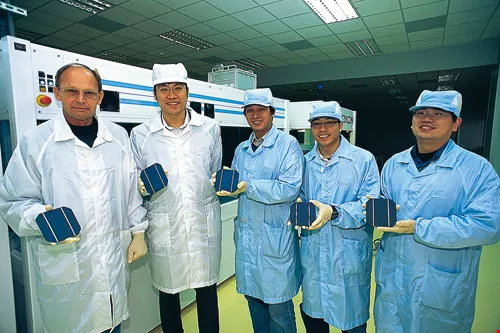
"The first solar cell we made had a conversion efficiency rate of 16%." The technical team at Sunrise Global Solar Energy is aiming for 20%, and hopes to set a new record for conversion rate for monocrystalline silicon power cells. First at left is Ted Szpitalak, the soul of the tech team, while second from left is Hsu Kuei-chang, the company CEO.
An industry on fire
Let's take a quick look back at the history of the solar energy industry in Taiwan. Twenty years ago several firms were already investing in solar power, but they were too far ahead of the curve, the technology was immature, and business was tough. It was only in 1997 when Motech began developing photovoltaic cells that one could see the profitable light at the end of the tunnel. In 2000, Sino-American Silicon Products, which had been making silicon ingots for semiconductors, saw that there was overproduction in that field and switched to making solar-energy silicon wafers. This move established them as Taiwan's pioneers of the upstream part of the production chain.
Not long before that, the Kyoto Protocol had assigned industrialized countries responsibility for carbon reductions, causing the European Union to encourage its members to use more clean energy sources, which drove demand in the market sharply upward. Since the Kyoto Protocol took effect in 2005, the value of solar energy production worldwide has risen by an average of 35% per year. Export-oriented Taiwan has been on fire, with several large companies jumping on the solar power bandwagon. Total production value in the up-, mid-, and downstream sectors skyrocketed from NT$6 billion or so in 2005 to NT$90 billion in 2008.
Nonetheless, behind this seemingly burgeoning development there are hidden worries and potential pitfalls.
"Taiwan's competitive advantage in development of the solar power industry is that it has a comprehensive semiconductor supply chain," explains Lan Chung-wen, head of the Photovoltaics Technology Center of the Industrial Technology Research Institute (ITRI). Elements of the production process for solar power, including acid and alkali etching, procedures for N- and P-type semiconductors, and clean-room controls, are strikingly similar to the semiconductor industry. But the level of complexity is actually a lot lower than it is for the 200-plus-step semiconductor production process, so competitive advantage can certainly be created by reproducing the methods used in the success of the semiconductor industry. Nonetheless, businesses face a major headache: lack of exclusive technology.
The barriers to entry into the mid- and downstream sectors are low, and over the past two years many entrepreneurs hoping to seize the business day have adopted the turnkey approach. Taking the manufacturing of photovoltaic cells as one example, you can start up a production line (including purchasing equipment and paying patent royalties to the original maker) for only about NT$200-300 million (less than US$10 million). Fortunately for cell manufacturers, because upstream supply of polycrystalline silicon has never been able to keep up with market demand, causing a similar bottleneck in supply of downstream products compared to demand, everyone has been able to charge high prices and maintain profits despite the low barriers to entry.
It remains to be seen how long this situation will last. Especially problematic for the future is that Taiwan has pathetically few patents for solar-power-industry technology, yet R&D will be the key to competitiveness.
"When you compare us to the amazing development of the solar power industry in mainland China," Lan Chung-wen points out, "you can't help but worry." Mainland companies are steadily improving their ability to imitate technology, and have invested huge sums in creating a complete production chain; ambitions are running high there. If Taiwan does not move quickly to boost its technical independence, it will quickly lose its competitive advantage. Now that several mainland firms which overinvested earlier have been hit hard by the global financial crisis, this is a good opportunity for Taiwanese companies to stay a step ahead.
Out of the lab
Looked at from this angle, Sunrise Global Solar Energy, by emphasizing R&D, is showing a lot of vision.
"Our technical team comes from New South Wales University in Australia," relates CEO Hsu Kuei-chang, who himself graduated from Texas A&M and previously worked in ITRI's Energy and Environment Research Laboratories. NSWU is one of the two universities in the world (along with Georgia Tech in the US) most renowned for solar cell research, and has been doing R&D in this field for over 30 years now.
NSWU not only holds a leading position in the academic world, it has also played a critical role in the solar power industry in mainland China. Several of the mainland's most famous entrepreneurs-such as Shi Zhengrong, founder of Suntech Power and once listed as the mainland's richest man; as well as Zhao Jianhua and Zhang Fengming, founders of China Sunergy, the first mainland company to be listed on the NASDAQ stock exchange-are NSWU-trained "returned scholar-entrepreneurs." Zhao Jianhua is particularly noteworthy for holding the world record for conversion rate of a monocrystalline photovoltaic cell of 25%.
Ted Szpitalak and Bruce Beilby, two founding partners in Sunrise and the key technical people, besides both being professors at NSWU were also co-founders of these major companies in the mainland all those years ago.
"The reason they left the mainland and came to Taiwan to found Sunrise is that they have even greater visions for the future," explains Hsu Kuei-chang. After having spent many years in the trenches of the struggle for solar power, these R&D veterans are no longer just looking for large production volume or low costs-they want to "do something meaningful."
"If we want to moderate the effects of global warming, we have to work as quickly as we can to get people to use solar power as widely as possible. And the only way each and every household will use solar energy will be if there are cheap, highly efficient power cells," says Hsu. "That's really our major goal."
Looking over the factory, it's an interesting layout: The production lines are straight, not winding like they are in other facilities where the main consideration is saving space. Ted Szpitalak says: "If we really wanted to squeeze, we could get 12 production lines in here, but we only plan to install six." There is a good reason-future R&D.
Hsu says that in the beginning he urged Szpitalak to build a smaller plant, so they could get started faster and exploit commercial opportunities sooner. But Szpitalak turned him down, because the very purpose of this company from the start has been to produce a new kind of high-conversion power cell. Since there is no equipment for this kind of thing anywhere in the world, Sunrise will have to work directly with machinery manufacturers to create it. So, Hsu sums up, "Only if there is enough space can we bring in new machinery and test it right on the spot."
Szpitalak anticipates that the first production line will produce enough solar cells per year to produce 30 megawatts of electricity. In the future the tech team will develop new equipment for volume production incorporating their own patented laser doping process. This kind of advanced technology is presently being used in only small-scale production overseas, whereas Sunrise is building the first line in the world for mass production (14,000 cells per day), with an anticipated conversion efficiency of at least 18-20%.
Setting down roots
Because they feel a mission to do what they can to save the planet, and because the technical challenges are so inspiring, morale is extremely high at Sunrise. Engineers, many of whom have transferred here from firms in the Hsinchu Science-Based Industrial Park or from well-known institutions of higher learning, seem indefatigable and even happy to work overtime.
With an eye to the long term, the seven foreign members of the R&D team have all bought property in Yilan, and Szpitalak has even moved his whole family over (two of his four children also work in the firm).
"This is my last campaign!" says the 60-something Szpitalak. When they were evaluating where to set up the factory, they considered Germany and Australia before deciding on Taiwan. They chose Taiwan because of its good infrastructure, the maturity of the IC industry here, and the "super-high-value" engineers in related fields, creating the possibility of making the whole solar power industry more competitive. Only if costs fall continually will use become more and more widespread.
"New South Wales' patented technology is quite advanced. The problem is how to bring the technology out of the laboratory and into mass production," says Lan Chung-wen, commenting as an interested bystander. Production techniques are already mature for existing solar cells, but the application of more efficient new-generation technologies like laser doping and buried contactors is hung up on the lack of machinery, facilities, and experience, so it will still be a while before mass production can begin.
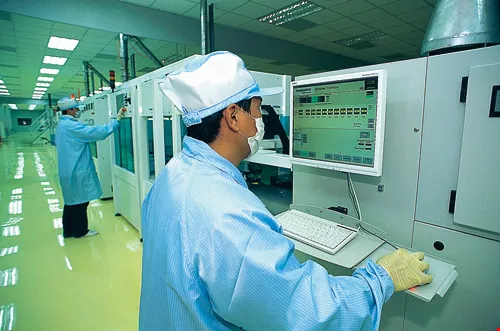
Unlike many solar cell companies which set up their production lines in a winding shape to save space, the machinery at Sunrise is in a straight line, with lots of space left unused, because they will need room to test and install innovative equipment that they will develop from scratch.
Expensive and in short supply
For Taiwan's solar power industry, which is just beginning to grow, another critical problem is self-sufficiency in materials. Currently there are Taiwanese firms, including Sino-American, Wafer Works, and Green Energy Technology (created by the Tatung Corporation), working in the upstream sector of wafer manufacture and dicing. But the earliest link in the production chain, silicon crystals, is still controlled by seven large firms in Japan, the US, and Germany. Because the environmental and financial barriers to building a silicon-crystal plant are very high, supply has continually lagged behind market growth. Right now, some large firms in Japan and Korea are newly entering this field, and in addition several companies in mainland China have said that they are investing in silicon raw materials. But for the time being the supply shortage will continue to be a nightmare for mid- and downstream firms.
In their efforts to guarantee access to product, the large solar-cell manufacturers have adopted various strategies. Some, like Motech, have directly invested in upstream factories to create vertical integration. Others have signed long-term contracts with wafer suppliers. For example, Mosel Vitelic, in addition to signing a series of contracts for supply of polycrystalline silicon with LDK Solar of Jiangxi Province, mainland China, has also reached an agreement with Nexolon, a major producer of silicon wafers in Korea.
Meanwhile, Sun Materials Technology Corporation, the first maker of polycrystalline silicon materials in Taiwan, broke ground at the end of 2008. If the investment is successful, this will not only ease the shortage of raw materials, its prices-far below the current market level-will send shockwaves through the industry.
"Polycrystalline silicon ballooned from US$45 per kilo in 2004 to US$400 in the fourth quarter of 2008, which was a devastating blow for the development of the solar power industry as a whole," says Mark Wu, chief technology officer at Sun Materials. Although the dropoff in demand caused by the recent economic crisis has caused the price to fall to US$100, this still makes solar energy generation several times more expensive than traditional coal-fired plants, making wide adoption of the former most unlikely. However, the "high-energy hydrogen atomic beam cyclone reductive combustion process" developed and patented by Sun Materials can reduce the cost of production from the existing level of US$35 per kilo (using the traditional "Siemens process" or the "improved Siemens process") to only US$15 per kilo.
Mark Wu, who has a doctorate in chemistry from the California Institute of Technology, says that unlike semiconductors, which need "9N" purity silicon, Sun Materials manufactures "6N" purity polycrystalline silicon specifically for use in solar cells. The raw material they use is sodium fluorosilicate, a byproduct from processing wastewater from the fertilizer industry, which is then turned into polycrystalline silicon using the "reductive combustion" process.
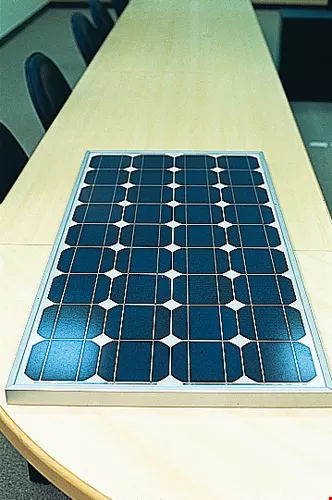
A new "Taiwan first"?
Mark Wu explains that the Siemens process, in contrast, uses silica sand and requires a huge amount of chlorine gas in the manufacturing process to produce trichlorosilane. This not only uses up a lot of electricity, there is high risk of explosion, not to mention that trichlorosilane is highly corrosive. If there were an industrial accident, an area ten kilometers in radius might be affected. "This is the reason," concludes Wu, "why several big firms like Formosa Plastics and China Petroleum that have been evaluating entering the silicon crystal industry for many years now have kept putting off taking any action."
"In contrast," Wu states, "the fluorosilicate that we use is not explosive, so it is very safe. Moreover, the second great thing about it is that it is reclaimed from waste." Every year mainland China's phosphate fertilizer industry produces about 3 million metric tons of wastewater. Only about 20 tons are recycled; the rest is dumped into rivers. In the future, because the reuse value will greatly increase, the recycling rate will certainly go up greatly. Moreover, the products made from this recycled raw material are also "green," which means multiple benefits for humankind and the planet. Wu is confident that after Sun Materials gets rolling with mass production, its process will steadily replace the Siemens process as the market mainstream.
Sun Materials general manager Wayne Chang has stated that the first plant, with an annual production capacity of 3500 metric tons, is expected to be completed by July or August of 2009. In fact, early in 2009, small-scale production already began-in collaboration with the affiliated enterprise Enerage, also located in the Letzer Industrial Park-of samples to be provided to customers, and orders are being accepted. In the future Sun Materials expects to build six factories with total annual production volume as high as 20,000 tons, enough to supply the needs of the entire mid- and downstream solar power industry in all of Taiwan.
However, right now the academic and business communities are still taking a wait-and-see attitude towards the novel process announced by Sun Materials. Lan Chung-wen guesses that Sun Materials has probably adapted its process from a 1982 patent of the Stanford Research Institute. He adds that Taiwan has already had companies produce samples using the SRI patent, and quality was acceptable, but they got hung up on the problem of handling liquid sodium, and environmental impact assessments remain a problem. To succeed with mass production, yield rate and quality control and will be critical. Moreover, because right now this manufacturing process is not being used anywhere in the world for making high-purity silicon crystals, there are no relevant laws or regulations at all, and chemical industry plants all have to pass environmental impact assessments and other obstacles. The process for setting up a factory of this nature can be quite time-consuming, and may not be as easy as the company imagines.
With regard to these issues, Sun Materials spokesperson Allan Kuang says that although their technology is similar to SRI's in that both have their origins in the satellite program of the USA's National Aeronautics and Space Administration, this is not a case of technology transfer, but of an independently owned patent. Moreover, the byproducts of their "reductive combustion" process can be recycled, and will not produce pollution. Finally, because the Letzer Industrial Park has 32 review items for polluting industries, the environmental barrier is very high, so would it have been possible for Sun Materials to get admission to Letzer so smoothly if there were genuine environmental concerns?
Will the two dark horses of Letzer investing in critical elements of solar power development-Sun Materials in upstream materials production and Sunrise in midstream solar cell technology-produce amazing results out there in Yilan? Will they be able to lower production costs and change the widespread view that solar energy is itself highly energy-consuming and discouragingly expensive? Although there are still many variables, those in charge emanate tremendous confidence. Observers estimate that we will have some results by which to judge within a year or two.
In any case, of one thing we can be certain: The Letzer Industrial Park now has nine firms working in various sectors of the solar power industry, occupying more than 40 hectares of land. Such a concentration will attract talented people, and if close cooperation can be launched with academic institutes, R&D capacity will be impressive. Mutual support and cooperation among suppliers will also make costs more competitive. All things considered, wherever it may lead, Taiwan's "green energy" development is taking a giant step forward.
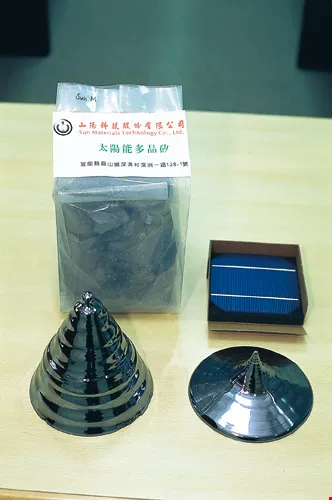
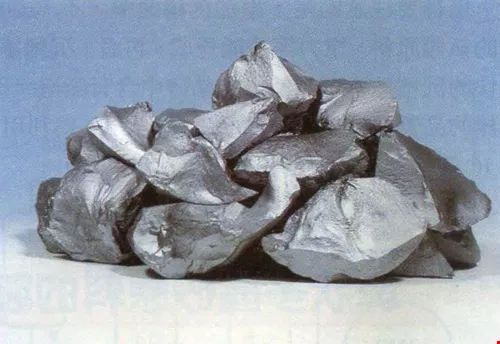
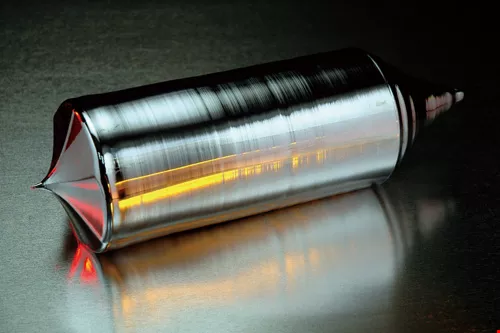
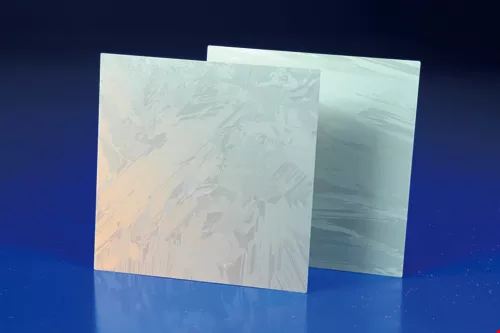
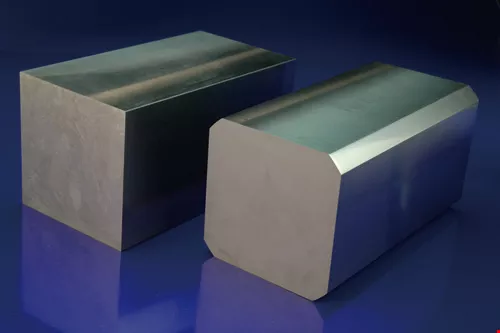
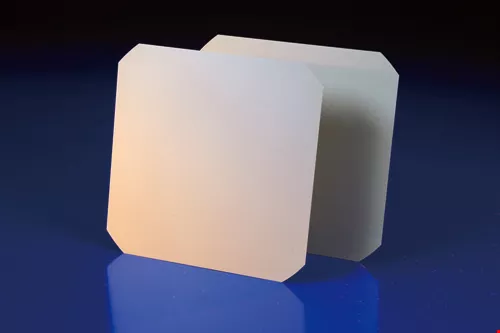
A polycrystalline silicon sample recently produced by Sun Materials (in the plastic bag at back left); the "head" and "tail" of a silicon ingot following crystal growth (foreground); and a solar cell manufactured using a wafer cut from the central segment of the ingot (back right).
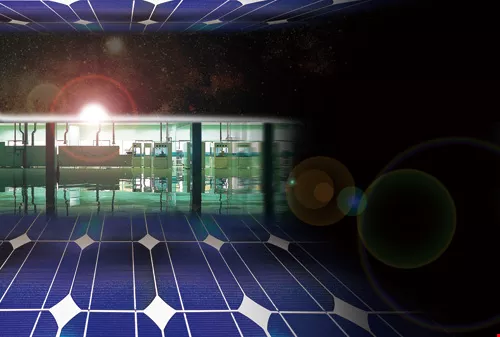
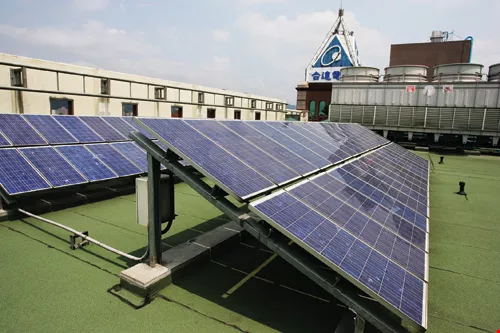
In recent years Taiwan's solar energy industry has been on fire, with annual production volume nearing NT$100 billion. But behind the success there is the looming challenge of developing exclusive technologies. Pictured below is part of Sunrise Global Solar Energy's Yilan factory.
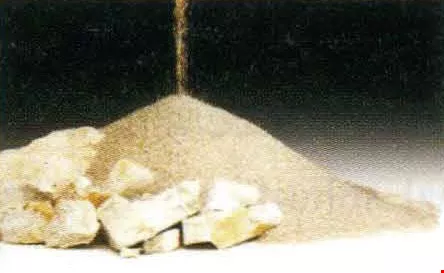
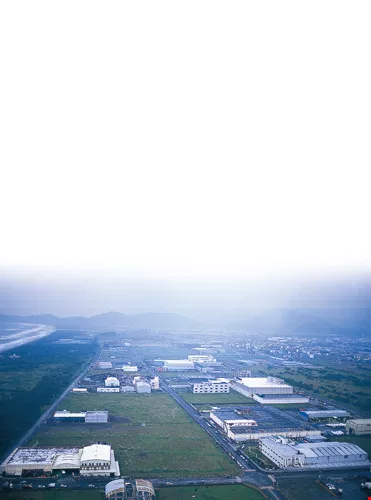
Will the concentration of solar energy firms at the Letzer Industrial Park allow this long-neglected industrial zone on the Lanyang Plain to finally find its place in the sun?
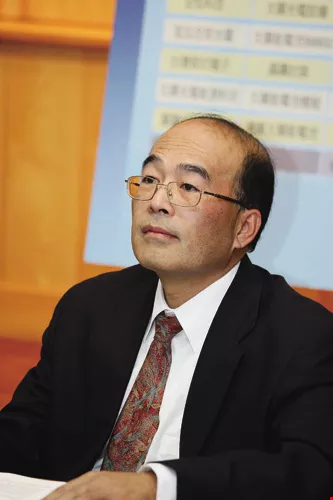
The "high energy hydrogen atomic beam cyclone reductive combustion process" invented by Sun Materials technology chief Mark Wu uses sodium fluorosilicate recovered from fertilizer wastewater to produce polycrystalline silicon, which saves on costs and is environmentally friendly.



@List.jpg?w=522&h=410&mode=crop&format=webp&quality=80)


